
Verwandte Artikel zu Goodbye to All That: Introduction by Miranda Seymour...
Goodbye to All That: Introduction by Miranda Seymour (Everyman's Library Contemporary Classics Series) - Hardcover
Inhaltsangabe
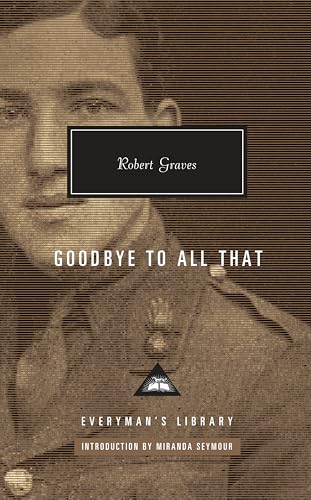
On the hundredth anniversary of the end of World War I: a hardcover edition of one of the best and most famous memoirs of the conflict.
Good-bye to All That was published a decade after the end of the first World War, as the poet and novelist Robert Graves was preparing to leave England for good. The memoir documents not only his own personal experience, as a patriotic young officer, of the horrors and disillusionment of battle, but also the wider loss of innocence the Great War brought about. By the time of his writing, a way of life had ended, and England and the modern world would never be the same. In Graves's portrayal of the dehumanizing misery of the trenches, his grief over lost friends, and the surreal absurdity of government bureaucracy, Graves uses broad comedy to make the most serious points about life and death.
Die Inhaltsangabe kann sich auf eine andere Ausgabe dieses Titels beziehen.
Über die Autorin bzw. den Autor
Robert Graves (1895-1985) was a poet, novelist, translator, and author of more than 120 books of history, mythology, and fiction, including the historical novel I, Claudius and the mythological study The White Goddess. Born in England, he made his home in Majorca after 1929. He was elected Professor of Poetry at Oxford in 1961 and made an Honorary Fellow of St. John's College, Oxford, in 1971. Good-bye to All That is his only autobiography.
Auszug. © Genehmigter Nachdruck. Alle Rechte vorbehalten.
from the Introduction by Miranda Seymour
Paying homage to a great poet at the time of his death, aged 90, obituarists celebrated the author of the I, Claudius novels (written in the early Thirties and memorably filmed in 1975) and The White Goddess (praised to Graves himself by an admiring Ted Hughes in 1967 as 'the chief holy book of my poetic conscience').
Thirty-two years ago, Goodbye To All That commanded respect, but significantly less awe than The White Goddess. Part of the immense output of an exceptionally prolific career (Graves published 55 collections of poems, 43 works of non-fiction, ten translations, fifteen novels and one play), his only major work of autobiography was perceived as an admirable contribution to a majestic career. It was an impressionistic and candid document of record about a war that Graves was not alone in believing should never have happened. Nevertheless, the sense conveyed by obituary writers at the time of its author's death was not - as may be argued today - that Goodbye to All That had been his most significant prose achievement.
Back in July 1916, the month of his 21st birthday, The Times had published - no obituary was required for a young man whose mildly mischievous poems had been published only in school magazines - a brief announcement of the death of Robert Graves.
Graves's narrow escape from a premature demise at Bois de Fourneaux or High Wood (where some 8,000 men lost their lives) stands at the heart of Goodbye To All That, the eloquent, angry book which the thirty-three year old poet wrote - merely to raise funds, so he said at the time - on the verge of leaving England for a new life in Europe. Attracting a high degree both of censure and praise at the time of its first publication by Cape in 1929, Goodbye was republished by Cassell in 1957. Revising his youthful work at the height of his fame (he had recently delivered - in characteristically iconoclastic mode - the Clark lectures at Cambridge and was about to undertake his first major American lecture tour), Robert Graves had already turned down Harold Macmillan's offer of a CBE. While demurely explaining that poets, as private persons, possess no need of public honours, Graves remained savvy enough to preserve from deletion his 1929 book's apparently superfluous record of a visit to Egypt. Graves, accompanied both by Laura Riding and his wife, Nancy Nicholson, had spent five months teaching English Literature in Cairo in 1926. In 1957, a year after the Crisis, Suez was still a hot topic. A marketing opportunity was not to be resisted.
Today, Goodbye has become a classic, a wartime memoir that is studied in schools, taught in colleges and read - as it has always been - for the sheer pleasure of hearing Graves's voice. (Graves, who later told a young writer to employ a tape recorder because 'The vox humana is a great help,' had himself dictated much of Goodbye to Jane Lye, a London neighbour whose husband designed the book's first wrapper. In the troubled and unpredictable world of the 21st century, Graves's autobiography feels more relevant either than the mythic questings of The White Goddess or the admirable but slightly dated Roman novels, best known now through the halting, meticulously created performance of Derek Jacobi as the Emperor Claudius and that of Sian Phillips as Livia, his shimmeringly unpleasant mother. (Mothers seldom emerge with credit in Graves's work. Sassoon was furious about Goodbye's tactless presentation of his own grief-stricken mamma as a seance-holding obsessive; Amy Graves's response to the monstrous presence who presides over The White Goddess remains unguessable.
Graves published Goodbye to All That at a time when several traumatised writers were feeling that the moment had come to take stock of the recent past. Ford Madox Ford had already published his great but flawed wartime tetralogy, Parade's End (1924-28). In 1929, Erich Maria Remarque produced All Quiet on the Western Front, while R.C. Sherriff's 1928 play Journey's End continued to shock audiences around the world (it was translated into seventeen languages in 1929). Like Graves himself, Ford, Remarque and Sherriff, all of whom had served at the front, viewed war as an essentially futile venture, in which exceptional acts of loyalty and courage became the norm.
Among all the works that emerged from a decade's musing upon a war that its most clear-sighted recorders believed to have been catastrophically conceived, managed and concluded, Goodbye survives as the most approachable, the most powerful and - reading it with all the bitter hindsights of a century of shabby acts and betrayals - the most applicable to our own times. On the verge of Britain's momentous break with Europe, we are uniquely placed to read a book replete with folly, written in a spirit of fierce regret.
Although undeniably autobiographical, Goodbye to All That was written with an agenda and with more concern for effect than precise detail. ('My imagination is not that of a natural liar... but I am Irishman enough to coax stories into a better shape than I found them,' Graves would acknowledge in 1956.) Almost as if staging a school play, the author wanted light to fall most brightly wherever he chose to shine his torch. It troubled Graves far more in 1929 than it had in 1914 that England had taken up arms against a country to which he felt a powerful bond. Describing his early years in the opening chapters of Goodbye (the Graves family occupied homes in Wimbledon and in Wales, where his mother bought land and built a house near Harlech), Graves took care that his book should emphasise his personal connection to England's wartime enemy.
Linked to the illustrious von Ranke family both through the German marriage of a paternal great-aunt, Clarissa Graves, back in 1840, and through his widowed father's second marriage to the independently wealthy Amalia, or Amy von Ranke, Graves had paid five visits to Germany before he turned twelve. His summers at Laufzorn, a Bavarian country estate owned by his German grandfather, were (so he asserted in both editions of Goodbye) 'easily the best things of my childhood.'
Graves heightened the poignancy of those early exposures to Germany by his deliberate evocation in Goodbye of Laufzorn as a lost Eden, an earthly paradise in which everything had its place. It was against this bliss-filled idyll of reminiscence that he placed the deaths of his kindly, playful Uncle Siegfried von Aufsess, owner of an Alpine castle, killed while serving on the Imperial German Staff, and of his German cousin, Wilhelm, 'later shot down in the air by a schoolfriend of mine'. He wrote with tenderness about another cousin, Conrad, 'a gentle, proud creature' who studied animals but hated to shoot them, with whom he went joyously sledging through the snowy streets of Zurich in January 1914. ('Soon after the war ended, a party of Bolsheviks killed him in a Baltic village, where he had been sent to make requisitions.'') Revising Goodbye for the 1957 edition, Graves decided to introduce another German uncle, a skilled marksman who recalled having shot down - under orders - a single French sniper who had concealed himself within a pinnacle high above Reims cathedral. ('I felt proud to have limited the damage like that,' Graves quoted...
„Über diesen Titel“ kann sich auf eine andere Ausgabe dieses Titels beziehen.
Weitere beliebte Ausgaben desselben Titels

Suchergebnisse für Goodbye to All That: Introduction by Miranda Seymour...

Beispielbild für diese ISBN
Goodbye to All That (Everyman's Library Contemporary Classics Series)
Anbieter: World of Books (was SecondSale), Montgomery, IL, USA
Verkäuferbewertung 5 von 5 Sternen

Zustand: Good. Item in good condition. Textbooks may not include supplemental items i.e. CDs, access codes etc. Artikel-Nr. 00106684464
Gebraucht kaufen
EUR 8,96
Versand gratis
Versand innerhalb von USA
Versand innerhalb von USA
Anzahl: 1 verfügbar
Beispielbild für diese ISBN
Good-bye to All That
Anbieter: Revaluation Books, Exeter, Vereinigtes Königreich
Verkäuferbewertung 5 von 5 Sternen
Hardcover. Zustand: Brand New. 359 pages. 8.25x5.25x1.00 inches. In Stock. Artikel-Nr. x-1101907983
Neu kaufen
EUR 32,28
EUR 11,66 Versand
Versand von Vereinigtes Königreich nach USA
Versand von Vereinigtes Königreich nach USA
Anzahl: 2 verfügbar
Beispielbild für diese ISBN
Goodbye to All That: Introduction by Miranda Seymour
Anbieter: Kennys Bookstore, Olney, MD, USA
Verkäuferbewertung 5 von 5 Sternen
Zustand: New. 2018. Hardback. . . . . . Books ship from the US and Ireland. Artikel-Nr. V9781101907986
Neu kaufen
EUR 35,31
EUR 9,10 Versand
Versand innerhalb von USA
Versand innerhalb von USA
Anzahl: 15 verfügbar
Foto des Verkäufers
Goodbye to All That
Verlag:
Knopf Doubleday Publishing Group, 2018
ISBN 10: 1101907983
ISBN 13: 9781101907986
Neu
Hardcover
Anbieter: moluna, Greven, Deutschland
Verkäuferbewertung 5 von 5 Sternen
Zustand: New. Robert Graves (1895-1985) was a poet, novelist, translator, and author of more than 120 books of history, mythology, and fiction, including the historical novel I, Claudius and the mythological study The White Goddess. Born in England, he made. Artikel-Nr. 900002137
Neu kaufen
EUR 27,73
EUR 48,99 Versand
Versand von Deutschland nach USA
Versand von Deutschland nach USA
Anzahl: 5 verfügbar
Foto des Verkäufers
Goodbye to All That : Introduction by Miranda Seymour
Verlag:
Knopf Doubleday Publishing Group Apr 2018, 2018
ISBN 10: 1101907983
ISBN 13: 9781101907986
Neu
Hardcover
Anbieter: AHA-BUCH GmbH, Einbeck, Deutschland
Verkäuferbewertung 5 von 5 Sternen
Buch. Zustand: Neu. Neuware - On the hundredth anniversary of the end of World War I: a hardcover edition of one of the best and most famous memoirs of the conflict.Good-bye to All That was published a decade after the end of the first World War, as the poet and novelist Robert Graves was preparing to leave England for good. The memoir documents not only his own personal experience, as a patriotic young officer, of the horrors and disillusionment of battle, but also the wider loss of innocence the Great War brought about. By the time of his writing, a way of life had ended, and England and the modern world would never be the same. In Graves's portrayal of the dehumanizing misery of the trenches, his grief over lost friends, and the surreal absurdity of government bureaucracy, Graves uses broad comedy to make the most serious points about life and death. Artikel-Nr. 9781101907986
Neu kaufen
EUR 34,55
EUR 62,50 Versand
Versand von Deutschland nach USA
Versand von Deutschland nach USA
Anzahl: 2 verfügbar