
Verwandte Artikel zu The Sea, the Sea; A Severed Head: Introduction by Sarah...
The Sea, the Sea; A Severed Head: Introduction by Sarah Churchwell (Everyman's Library) - Hardcover
Buch 19 von 45: Everyman's Library Contemporary Classics Series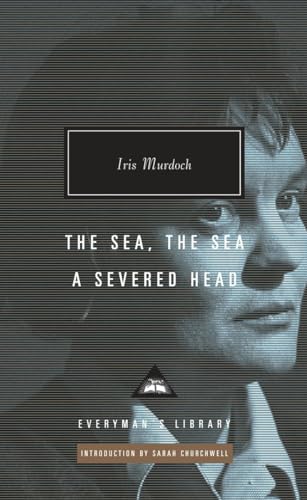
Inhaltsangabe
These two major novels—by one of the most influential British writers of the twentieth century—are ferociously dark comedies that combine playfulness with profundity.
A Severed Head (1961) is one of Iris Murdoch’s most entertaining works, tracing the turbulent emotional journey of Martin Lynch-Gibbon, a smug, prosperous London wine merchant and unfaithful husband, whose life is turned inside out when his wife leaves him for her psychoanalyst. The story takes bedroom farce to a new level of sophistication, with scenes that are both wickedly funny and emblematic of the way momentous moral issues play out in everyday life.
The Booker Prize–winning The Sea, the Sea (1978) is set on the edge of England’s North Sea, where egotistical Charles Arrowby, a big name in London’s glittering theatrical world, has retreated into seclusion to write his memoirs. Arrowby’s plans begin to unravel when he encounters his long-lost first love and finds himself increasingly besieged by his own fantasies, delusions, and obsessions.
Both novels are tragicomic masterpieces that brilliantly dramatize how much our lives are governed by the lies we tell ourselves and by the all-consuming need for love, meaning, and redemption.
Introduction by Sarah Churchwell
Die Inhaltsangabe kann sich auf eine andere Ausgabe dieses Titels beziehen.
Über die Autorin bzw. den Autor
IRIS MURDOCH (1919-1999) was born in Dublin and brought up in London. She studied philosophy at Cambridge and was a philosophy Fellow at St Anne's College for twenty years. She published her first novel in 1954 and was instantly recognized as a major talent. She went on to publish more than twenty-six novels, as well as works of philosophy, plays, and poetry.
SARAH CHURCHWELL is Professor of American Literature and Public Understanding of the Humanities at the University of East Anglia. She is the author of The Many Lives of Marilyn Monroe and Careless People: Murder, Mayhem and the Invention of The Great Gatsby. She writes regularly for New Statesman, The Guardian, and The Times Literary Supplement, among other publications.
Auszug. © Genehmigter Nachdruck. Alle Rechte vorbehalten.
INTRODUCTION
In Iris Murdoch’s 1973 novel The Black Prince, a popular writer named Arnold Baffin defends his regular production of books he knows are not as good as he’d like them to be: ‘Every book is the wreck of a perfect idea. The years pass and one has only one life. If one has a thing at all one must do it and keep on and on and on trying to do it better.’ Character here presumably speaks for author, although one also suspects that poor silly Arnold Baffin’s platonic conception of a perfect idea is probably less perfect than he thinks. It’s a good bet that Iris Murdoch’s perfect ideas were better.
A published philosopher whose first book was the first book in English on Jean-Paul Sartre, Iris Murdoch wrote novels of ideas about love, as well as the occasional love letter to ideas. Obsession is everywhere in her fictional landscape, but characters are as likely to be obsessed with art as with sex. Adulteration is the game: nothing remains pure, certainly not fidelity to other people, or to social conventions, even the most deeply held. Her characters are most faithful to their conceptions of themselves, which are almost never shared by those around them. In her essay ‘The Sublime and the Beautiful Revisited’, Murdoch wrote that the most important thing for a novel to reveal, ‘not necessarily the only thing, but incomparably the most important thing, is that other people exist’. It was a point she made repeatedly outside her fiction: ‘In the moral life the enemy is the fat relentless ego,’ as she wrote in ‘On ‘‘God’’ and ‘‘Good’’ ’.
Although Murdoch consistently denied that her novels explored her philosophical preoccupations, the project of forcing flawed protagonists to see beyond the blinkers of their own egotism defines most if not all of her twenty-six published novels, among which two of the best are A Severed Head (1961) and The Sea, The Sea (1978). Both are narrated by self-regarding middle-class men with aspirations to aesthetic mastery. Fastidious and complacent, less wise and less kind than they like to think, they find their lives thrown into turmoil by their inability to recognize the agency, and desires, of those around them. These desires are always in part, but never exclusively, sexual: they are also a will to power. ‘Love is the extremely difficult realization that something other than oneself is real,’ Murdoch declared in her essay ‘The Sublime and the Good’. ‘Love, and so art and morals, is the discovery of reality.’
But Murdoch’s novels are not merely cerebral exercises in ideas about moral philosophy, ethics and aesthetics, although those ideas shape her fiction. They are also shot through with the dark energies of occult forces, variously figured as Eros, the id, the unconscious, the repressed, the monstrous, the supernatural, the libidinous: all that the conscious mind cannot comprehend stalks her hapless protagonists, as their precarious fantasies of control are exposed for the delusions they are. Murdoch’s fictional experiments, as admirers like A. S. Byatt have written, fuse realism with the mystical, producing a very English magical realism at the point where nineteenth-century realism meets myth and fable. The cosmos of Murdoch’s fictional world does not remain mapped out in neat constellations, but magnetically contracts into accidental formations that bear a suspicious, if factitious, resemblance to myth.
Pattern comes through myth and symbol, as well as through the symmetries of plot that Murdoch loves: her characters dance an eighteenth-century minuet, promenading, dividing, recombining, and dividing again. If the presence of occult forces implicitly resists verisimilitude, so do her configurations. Murdoch’s books are metafictional in their insistence upon their own fabricatedness: her voice does not intrude, but her patterns bewilder and amuse, estrange and surprise, reminding us that realism is not the same as the real, but something more artful, systematic, arranged. Harkening back to Shakespeare and Restoration comedy, her carefully ordered plots suggest we are all marionettes on a string, playing our part in foolish charades. People spin, entangle, loosen, but are rarely freed from the Gordian knots their desires create. What feels to the characters like the forces of contingency battering away at them is just as likely to be their author’s implacable design, creating ruthless comedies of manners, and various manners of comedy. Around her intricate plotting orbits satires of art and morality, accountability and guilt, ethics and erotics.
Truth is not the same thing as realism, Murdoch tells us again and again: ‘People lie so, even we old men do,’ as the narrator’s cousin tries to tell him in The Sea, The Sea. ‘Though in a way, if there is art enough it doesn’t matter, since there is another kind of truth in the art.’ But pattern may also have its own immanent truths, a hierophant’s sense of the divine made manifest.
For Murdoch, artistic form was a temptation and compensation, a remedy for the contingent messiness of life, but also a consolatory falsification. She wrote that the novel was caught between the ‘journalistic’ and the ‘crystalline’, the loose baggy monster that Henry James saw in the nineteenth-century novel, and modernist experiments in controlled, limited artifice. Form, for Murdoch, is a kind of totem for modernist art, a guardian spirit which cannot be lost but must not be fetishized, and never mistaken for truth: form is the shadow on the artist’s cave. Plato’s prisoners watching shadows dancing in the back of a cave may come to admire the dark beauty of the shadows themselves, terrible as a revelation. Artistic design creates a bulwark against erotic extravagance; it produces a kind of moral blueprint, a metaphysics that can imagine, without believing in, necessary gods.
Murdoch has been compared to Henry James more than once in her interest in the moral consequences of relationships, of romance and society. Her sense of social and psychological satire owes much to his, as when her protagonist in The Sea, The Sea chooses The Wings of the Dove to read, ‘another story of death and moral smash-up’. But James’s careful social realism is quite alien to Murdoch’s sense of the ludicrous in her plotting, the sheer pleasure she takes in her own designs, while her willingness to tell her story from the viewpoint of her protagonists’ immoral casuistries is like reading The Portrait of a Lady from the perspective of Gilbert Osmond.
*
One such figure is the appalling Charles Arrowby, the complacent centre of The Sea, The Sea, which won the Booker prize in 1978. A failed playwright and actor, the tyrannically selfish Charles only found success in the theatre as a director, when he could exert his will over those around him (indeed he announces early on that any director who isn’t dictatorial isn’t doing his job). Charles fancies himself a Prospero, an old sorcerer abjuring a life of power and magic, but Murdoch gradually reveals that his most successful tricks were practised on himself. Charles has retired to a house by the sea, where he intends to write his memoirs. Insisting upon his need for solitude, he is irked when no letters come from his friends, and decides with characteristic high-handedness to summon a former lover, Lizzie, who once played Ariel to his Prospero, to keep house for him. He treats women as useful labour-saving devices, explaining, for instance, that he never learned to drive as long as he had girlfriends around: ‘Why keep...
„Über diesen Titel“ kann sich auf eine andere Ausgabe dieses Titels beziehen.
Suchergebnisse für The Sea, the Sea; A Severed Head: Introduction by Sarah...

Beispielbild für diese ISBN
The Sea, the Sea; A Severed Head (Everyman's Library Contemporary Classics Series)
Anbieter: World of Books (was SecondSale), Montgomery, IL, USA
Verkäuferbewertung 5 von 5 Sternen

Zustand: Good. Item in good condition. Textbooks may not include supplemental items i.e. CDs, access codes etc. Artikel-Nr. 00106684094
Gebraucht kaufen
EUR 18,25
Versand gratis
Versand innerhalb von USA
Versand innerhalb von USA
Anzahl: 1 verfügbar
Beispielbild für diese ISBN
The Sea, the Sea; A Severed Head
Anbieter: Remarks Used Books, Pittsfield, MA, USA
Verkäuferbewertung 5 von 5 Sternen
Hardcover. Zustand: As New. Zustand des Schutzumschlags: As New. First included in Everyman's Library, 2016. Introduction by Sarah Churchwell. Bright, clean & tight copy, unread, in AS NEW condition. "These two major novels--by one of the most influential British writers of the twentieth century--are ferociously dark comedies that combine playfulness with profundity. [] A SEVERED HEAD (1961) is one of Iris Murdoch's most entertaining works, tracing the turbulent emotional journey of Martin Lynch-Gibbon, a smug, prosperous London wine merchant and unfaithful husband, whose life is turned inside out when his wife leaves him for her psychoanalyst. The story takes bedroom farce to a new level of sophistication, with scenes that are both wickedly funny and emblematic of the way momentous moral issues play out in everyday life. [] The Booker Prizewinning THE SEA, THE SEA (1978) is set on the edge of England's North Sea, where egotistical Charles Arrowby, a big name in London's glittering theatrical world, has retreated into seclusion to write his memoirs. Arrowby's plans begin to unravel when he encounters his long-lost first love and finds himself increasingly besieged by his own fantasies, delusions, and obsessions. [] Both novels are tragicomic masterpieces that brilliantly dramatize how much our lives are governed by the lies we tell ourselves and by the all-consuming need for love, meaning, and redemption." [jacket copy] ASH: "Remarkable. One feels a power of intellect quite exceptional in a novelist."--The Sunday Times. TSTS: "Dazzlingly entertaining and inventive."--The Times of London. "One of Miss Murdoch's best novels. Murdoch was always balancing the demands of storytelling with the more urgent need to examine how the truth of a fleeting life reflected the larger, permanent truths of existence."--The New York Times. Pristine hardcover w/brilliant corners & crisp edges, a square & tight binding; a beautiful Knopf edition. Artikel-Nr. RUB2148
Gebraucht kaufen
EUR 31,45
EUR 5,16 Versand
Versand innerhalb von USA
Versand innerhalb von USA
Anzahl: 1 verfügbar
Beispielbild für diese ISBN
The Sea, the Sea; A Severed Head: Introduction by Sarah Churchwell
Anbieter: Kennys Bookstore, Olney, MD, USA
Verkäuferbewertung 5 von 5 Sternen
Zustand: New. Artikel-Nr. V9781101907665
Neu kaufen
EUR 36,75
EUR 9,03 Versand
Versand innerhalb von USA
Versand innerhalb von USA
Anzahl: Mehr als 20 verfügbar
Beispielbild für diese ISBN
The Sea, the Sea / A Severed Head
Anbieter: Revaluation Books, Exeter, Vereinigtes Königreich
Verkäuferbewertung 5 von 5 Sternen
Hardcover. Zustand: Brand New. 752 pages. 8.00x4.25x1.50 inches. In Stock. Artikel-Nr. xr1101907665
Neu kaufen
EUR 34,69
EUR 14,56 Versand
Versand von Vereinigtes Königreich nach USA
Versand von Vereinigtes Königreich nach USA
Anzahl: 2 verfügbar
Beispielbild für diese ISBN
The Sea, the Sea / A Severed Head
Anbieter: Revaluation Books, Exeter, Vereinigtes Königreich
Verkäuferbewertung 5 von 5 Sternen
Hardcover. Zustand: Brand New. 752 pages. 8.00x4.25x1.50 inches. In Stock. Artikel-Nr. 1101907665
Neu kaufen
EUR 37,11
EUR 14,56 Versand
Versand von Vereinigtes Königreich nach USA
Versand von Vereinigtes Königreich nach USA
Anzahl: 1 verfügbar
Foto des Verkäufers
The Sea, the Sea A Severed Head: Introduction by Sarah Churchwell
Anbieter: moluna, Greven, Deutschland
Verkäuferbewertung 5 von 5 Sternen
Zustand: New. Artikel-Nr. 900002111
Neu kaufen
EUR 29,07
EUR 48,99 Versand
Versand von Deutschland nach USA
Versand von Deutschland nach USA
Anzahl: Mehr als 20 verfügbar