
Verwandte Artikel zu The Autobiography and Other Writings: Introduction...
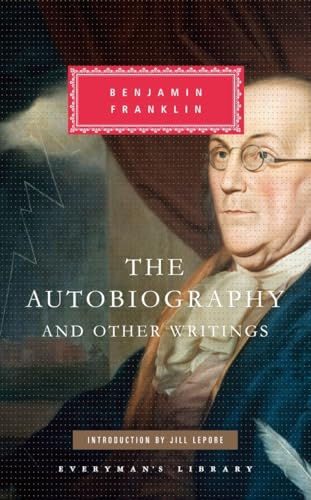
The Autobiography and Other Writings: Introduction by Jill Lepore (Everyman's Library Classics Series, Band 366) - Hardcover
Inhaltsangabe
Benjamin Franklin’s account of his rise from poverty and obscurity to affluence and fame has charmed every generation of readers since it first appeared. Begun as a collection of anecdotes for his son, the memoir grew into a history of his remarkable achievements in the literary, scientific, and political realms. A printer, inventor, scientist, diplomat, and statesman, Franklin was also a brilliant writer whose wit and wisdom shine on every page. His Autobiography has deservedly become the most widely read American autobiography of all time—the self-portrait of a quintessential American.
Franklin was a remarkably prolific writer, and is equally beloved for his humorous, philosophical, parodic, and satirical writings, parables, and maxims, which he published under an astonishing number of pen names, including Poor Richard, the Busy-Body, and Silence Dogood. This hardcover edition of The Autobiography and Other Writings contains a varied selection of these, including “The Kite Experiment,” “A Parable Against Persecution,” “Observations Concerning the Increase of Mankind,” “Rules for Making Oneself a Disagreeable Companion,” and “The Way to Wealth.”
Die Inhaltsangabe kann sich auf eine andere Ausgabe dieses Titels beziehen.
Über die Autorin bzw. den Autor
BENJAMIN FRANKLIN (1706-1790) was a printer, writer, inventor, scientist, diplomat, and statesman. JILL LEPORE is the David Woods Kemper '41 Professor of American History at Harvard University and a staff writer at The New Yorker. Her books include Book of Ages, a finalist for the National Book Award; New York Burning, a finalist for the Pulitzer Prize; The Name of War, winner of the Bancroft Prize; The Mansion of Happiness, which was short-listed for the 2013 Andrew Carnegie Medal for Excellence in Nonfiction; and The Secret History of Wonder Woman. She lives in Cambridge, Massachusetts.
Auszug. © Genehmigter Nachdruck. Alle Rechte vorbehalten.
Excerpt from the Introduction by Jill Lepore
I N T R O D U C T I O N
Or, from the Printer to the Reader
‘‘I could as easily make a Collection for you of all the past Parings of my Nails,’’ Benjamin Franklin wrote to his sister Jane in 1767, after she asked him to send her all his old essays on politics. It was as if, in dashing off articles, he’d been sloughing off pages, like a snake shedding skin.[1] Franklin liked to think of himself as a book: a man of letters, spine of bone, flesh of paper, blood of ink, his skin a cover of leather, stitched. When he wrote, he molted.He could be as sneaky as a snake, too, something to bear in mind when reading his autobiography, as sly an account as anything Franklin ever allowed himself the grave indiscretion of putting on paper.
Franklin was awriter, a scientist, and a statesman but, first and last, he was a printer. He knew every form and each style, every font and each type. In his shop, he sold quills and inkstands, foolscap and folios, almanacs and spelling books. He bought rags for making paper. ‘‘READY MONEY for old RAGS, may be had of the Printer thereof,’’ he announced in the pages of his newspaper, the Pennsylvania Gazette.[2] He owned papermills and printing presses. He printed newspapers and novels, magazines and treatises. He sold, in his shop, an entire inventory of blank forms: ‘‘Bills of Lading bound and unbound, Common Blank Bonds for Money, Bonds with Judgment, Counterbonds, Arbitration Bonds, Arbitration Bonds with Umpirage, Bail Bonds, Counterbonds to save Bail harmless, Bills of Sale, Powers of Attorney, Writs, Summons, Apprentices Indentures, Servants Indentures, Penal Bills, Promissory Notes, &c. all the Blanks in the most authentick Forms, and correctly printed.’’[3]He was a jack-of-allpages: authentick, and correctly printed.
Aprinter ofmoney, a trader in the authentic, amaster of every form, Benjamin Franklin had a genius for counterfeit. Long after he stopped buying rags, soaking them, pressing theminto pages, gracing them with ink, and selling them as books – turning rags into riches – he signed himself ‘‘B. Franklin, printer.’’ But what he liked bestwas not signing his name. He loved satire, imposture, and anonymity. He once wrote a parody of a gentleman’s conduct manual in the form of a letter advising a young man suffering from ‘‘violent natural Inclinations’’ – ‘‘that hard-to-be govern’d Passion of Youth’’ – but unwilling to get married to remedy what ailed him, to take only older women for mistresses. ‘‘Their Conversation is more improving,’’ he remarked; they’re ‘‘more prudent and discreet,’’ and they’re better at other things, too, ‘‘every Knack being by Practice capable of Improvement,’’ not to mention, ‘‘There is no hazard of Children.’’ Then, too, ‘‘in the dark all Cats are grey’’ and, after all, ‘‘They are so grateful !!’’[4] Not counting his mistresses, he rarely placed his faith in the discretion of others. ‘‘Three can keep a secret if two of them are dead,’’ went one of themany proverbs Franklin signed using the name of Richard Saunders, a fictional character he’d created, a daft astrologer who was the alleged author of Poor Richard’s Almanack.[5] (Poor Richard was Franklin’s affectionate homage to Jonathan Swift’s imaginary almanac-maker, Isaac Bickerstaff, Esq.) Most of his best fakes he never printed; instead, he read them – performed them – for friends. (‘‘Strange! that a Man who has wit enough to write a Satyr; should have folly enough to publish it,’’ Poor Richard says.) He faked court documents, elegies, and even Scripture. He was an exceptionally skilled mimic: he taught himself to write by reading Swift, and by copying the style of the essayists in an English gentlemen’s magazine, The Spectator. He once wrote a chapter of the Old Testament in pitch-perfect King James that he bound within the pages of his own Bible so that he could read it aloud to see who would fall for it. (He’d never have published it because, as Poor Richard says, ‘‘Talking against Religion is unchaining a Tyger.’’) In Franklin’s fake Genesis chapter 39, Abraham is sitting in the door of his tent at sundown when ‘‘behold a Man, bowed with Age, came from the Way of the Wilderness, leaning on a Staff.’’ Abraham invites the stranger into the tent but when the old man reveals himself an infidel, Abraham, self-righteous, kicks him out. The next morning, God, finding the old man gone, is peevish and exasperated: ‘‘Have I borne with him these hundred ninety and eight Years, and nourished him, and cloathed him, notwithstanding his Rebellion against me, and couldst not thou, that art thyself a Sinner, bear with himone
Night?’’
Swift first published nearly everything he ever wrote either anonymously, or using a pen name; so did Franklin. ‘‘When the Writer conceals himself, he has the Advantage of hearing the Censure both of Friends and Enemies, express’d with more Impartiality,’’ Franklin explained.[6] It was also more fun that way: he wished to delight himself. Some of Franklin’s satires are so cunning they weren’t discovered to be hoaxes, or his, until long after he was dead, and some, once discovered, were buried, or even destroyed. The first scholar to collect Franklin’s papers, the Harvard historian and former chaplain of Congress, Jared Sparks, who published a ten-volume edition of Franklin’s Works in the 1830s, was a humorless pedant who suppressed anything he found in Franklin that offended his sensibilities, silently cutting out of Franklin’s letters, for instance, all of his filthy jokes. Needless to say, Sparks included in his edition of Franklin’s Works neither Franklin’s advice about taking old women as mistresses nor his parable against religious persecution. ‘‘If you wou’d not be forgotten/As soon as you are dead and rotten,’’ Poor Richard says, ‘‘Either write things worth the reading,/Or do things worth the writing.’’ He might have added: And leave your papers in the hands of a better editor.
‘‘He was a hard lot,’’ Mark Twain once wrote about Franklin, but all Twain or anyone else knew, for a century, was Sparks’s Franklin, which was hardly Franklin at all.[7] In 1938, when Carl Van Doren published a biography of Benjamin Franklin, on the heels of a biography of Jonathan Swift, he explained that he felt he had no choice. It was as if Sparks had locked Franklin in a box. ‘‘The dry, prim people seem to regard him as a treasure shut up in a savings bank, to which they have the lawful key,’’ Van Doren wrote. ‘‘I herewith give him back, in grand dimensions, to his nation and the world.’’[8] But it was, by then, nearly too late: Franklin is still locked in that bank vault, his face on the hundred-dollar bill, his best-known essay ‘‘The Way to Wealth,’’ as if what he stood for was making money. Nothing could be less true. What Franklin stood for was making knowledge.
Much of what Sparks kept out of Franklin’s Works he set aside because it offended him, but a lot of it he never found. After Franklin’s death, his papers, including drafts of the story of his life, had been scattered. Sheaves of his papers wound up in a...
„Über diesen Titel“ kann sich auf eine andere Ausgabe dieses Titels beziehen.
Suchergebnisse für The Autobiography and Other Writings: Introduction...

Beispielbild für diese ISBN
The Autobiography and Other Writings: Introduction by Jill Lepore (Everyman's Library Classics Series)
Verlag:
Everyman's Library (edition Reprint), 2015
ISBN 10: 1101907606
ISBN 13: 9781101907603
Gebraucht
Hardcover
Anbieter: BooksRun, Philadelphia, PA, USA
Verkäuferbewertung 5 von 5 Sternen

Hardcover. Zustand: Very Good. Reprint. With dust jacket. It's a well-cared-for item that has seen limited use. The item may show minor signs of wear. All the text is legible, with all pages included. It may have slight markings and/or highlighting. Artikel-Nr. 1101907606-11-1-29
Gebraucht kaufen
EUR 10,35
Versand gratis
Versand innerhalb von USA
Versand innerhalb von USA
Anzahl: 1 verfügbar
Beispielbild für diese ISBN
The Autobiography and Other Wr
Anbieter: World of Books (was SecondSale), Montgomery, IL, USA
Verkäuferbewertung 5 von 5 Sternen
Zustand: Good. Item in good condition. Textbooks may not include supplemental items i.e. CDs, access codes etc. Artikel-Nr. 00104262922
Gebraucht kaufen
EUR 12,52
Versand gratis
Versand innerhalb von USA
Versand innerhalb von USA
Anzahl: 1 verfügbar
Foto des Verkäufers
The Autobiography and Other Writings: Introduction by Jill Lepore (Everyman's Library Classics Series)
Anbieter: Southampton Books, Sag Harbor, NY, USA
Verkäuferbewertung 5 von 5 Sternen
Hardcover. Zustand: Like New. FIRST THUS. First Edition Thus, First Printing. Published by Everyman's Library, 2015. Octavo. Hardcover. Book is like new. Dust jacket is like new. Artikel-Nr. 514349
Gebraucht kaufen
EUR 17,76
EUR 4,30 Versand
Versand innerhalb von USA
Versand innerhalb von USA
Anzahl: 1 verfügbar
Beispielbild für diese ISBN
The Autobiography and Other Writings (Everyman's Library (Cloth))
Anbieter: Kennys Bookstore, Olney, MD, USA
Verkäuferbewertung 5 von 5 Sternen
Zustand: New. 2015. Reprint. Hardcover. . . . . . Books ship from the US and Ireland. Artikel-Nr. V9781101907603
Neu kaufen
EUR 35,62
EUR 9,05 Versand
Versand innerhalb von USA
Versand innerhalb von USA
Anzahl: 15 verfügbar
Beispielbild für diese ISBN
The Autobiography and Other Writings
Anbieter: Revaluation Books, Exeter, Vereinigtes Königreich
Verkäuferbewertung 5 von 5 Sternen
Hardcover. Zustand: Brand New. reprint edition. 281 pages. 8.25x5.25x1.25 inches. In Stock. Artikel-Nr. 1101907606
Neu kaufen
EUR 49,89
EUR 14,58 Versand
Versand von Vereinigtes Königreich nach USA
Versand von Vereinigtes Königreich nach USA
Anzahl: 1 verfügbar
Foto des Verkäufers
The Autobiography and Other Writings
Verlag:
Knopf Doubleday Publishing Group, 2015
ISBN 10: 1101907606
ISBN 13: 9781101907603
Neu
Hardcover
Anbieter: moluna, Greven, Deutschland
Verkäuferbewertung 5 von 5 Sternen
Gebunden. Zustand: New. BENJAMIN FRANKLIN (1706-1790) was a printer, writer, inventor, scientist, diplomat, and statesman. JILL LEPORE is the David Woods Kemper 41 Professor of American History at Harvard University and a staff writer at The New Yorker. . Artikel-Nr. 900002107
Neu kaufen
EUR 31,32
EUR 48,99 Versand
Versand von Deutschland nach USA
Versand von Deutschland nach USA
Anzahl: Mehr als 20 verfügbar