
Verwandte Artikel zu Wellth: How to Build a Life, Not a Résumé
Inhaltsangabe
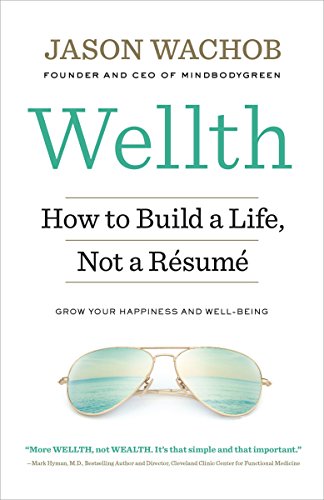
mindbodygreen founder Jason Wachob redefines successful living and offers readers a new life currency to build on, one that is steeped in wellbeing…Wellth.
“Many of us aren’t satisfied with just trying to accumulate the most money and toys. The good life is no longer just about the material—instead, it can be found in a lifestyle that is devoted to mental, physical, and emotional health. A wellthy existence is one in which happiness is attainable, health is paramount, and daily living is about abundance. It’s a life in which work is purposeful; friendships are deep and plentiful; and there’s a daily sense of richness or overflowing joy. But since there’s no one-size-fits all definition for a wellthy existence, I hope this book will serve as a guide to help you embark on your own personal journey that is both unique and meaningful.”
Eat. Move. Work. Believe. Explore. Breathe. Connect. Love. Heal. Thank. Ground. Live. Laugh.
These are the building blocks of Wellth…and in this blend of memoir and prescriptive advice Jason Wachob shows us all how to enjoy truly ‘wellthy’ lives—lives that are deeply rich in every conceivable way. Through his experience and personal story, as well as in exclusive material from popular expert contributors (including Dr. Frank Lipman, Dr. Lissa Rankin, Joe Cross, Charlie Knoles, Kathryn Budig, Dr. Aviva Romm, and Dr. Sue Johnson), we learn how we too can embrace this new movement and develop richer, fuller, happier, healthier, and more meaningful lives.
Die Inhaltsangabe kann sich auf eine andere Ausgabe dieses Titels beziehen.
Über die Autorin bzw. den Autor
JASON WACHOB is the Founder and CEO of mindbodygreen, the leading independent media company dedicated to health and happiness with 15 million monthly unique visitors. He has been featured in The New York Times, Entrepreneur, Fast Company, and Vogue. Jason has a BA in history from Columbia University, where he played varsity basketball for four years. He lives in Brooklyn with his wife, and loves German Shepherds, Chuck Taylors, and guacamole.
Auszug. © Genehmigter Nachdruck. Alle Rechte vorbehalten.
One of the first and most elemental aspects of accruing wellth comes from how we nourish our bodies. It seems that everyone wants to know the perfect “diet” in order to look great. Many think that means eating exclusively organic, vegetarian/ vegan, raw, Paleo, low-fat, or low-carb foods. But how do you tell which eating plan is best for you? Is there a one-size-fits-all diet that leads to wellth?
When it comes to diets, I’ve tried them all. Every diet book you’ll read promises benefits like weight loss, increased energy, glowing skin, better sex, and increased productivity and focus; but I believe that these one-size-fits-all approaches are all wrong. Yet I think there are a few universal truths.
I’m six foot seven, and I weigh 220 pounds. A third-degree sprain in my right ankle from twenty-five years ago still won’t let me ground my heel onto the floor. I love playing basketball, but I’ve always hated running. Back in college, I could get my elbow above the rim and dunk very easily, but no more. I love Brussels sprouts but hate mushrooms. Oddly enough, I’m allergic to celery. Each and every one of us has our own physical gifts, quirks, likes, and dislikes. This may sound obvious, but sometimes it seems as if those in the health and diet industry think otherwise.
I'm not just talking about the health care system and the way doctors treat symptoms rather than patients. I'm referring to the way we think about everyday diet and exercise. How can one particular diet or workout be good for the entire world? How can a diet be the same for a six-foot-seven, 220-pound, forty-one-year-old man who practices fifteen minutes of yoga a few times a week; and a five-foot-two, 102-pound, twenty two-year-old woman who runs fifteen miles every day? How can being vegan or Paleo be good for everyone? How can any one believe that their health routine is appropriate for everyone else?
In reality, what is good for me may be awful for you. I absolutely love coffee, and I'm delighted that it has antioxidants that may fight cancer. But for my coworker, even a sip causes painful acid reflux. For him, it's green tea all the way. My wife loves running with the rising sun. I hate running at any time of day. Just the idea of getting dressed to go for a run triggers a stress response in my body.
To be truly wellthy is to find your personal prescription-to discover what works for you, what feels good, what you love. That process of discovery never ends. There are certain diets and types of exercise that are right for you in certain periods of your life but not others. Not only do we have to find the ap proach that works for us; we need to learn how to adapt that approach, or change it entirely, throughout our lives.
I was a gym rat for much of my twenties and early thirties, lifting weights and doing the elliptical machine daily. In my mid-thirties, after yoga played a huge role in healing my back, I practiced yoga every morning and did nothing else. In my late thirties and now forties, I’ve switched it up again. Now I do yoga at home a few days a week for fifteen minutes, lift weights twice a week for 25 minutes, and meditate daily for twenty minutes.
As passionately as Paleo expert Chris Kresser advocates for his diet, he also teaches that our bodies need different diets and foods at different stages of our lives. Being an omnivore might be great for us at age twenty, but at age twenty-five, we might want to be vegetarian. At thirty, we might find that being vegan is just what the doctor ordered. At forty, we might try Paleo; and at age forty-five, go back to being an omnivore once again.
This has certainly been my experience. In my mid-twenties I thrived on a low-carb, low-sugar diet during the week, and on the weekends I ate and drank anything I wanted to. (I definitely did too much drinking!) In my mid-thirties, when I began to get serious about yoga, I felt better as a vegetarian, although occasionally I ate meat. My digestion improved when I went gluten-free. Then in my late thirties I went Paleo, eating a lot of cooked vegetables, grass-fed beef, wild salmon, and no raw foods (in an effort to kick a parasite). In the past few months, I went back again to eating mostly vegetables (cooked or raw), and I don’t eat much red meat. I’ve added a variety of grains and the occasional gluten.
I discovered that it no longer serves me to resist going to Roberta’s for the best pizza in Brooklyn once in a while. Plea- sure is not to be underestimated. I’ll also have a margarita or two (or three!) whenever I eat Mexican food—there’s one that
I love that is made of carrot juice! Sometimes we all need a doughnut. It's probably not a great idea to eat one every day, but the occasional treat isn't going to kill you. Life should be fun. Being obsessive about diet can be stressful and can bring on orthorexia-an unhealthy obsession with healthy eating. So aim to be balanced in your eating, as well as in your life.
Someone has to stand u p and soy t hat t he answer isn't another pill. The answer is spinach.
-BILL MAHER
And keep in mind that our diets and bodies change, so it's important to listen and fine-tune your diet whenever you sense that something may be off, whether it's digestive issues, a lack of energy, weight gain, or boredom and a lack of pleasure in your eating. Don't fall victim to health orthodoxy that gives you no room for experimentation. Tune in to what feels good. Be open to change. Our bodies are constantly shifting, and so should our personal approaches to wellness.
Yet I do think that my doctor friends all would agree that processed foods are not ideal. I try not to demonize entire food groups, but I'm okay with demonizing sugar. There are studies that go as far as saying that sugar is more addictive than cocaine. Oh, and that sugar is making us fat and sick, too. There's a great documentary film, Fed Up, that dives into some of the harsh realities of sugar. For example, did you know that 80 percent of the 600,000 items sold in grocery stores have added sugar? Or that a typical bottle of soda contains 16 tea spoons of sugar from high-fructose corn syrup? Did you ever notice that on all nutrition labels there’s a “recommended daily percent” right next to calories, fat, protein—but there’s no recommended percentage for sugar, although it’s now being discussed by the FDA.
You can’t expect to live a vibrant life when you live on Twinkie consciousness.
—KRISCARR, WELLNESS ACTIVIST AND DOCUMENTARY FILMMAKER
Still not sold on the evils of sugar? Then you should watch the great April 2012 segment on 60 Minutes titled “Cancer Loves Sugar.” It explains that some of this country’s most respected institutions have found that sugar can lead to chronic illnesses such as heart disease, obesity, and cancer.
There are so many different viewpoints about food that a routine trip to the grocery store can quickly turn into an episode of Portlandia. With labels like low-fat, non-GMO, local, organic, natural, wild, grass-fed, cage-free, gluten-free, and dairy- free (I could go on and on), merely shopping for dinner can be overwhelming. But a few straightforward suggestions can help to streamline the process.
Keep it simple. Try to avoid gluten, sugar, and processed foods whenever possible. If it’s in a box and has a label, then try not to make a habit of buying it. Avoiding processed foods can seem almost impossible at first, but after a few weeks it becomes easier. Author and wellness expert Dr. Mark Hyman says, “Stick to things that God made and not that man made.”
Eat real food. Mostly shop the...
„Über diesen Titel“ kann sich auf eine andere Ausgabe dieses Titels beziehen.
Suchergebnisse für Wellth: How to Build a Life, Not a Résumé

Beispielbild für diese ISBN
Wellth: How to Build a Life, Not a R?sum?
Anbieter: World of Books (was SecondSale), Montgomery, IL, USA
Verkäuferbewertung 5 von 5 Sternen

Zustand: Good. Item in good condition. Textbooks may not include supplemental items i.e. CDs, access codes etc. Artikel-Nr. 00099534436
Gebraucht kaufen
EUR 4,60
Versand gratis
Versand innerhalb von USA
Versand innerhalb von USA
Anzahl: 2 verfügbar
Beispielbild für diese ISBN
Wellth: How to Build a Life, Not a Résumé
Verlag:
Harmony (edition Reprint), 2017
ISBN 10: 110190450X
ISBN 13: 9781101904503
Gebraucht
Paperback
Anbieter: BooksRun, Philadelphia, PA, USA
Verkäuferbewertung 5 von 5 Sternen
Paperback. Zustand: Very Good. Reprint. It's a well-cared-for item that has seen limited use. The item may show minor signs of wear. All the text is legible, with all pages included. It may have slight markings and/or highlighting. Artikel-Nr. 110190450X-8-1
Gebraucht kaufen
EUR 4,61
Versand gratis
Versand innerhalb von USA
Versand innerhalb von USA
Anzahl: 1 verfügbar
Beispielbild für diese ISBN
Wellth : How to Build a Life, Not a RÃÂ sumÃÂ
Verlag:
Potter/Ten Speed/Harmony/Rodale, 2017
ISBN 10: 110190450X
ISBN 13: 9781101904503
Gebraucht
Softcover
Anbieter: Better World Books: West, Reno, NV, USA
Verkäuferbewertung 5 von 5 Sternen
Zustand: Very Good. Former library copy. Pages intact with possible writing/highlighting. Binding strong with minor wear. Dust jackets/supplements may not be included. Includes library markings. Stock photo provided. Product includes identifying sticker. Better World Books: Buy Books. Do Good. Artikel-Nr. 19242544-6
Gebraucht kaufen
EUR 6,16
Versand gratis
Versand innerhalb von USA
Versand innerhalb von USA
Anzahl: 1 verfügbar
Beispielbild für diese ISBN
Wellth : How to Build a Life, Not a RÃ sumÃ
Verlag:
Potter/Ten Speed/Harmony/Rodale, 2017
ISBN 10: 110190450X
ISBN 13: 9781101904503
Gebraucht
Softcover
Anbieter: Better World Books, Mishawaka, IN, USA
Verkäuferbewertung 5 von 5 Sternen
Zustand: Good. Former library copy. Pages intact with minimal writing/highlighting. The binding may be loose and creased. Dust jackets/supplements are not included. Includes library markings. Stock photo provided. Product includes identifying sticker. Better World Books: Buy Books. Do Good. Artikel-Nr. 19269907-6
Gebraucht kaufen
EUR 6,16
Versand gratis
Versand innerhalb von USA
Versand innerhalb von USA
Anzahl: 1 verfügbar
Beispielbild für diese ISBN
Wellth : How to Build a Life, Not a RÃ sumÃ
Verlag:
Potter/Ten Speed/Harmony/Rodale, 2017
ISBN 10: 110190450X
ISBN 13: 9781101904503
Gebraucht
Softcover
Anbieter: Better World Books, Mishawaka, IN, USA
Verkäuferbewertung 5 von 5 Sternen
Zustand: Good. Pages intact with minimal writing/highlighting. The binding may be loose and creased. Dust jackets/supplements are not included. Stock photo provided. Product includes identifying sticker. Better World Books: Buy Books. Do Good. Artikel-Nr. 15742896-6
Gebraucht kaufen
EUR 6,16
Versand gratis
Versand innerhalb von USA
Versand innerhalb von USA
Anzahl: 1 verfügbar
Beispielbild für diese ISBN
Wellth: How to Build a Life, Not a RÃ sumÃ
Anbieter: ThriftBooks-Dallas, Dallas, TX, USA
Verkäuferbewertung 5 von 5 Sternen
Paperback. Zustand: Very Good. No Jacket. May have limited writing in cover pages. Pages are unmarked. ~ ThriftBooks: Read More, Spend Less. Artikel-Nr. G110190450XI4N00
Gebraucht kaufen
EUR 6,18
Versand gratis
Versand innerhalb von USA
Versand innerhalb von USA
Anzahl: 1 verfügbar
Beispielbild für diese ISBN
Wellth: How to Build a Life, Not a RÃ sumÃ
Anbieter: ThriftBooks-Atlanta, AUSTELL, GA, USA
Verkäuferbewertung 5 von 5 Sternen
Paperback. Zustand: Very Good. No Jacket. May have limited writing in cover pages. Pages are unmarked. ~ ThriftBooks: Read More, Spend Less. Artikel-Nr. G110190450XI4N00
Gebraucht kaufen
EUR 6,18
Versand gratis
Versand innerhalb von USA
Versand innerhalb von USA
Anzahl: 1 verfügbar
Beispielbild für diese ISBN
Wellth: How to Build a Life, Not a RÃ sumÃ
Anbieter: WorldofBooks, Goring-By-Sea, WS, Vereinigtes Königreich
Verkäuferbewertung 5 von 5 Sternen
Paperback. Zustand: Very Good. The book has been read, but is in excellent condition. Pages are intact and not marred by notes or highlighting. The spine remains undamaged. Artikel-Nr. GOR008828918
Gebraucht kaufen
EUR 9,94
EUR 6,57 Versand
Versand von Vereinigtes Königreich nach USA
Versand von Vereinigtes Königreich nach USA
Anzahl: 1 verfügbar