
Verwandte Artikel zu Stranger at My Table: The postcolonial story of a family...
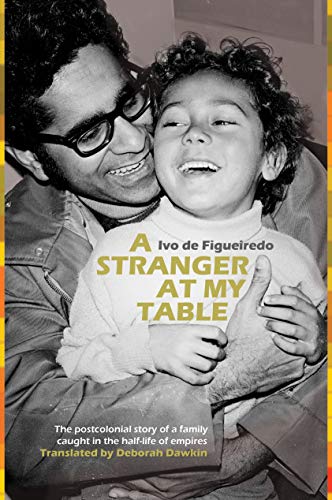
Stranger at My Table: The postcolonial story of a family caught in the half-life of empires - Softcover
Inhaltsangabe
"A touching, contemplative chronicle of loss and self-discovery."
– Publishers Weekly
From the acclaimed biographer of Norway’s most treasured cultural icons, Henrik Ibsen and Edvard Munch, comes a story of a migrant family in search of roots and for each other.
Ivo de Figueiredo’s lyrical and imagistic memoir navigates a difficult search for the origins of his estranged father, which opens a door to a family history spanning four continents, five centuries and the rise and fall of two empires. At the age of 45, Figueiredo traces his father’s family in the diaspora. Having emigrated from the Portuguese colony of Goa on the west coast of India to British East Africa, and later to the West, his father’s ancestors were Indians with European ways and values―trusted servants of the imperial powers. But in postcolonial times they became homeless, redundant, caught between the age of empires and the age of nations.
With lush descriptions and forthcoming honesty, A Stranger at My Table tells the story of a family unwittingly tied to two European empires, who paid the price for their downfall, weathering revolution and many forms of prejudice. The author’s trove of often-strange photographs, letters and recordings as well as his eye for the smallest details and double-meanings lead the reader down a mysterious path as his search for his family’s heritage results in a surprising reunification with his father and reconciliation with his past.
Praise for Henrik Ibsen. The Man and the Mask, 2019
Ivo de Figueiredo’s work marks the high point in the long line of biographies of Ibsen that have been published since 1888.
– Dagbladet
This Ibsen-biography shares the quality of its subject: It is unsurpassable. […] Anybody with the slightest interest in literature should indulge in a meeting with the most important Norwegian contribution to world literature: The works of Henrik Ibsen. Outside of the plays themselves, there is no better place to start than Ivo de Figueiredo’s two books, “The Man” (2006) and “The Mask” (2007).
– Klassekampen
A jubilant outcry … it is this literary composition that makes Ivo de Figueiredo revise our understanding of Ibsen.
– Dag Solstad
Praise for Sleeping Sinner, The Køber Case. A true story of spiritualism, love and a possible murder, 2010
The book is so well written that I almost forgot that it was a book. It resembles a film or a court case. Figueiredo’s trick is to focus on the unsolved parts of the case […] Figueiredo deserves gratitude and admiration.
– Aftenposten
Wonderfully fascinating reading. Exciting like a crime novel, but from real life.
– Varden
Electrifyingly well written. The historian and writer, Ivo de Figueiredo, stylistically just gets better and better […] It is like a thriller you cannot put down.
– VG+
Die Inhaltsangabe kann sich auf eine andere Ausgabe dieses Titels beziehen.
Über die Autorin bzw. den Autor
Ivo de Figueiredo (b. 1966) is the critically-acclaimed biographer of Norway’s treasured cultural icon, Henrik Ibsen (forthcoming in English with Yale University Press, 2019), and his next book is the official biography of Edvard Munch, commissioned by the Munch Foundation. In 2002, he was awarded the Brage Prize for a biography of Johan Bernhard Hjort, the co-founder of the Norwegian Fascist Party who later became a resistance fighter and human rights lawyer. A Stranger at My Table received one of the highest non-fiction honors in Norway, the 2016 Language Prize and was nominated for the Brage Prize that same year. Figueiredo works as a critic at Morgenbladet and Aftenposten and is a member of the Norwegian Academy.
Auszug. © Genehmigter Nachdruck. Alle Rechte vorbehalten.
I’VE NOT SEEN OR TALKED to Dad for over five years. I believe I sent him an email on his seventieth birthday out of a sense duty. Beyond that, we no longer have any contact. As the years have passed I’ve come to think of him as a stranger, some guy who lived with us for a few years, and then disappeared. In the picture below he stands outside Grandpa’s workshop in Bamble. An Indian in the Norwegian snow. Dressed for the city in a snowdrift in the middle of the forest. For years I’ve looked at this picture and felt it safest that he stay there, at a distance, frozen, tranquil, before the snow melts and stirs everything into motion.
The snow has begun to pile up in my own life now. I can’t leave him standing there any longer. I need to know how he came to be there, how it all began, and why everything went so dreadfully wrong between us. I need to know this now, before everything freezes again.
For the last eight or ten years Dad has lived in Alfaz del Pi on the Spanish Costa Blanca, surrounded by people I’ve never met and don’t know. I could visit him there, but I don’t. Not yet. I’m not ready. Instead, I take a plane to the United States, to Boston, where his sisters live. We sit around the dining table in an old apartment building on Mass Avenue. The apartment is arranged around a long, dark corridor with doors that lead to a series of rooms that all face out toward the traffic. The floors are warped with age. The thin windowpanes keep neither the noise nor summer at bay. The air is heavy with heat, except in the dining room where an air-conditioner roars.
My aunts look at me with the same gentle, empathic gaze I remember so well from their visits to Langesund when I was a child; it’s as though everything I tell them, any feelings I express, become etched in their faces. Though, in fact, they speak with their whole bodies, the way Indian women do. The many years they have spent in the United States have undoubtedly wrought changes in them, but not in their body language; heads that sway as they talk, forefingers that wag. When they get animated, up pops a forefinger, always the right, and always rocking in a perfect sideways arc, back and forth, affirming or negating, as though they need a metronome to maintain the stream of conversation.
Now and then the metronome halts, and the forefinger points straight up in front of two gentle, but penetrating eyes. Then I know that what will follow is important:
“Your Dad got very hurt. He was only nineteen when he left East Africa. And he’d been like a king.”
Dad hadn’t been any kind of king when I knew him. Not in our house. So where was it he’d been king? In Zanzibar, in Dar Es Salaam or Nairobi? In Goa perhaps, or in England? Now that I think about it, I’m not really sure where he came from; whether it was from just one of these places, or all of them. But somewhere in the world, at some point in his life, he seems to have been strong; a king. Then, somewhere along the road, a king he ceased to be.
As I’m about to leave, Dad’s youngest sister emerges from the bedroom carrying a black folder stuffed with old letters. I recognize the flimsy, blue air-mail paper from my childhood. It arouses memories of Dad sitting at the kitchen table reading.
“Your father wanted you to have these.”
The folder holds all the letters he received from his parents and siblings during those difficult years when the family was scattered to the four winds, uncertain whether they’d ever see each other again. Dad wants to give the letters to my brothers and me, but since we’re no longer on speaking terms, his sister has agreed to hand them over to me.
On my flight home to Norway I glance through one of the letters to Dad from his mother, Herminia:
Nairobi, March 19, 1965: “What passport have you got, Xavier?”
I open another, from the following year:
“We are in a desperate situation...”
Then another, also from my grandmother:
“Please, please, start talking to Baby in English, right away, do not talk to him in Norge [sic]…”
Suspended over the Atlantic Ocean I am grasping fragments of a world in my hands, a world and a history that I’ve started to realize is far greater than I’d ever imagined. Confusing glimpses into the thoughts and anxieties of a stranger – Herminia, the grandmother I never met. Baby. Is that me? A voice from a world about which I have a vague notion, but have never known because it is long-gone; a world that went under and disappeared years before he came to us. Dad’s world. And perhaps mine?
THE EARLIEST PHOTOGRAPH I have found of Dad shows him sitting on a lawn. The year is 1939. I assume it was taken in Victoria Gardens, just outside the city of Zanzibar, where the family’s African ayah often took my father and his siblings. It’s unlikely the servant would have taken this picture. My guess is that Grandfather is the photographer. In which case the picture was probably taken on a Sunday, when he was free. The rest of the week he sat in the office of the British District Commissioner shifting papers, while my grandmother, Herminia Sequeira took care of the housework at their home in Vuga Street. On second thought, the picture may have been taken on a weekday afternoon, since he finished work by one o’clock. The pace of life was slow in Zanzibar, even in the British Protectorate Administration. Dad sits there on the grass in the park. What is he looking at? He doesn’t know. His gaze is open, as are his thoughts. He simply is who he is – Xavier Hugo Ian Peter de Figueiredo. Born in East Africa in an Arab sultanate under British rule, he has both English and Portuguese names, has been baptized into the Catholic faith, and has a complexion that bears witness to his Indian Subcontinent roots. When he learned to talk, it was in English, with some Swahili – just enough to communicate with the servants. He only understood scraps of my grandparents’ mother tongue, Konkani – the language of the Goan people – and never learned Portuguese, which my grandmother spoke fluently.
This is Dad. A boy with a wide, open gaze and the whole world running through his young body. In this he resembles his birthplace Stone Town, the city of stone that occupies the natural peninsula in West Zanzibar. With the ocean on both sides, it looks across the island in one direction and the African mainland in the other. It is a city crammed with churches, with Hindu temples and mosques, yet its silhouette is not dominated by showy spires or minarets, but by the simple, whitewashed houses that lie cheek by jowl, forming a labyrinth of alleys and squares. The effect from a distance is of absolute unity and harmony, despite the fact that the architecture here is so diverse, influenced by the Swahilis, the Portuguese, the Arabs, the Indians and British in that order. Only upon entering the city can you see the contribution each ethnic group has made; from the elegantly carved doors, originally Swahili but elaborated upon later by Arab and Indian craftsmen, to the once unadorned outside walls, now graced with decorative balconies, a sure sign that a house belonged to an Indian merchant.
A unique place in the world, Zanzibar also is the whole world in one place, and this was even truer in Dad’s time. The slaves were long gone, and European explorers no longer came here to prepare for their daring expeditions into the heart of Africa. But in and between these houses people of every shade of brown and black, and a few whites, lived out their lives. In the narrow alleyways, in the fruit market and the bazaars, there were coffee merchants who walked along clanking their bowls, women in black with their faces covered, majestic Ceylonese merchants in white robes and hair tied up in a knot, distinguished Arabs, and African porters who came running up from the harbor carrying cases and bags suspended from long...
„Über diesen Titel“ kann sich auf eine andere Ausgabe dieses Titels beziehen.
Suchergebnisse für Stranger at My Table: The postcolonial story of a family...

Beispielbild für diese ISBN
A Stranger at My Table: The postcolonial story of a family caught in the half-life of empires
Anbieter: World of Books (was SecondSale), Montgomery, IL, USA
Verkäuferbewertung 5 von 5 Sternen

Paperback. Zustand: Good. A biracial son of a subcontinental, migrant family searches for his estranged fathers story and ultimately rewrites his own. Artikel-Nr. 00096986308
Gebraucht kaufen
EUR 3,99
Versand gratis
Versand innerhalb von USA
Versand innerhalb von USA
Anzahl: 1 verfügbar
Beispielbild für diese ISBN
A Stranger at My Table: The postcolonial story of a family caught in the half-life of empires
Anbieter: World of Books (was SecondSale), Montgomery, IL, USA
Verkäuferbewertung 5 von 5 Sternen
Paperback. Zustand: Very Good. A biracial son of a subcontinental, migrant family searches for his estranged fathers story and ultimately rewrites his own. Artikel-Nr. 00082140226
Gebraucht kaufen
EUR 3,99
Versand gratis
Versand innerhalb von USA
Versand innerhalb von USA
Anzahl: 2 verfügbar
Beispielbild für diese ISBN
A Stranger at My Table : The Postcolonial Story of a Family Caught in the Half-Life of Empires
Anbieter: Better World Books Ltd, Dunfermline, Vereinigtes Königreich
Verkäuferbewertung 5 von 5 Sternen
Zustand: Good. Former library copy. Pages intact with minimal writing/highlighting. The binding may be loose and creased. Dust jackets/supplements are not included. Includes library markings. Stock photo provided. Product includes identifying sticker. Better World Books: Buy Books. Do Good. Artikel-Nr. 18807096-20
Gebraucht kaufen
EUR 5,73
EUR 5,83 Versand
Versand von Vereinigtes Königreich nach USA
Versand von Vereinigtes Königreich nach USA
Anzahl: 1 verfügbar
Beispielbild für diese ISBN
A Stranger at My Table: The Postcolonial Story of a Family Caught in the Half-Life of Empires
Anbieter: ThriftBooks-Atlanta, AUSTELL, GA, USA
Verkäuferbewertung 5 von 5 Sternen
Paperback. Zustand: Good. No Jacket. Pages can have notes/highlighting. Spine may show signs of wear. ~ ThriftBooks: Read More, Spend Less. Artikel-Nr. G0999754475I3N00
Gebraucht kaufen
EUR 13,68
Versand gratis
Versand innerhalb von USA
Versand innerhalb von USA
Anzahl: 1 verfügbar
Beispielbild für diese ISBN
A Stranger at My Table: Searching for a Family's Origins from Colonial India and East Africa to Norway
Anbieter: Revaluation Books, Exeter, Vereinigtes Königreich
Verkäuferbewertung 5 von 5 Sternen
Paperback. Zustand: Brand New. 368 pages. 9.00x5.50x1.00 inches. In Stock. Artikel-Nr. __0999754475
Neu kaufen
EUR 18,84
EUR 11,66 Versand
Versand von Vereinigtes Königreich nach USA
Versand von Vereinigtes Königreich nach USA
Anzahl: 2 verfügbar
Beispielbild für diese ISBN
A Stranger at My Table: The postcolonial story of a family caught in the half-life of empires
Anbieter: Majestic Books, Hounslow, Vereinigtes Königreich
Verkäuferbewertung 4 von 5 Sternen

Zustand: New. pp. 336. Artikel-Nr. 379628891
Neu kaufen
EUR 27,56
EUR 7,58 Versand
Versand von Vereinigtes Königreich nach USA
Versand von Vereinigtes Königreich nach USA
Anzahl: 1 verfügbar
Beispielbild für diese ISBN
A Stranger at My Table: The postcolonial story of a family caught in the half-life of empires
Anbieter: Ria Christie Collections, Uxbridge, Vereinigtes Königreich
Verkäuferbewertung 5 von 5 Sternen
Zustand: New. In English. Artikel-Nr. ria9780999754474_new
Neu kaufen
EUR 22,29
EUR 13,16 Versand
Versand von Vereinigtes Königreich nach USA
Versand von Vereinigtes Königreich nach USA
Anzahl: 6 verfügbar

Internationale Ausgabe
A STRANGER AT MY TABLE
Internationale AusgabeAnbieter: Romtrade Corp., STERLING HEIGHTS, MI, USA
Verkäuferbewertung 5 von 5 Sternen
Zustand: New. Brand New. Soft Cover International Edition. Different ISBN and Cover Image. Priced lower than the standard editions which is usually intended to make them more affordable for students abroad. The core content of the book is generally the same as the standard edition. The country selling restrictions may be printed on the book but is no problem for the self-use. This Item maybe shipped from US or any other country as we have multiple locations worldwide. Artikel-Nr. ABBB-222155