
Verwandte Artikel zu Girl Factory
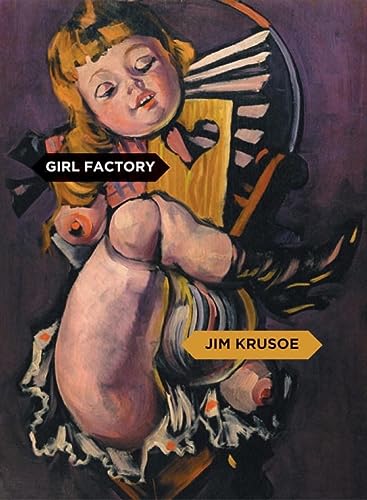
Inhaltsangabe
Things don't always work out the way they ought to—or do they?—in this unsettling darkly comic novel. Filled with memorable characters, Girl Factory is an exploration of memory, desire, and the nature of storytelling.
A yogurt parlor in a corner mall somewhere in the city of St. Nils contains a dark secret in its basement, and Jonathan, the mostly clueless clerk who works there, just wants to fix things once and for all. But, beginning with an early encounter in an animal shelter that leaves three dead, things don’t always work out the way they ought to. Or do they? Filled with memorable characters, including two dogs (one too smart for his own good) and a retired sea captain, this unsettling darkly comic novel is an exploration of memory, desire, and the nature of storytelling. More disturbingly, Girl Factory raises questions about the ubiquitous objectification of women, the possibility for change, and the nature of freedom.
Die Inhaltsangabe kann sich auf eine andere Ausgabe dieses Titels beziehen.
Über die Autorinnen und Autoren
Jim Krusoe is the author of the novels Parsifal, Toward You, Erased, Girl Factory, and Iceland; two collections of stories; and five books of poetry. His stories and poems have appeared in the Antioch Review, Bomb, the Chicago Review, the Denver Quarterly, the American Poetry Review, and other publications. He is the recipient of fellowships from the National Endowment for the Arts and the Lila Wallace Reader’s Digest Fund.
Jim Krusoe has written five books of poems, a book of stories, Blood Lake, and a novel, Iceland, published by Dalkey Archive Press. His stories and poems have appeared in the Antioch Review, Bomb, Denver Quarterly, the Iowa Review, Field, North American Review, American Poetry Review, and the Santa Monica Review, which he began in 1988. His essays and book reviews have appeared in the Los Angeles Times Book Review, the Washington Post, and Manoa. He is the recipient of fellowships from the National Endowment for the Arts and the Lila Wallace Reader’s Digest fund. He teaches at Santa Monica College and in the graduate writing program at Antioch University, Los Angeles. Iceland was selected by the Los Angeles Times and the Austin Chronicle as one of the ten best fiction books of 2002, and was on the Washington Post list of notable fiction for the same year. A collection of his stories, Abductions, which will be illustrated by Dani Tull, is scheduled for publication in September 2007.
Jim Krusoe teaches writing at Santa Monica College and in the graduate writing program at Antioch University, Los Angeles.
Auszug. © Genehmigter Nachdruck. Alle Rechte vorbehalten.
GIRL FACTORY
A NovelBy Jim KrusoeTin House Books
Copyright © 2008 Jim KrusoeAll right reserved.
ISBN: 978-0-9794198-2-9
Chapter One
It was early on a Saturday morning. I'd been sitting in my kitchen, drinking coffee (black, two sugars), when I decided to carry the newspaper out to the balcony of my one-bedroom apartment and read it there. It was the sort of thing I liked to do when I had the time. I had just finished the comics, the weather report, and sports pages, and was deep into a section entitled Out and About when I came across the headline "Dog Too Smart for Own Good." But instead of the pleasant human-interest story I anticipated, I found a tale both darker and more disturbing.According to the article, a dog named Buck, a particular mix of German shepherd, rottweiler, pit bull, and chow, was the product of a government-sponsored enterprise to create an animal of exceptional intelligence for use in the military. The whole course of the experiment had taken several generations of dogs to completely develop, the article explained. It added that, to the researchers' surprise, in the end they discovered that the gene for intelligence, at least in dogs, is somehow connected to the one for aggression.
It wasn't exactly that Buck was a mean dog, the reporter noted. Buck was far too intelligent for that. However, the animal's surly way and judgmental demeanor made many of those who worked with him feel so uncomfortable that they were unable to perform their own duties properly. They became self-conscious and began to make mistakes when the dog was around. The article hinted that there was more, but didn't say what. As a result, the army had released Buck to civilian life, but even there apparently he had a way about him that made people feel insecure. The unhappy result was that Buck was scheduled to be put down, and the entire breeding project had been written off as a failure. The newspaper named the location where Buck was being held prior to his execution. It was an animal shelter not far from where I lived.
I lowered the paper, picked up my cup of French roast, and looked out at the neighborhood. Below me and to my right, Captain Bloxheim in his plaid bathrobe was intent on watching his hose spray water onto a square of brownish grass. The loveable captain was a neighbor across the way, and had once been in charge of a cargo vessel in the Pacific. On second thought, he wasn't especially loveable, though he was still fit, and wore the kind of thin moustache that movie actors used to sport. From time to time he'd give me a piece of well-meaning advice, and I would nod to show I'd heard it. We were close and not, in the way that neighbors in an apartment complex often are. To my left, a small child was smashing a former table leg into splinters. Between them an old lady slowly made her way down the sidewalk. She listed badly to the right, her three-pronged aluminum cane thumping beside her like a claw.
Well, Jonathan, I thought, there they are, your fellow countrymen, all products of some random, flawed combination of genes that, good or bad, thanks to the Constitution of the United States of America, are being allowed to play themselves out in perfect freedom on the highways and byways of our cities and states as best they can. And meanwhile a helpless animal, an innocent by-product of man's tampering with the sacred code of nature, will not be allowed even a chance. It didn't seem fair.
Certainly, I reasoned, Buck hadn't asked to be created only to have his life snatched away just because some overly fastidious bureaucrat had changed his mind any more than the three humans beneath my balcony, or me, for that matter-I hadn't exactly chosen my fate. Not for the first time, I was sickened by the arrogance of my own species, by the arrogance of all humans, by mankind's endless capacity for cruelty, artificial limitations, and prisons.
St. Nils's only animal shelter was about halfway between my apartment and my job at Mister Twisty's yogurt parlor, and for the most part I didn't give it much thought. I walked by it on the way to work about ten most mornings, and then in the evenings or late at night passed it again on the way back home, but at that moment, reading the paper, I was suddenly struck by how, hypocrite that I was, each time I passed the shelter I picked up my pace ever so slightly in order to leave behind the smell of urine and feces and the primal stink of animal fear. That Saturday, however, that very morning, was my chance to make amends and face things head-on. I'd been given the day off from Mister Twisty's so that my boss, Spinner, could repair the refrigeration equipment, and while he did, the entire place would be closed. Just suppose, I thought, I pay Buck a little visit, if only to see for myself exactly what the situation is, and maybe to let Buck know that all humans aren't as bad as those cold-blooded researchers-that some of us are deeply ashamed of the acts of our fellow men. Some of us, possibly a great many of us in fact, want only to apologize from the very bottom of our stunted and selfish human hearts.
It was still chilly out, so I went back inside to find a jacket, and it was really more as an afterthought than anything that I took along a crowbar, slipping it up my sleeve so as not to alarm anyone.
Keeping one arm straight at my side in as natural a fashion as possible, I soon arrived at the shelter and asked the person at the front desk ("Animal Technician One" was stenciled on her shirt) where the dogs waiting for adoption were kept. Without even looking up from a game of solitaire on her computer screen, she pointed wearily to my left, to a set of double doors from which a continuous stream of barks, howls, and yelps emanated. "Jesus, send this idiot on his way tout de suite," her gesture seemed to imply. I noted with some satisfaction that she appeared to be losing her stupid card game. I wasn't big on games, except for chess.
I walked through the doors into a large area intersected by a maze of chain-link fencing. Not wanting to arouse suspicion, I strolled between the rows of cages as if I were looking for a pet, but really keeping an eye out for where the shelter might have stashed its most famous boarder, Buck. I wasn't so nave as to believe that in the aftermath of the article in the paper some supervisor would not have understood the need for security precautions, however minimal. Still, as disinterested as I was pretending to be, the sight that spread before me was enough to break a person's heart: the litters of fat-bellied pups playing, napping, leaping up to greet visitors in the very shadow of the cast-iron gas chamber beyond the corridors of cages; the lean old dogs, somehow sensing the impossibility of adoption, lifting their eyes like the inhabitants of a terminal nursing home to each visitor who walked by the doors of their pens, hoarding their energy for a last-ditch tail wag or two, not even staggering up from the cold concrete floors where they lay in the sun, hopelessly trying to warm themselves one last time before the final chill; the plain-looking dogs, brown or black, or brown and black, furiously yapping for someone to take them home, as if against all odds they might somehow distinguish themselves from every other plain-looking dog yapping for exactly the same thing; and then, saddest of all in their way, the snarlers and the growlers, the exact fierceness they had worked so hard to cultivate and which they now displayed so bravely being the very trait that would seal them to their fates, their pathetic biographies...
„Über diesen Titel“ kann sich auf eine andere Ausgabe dieses Titels beziehen.
Suchergebnisse für Girl Factory

Beispielbild für diese ISBN
Girl Factory
Anbieter: World of Books (was SecondSale), Montgomery, IL, USA
Verkäuferbewertung 5 von 5 Sternen

Zustand: Good. Item in good condition. Textbooks may not include supplemental items i.e. CDs, access codes etc. Artikel-Nr. 00045349499
Gebraucht kaufen
EUR 3,18
Versand gratis
Versand innerhalb von USA
Versand innerhalb von USA
Anzahl: 1 verfügbar
Beispielbild für diese ISBN
Girl Factory
Anbieter: Better World Books, Mishawaka, IN, USA
Verkäuferbewertung 5 von 5 Sternen
Zustand: Good. Former library copy. Pages intact with minimal writing/highlighting. The binding may be loose and creased. Dust jackets/supplements are not included. Includes library markings. Stock photo provided. Product includes identifying sticker. Better World Books: Buy Books. Do Good. Artikel-Nr. 3672536-6
Gebraucht kaufen
EUR 6,11
Versand gratis
Versand innerhalb von USA
Versand innerhalb von USA
Anzahl: 1 verfügbar
Beispielbild für diese ISBN
Girl Factory
Anbieter: Kennys Bookstore, Olney, MD, USA
Verkäuferbewertung 5 von 5 Sternen
Zustand: New. 2008. Paperback. . . . . . Books ship from the US and Ireland. Artikel-Nr. V9780979419829
Neu kaufen
EUR 20,51
EUR 9,26 Versand
Versand innerhalb von USA
Versand innerhalb von USA
Anzahl: 15 verfügbar