
Verwandte Artikel zu Waking the Buddha: How the Most Dynamic and Empowering...
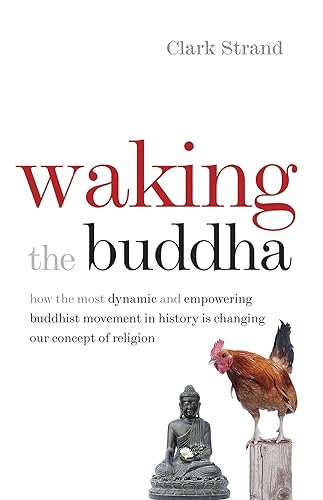
Waking the Buddha: How the Most Dynamic and Empowering Buddhist Movement in History Is Changing Our Concept of Religion - Softcover
Inhaltsangabe
Is there more to Buddhism than sitting in silent meditation? Is modern Buddhism relevant to the problems of daily life? Does it empower individuals to transform their lives? Or has Buddhism become too detached, so still and quiet that the Buddha has fallen asleep? Waking the Buddha tells the story of the Soka Gakkai International, the largest, most dynamic Buddhist movement in the world today&;and one that is waking up and shaking up Buddhism so it can truly work in ordinary people&;s lives. Drawing on his long personal experience as a Buddhist teacher, journalist, and editor, Clark Strand offers broad insight into how and why the Soka Gakkai, with its commitment to social justice and its egalitarian approach, has become a role model, not only for other schools of Buddhism, but for other religions as well. Readers will be inspired by the struggles and triumphs of the Soka Gakkai&;s three founding presidents&;individuals who staked their lives on the teachings of the Lotus Sutra and the extraordinary power of those teachings to help people become happy.
Die Inhaltsangabe kann sich auf eine andere Ausgabe dieses Titels beziehen.
Über die Autorinnen und Autoren
Clark Strand is a spiritual writer and former Zen Buddhist monk who was previously senior editor of Tricycle magazine. He is the author of How to Believe in God: Whether You Believe in Religion or Not and Meditation Without Gurus as well as countless groundbreaking articles, including the first comprehensive feature article ever written in English on internet spirituality. He has founded and led spiritual study groups, taught workshops and retreats, lectured at colleges and universities, and has spoken at some of the largest Buddhist gatherings ever held in America. He lives in Woodstock, New York.
Clark Strand is a spiritual writer and former Zen Buddhist monk who was previously senior editor of Tricycle magazine. He is the author of How to Believe in God: Whether You Believe in Religion or Not and Meditation Without Gurus as well as countless groundbreaking articles, including the first comprehensive feature article ever written in English on internet spirituality. He has founded and led spiritual study groups, taught workshops and retreats, lectured at colleges and universities, and has spoken at some of the largest Buddhist gatherings ever held in America. He lives in Woodstock, New York.
Auszug. © Genehmigter Nachdruck. Alle Rechte vorbehalten.
Waking the Buddha
How the Most Dynamic and Empowering Buddhist Movement in History is Changing our Concept of Religion
By Clark StrandMiddleway Press
Copyright © 2014 Clark Strand
All rights reserved.
ISBN: 978-0-9779245-6-1All rights reserved.
Contents
the spark an idea ahead of its time,
a change in the life of one individual,
the flame of reform,
a thing of lasting beauty,
the foundation the creation of the soka gakkai,
just one verse of the lotus sutra,
understanding our common humanity,
the power of ideas,
opening a way toward the future,
personal transformation through group discussion,
the development the discovery of modern buddhism,
religion serving life, not life religion,
glimmers of a global movement,
a global spiritual shift,
passing the flame of reform,
the completion the spread of religious humanism,
waking the buddha,
the culture of mentorship,
the oneness of mentor and disciple,
spiritual independence,
even to the fiftieth person,
the ultimate declaration,
the future a religion for the twenty-first century,
the foundation for a happy life,
boomers, buddhism, and beyond,
facing the challenge ahead,
entering the age of life,
CHAPTER 1
a change in the life of one individual
In February of 2003, just weeks before the U.S. invasion of Iraq, I came across a photograph of some Buddhist prayer beads made in a Tokyo prison during World War II. With limited resources to draw from, a prisoner of conscience had improvised them using the bottle caps from his daily milk ration.
I found the "beads" in the photograph strangely moving, even beautiful. Not that they were elegantly made. Far from it. The cardboard bottle caps were dark from handling and worn to the point of falling apart. Nevertheless, the photo inspired me to learn more about the imprisonment of Josei Toda — the man who had made them and then later became the president of the Nichiren Buddhist lay group the Soka Gakkai (Value Creation Society). A month later, I wrote a short article for an American Buddhist magazine that began with a series of questions:
What goes through the mind of the person who chooses to go to jail rather than betray his spiritual convictions, the person who, refusing to be swept up in the militant patriotism that precedes most wars, chooses loneliness and isolation instead? It is hard enough to imagine how such a person passes the days and weeks. What of the hours and minutes? Isn't it conceivable that the resolve of the heart might collapse under the weight of even a single moment?
The article went on to describe how Toda and his mentor, Tsunesaburo Makiguchi, had been arrested by the government as "thought criminals" because of their refusal to support the Japanese war machine. Makiguchi had died in prison, but Toda survived, renewing his resolve day by day, bottle cap by bottle cap — a moment's weight ... added to another moment's weight ... added to another.
Sometime later, when a friend asked why I'd become interested in the Soka Gakkai, I knew the answer right away. Toda hadn't collapsed. He'd borne up under the weight of countless moments when it would have been easier to accept defeat.
One of the most striking things about the Soka Gakkai from a Buddhist point of view is its emphasis on attaining victory in ordinary life — sometimes under extraordinary circumstances, like the ones Toda had endured. Soka Gakkai members chant the mantra-like title of the Lotus Sutra, Nam-myoho-renge-kyo, as a way of harnessing the universal life force inherent in their own bodies and minds. According to the teachings of Nichiren Buddhism, that mantra activates the basic, positive creative energy of the universe — a force that animates all sentient beings, driving them to grow and express their true nature eternally, from one lifetime to the next. By chanting Nam-myoho-renge-kyo and working for the happiness of others, Nichiren Buddhists seek to improve their current life condition and demonstrate "actual proof" of the Buddhist principle that all things are interconnected — that an inner change in the life of one individual can trigger outer changes in their community, their environment, and ultimately the world at large.
That principle of interconnectedness corresponds with what we know today about particle physics and planetary ecology, both of which support the view that all things are intimately interrelated and dependent upon one another — that nothing exists as separate and alone. Before Nichiren, however, that teaching was mostly theory, a topic for discussion between religious intellectuals or debate among cloistered monks and nuns. It didn't have much application outside of the sedate (some might say sleepy) world within temple or monastery walls. The idea that individuals could use it to awaken to the possibilities for change in everyday life, producing positive effects in their own lives and the lives of those around them, honoring their responsibilities to society and to the life of the planet itself — that had never been put to the test.
Nichiren changed all that. He staked his life on that theory, making it the basis of his teaching and standing alone against the corrupt military government of thirteenth-century Japan. Like Toda and Makiguchi seven centuries later, he believed that religion should serve the lives of individuals rather than merely functioning as a pawn of the state. And, also like Toda and Makiguchi, he ran afoul of the government and of the religious institutions that supported it. Twice attacked, twice exiled, and once sentenced to execution for his uncompromising views, Nichiren refused to back down from his belief that ordinary people could change their karma and attain enlightenment in this lifetime simply by chanting Nam-myoho-renge-kyo. It was a revolutionary vision of Buddhism that empowered lay people to take charge of their spiritual and material destiny, and he was widely condemned for it.
Today, you might call Nichiren Buddhism "an idea way ahead of its time." After Nichiren's death, the school of Buddhism he founded grew steadily but never became the dominant voice of Buddhism in Japan. When Toda left prison in 1945, it was just what it had been for centuries: a small sect with a big teaching that had never really come into its own. Were it not for his efforts, and those of his successor, Daisaku Ikeda, it is unlikely that anybody outside of Japan would ever have heard of it. As it is, the Soka Gakkai, the largest and most influential lay group in Buddhist history, has now spread the teachings of Nichiren Buddhism to some 192 countries around the globe. How and why that happened, and what it means for religion in the twenty-first century, is the subject of this book. It's the story of an idea whose time has come, and of the people who made it a reality.
CHAPTER 2the flame of reform
Life is a struggle. That is one way of understanding the first noble truth of Buddhism: that life is suffering. Given that reality, it is no surprise that human beings the world over tend to experience their lives in terms of whether they are winning that struggle or not — in other words, in terms of gain and loss. And yet, these are seldom emphasized by religion. Marx called religion "the opiate of the masses." Granted, he judged religion mostly on the basis of its failures; nevertheless, it is fair to say that religions the world over have tended to prefer...
„Über diesen Titel“ kann sich auf eine andere Ausgabe dieses Titels beziehen.
Suchergebnisse für Waking the Buddha: How the Most Dynamic and Empowering...

Beispielbild für diese ISBN
Waking the Buddha: How the Most Dynamic and Empowering Buddhist Movement in History Is Changing Our Concept of Religion
Anbieter: World of Books (was SecondSale), Montgomery, IL, USA
Verkäuferbewertung 5 von 5 Sternen

Zustand: Very Good. Item in very good condition! Textbooks may not include supplemental items i.e. CDs, access codes etc. Artikel-Nr. 00108759904
Gebraucht kaufen
EUR 4,42
Versand gratis
Versand innerhalb von USA
Versand innerhalb von USA
Anzahl: 1 verfügbar
Beispielbild für diese ISBN
Waking the Buddha: How the Most Dynamic and Empowering Buddhist Movement in History Is Changing Our Concept of Religion
Anbieter: World of Books (was SecondSale), Montgomery, IL, USA
Verkäuferbewertung 5 von 5 Sternen
Zustand: Good. Item in good condition. Textbooks may not include supplemental items i.e. CDs, access codes etc. Artikel-Nr. 00102371360
Gebraucht kaufen
EUR 4,42
Versand gratis
Versand innerhalb von USA
Versand innerhalb von USA
Anzahl: 3 verfügbar
Beispielbild für diese ISBN
Waking the Buddha: How the Most Dynamic and Empowering Buddhist Movement in History Is Changing Our Concept of Religion
Anbieter: ThriftBooks-Reno, Reno, NV, USA
Verkäuferbewertung 5 von 5 Sternen
Paperback. Zustand: Very Good. No Jacket. May have limited writing in cover pages. Pages are unmarked. ~ ThriftBooks: Read More, Spend Less. Artikel-Nr. G0977924564I4N00
Gebraucht kaufen
EUR 5,88
Versand gratis
Versand innerhalb von USA
Versand innerhalb von USA
Anzahl: 1 verfügbar
Beispielbild für diese ISBN
Waking the Buddha: How the Most Dynamic and Empowering Buddhist Movement in History Is Changing Our Concept of Religion
Anbieter: ThriftBooks-Atlanta, AUSTELL, GA, USA
Verkäuferbewertung 5 von 5 Sternen
Paperback. Zustand: Very Good. No Jacket. May have limited writing in cover pages. Pages are unmarked. ~ ThriftBooks: Read More, Spend Less. Artikel-Nr. G0977924564I4N00
Gebraucht kaufen
EUR 5,93
Versand gratis
Versand innerhalb von USA
Versand innerhalb von USA
Anzahl: 1 verfügbar
Beispielbild für diese ISBN
Waking the Buddha: How the Most Dynamic and Empowering Buddhist Movement in History Is Changing Our Concept of Religion
Anbieter: ThriftBooks-Dallas, Dallas, TX, USA
Verkäuferbewertung 5 von 5 Sternen
Paperback. Zustand: Very Good. No Jacket. May have limited writing in cover pages. Pages are unmarked. ~ ThriftBooks: Read More, Spend Less. Artikel-Nr. G0977924564I4N00
Gebraucht kaufen
EUR 5,93
Versand gratis
Versand innerhalb von USA
Versand innerhalb von USA
Anzahl: 1 verfügbar
Beispielbild für diese ISBN
Waking the Buddha: How the Most Dynamic and Empowering Buddhist Movement in History Is Changing Our Concept of Religion
Anbieter: ThriftBooks-Atlanta, AUSTELL, GA, USA
Verkäuferbewertung 5 von 5 Sternen
Paperback. Zustand: As New. No Jacket. Pages are clean and are not marred by notes or folds of any kind. ~ ThriftBooks: Read More, Spend Less. Artikel-Nr. G0977924564I2N00
Gebraucht kaufen
EUR 5,93
Versand gratis
Versand innerhalb von USA
Versand innerhalb von USA
Anzahl: 1 verfügbar
Beispielbild für diese ISBN
Waking the Buddha : How the Most Dynamic and Empowering Buddhist Movement in History Is Changing Our Concept of Religion
Anbieter: Better World Books: West, Reno, NV, USA
Verkäuferbewertung 5 von 5 Sternen
Zustand: Fine. Used book that is in almost brand-new condition. May contain a remainder mark. Better World Books: Buy Books. Do Good. Artikel-Nr. 17899258-6
Gebraucht kaufen
EUR 5,98
Versand gratis
Versand innerhalb von USA
Versand innerhalb von USA
Anzahl: 1 verfügbar
Beispielbild für diese ISBN
Waking the Buddha : How the Most Dynamic and Empowering Buddhist Movement in History Is Changing Our Concept of Religion
Anbieter: Better World Books, Mishawaka, IN, USA
Verkäuferbewertung 5 von 5 Sternen
Zustand: Good. Pages intact with minimal writing/highlighting. The binding may be loose and creased. Dust jackets/supplements are not included. Stock photo provided. Product includes identifying sticker. Better World Books: Buy Books. Do Good. Artikel-Nr. 5411619-6
Gebraucht kaufen
EUR 5,98
Versand gratis
Versand innerhalb von USA
Versand innerhalb von USA
Anzahl: 2 verfügbar
Beispielbild für diese ISBN
Waking the Buddha: How the Most Dynamic and Empowering Buddhist Movement in History Is Changing Our Concept of Religion
Anbieter: Wonder Book, Frederick, MD, USA
Verkäuferbewertung 5 von 5 Sternen
Zustand: As New. Like New condition. A near perfect copy that may have very minor cosmetic defects. Artikel-Nr. A04A-04631
Gebraucht kaufen
EUR 6,92
Versand gratis
Versand innerhalb von USA
Versand innerhalb von USA
Anzahl: 1 verfügbar
Beispielbild für diese ISBN
Waking the Buddha: How the Most Dynamic and Empowering Buddhist Movement in History Is Changing Our Concept of Religion
Verlag:
Middleway Press (edition ), 2014
ISBN 10: 0977924564
ISBN 13: 9780977924561
Gebraucht
Paperback
Anbieter: BooksRun, Philadelphia, PA, USA
Verkäuferbewertung 5 von 5 Sternen
Paperback. Zustand: Very Good. It's a well-cared-for item that has seen limited use. The item may show minor signs of wear. All the text is legible, with all pages included. It may have slight markings and/or highlighting. Artikel-Nr. 0977924564-11-1
Gebraucht kaufen
EUR 7,10
Versand gratis
Versand innerhalb von USA
Versand innerhalb von USA
Anzahl: 1 verfügbar