
Verwandte Artikel zu Fit to Play Tennis: High Performance Training Tips
Inhaltsangabe
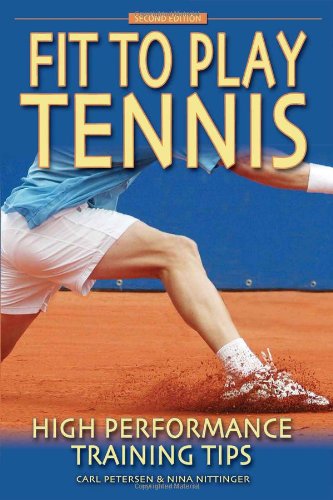
This physical and mental training manual arms athletes, coaches, parents, and sports scientists with an easy-to-follow, seven-point plan to enhance performance, limit injuries, and help tennis players avoid overtraining and burnout. Delivering practical tips and techniques that integrate the numerous factors influencing tennis performances into year-round training plans and schedules, the manual outlines key strategies such as structured on-court training, guidance on smart training and playing, and survival tips for staying healthy and keeping athletes playing at the top of their game.
Die Inhaltsangabe kann sich auf eine andere Ausgabe dieses Titels beziehen.
Über die Autorin bzw. den Autor
Carl Petersen is a physiotherapist and fitness coach for players ranging from club-level to ATP-, ITF-, and WTA-ranked pros. He is a former director of sport medicine and science for the Canadian Alpine Ski Team and traveled on the World Cup circuit from 1984 to 2003 as a physiotherapist and fitness coach. He is a partner and director of high performance training at City Sports and Physiotherapy Clinics in Vancouver, Canada. Nina Nittinger is a former professional tennis player, a certified tennis coach for the German and Swiss Tennis Federation, and a mental trainer for professional athletes.
Auszug. © Genehmigter Nachdruck. Alle Rechte vorbehalten.
Fit to Play Tennis
High Performance Training Tips
By Carl Petersen, Nina NittingerUSRSA
Copyright © 2006 Carl Petersen and Nina Nittinger
All rights reserved.
ISBN: 978-0-9722759-5-8All rights reserved.
Contents
Acknowledgements,
Preface,
Introduction: Making Yourself a Better Player and Athlete,
Part One: Structured Training and Practice,
1. The ABCs of Smart Training,
2. Dynamic Warm-Up and Cool-Down Guidelines,
3. Smart Stretching Guidelines,
4. Agility and Quickness Training,
5. Balance Training,
6. Upper and Lower Core Training in 3-D,
7. Fast Eyes — Visual Fitness 123,
8. Cross Training — Water Training and Recovery Workouts,
9. Stroke Fundamentals Training,
10. Tips for Tennis Training and Tactics,
Part Two: Structured Yearly Planning and Periodization,
11. The Yearly Training Plan and Periodization,
12. Tapering and Peaking for Major Tournaments,
Part Three: Structured Environment,
13. Tennis Nutrition,
14. Hydration For Tennis,
15. Playing and Training in the Heat,
16. Playing and Training at Altitude,
17. The Traveling Athlete and Jet Lag,
18. Footwear for Playing and Training,
19. Traveling Medicine and Fitness Kits,
Part Four: Structured Mental Training,
20. Mental Training,
21. Mind Games — Psychological Skills, Spills, and Thrills,
22. Weekly Training Diary,
23. The Psychology of Injury Rehabilitation,
Part Five: Structured Physical and Mental Assessments,
24. Self-Assessment and Functional Testing,
Part Six: Structured Recovery and Injury Prevention,
25. Common Back Problems and the Malaligned Player,
26. Core Training To Hold Neutral,
27. Outsmarting Your Injuries,
28. Overtraining and Recovery Guidelines,
29. Sleep Smarts for Recovery,
30. Soft Tissue Release (Muscle and Fasciae),
31. High Performance Recovery Tips and Strategies,
Index,
About the Authors,
CHAPTER 1
The ABCs of Smart Training
Carl Petersen
When designing your training program, it is wise to follow the concepts outlined in the ABCs of smart training. Apply the ABCs of smart training during all off-and on-court training and all daily activities, including school and travel. Following the ABCs will increase training potential, improve skills, improve recovery time, and decrease injury potential.
A1–Athletic Stance and Alignment
Proper athletic stance means being prepared for the sports activity ahead. Think of keeping the knees soft (slightly bent), switch on your core (pelvic tension like a dimmer switch), and keep your shoulders relaxed and down and head neutral. Correct anatomical alignment must be attained and maintained to allow for proper force distribution upon the weight-bearing structures during activity. This can be facilitated by:
• Actively stretching muscles that are usually short and stiff (e.g., hamstrings, hip flexors, calves, and pectorals).
• Actively strengthening muscles that are usually long and weak (e.g., lower abdominals, upper back and posterior shoulder girdle muscles [infraspinatus], and hip external rotators [gluteal muscles]).
Proper alignment starts with excellent spinal alignment. To align your spine:
• Imagine someone pulling you by the top of your head, lengthening out your spine.
• The neck should be long and the shoulders relaxed, back, and down.
Checks on proper alignment include these:
• During movement emphasize correct knee alignment, with knees always tracking over the toes but not going past them.
• When doing lunges or split squats, keep the line of gravity through the pubic bone of the pelvis to avoid shear forces on the pelvic joints.
A2–Adaptive Training
High performance and superior levels of fitness are the result of many months or years of well-planned training. Adaptations occur to the body's systems when they are challenged by new stresses. If the workload is not high enough, no adaptation will occur. If the workload is too high, maladaptation occurs, possibly leading to over-training, overuse, and injury. The following are some principles of adaptive training:
• When designing a training program, one must respect the time frames for anatomical, physiological, and psychological adaptation to occur.
• Regular participation — at least 4-6 days per week — in a planned activity outside of tennis.
• Overload:
* The training load must be high enough to tax the body's systems during a training session.
* Overload encourages physical change and promotes adaptation.
* To achieve overload, the duration of the activity must be long enough to produce a training effect and the intensity of the workouts must increase in a gradual and progressive manner.
* A good rule of thumb is to increase intensity 10 percent per week.
• Regularly scheduling rest or recovery days (at least one per week):
* Helps tissues such as muscle, tendon, ligament, and bone to adapt to the new stresses being placed on them through training and sports.
* Helps prevent staleness or over-training.
A3–Agility Training and Acceleration (quickness) Drills
Playing and training for tennis often find you off balance and in a uncontrolled environment such as wind, playing surfaces, and unpredictable opponents. Tennis requires stops and starts, lateral movements, backpedaling, crossover turns, and pivots. But with the decreased physical education in schools and lack of multi-sport involvement due to early sport specialization, many young players do not get the agility training needed. So, some form of agility and coordination training should be included as part of your daily sessions; you do not want to be an athlete who can play but cannot move. Points to remember when training for agility are these:
• Always start with an athletic stance.
• Agility and acceleration (quickness) drills must be structured so the muscles learn to fire quickly and in a coordinated manner.
• Quickness within two steps in all directions is key in tennis.
• Straight line sprinting may serve a conditioning purpose and helps fire the CNS (central nervous system), but it has little use in tennis.
• Agility and acceleration allow smaller players to be able to compete well and give larger players another weapon in their game.
• Agility can be gained by playing other sports and dynamic games that involve lateral movement and quick stops and starts, or by doing circuit drills that incorporate different exercises.
• Explosive first step side shuffle and crossover steps are essential to tennis quickness.
• You must give your body the opportunity to practice and play with changed and strengthened muscles.
See Chapter 4 for more ideas.
B1–Balanced Training
Balanced training means a correct ratio of time spent on the different components of fitness and performance: flexibility, stamina (aerobic and anaerobic), strength, speed, coordination, and tennis-specific skill exercises. All are important components of fitness and should be included in your program, depending on the phase of training you are in. Obviously, different activities have different demands and will require more emphasis on one type of training than...
„Über diesen Titel“ kann sich auf eine andere Ausgabe dieses Titels beziehen.
Suchergebnisse für Fit to Play Tennis: High Performance Training Tips

Beispielbild für diese ISBN
Fit to Play Tennis: High Performance Training Tips
Anbieter: World of Books (was SecondSale), Montgomery, IL, USA
Verkäuferbewertung 5 von 5 Sternen

Zustand: Good. Item in good condition. Textbooks may not include supplemental items i.e. CDs, access codes etc. Artikel-Nr. 00087930670
Gebraucht kaufen
EUR 3,91
Versand gratis
Versand innerhalb von USA
Versand innerhalb von USA
Anzahl: 1 verfügbar
Beispielbild für diese ISBN
Fit to Play Tennis: High Performance Training Tips
Anbieter: BooksRun, Philadelphia, PA, USA
Verkäuferbewertung 5 von 5 Sternen
Paperback. Zustand: Very Good. 2nd. It's a well-cared-for item that has seen limited use. The item may show minor signs of wear. All the text is legible, with all pages included. It may have slight markings and/or highlighting. Artikel-Nr. 0972275959-8-1
Gebraucht kaufen
EUR 5,78
Versand gratis
Versand innerhalb von USA
Versand innerhalb von USA
Anzahl: 1 verfügbar
Beispielbild für diese ISBN
Fit to Play Tennis : High Performance Training Tips
Anbieter: Better World Books, Mishawaka, IN, USA
Verkäuferbewertung 5 von 5 Sternen
Zustand: Good. 2nd. Pages intact with minimal writing/highlighting. The binding may be loose and creased. Dust jackets/supplements are not included. Stock photo provided. Product includes identifying sticker. Better World Books: Buy Books. Do Good. Artikel-Nr. 6004679-6
Gebraucht kaufen
EUR 6,69
Versand gratis
Versand innerhalb von USA
Versand innerhalb von USA
Anzahl: 1 verfügbar
Beispielbild für diese ISBN
Fit to Play Tennis : High Performance Training Tips
Anbieter: Better World Books: West, Reno, NV, USA
Verkäuferbewertung 5 von 5 Sternen
Zustand: Very Good. 2nd. Pages intact with possible writing/highlighting. Binding strong with minor wear. Dust jackets/supplements may not be included. Stock photo provided. Product includes identifying sticker. Better World Books: Buy Books. Do Good. Artikel-Nr. 21367505-75
Gebraucht kaufen
EUR 6,69
Versand gratis
Versand innerhalb von USA
Versand innerhalb von USA
Anzahl: 1 verfügbar
Beispielbild für diese ISBN
Fit to Play Tennis : High Performance Training Tips
Anbieter: Better World Books: West, Reno, NV, USA
Verkäuferbewertung 5 von 5 Sternen
Zustand: Very Good. 2nd. Former library copy. Pages intact with possible writing/highlighting. Binding strong with minor wear. Dust jackets/supplements may not be included. Includes library markings. Stock photo provided. Product includes identifying sticker. Better World Books: Buy Books. Do Good. Artikel-Nr. 18618427-6
Gebraucht kaufen
EUR 6,69
Versand gratis
Versand innerhalb von USA
Versand innerhalb von USA
Anzahl: 1 verfügbar
Beispielbild für diese ISBN
Fit to Play Tennis: High Performance Training Tips
Verlag:
Racquet Tech Publishing, 2006
ISBN 10: 0972275959
ISBN 13: 9780972275958
Gebraucht
Paperback
Anbieter: ThriftBooks-Reno, Reno, NV, USA
Verkäuferbewertung 5 von 5 Sternen
Paperback. Zustand: Very Good. No Jacket. May have limited writing in cover pages. Pages are unmarked. ~ ThriftBooks: Read More, Spend Less. Artikel-Nr. G0972275959I4N00
Gebraucht kaufen
EUR 6,94
Versand gratis
Versand innerhalb von USA
Versand innerhalb von USA
Anzahl: 1 verfügbar
Beispielbild für diese ISBN
Fit to Play Tennis: High Performance Training Tips
Verlag:
Racquet Tech Publishing, 2006
ISBN 10: 0972275959
ISBN 13: 9780972275958
Gebraucht
Paperback
Anbieter: ThriftBooks-Atlanta, AUSTELL, GA, USA
Verkäuferbewertung 5 von 5 Sternen
Paperback. Zustand: As New. No Jacket. Pages are clean and are not marred by notes or folds of any kind. ~ ThriftBooks: Read More, Spend Less. Artikel-Nr. G0972275959I2N00
Gebraucht kaufen
EUR 6,94
Versand gratis
Versand innerhalb von USA
Versand innerhalb von USA
Anzahl: 1 verfügbar
Beispielbild für diese ISBN
Fit to Play Tennis: High Performance Training Tips
Verlag:
Racquet Tech Publishing, 2006
ISBN 10: 0972275959
ISBN 13: 9780972275958
Gebraucht
Paperback
Anbieter: ThriftBooks-Dallas, Dallas, TX, USA
Verkäuferbewertung 5 von 5 Sternen
Paperback. Zustand: Very Good. No Jacket. May have limited writing in cover pages. Pages are unmarked. ~ ThriftBooks: Read More, Spend Less. Artikel-Nr. G0972275959I4N00
Gebraucht kaufen
EUR 6,94
Versand gratis
Versand innerhalb von USA
Versand innerhalb von USA
Anzahl: 1 verfügbar
Beispielbild für diese ISBN
Fit to Play Tennis: High Performance Training Tips
Verlag:
Racquet Tech Publishing, 2006
ISBN 10: 0972275959
ISBN 13: 9780972275958
Gebraucht
Paperback
Anbieter: ThriftBooks-Atlanta, AUSTELL, GA, USA
Verkäuferbewertung 5 von 5 Sternen
Paperback. Zustand: Very Good. No Jacket. May have limited writing in cover pages. Pages are unmarked. ~ ThriftBooks: Read More, Spend Less. Artikel-Nr. G0972275959I4N00
Gebraucht kaufen
EUR 6,94
Versand gratis
Versand innerhalb von USA
Versand innerhalb von USA
Anzahl: 1 verfügbar
Beispielbild für diese ISBN
FIT TO PLAY TENNIS: High Performance Training Tips
Anbieter: WorldofBooks, Goring-By-Sea, WS, Vereinigtes Königreich
Verkäuferbewertung 5 von 5 Sternen
Paperback. Zustand: Very Good. The book has been read, but is in excellent condition. Pages are intact and not marred by notes or highlighting. The spine remains undamaged. Artikel-Nr. GOR005255248
Gebraucht kaufen
EUR 8,43
EUR 6,53 Versand
Versand von Vereinigtes Königreich nach USA
Versand von Vereinigtes Königreich nach USA
Anzahl: 1 verfügbar