
Verwandte Artikel zu How To Automate Both New & Existing Homes
Inhaltsangabe
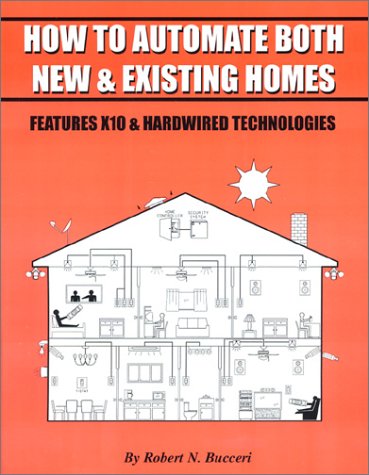
‘How To Automate Both New & Existing Homes’ illustrates and describes over 140 residential automation system features using X10 and Hardwired protocols. Information on what each protocol consists of and how it is used in a residential automation application is provided in detail. Also, the system components used to automate each type of electrical load when using a specific protocol is provided.
Each residential automation system feature presented in this book is illustrated in an easy to follow format consisting of pictures and diagrams that provide the reader with a wealth of information. Each feature is described in detail and a sequence of operation explaining how the feature works is also provided. Each feature provides the manufacturer and component model numbers along with specifications required to support the feature. System features that use components that require control wiring are also illustrated.
Some of the electrical loads automated in this book include the following:
Interior and exterior lighting, ceiling fans, attic ventilation fans, window coverings, heating and cooling systems, pools and spas, multi-zone audio/video systems, multi-zone sprinkler systems, water heaters, garage doors, property access gates, hurricane shutters, security camera surveillance systems, integrated security systems, vehicle detection systems, water leak detection systems, door locks and much more!
A few ‘Modes of Operation’ included in this book are as follows:
The Leaving Home Mode, Arriving Home Mode, Good Morning Mode, Good Night Mode, In Bed Mode, Vacation Mode, Intruder Deterrent Mode, Sunrise and Sunset Modes, Party Mode, Entertainment Mode, Pool Mode, Spa Mode, Christmas Mode plus many more.
Smarthomes are no longer for only the wealthy. They have become much more common since the recent home building boom we have experienced across the country.
By reading this book, you will learn what you need to know to automate a wide range of electrical loads. You will also be able to include a multitude of system features and modes that will make your home more convenient, comfortable, secure, fun, and energy efficient.
This book is highly recommended by home automation enthusiasts!
Die Inhaltsangabe kann sich auf eine andere Ausgabe dieses Titels beziehen.
Über die Autorin bzw. den Autor
I have a Bachelors of Science degree in Mechanical Engineering. I have worked as an Environmental Control System Design Engineer for an aerospace company for the past 22 years and my back ground includes extensive experience with (DDC) Direct Control Systems used to control industrial environmental mechanical systems.
I became interested in residential automation systems in 1985 and have been researching this industry ever since. I designed my first residential automation system for my own home in 1987 and after automating the majority of electrical loads in the home, I continued my hands on experience by automating the homes of family members and friends. After a number of years it became second nature for me when it came to designing and installing these systems. This allowed me to venture out into the real world and design numerous whole house automation systems for high-end homes during the mid 1990s and have continued to do so during the more recent residential building boom. I am continuing to research the industry for new design and installation methods and also look for new system components that incorporate the very latest technologies. I use this information extensively to periodically up date my publications and will continue to do so for many years to come.
Auszug. © Genehmigter Nachdruck. Alle Rechte vorbehalten.
The Arriving Home Mode:
This Mode is one of the most useful modes to incorporate into a home automation system. There are a number of methods to activate this mode; however, in this example the homeowner approaches the home and pushes a keychain button. This transmits RF signals to the Street Smart wireless receiver located inside the home. When the receiver reads these signals, it closes a set of N.O. contacts that provides a Digital Input ON indication to the Home Controller. When the Home Controller reads this input, it will automatically turn ON exterior lighting, garage lights and one light in each room for safety only when it is after dark. It will then open the garage door, disarm the security system, open the drapes, turn ON the water heater, turn ON some music and control any other electrical load.
Control your Automation System over the Internet:
In this feature the Stargate Home Controller and the Web-Xpander are used. With this equipment the homeowner can get on the Internet at work or anywhere in the world to have complete control of all electrical loads in the home. The user can also check the status of the security system or any other electrical loads on the property. Thermostats can be adjusted, lights can be turned ON/OFF, drapes can be repositioned and doors can be opened for service personnel. The spa can even be started so it will be ready upon arrival. The home can also be controlled from a pocket PC. In addition, the Web-Xpander can send E-mails in response to any condition.
Remote control of spa temperature:
In this feature the people in the spa do not need to get out to adjust the temperature knob on the heater when the water feels to hot or not hot enough. To have this feature work, the homeowner needs to set the thermostat temperature knob up high to make sure the heater comes on when control power is applied to the heater. While in the spa, the woman feels that the water is getting too hot. The gentlemen grabs the hand-held remote, pushes the OFF button to sends RF signals to plug-in Transceiver PAT01 located in the home. The Transceiver then sends X10-OFF signals over the power lines to Fixture Receiver switch 6375. This turns OFF the power to the heater control circuit, which turns OFF the heater. When the water becomes too cool, the Heater ON button can be pushed on the remote.
„Über diesen Titel“ kann sich auf eine andere Ausgabe dieses Titels beziehen.
Suchergebnisse für How To Automate Both New & Existing Homes

Beispielbild für diese ISBN
How To Automate Both New & Existing Homes
Anbieter: Better World Books, Mishawaka, IN, USA
Verkäuferbewertung 5 von 5 Sternen

Zustand: Good. Pages intact with minimal writing/highlighting. The binding may be loose and creased. Dust jackets/supplements are not included. Stock photo provided. Product includes identifying sticker. Better World Books: Buy Books. Do Good. Artikel-Nr. 1251275-6
Gebraucht kaufen
EUR 11,08
Versand gratis
Versand innerhalb von USA
Versand innerhalb von USA
Anzahl: 1 verfügbar
Beispielbild für diese ISBN
How To Automate Both New & Existing Homes
Anbieter: ThriftBooks-Dallas, Dallas, TX, USA
Verkäuferbewertung 5 von 5 Sternen
Paperback. Zustand: Very Good. No Jacket. May have limited writing in cover pages. Pages are unmarked. ~ ThriftBooks: Read More, Spend Less. Artikel-Nr. G0970005733I4N00
Gebraucht kaufen
EUR 11,35
Versand gratis
Versand innerhalb von USA
Versand innerhalb von USA
Anzahl: 1 verfügbar
Beispielbild für diese ISBN
How To Automate Both New & Existing Homes
Anbieter: ThriftBooks-Atlanta, AUSTELL, GA, USA
Verkäuferbewertung 5 von 5 Sternen
Paperback. Zustand: Very Good. No Jacket. May have limited writing in cover pages. Pages are unmarked. ~ ThriftBooks: Read More, Spend Less. Artikel-Nr. G0970005733I4N00
Gebraucht kaufen
EUR 11,35
Versand gratis
Versand innerhalb von USA
Versand innerhalb von USA
Anzahl: 1 verfügbar