
Verwandte Artikel zu Home Again: Stories of Migration and Return
Inhaltsangabe
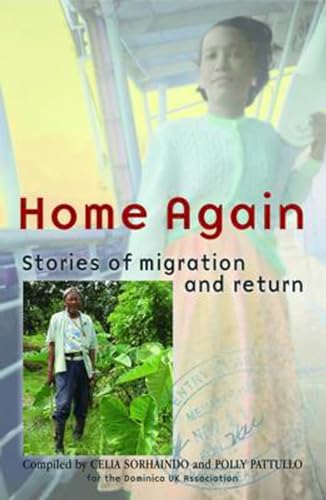
"Frankness and insight." New West India Guide What happens when people return to the land of their birth after decades away? The migrants' journey is a well-told story but much less is known about those who return. Why do they go back? What is it like to be back home? Home Again is a collection of contemporary real-life stories by men and women who have returned to Dominica. Their feelings and experiences, expressed in their own words, link the challenges of the past to both the positive aspects of return - a sense of belonging and well-being - and also to its difficulties - of rejection and frustration. Compelling, moving and intensely personal, Home Again, is a revealing insight into the lives of these pioneering migrants.
Die Inhaltsangabe kann sich auf eine andere Ausgabe dieses Titels beziehen.
Über die Autorin bzw. den Autor
Celia A Sorhaindo was born in Dominica. She left when she was eight, lived for many years in the UK and returned home in 2005. Her poems have been published in Caribbean journals and in the anthology, New Daughters of Africa. She is a fellow of the Cropper Foundation Creative Writers Workshop and the Callaloo Creative Writing Workshop. She has been long-listed for the UK National Poetry competition. This is her first published collection.
Auszug. © Genehmigter Nachdruck. Alle Rechte vorbehalten.
Home Again
Stories of Migration and Return
By Celia Sorhaindo, Polly PattulloPapillote Press
Copyright © 2009 Papillote Press and Dominica UK Association
All rights reserved.
ISBN: 978-0-9532224-5-2All rights reserved.
Contents
Foreword by Vincent John,
Map,
Introduction by Celia Sorhaindo,
Jean Popeau,
Alexandra Sorhaindo,
Clayton Shillingford,
Helena Durand,
Janet Heath,
Franklyn Georges,
Eustace Maxim,
Bernadette and Leonard Alexander,
Nursie Frederick,
Michael Baron,
Sylvester Joseph,
Francis Edwards,
Christopher Valerie,
Kenneth Bruney,
Heskeith Clarke,
Patricia Bobb,
Joan Etienne,
Billy Lawrence,
Stanley Paul,
Philbert Aaron,
Robert John,
CHAPTER 1
JEAN POPEAU
Just before I left Dominica in 1957, the headmaster of my school in Belvedere made me stand up with everyone sitting there, and said: "Who is the one going to England?" And I said, "Me". And he said, "Boy, you're going to be a big shot." I was 11 at the time and the assumption was that one of the reasons you were going to England was to get a better education.
That school, near where I'm now building my home, was basically one large crumbling wooden building – there were no room dividers, just a series of benches and each bench was a class and you had teachers shouting at each class to get your attention. There was a sign that said, "Cleanliness is next to godliness", but there were outside toilets and no facilities for washing your hands. We would get free powdered milk which they would mix every morning to provide something to drink. We learned about England at school, and I probably knew more about English heroes than the fellas I met when I went to school in London. We learned about Rodney and Nelson and their exploits in the Caribbean but not much about the rest of our history. Education was limited to colonial matters.
My father went to England in 1955 to seek some better sort of economic situation. My parents were essentially peasant farmers from La Roche, but it was so dire on the island that it was impossible to get on and look after your family. We would go to our garden which was in the mountains with our mother at the weekend and during school holidays. We would all carry a basket of food and have to cross the White river on foot to get home and if the river was high we would be in trouble. We had to walk everywhere; we only had shoes for going to church, we had few clothes. It was a precarious form of life. Flour and rice and codfish were luxuries but perhaps because all families had poverty in common, as children it didn't hit you hard. The only thing you knew was that children in town were probably better off.
Even so, there was time for enjoyment – dances on a Saturday, cricket matches, celebrations for first communion (photograph previous page), and at Christmas people would celebrate for a whole week; then you would have carnival – and there would be bands going from village to village. There was a great sense of communal activity and caring. Things started to change, however, in the 1950s, when people, especially the men, started going to England. And then you began to get an atmosphere of people saying, "Well if you're getting money from your man and if you want me to do something for you, you'll have to pay for it." Then money started to figure in transactions.
When my father had been in England a couple of years, he decided to send for the rest of us. For my sister and I it seemed that we were going to be plucked away from the island because our father wanted his family with him, and there was no alternative but to adjust to a new way of life. I had mixed feelings about leaving Dominica. On one hand you wanted to get away from the poverty and you were told you would get a better education, on the other hand the natural setting and beauty of the place was still something that struck you. My father would write when he was away but he did not say much – he would write about practical matters like "I have been able to send you a little bit of money, look after it" and so on. We knew that it was cold in England though and that there was prejudice – those stories filtered back. And there was an awareness that there was poverty there because a lot of them were sharing a room, and, wages being limited, they had to really scrimp and save to send any money back home. I didn't have a concept of England as a mother country, but as an alien place that I would have to get used to.
My mother, sister and I left on a Greek ship crowded with emigrants in September 1957. It was an atmosphere of chaos on the ship, children running around and spilling things on people's clothes, belongings spread all over the place. It docked in Genoa and then we went on a train to England where my father met us. We ended up living in the most run-down part of east London you could imagine, among the gasometers of Millwall, on the Isle of Dogs. We lived in a terraced house, in a couple of rooms with my uncle. It was very cramped and crowded. You were basically in very meagre conditions, and you looked out at a dank and rather depressing street. You were suddenly in a very enclosed atmosphere from what you were used to. But then London was still in a state of post-war poverty – terraced houses with no bathrooms and outside toilets, coal fires for heating the rooms.
We had a radio but there was no TV to talk about – and anyway we couldn't afford a television. I enjoyed the radio because it helped me to improve my English – I started to listen avidly and I remember listening to a programme called The Clitheroe Kid – the comedy helped you to get used to the language and the working-class culture. There was also a programme called In Town Tonight about the West End of London, and Vic Oliver's dance music show.
We met people from other Caribbean islands – a lot of men on their own, who had left wife and children behind, living in one room as in Samuel Selvon's Lonely Londoners. But there were not many children coming from the Caribbean at that time – it was very bleak. People would ignore you when you went to the shops and serve others.
When I arrived there was no time to take the eleven plus exam and there was no real assessment of me so I just fell into an all-white, working-class, secondary modern Catholic school in Poplar. A certain way to ensure that you become an atheist is to go to a Catholic school. It was very run down, there was a lot of disruption, poor behaviour, poor standards. There were the usual racist remarks from the children and also from the teachers, who were really quite ignorant about the Caribbean. I was shocked. The school provided a very crude education and it was assumed that you were factory fodder.
I was a school failure really and came out with only one O Level. But I was interested in science and got a job in a science laboratory doing control work for a factory. I had to educate myself after work with evening classes and part-time study. Eventually, I got qualifications to do a degree, and went to North London Polytechnic as it was then, in 1970, to do a degree in philosophy of all things.
My parents never discussed coming back – it was too early on in that period. But they enjoyed talking amongst themselves about people they knew and funny experiences they'd had back home. There was very little discussion about what was going on in England. Neither of them went back to Dominica. Mother was killed in...
„Über diesen Titel“ kann sich auf eine andere Ausgabe dieses Titels beziehen.
Suchergebnisse für Home Again: Stories of Migration and Return

Beispielbild für diese ISBN
Home Again: Stories of Migration and Return
Anbieter: ThriftBooks-Dallas, Dallas, TX, USA
Verkäuferbewertung 5 von 5 Sternen

Paperback. Zustand: As New. No Jacket. Pages are clean and are not marred by notes or folds of any kind. ~ ThriftBooks: Read More, Spend Less. Artikel-Nr. G0953222454I2N00
Gebraucht kaufen
EUR 12,28
Versand gratis
Versand innerhalb von USA
Versand innerhalb von USA
Anzahl: 1 verfügbar
Beispielbild für diese ISBN
Home Again: Stories of Migration and Return
Anbieter: WorldofBooks, Goring-By-Sea, WS, Vereinigtes Königreich
Verkäuferbewertung 5 von 5 Sternen
Paperback. Zustand: Very Good. The book has been read, but is in excellent condition. Pages are intact and not marred by notes or highlighting. The spine remains undamaged. Artikel-Nr. GOR005810952
Gebraucht kaufen
EUR 7,66
EUR 6,55 Versand
Versand von Vereinigtes Königreich nach USA
Versand von Vereinigtes Königreich nach USA
Anzahl: 1 verfügbar
Beispielbild für diese ISBN
Home Again
Anbieter: PBShop.store US, Wood Dale, IL, USA
Verkäuferbewertung 5 von 5 Sternen
PAP. Zustand: New. New Book. Shipped from UK. Established seller since 2000. Artikel-Nr. BS-9780953222452
Beispielbild für diese ISBN
Home Again
Anbieter: PBShop.store UK, Fairford, GLOS, Vereinigtes Königreich
Verkäuferbewertung 5 von 5 Sternen
PAP. Zustand: New. New Book. Shipped from UK. Established seller since 2000. Artikel-Nr. BS-9780953222452
Neu kaufen
EUR 13,32
EUR 4,86 Versand
Versand von Vereinigtes Königreich nach USA
Versand von Vereinigtes Königreich nach USA
Anzahl: 15 verfügbar
Beispielbild für diese ISBN
Home Again
Anbieter: Majestic Books, Hounslow, Vereinigtes Königreich
Verkäuferbewertung 4 von 5 Sternen

Zustand: New. pp. viii + 232 Illus. Artikel-Nr. 92910192
Neu kaufen
EUR 12,64
EUR 7,60 Versand
Versand von Vereinigtes Königreich nach USA
Versand von Vereinigtes Königreich nach USA
Anzahl: 3 verfügbar
Beispielbild für diese ISBN
Home Again: Stories of Migration and Return
Anbieter: Revaluation Books, Exeter, Vereinigtes Königreich
Verkäuferbewertung 5 von 5 Sternen
Paperback. Zustand: Brand New. 242 pages. 7.68x5.16x0.63 inches. In Stock. Artikel-Nr. __0953222454
Neu kaufen
EUR 9,71
EUR 11,69 Versand
Versand von Vereinigtes Königreich nach USA
Versand von Vereinigtes Königreich nach USA
Anzahl: 2 verfügbar
Beispielbild für diese ISBN
Home Again: Stories of Migration and Return
Anbieter: Ria Christie Collections, Uxbridge, Vereinigtes Königreich
Verkäuferbewertung 5 von 5 Sternen
Zustand: New. In. Artikel-Nr. ria9780953222452_new
Neu kaufen
EUR 14,93
EUR 14,00 Versand
Versand von Vereinigtes Königreich nach USA
Versand von Vereinigtes Königreich nach USA
Anzahl: Mehr als 20 verfügbar