
Verwandte Artikel zu Hot Talk, Cold Science: Global Warming's Unfinished...
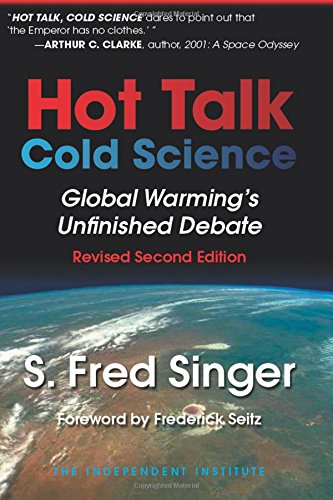
Hot Talk, Cold Science: Global Warming's Unfinished Debate: Global Warninng's Unfinished Debate - Softcover
Inhaltsangabe
Are the often alarming claims about global warming based on science and justified by the facts? Is the human race really facing a major crisis due to emissions from fossil fuels? Would the proposed Climate Treaty solve a real environmental threat or would it create worldwide economic and social harm? S. Fred Singer is a distinguished astrophysicist who has taken a hard, scientific look at the evidence. In this new book, Dr. Singer explores the inaccuracies in historical climate data, the limitations of attempting to model climate on computers, solar variability and its impact on climate, the effects of clouds, ocean currents, and sea levels on global climate, and factors that could mitigate any human impacts on world climate.
Singer’s masterful analysis decisively shows that the pessimistic, and often alarming, global warming scenarios depicted in the media have no scientific basis. In fact, he finds that many aspects of any global warming, such as a longer growing season for food and a reduced need to use fossil fuels for heating, would actually have a positive impact on the human race. Further, Singer notes how many proposed “solutions” to the global warming “crisis” (like “carbon” taxes) would have severe consequences for economically disadvantaged groups and nations.
According to Arthur C. Clarke, author of 2001: A Space Odyssey, Hot Talk, Cold Science dares to point out that ‘the Emperor has no clothes.’ Is there evidence to suggest discernible human influence on global climate? Of great interest, this book demonstrates that, at best, the evidence is sketchy and incomplete. Hot Talk, Cold Science is essential reading for anyone who wants to be fully informed about the global warming debate.
Singer’s masterful analysis decisively shows that the pessimistic, and often alarming, global warming scenarios depicted in the media have no scientific basis. In fact, he finds that many aspects of any global warming, such as a longer growing season for food and a reduced need to use fossil fuels for heating, would actually have a positive impact on the human race. Further, Singer notes how many proposed “solutions” to the global warming “crisis” (like “carbon” taxes) would have severe consequences for economically disadvantaged groups and nations.
According to Arthur C. Clarke, author of 2001: A Space Odyssey, Hot Talk, Cold Science dares to point out that ‘the Emperor has no clothes.’ Is there evidence to suggest discernible human influence on global climate? Of great interest, this book demonstrates that, at best, the evidence is sketchy and incomplete. Hot Talk, Cold Science is essential reading for anyone who wants to be fully informed about the global warming debate.
Die Inhaltsangabe kann sich auf eine andere Ausgabe dieses Titels beziehen.
Über die Autorin bzw. den Autor
S. Fred Singer is research fellow at The Independent Institute, president of the Science and Environmental Policy Project, and a distinguished research fellow at the Institute for Space Science and Technology. He was the first director of the U.S. Weather Satellite Service. He is the former director of the Center for Atmospheric and Space Physics, and former chief scientist, U.S. Department of Transportation.
Auszug. © Genehmigter Nachdruck. Alle Rechte vorbehalten.
Hot Talk Cold Science
Global Warming's Unfinished Debate
By S. Fred SingerThe Independent Institute
Copyright © 1999 S. Fred Singer
All rights reserved.
ISBN: 978-0-945999-81-2All rights reserved.
Contents
Acknowledgments,
Foreword Frederick Seitz,
Preface,
1 Overview: The Scientific Case Against the Global Climate Treaty,
2 Unfinished Business: Scientific Issues to Be Resolved,
3 Epilogue: What to Do about Greenhouse Effects,
Notes,
Appendix: Mitigation of Climate Change: A Scientific and Economic Appraisal,
References,
About the Author,
Index,
CHAPTER 1
Overview
The Scientific Case Against the Global Climate Treaty
A driving force behind the push for a global climate treaty has been the United Nations' Intergovernmental Panel on Climate Change (IPCC). Through a series of well-publicized reports — co-authored by teams of scientists and policy specialists — the IPCC has come to be viewed by many governmental agencies, environmental policy organizations and the media as the leading source of scientific information on climate change. It is for this reason that I focus much of my attention on reports issued by this esteemed organization.
The major conclusion of the United Nations' Intergovernmental Panel on Climate Change (IPCC WG-I 1996) — that "the balance of evidence suggests a discernible human influence on global climate" — cannot and should not be used to validate current Global Circulation Models (GCMs). The growing discrepancy between weather satellite observations, backed by balloon radiosonde data, and the results of computer models, throws doubt on the models' adequacy to predict a future warming. An earlier IPCC (1990) conclusion that observed and calculated temperature changes are "broadly consistent" is no longer accepted; the current IPCC explanation of the acknowledged discrepancy in terms of cooling effects from anthropogenic (man-made) sulfate aerosols is being increasingly disputed. There exist different, competing views about the cause(s) of the discrepancy — including exogenous factors like solar variability, and endogenous factors like clouds or water vapor distribution — all inadequately treated by current computer models. The models do not include a variety of human influences, ranging from possible climate effects of air traffic to the diversion of fresh water from the Mediterranean.
Even if a moderate warming were to materialize, its consequences would be largely benign — for other climate parameters, for sea-level changes, and for agricultural production. The goal of the Global Climate Treaty — avoiding a "dangerous" level of greenhouse (GH) gases — cannot as yet be scientifically defined; higher GH gas levels may well produce a more stable climate. Therefore, the prudent course is to practice a "no-regrets" policy of conservation and efficiency improvements and rely on adaptation to meet any damaging effects of climate change. At the same time, building on successful initial experiments, the capability of ocean fertilization to draw down atmospheric CO2 should be demonstrated.
The chief points of this overview are as follows:
1. The major conclusion of the 1996 report of the U.N.-sponsored science advisory group, the Intergovernmental Panel on Climate Change (IPCC), is that "the balance of evidence suggests a discernible human influence on global climate" (IPCC WG-I 1996, Chapter 8). This innocuous but ambiguous phrase has been (mis)interpreted to mean that computer models predicting a future warming have now been validated. But such a connection is specifically denied in the body of the IPCC report (IPCC WG-I 1996, p. 434) — although not in the politically approved IPCC Summary for Policymakers (SPM).
On the contrary, the global temperature record of this century, which shows both warming and cooling, can best be explained by natural climate fluctuations caused by the complex interaction between atmosphere and oceans, and perhaps stimulated by variations of solar radiation that drives the Earth's climate system. The satellite record of global temperature, spanning nearly twenty years, does not show a global warming — much less one of the magnitude predicted by General Circulation Models (GCMs). The gap between the satellite observations and existing theory is so large that it throws serious doubt on all computer-modeled predictions of future warming. Yet this discrepancy is never mentioned in the IPCC report's Summary — nor does the SPM even admit the existence of satellites (Singer 1996).
If one were to extrapolate the maximum allowed temperature trend from satellites to the year 2100, allowing for a further increase in atmospheric carbon dioxide and other greenhouse gases (GHG), one might estimate the increase in global average temperature at about 0.5 C (U.S. General Accounting Office 1995) — about one-fourth of the "best" IPCC value — hardly detectable and completely inconsequential.
Any future warming would be reduced further by the cooling effects of volcanoes — a factor not specifically considered by the IPCC. Even though we cannot predict the exact dates of future volcanic eruptions, we have sufficient statistical information about past eruptions to estimate an average cooling effect.
2. Even if global warming were to occur, it would most likely lead to positive benefits overall rather than to disbenefits. Human activities, especially agriculture, have always thrived during warm periods and faltered during cold periods (Moore 1995). A greenhouse warming should lead to a reduction in severe storms. Furthermore, it seems likely that a global warming will lower, rather than raise, sea levels, because more evaporation from the ocean would increase precipitation and thereby thicken the ice caps of Greenland and Antarctica (Singer 1997a).
3. Finally, no credible attempt has been made to define what constitutes a "dangerous" level of atmospheric CO2; thus the goal of the U.N. Climate Treaty (the Framework Convention on Climate Change-FCCC) is arbitrary. If one chooses as the target the present concentration, about 30 percent higher than the preindustrial CO2 level of 280 parts per million by volume (ppmv), emission rates must be cut by over 60 percent on a worldwide basis, according to IPCC modeling (IPCC WG-I 1990, p. xi).
A policy of adaptation to a possible climate change should be considered rather than energy rationing. If it becomes advisable to limit the growth of atmospheric CO2, it might be more cost effective to speed up CO2 absorption into the ocean, rather than by reducing emissions. In fact, by fertilizing the ocean with micronutrients, it may be possible to increase phytoplankton and fish populations, and thereby derive commercial benefits from the excess atmospheric CO2 (Cooper et al. 1996).
A discussion of the underlying science will reveal the following:
1. There Is No Detectable Anthropogenic Global Warming
The fear has often been expressed that anthropogenic release of GH gases could cause a temperature increase larger and more rapid than anything experienced in human history. The geologic record gives us an important perspective on this issue.
Carbon Dioxide: The paleo record of atmospheric carbon dioxide (Berner 1997, Fig. 1) shows considerable changes. The CO2 concentration was about twenty times the preindustrial value 500 million years (Myr) ago, diminished rapidly as CO2 was removed by weathering and reached its lowest level about...
„Über diesen Titel“ kann sich auf eine andere Ausgabe dieses Titels beziehen.
Suchergebnisse für Hot Talk, Cold Science: Global Warming's Unfinished...

Beispielbild für diese ISBN
Hot Talk, Cold Science: Global Warming's Unfinished Debate
Anbieter: ThriftBooks-Atlanta, AUSTELL, GA, USA
Verkäuferbewertung 5 von 5 Sternen

Paperback. Zustand: Fair. No Jacket. Readable copy. Pages may have considerable notes/highlighting. ~ ThriftBooks: Read More, Spend Less. Artikel-Nr. G094599981XI5N00
Gebraucht kaufen
EUR 5,88
Versand gratis
Versand innerhalb von USA
Versand innerhalb von USA
Anzahl: 1 verfügbar
Beispielbild für diese ISBN
Hot Talk, Cold Science: Global Warming's Unfinished Debate
Anbieter: ThriftBooks-Dallas, Dallas, TX, USA
Verkäuferbewertung 5 von 5 Sternen
Paperback. Zustand: As New. No Jacket. Pages are clean and are not marred by notes or folds of any kind. ~ ThriftBooks: Read More, Spend Less. Artikel-Nr. G094599981XI2N00
Gebraucht kaufen
EUR 5,88
Versand gratis
Versand innerhalb von USA
Versand innerhalb von USA
Anzahl: 1 verfügbar
Beispielbild für diese ISBN
Hot Talk, Cold Science: Global Warming's Unfinished Debate
Anbieter: ThriftBooks-Atlanta, AUSTELL, GA, USA
Verkäuferbewertung 5 von 5 Sternen
Paperback. Zustand: Good. No Jacket. Pages can have notes/highlighting. Spine may show signs of wear. ~ ThriftBooks: Read More, Spend Less. Artikel-Nr. G094599981XI3N00
Gebraucht kaufen
EUR 5,88
Versand gratis
Versand innerhalb von USA
Versand innerhalb von USA
Anzahl: 1 verfügbar
Beispielbild für diese ISBN
Hot Talk, Cold Science: Global Warming's Unfinished Debate
Verlag:
Independent Institute,U.S., 2001
ISBN 10: 094599981X
ISBN 13: 9780945999812
Gebraucht
Paperback
Anbieter: World of Books (was SecondSale), Montgomery, IL, USA
Verkäuferbewertung 5 von 5 Sternen
Paperback. Zustand: Good. Are the often alarming claims about global warming based on science and justified by the facts? Is the human race really facing a major crisis due to emissions from fossil fuels? Would the proposed Climate Treaty solve a real environmental threat or would it create worldwide economic and social harm? S. Fred Singer is a distinguished astrophysicist who has taken a hard, scientific look at the evidence. In this new book, Dr. Singer explores the inaccuracies in historical climate data, the limitations of attempting to model climate on computers, solar variability and its impact on climate, the effects of clouds, ocean currents, and sea levels on global climate, and factors that could mitigate any human impacts on world climate. Singer s masterful analysis decisively shows that the pessimistic, and often alarming, global warming scenarios depicted in the media have no scientific basis. In fact, he finds that many aspects of any global warming, such as a longer growing season for food and a reduced need to use fossil fuels for heating, would actually have a positive impact on the human race. Further, Singer notes how many proposed solutions to the global warming crisis (like carbon taxes) would have severe consequences for economically disadvantaged groups and nations. According to Arthur C. Clarke, author of 2001: A Space Odyssey, Hot Talk, Cold Science dares to point out that the Emperor has no clothes. Is there evidence to suggest discernible human influence on global climate? Of great interest, this book demonstrates that, at best, the evidence is sketchy and incomplete. Hot Talk, Cold Science is essential reading for anyone who wants to be fully informed about the global warming debate. Artikel-Nr. 00095219590
Gebraucht kaufen
EUR 5,90
Versand gratis
Versand innerhalb von USA
Versand innerhalb von USA
Anzahl: 2 verfügbar
Beispielbild für diese ISBN
Hot Talk, Cold Science: Global Warming's Unfinished Debate
Anbieter: Wonder Book, Frederick, MD, USA
Verkäuferbewertung 5 von 5 Sternen
Zustand: Very Good. Very Good condition. 2nd edition. A copy that may have a few cosmetic defects. May also contain light spine creasing or a few markings such as an owner's name, short gifter's inscription or light stamp. Artikel-Nr. A13B-02792
Gebraucht kaufen
EUR 6,32
Versand gratis
Versand innerhalb von USA
Versand innerhalb von USA
Anzahl: 1 verfügbar
Beispielbild für diese ISBN
Hot Talk, Cold Science : Global Warming's Unfinished Debate
Verlag:
Independent Institute, The, 2001
ISBN 10: 094599981X
ISBN 13: 9780945999812
Gebraucht
Softcover
Anbieter: Better World Books, Mishawaka, IN, USA
Verkäuferbewertung 5 von 5 Sternen
Zustand: Good. Former library copy. Pages intact with minimal writing/highlighting. The binding may be loose and creased. Dust jackets/supplements are not included. Includes library markings. Stock photo provided. Product includes identifying sticker. Better World Books: Buy Books. Do Good. Artikel-Nr. 1225012-6
Gebraucht kaufen
EUR 6,46
Versand gratis
Versand innerhalb von USA
Versand innerhalb von USA
Anzahl: 1 verfügbar
Beispielbild für diese ISBN
Hot Talk, Cold Science : Global Warming's Unfinished Debate
Verlag:
Independent Institute, The, 2001
ISBN 10: 094599981X
ISBN 13: 9780945999812
Gebraucht
Softcover
Anbieter: Better World Books, Mishawaka, IN, USA
Verkäuferbewertung 5 von 5 Sternen
Zustand: Very Good. Former library copy. Pages intact with possible writing/highlighting. Binding strong with minor wear. Dust jackets/supplements may not be included. Includes library markings. Stock photo provided. Product includes identifying sticker. Better World Books: Buy Books. Do Good. Artikel-Nr. 14271191-6
Gebraucht kaufen
EUR 6,46
Versand gratis
Versand innerhalb von USA
Versand innerhalb von USA
Anzahl: 1 verfügbar
Beispielbild für diese ISBN
Hot Talk, Cold Science : Global Warming's Unfinished Debate
Verlag:
Independent Institute, The, 2001
ISBN 10: 094599981X
ISBN 13: 9780945999812
Gebraucht
Softcover
Anbieter: Better World Books, Mishawaka, IN, USA
Verkäuferbewertung 5 von 5 Sternen
Zustand: Good. Pages intact with minimal writing/highlighting. The binding may be loose and creased. Dust jackets/supplements are not included. Stock photo provided. Product includes identifying sticker. Better World Books: Buy Books. Do Good. Artikel-Nr. 7529728-6
Gebraucht kaufen
EUR 6,46
Versand gratis
Versand innerhalb von USA
Versand innerhalb von USA
Anzahl: 1 verfügbar
Beispielbild für diese ISBN
Hot Talk, Cold Science: Global Warming's Unfinished Debate
Verlag:
Independent Institute (edition Revised edition), 2001
ISBN 10: 094599981X
ISBN 13: 9780945999812
Gebraucht
Paperback
Anbieter: BooksRun, Philadelphia, PA, USA
Verkäuferbewertung 5 von 5 Sternen
Paperback. Zustand: Very Good. Revised edition. It's a well-cared-for item that has seen limited use. The item may show minor signs of wear. All the text is legible, with all pages included. It may have slight markings and/or highlighting. Artikel-Nr. 094599981X-8-1
Gebraucht kaufen
EUR 6,52
Versand gratis
Versand innerhalb von USA
Versand innerhalb von USA
Anzahl: 1 verfügbar
Beispielbild für diese ISBN
Hot Talk, Cold Science: Global Warming's Unfinished Debate
Anbieter: Majestic Books, Hounslow, Vereinigtes Königreich
Verkäuferbewertung 4 von 5 Sternen

Zustand: New. pp. 120. Artikel-Nr. 7892292
Neu kaufen
EUR 14,30
EUR 7,56 Versand
Versand von Vereinigtes Königreich nach USA
Versand von Vereinigtes Königreich nach USA
Anzahl: 1 verfügbar