
Verwandte Artikel zu Dancing with Digital Natives: Staying in Step with...
Dancing with Digital Natives: Staying in Step with the Generation That's Transforming the Way Business Is Done - Hardcover
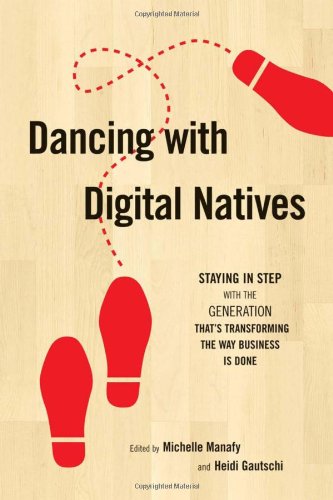
Inhaltsangabe
Generational differences have always influenced how business is done, but in the case of digital natives, those immersed in digital technology from birth, professionals are witnessing a tectonic shift. As an always-connected, socially networked generation increasingly dominates business and society, organizations can ignore the implications only at the risk of irrelevance. In this fascinating study, a stellar assemblage of experts from business and academia provides vital insights into the characteristics of this transformative generation. Offering an in-depth look at how digital natives work, shop, play, and learn, this resource offers practical advice geared to help managers, marketers, coworkers, and educators maximize their interactions and create environments where everyone wins.
Die Inhaltsangabe kann sich auf eine andere Ausgabe dieses Titels beziehen.
Über die Autorin bzw. den Autor
Michelle Manafy is the director of content for FreePint, Ltd., a publisher of sites and resources for the business information industry. She is also the chair of the Buying & Selling eContent conference. Heidi Gautschi is the cofounder of L'ACTE International Research Group, where she analyzes the relationship between society and communication technology.
Contributors to this book include the editors, as well as Mary Ann Bell, Shashi Bellamkonda, Sarah Bryans Bongey, Jami L. Carlacio, Albert M. Erisman, Brynn Evans, Susan Evans, Lance Heidig, David Hubbard, Richard Hull, Marshall Lager, Christa M. Miller, Emilie Moreau, Carolina M. Reid, Michael Russell, Peggy Anne Salz, Arana Shapiro, Dan Schawbel, Rebecca Rufo-Tepper, and Robert J. Torres
Contributors to this book include the editors, as well as Mary Ann Bell, Shashi Bellamkonda, Sarah Bryans Bongey, Jami L. Carlacio, Albert M. Erisman, Brynn Evans, Susan Evans, Lance Heidig, David Hubbard, Richard Hull, Marshall Lager, Christa M. Miller, Emilie Moreau, Carolina M. Reid, Michael Russell, Peggy Anne Salz, Arana Shapiro, Dan Schawbel, Rebecca Rufo-Tepper, and Robert J. Torres
Auszug. © Genehmigter Nachdruck. Alle Rechte vorbehalten.
Dancing With Digital Natives
Staying in Step With the Generation That's Transforming the Way Business Is Done
By Michelle Manafy, Heidi GautschiInformation Today, Inc./CyberAge
Copyright © 2011 Michelle Manafy and Heidi Gautschi
All rights reserved.
ISBN: 978-0-910965-87-3All rights reserved.
Contents
Acknowledgments,
Introduction Michelle Manafy and Heidi Gautschi,
PART ONE: THE DIGITAL NATIVE GOES TO WORK,
Chapter 1: When Facebook Comes to Work: Understanding the Work Practice of the Digital Native Brynn Evans,
Chapter 2: Thinking Outside the Cubicle: Examining the Changing Shape of Today's Workspace Susan Evans,
Chapter 3: The Dis-Organization of Invention Carolina M. Reid,
Chapter 4: Native in Blue: Understanding the Challenges and Opportunities in Managing Today's Police Officers Christa M. Miller and Lt. David Hubbard,
Chapter 5: I'm With the Brand: How Generation Y Will Transform Hiring Through Personal Branding Dan Schawbel,
PART TWO: MARKETING AND SELLING TO THE DIGITAL NATIVE,
Chapter 6: With, Not To: The Value of Social CRM Marshall Lager,
Chapter 7: Inspired Interaction: Youth Marketing on Mobile Peggy Anne Salz,
Chapter 8: Adapting Old-Fashioned Marketing Values to the Needs of the Digital Native Michael P. Russell,
Chapter 9: The Social Media Imperative: Learning to Engage Digital Natives Where They Live Shashi Bellamkonda,
Chapter 10: Social Capitalism and the Reputation Economy Michelle Manafy,
PART THREE: ENTERTAINING THE DIGITAL NATIVE,
Chapter 11: The Digital Natives Are the Entertainment! Richard Hull,
Chapter 12: Ethics, Technology, and the Net Generation: Rethinking IP Law Albert M. Erisman,
Chapter 13: The Old News and the Good News: Engaging Emerging Readers Through Social Interaction Michelle Manafy,
Chapter 14: T'écoutes quoi ti? Digital Natives as Music Consumers in Lille, France Heidi Gautschi and Emilie Moreau,
PART FOUR: EDUCATING THE DIGITAL NATIVE,
Chapter 15: Making the Grade: Standards and Promoting Achievement Through Technology Sarah Bryans Bongey,
Chapter 16: Quest to Learn: A Public School for Today's Digital Kids Robert J. Torres, Rebecca Rufo-Tepper, and Arana Shapiro,
Chapter 17: Teaching Digital Literacy Digitally: A Collaborative Approach Jami L. Carlacio and Lance Heidig,
Chapter 18: French Lessons: How France Is Educating Its Digital Natives Heidi Gautschi,
Chapter 19: Native Knowledge: Knowing What They Know — and Learning How to Teach Them the Rest Mary Ann Bell,
About the Editors,
Index,
CHAPTER 1
When Facebook Comes to Work: Understanding the Work Practice of the Digital Native
Brynn Evans
The most valuable thing I learned in graduate school is that progress is not linear. It would take me 10 days of hard work before a big insight would come along and give me the equivalent of a week's worth of progress. Although I'm talking in the past tense here, this simple life lesson is true of my current work too — and of the work style of many so-called knowledge workers.
This pattern reveals itself in other domains as well. Imagine that a soccer game is coming down to the wire, tied at 0–0. From an absolute perspective, each team has made zero "progress." Of course, both teams have played a full game — they're exhausted — but nothing quantifiably distinguishes them from each other. Yet, at the last possible moment, either team could orchestrate a single clever play and score the tie-breaking shot. The game would technically end with a winner and a loser, although a score of one to nothing hardly reflects the deliberate work that both teams put in throughout the match. Still, what matters is that the winning team finally pulled through.
This perspective is important to keep in mind as you read this chapter. Although digital natives may conduct their work differently, they still recognize the need to pull through and meet the same deadlines. Even if they appear to be progressing slowly, be aware that, in their work too, progress is not linear.
Work as a Practice
This chapter is about the way that digital natives approach work — something that I'll refer to as their work practice. We all have a work practice that's unique to us; but if you've been employed in an office setting for more than 10 years, chances are that your work practice revolves around the office. When you're at work, you're working. When you're home, you're not working. This is a mindset (and perhaps a coping strategy) that many people adopt in order to lead a balanced life. Yet it's a work practice that is likely absent among the digital natives at your company, even if you still work in a traditional office environment.
What exactly is a work practice? It's not a matter of what work gets done but rather how it gets done. It's the doing of the work; it's the process of producing; it's a frame of mind for dealing with the mundane as well as the urgent. Included in this frame of mind are habits, standards, expectations, and social norms. For example, a familiar standard is the one-hour lunch break. Additionally, there are certain workplace expectations, which may vary within enterprises (e.g., how quickly to respond to a coworker's email). Finally, basic social norms apply regardless of company culture (e.g., it's rude to be on Facebook during a client meeting).
However, digital natives have a different set of habits, standards, expectations, and social norms that stem from being raised in a culture deeply immersed in technology. While their differences may not always clash with nonnatives, their work practice is unique and demands patience and compromise from non-natives to understand it and make the most of it. It certainly matters that your employees — from whatever generation — get their work done: Business is business. However, if you have a greater appreciation for digital natives' attitudes about working, you will learn better how to coexist productively and appreciate the perspectives and techniques that help them succeed.
The Life and Times of a Digital Native
The following account depicts a young woman, Robin, whose childhood was filled with digital technologies, which were used for both work and play. Today, her behaviors reflect the attributes of a digital native, quite distinct from the attributes of workers from previous generations. As you read the following story, consider how Robin's upbringing might affect her current work practices:
Robin is a 25-year-old technical project manager at Intuit. Growing up in a large family, she needed to jockey for attention with her three younger brothers. She took to video games as a way to compete with them, spending hours on gaming consoles and on the family computer late into the night. She was a natural with computers and even won a programming contest in high school. However, her intellectual passions were history and English.
Her parents sent her to college with a personal laptop. It became her life. She used it for taking notes during class, researching material for writing assignments, and doing homework. It was with her in the dorm, on the front steps of the cafeteria, in the noisy student center, and in off-campus cafes. She never hesitated to call upon the trustworthy machine in the middle of a conversation (even once with the dean of her university) if she thought that Google or Wikipedia could resolve some pressing issue or embellish an important...
„Über diesen Titel“ kann sich auf eine andere Ausgabe dieses Titels beziehen.
Suchergebnisse für Dancing with Digital Natives: Staying in Step with...

Beispielbild für diese ISBN
Dancing With Digital Natives : Staying in Step With The Generation That's Transforming the Way Business is Done
Verlag:
Information Today, Incorporated, 2011
ISBN 10: 0910965870
ISBN 13: 9780910965873
Gebraucht
Hardcover
Anbieter: Better World Books: West, Reno, NV, USA
Verkäuferbewertung 5 von 5 Sternen

Zustand: Very Good. 1st New edition. Former library copy. Pages intact with possible writing/highlighting. Binding strong with minor wear. Dust jackets/supplements may not be included. Includes library markings. Stock photo provided. Product includes identifying sticker. Better World Books: Buy Books. Do Good. Artikel-Nr. 5427419-75
Gebraucht kaufen
EUR 7,53
Versand gratis
Versand innerhalb von USA
Versand innerhalb von USA
Anzahl: 1 verfügbar
Beispielbild für diese ISBN
Dancing With Digital Natives : Staying in Step With The Generation That's Transforming the Way Business is Done
Verlag:
Information Today, Incorporated, 2011
ISBN 10: 0910965870
ISBN 13: 9780910965873
Gebraucht
Hardcover
Anbieter: Better World Books, Mishawaka, IN, USA
Verkäuferbewertung 5 von 5 Sternen
Zustand: Very Good. 1st New edition. Former library copy. Pages intact with possible writing/highlighting. Binding strong with minor wear. Dust jackets/supplements may not be included. Includes library markings. Stock photo provided. Product includes identifying sticker. Better World Books: Buy Books. Do Good. Artikel-Nr. 5427419-75
Gebraucht kaufen
EUR 7,53
Versand gratis
Versand innerhalb von USA
Versand innerhalb von USA
Anzahl: 1 verfügbar