
Verwandte Artikel zu Celebrating Liturgical Time: Days, Weeks, and Seasons
Inhaltsangabe
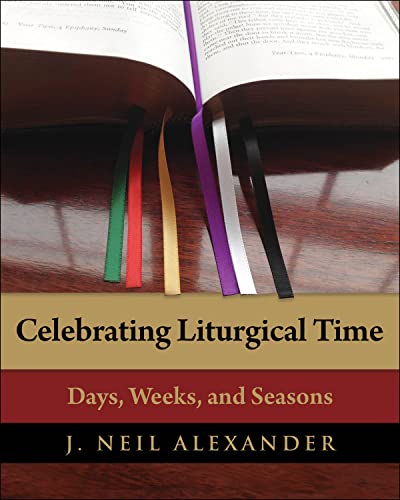
Celebrating Liturgical Time continues the standard of scholarship set by Patrick Malloy’s Celebrating the Eucharist. It is ideal for students, clergy, and church members who seek to strengthen their knowledge―and parochial practice―of liturgical timekeeping and the Daily Office.
Die Inhaltsangabe kann sich auf eine andere Ausgabe dieses Titels beziehen.
Über die Autorin bzw. den Autor
J. Neil Alexander is the former Dean of the School of Theology at the University of the South (Sewanee) and former bishop of the Diocese of Atlanta. He lives in Austin, Texas.
Auszug. © Genehmigter Nachdruck. Alle Rechte vorbehalten.
Celebrating Liturgical Time
Days, Weeks, and Seasons
By J. Neil AlexanderChurch Publishing
Copyright © 2014 J. Neil Alexander
All rights reserved.
ISBN: 978-0-89869-873-2All rights reserved.
Contents
Introduction,
1. Shaped by Time,
2. The Calendar: Sundays, Feasts, and Seasons,
The Liturgical Day: Time-keeping,
Principal Feast: Easter Day,
Principal Feast: Ascension Day,
Principal Feast: The Day of Pentecost: Whitsunday,
Principal Feast: Trinity Sunday,
Principal Feast: All Saints' Day,
Principal Feast: Christmas Day,
Principal Feast: Epiphany,
Other Feasts of Note: Holy Name, Presentation, Transfiguration, Annunciation,
A Brief Note about the Last Sunday after Pentecost,
The Titles of the Seasons, Sundays, and Major Holy Days Observed in this Church throughout the Year,
3. Marking the Meantime: The Daily Offices and The Great Litany,
Daily Morning Prayer,
An Order of Service for Noonday,
An Order of Worship for the Evening,
Daily Evening Prayer,
An Order for Compline,
The Great Litany,
Of the Personal Observance of the Daily Offices,
4. Proper Liturgies for Lent and Holy Week,
The Proper Liturgy for Ash Wednesday,
The Proper Liturgy for the Sunday of the Passion: Palm Sunday,
The Triduum,
CHAPTER 1
SHAPED BY TIME
My days are swifter than a weaver's shuttle. So says the prophet Job in his description of the human condition. There is no cessation of the passage of time. There are good days and bad ones, times of plenty and times of desperation, seasons of agony and seasons of delight. Eventually, we presume, the weaver runs out of thread, a sign that things are coming to an end. But in the meantime, the passage of time is relentless. It cannot be made to go more slowly. It will not pass any faster than it already does. It is impossible to tame it. Our only hope is to mark it, sanctify it, relax into it, enjoy it, and allow life to be shaped by the inevitability of its passage.
In our earliest records of ancient peoples, there is evidence of a strong sense of awareness with respect to the passage of time. A large part of this was rooted in the simple observation of natural phenomena. The daily rhythm of the sun's coming and going is hard to miss. The sun's "rising" brings light and warmth, makes work possible, and seems to energize the body and lift the spirit. The sun's "setting" steals the light and chills the air. It slows the body, pulls us toward rest, and tempts us with the fear of the unknown. The shadows come, they lengthen, they go, and, as if by promise, they return.
The light and darkness that come with the sun's rising and setting are shaped into seasons, and gradually the cold days will give way to warmer ones. In time, the gentle warmth of the morning will give way to the sweltering heat of the afternoon sun. But sooner or later the cold will come again. As time passes the rains come and the crops grow. In other years the rains come again, but this time in such abundance that floods destroy even the sturdiest plantings. If next year, or the year after, the rains do not come, there will be no water to drink. When everything is dry and everyone is thirsty, death lurks in the background. Days, night, weeks, months, seasons, cycles, years, feast, famine, flood, and drought—human beings have always been fascinated by the passage of time and all that it brings with it. Longing and hope, anticipation and expectation, so vital to human thriving, are anchored in time. Ecstasy and delight are experienced as moments in time. And when deep disappointment, profound grief, and excruciating pain are our companions, we comfort one another by saying that "time heals." Often it does; sometimes it doesn't.
As time unfolded, ancient peoples began to organize their thinking about its movement and organization. Some conceived of the passage of time as a cycle, visualized often by a circle. The relentless return of the sun and the moon, hot and cold, rain and dry, appeared to them as cyclical patterns with a certain consistency about them. In due course they began to conceive of larger blocks of time, and were often great observers of how these cycles of nature appeared to give a predictable, if uncontrollable, shape to their lives.
There were also the linear thinkers. They conceived of the movement of time more like points on a line, from one sunrise to the next, in endless succession. For many linear thinkers, time had no beginning and no end, just measurable moments in the meantime. What to others seemed like repetition, linear thinkers viewed as a never-ending procession of new moments relentlessly unfolding.
Naturally there were those for whom the previous two modes of organizing time were inadequate. Instead of limiting their mode of thinking to either the cyclical or the linear, they proposed a more spiral visualization of the progress of time, i.e., a line that gradually moves forward while at the same time constantly circling back upon itself, living constantly in the tension between renewing those things that constantly "return" to us (the cyclical), while reaching toward the promise of what is to come (the linear).
As time passes, it will require the capacity of each kind of thinking—the cyclical, the linear, and the spiral—to develop calendars based on days, weeks, lunar phases, and solar years. Keeping watch throughout the day and night by means of sundials, hourglasses, watchmen, and eventually mechanical (and now digital) timepieces, was the result of patterns of timekeeping that plotted the relentlessness of time's forward movement against the inevitable reoccurrence of observable patterns. However it was conceived, and by whatever means it was organized, it was an effort to gain some understanding, some control, of one of those things in life that was, and is, very much beyond human control: the passage of time.
The implications of this are many for people of faith. It's not just old Job who reflects a consciousness about time and God's role in it. The charter narrative of creation in the opening pages of Genesis is time-centered in the way it tells the story. The saga of Abraham and Sarah and the stories of the early ancestries of Israel are carefully set in time. The writers of lament use time as their principal point of reference. Nearly every psalm has a direct or oblique reference to God's work-in-time, and without a strong intuition about God's desire being wrought in time, the prophets' words would have made little sense.
The New Testament as well is replete with references to time. The annunciation and birth narratives in the gospels are careful to place the coming of Jesus in time. The reign of God that Jesus has come to inaugurate is expressed in relation to time: it is at once both here and not yet. A goodly portion of the content of Jesus' teaching is expressed in terms of time and eternity. The resurrection of Jesus causes a seismic shift in time because the future is no longer captive to the past: the way things have always been need not be the way they always will be. This "new age" is the gift of resurrection.
Time itself is neither holy nor unholy. Everyone who lives does so in time, whether or not they profess any faith convictions or claim any manner of religious affections. Even the most nonreligious person will be sensitive to the natural passages of time, to moments of grief and feasts of celebration, and surely to the inevitability of aging. The rate of time's passage is the same for...
„Über diesen Titel“ kann sich auf eine andere Ausgabe dieses Titels beziehen.
Suchergebnisse für Celebrating Liturgical Time: Days, Weeks, and Seasons

Beispielbild für diese ISBN
Celebrating Liturgical Time: Days, Weeks, and Seasons
Anbieter: World of Books (was SecondSale), Montgomery, IL, USA
Verkäuferbewertung 5 von 5 Sternen

Paperback. Zustand: Fair. Is the newest installment in the Celebrating series. An overview of liturgical theology written by a well-known liturgical scholar which includes history, theology, and practical information. Artikel-Nr. CIN0898698731A
Gebraucht kaufen
EUR 14,79
Versand gratis
Versand innerhalb von USA
Versand innerhalb von USA
Anzahl: 1 verfügbar
Beispielbild für diese ISBN
Celebrating Liturgical Time
Anbieter: PBShop.store US, Wood Dale, IL, USA
Verkäuferbewertung 5 von 5 Sternen
PAP. Zustand: New. New Book. Shipped from UK. Established seller since 2000. Artikel-Nr. CX-9780898698732
Beispielbild für diese ISBN
Celebrating Liturgical Time
Anbieter: PBShop.store UK, Fairford, GLOS, Vereinigtes Königreich
Verkäuferbewertung 5 von 5 Sternen
PAP. Zustand: New. New Book. Shipped from UK. Established seller since 2000. Artikel-Nr. CX-9780898698732
Neu kaufen
EUR 24,54
EUR 4,96 Versand
Versand von Vereinigtes Königreich nach USA
Versand von Vereinigtes Königreich nach USA
Anzahl: 15 verfügbar
Beispielbild für diese ISBN
Celebrating Liturgical Time: Days, Weeks, and Seasons
Anbieter: Ria Christie Collections, Uxbridge, Vereinigtes Königreich
Verkäuferbewertung 5 von 5 Sternen
Zustand: New. In English. Artikel-Nr. ria9780898698732_new
Neu kaufen
EUR 30,21
EUR 11,17 Versand
Versand von Vereinigtes Königreich nach USA
Versand von Vereinigtes Königreich nach USA
Anzahl: 1 verfügbar
Beispielbild für diese ISBN
Celebrating Liturgical Time: Days, Weeks, and Seasons
Anbieter: Revaluation Books, Exeter, Vereinigtes Königreich
Verkäuferbewertung 5 von 5 Sternen
Paperback. Zustand: Brand New. 240 pages. 10.25x8.25x0.50 inches. In Stock. Artikel-Nr. x-0898698731
Neu kaufen
EUR 42,84
EUR 11,93 Versand
Versand von Vereinigtes Königreich nach USA
Versand von Vereinigtes Königreich nach USA
Anzahl: 2 verfügbar
Beispielbild für diese ISBN
Celebrating Liturgical Time
Verlag:
Church Publishing, Incorporated, 2014
ISBN 10: 0898698731
ISBN 13: 9780898698732
Neu
Softcover
Anbieter: Majestic Books, Hounslow, Vereinigtes Königreich
Verkäuferbewertung 4 von 5 Sternen

Zustand: New. pp. 240. Artikel-Nr. 50974640
Neu kaufen
EUR 49,58
EUR 7,75 Versand
Versand von Vereinigtes Königreich nach USA
Versand von Vereinigtes Königreich nach USA
Anzahl: 1 verfügbar
Foto des Verkäufers
Celebrating Liturgical Time : Days, Weeks, and Seasons
Anbieter: AHA-BUCH GmbH, Einbeck, Deutschland
Verkäuferbewertung 5 von 5 Sternen
Taschenbuch. Zustand: Neu. Neuware - Celebrating Liturgical Time continues the standard of scholarship set by Patrick Malloy's Celebrating the Eucharist. It is ideal for students, clergy, and church members who seek to strengthen their knowledge-and parochial practice-of liturgical timekeeping and the Daily Office. Artikel-Nr. 9780898698732
Neu kaufen
EUR 46,59
EUR 35,00 Versand
Versand von Deutschland nach USA
Versand von Deutschland nach USA
Anzahl: 1 verfügbar
Foto des Verkäufers
Celebrating Liturgical Time: Days, Weeks, and Seasons
Anbieter: moluna, Greven, Deutschland
Verkäuferbewertung 5 von 5 Sternen
Zustand: New. Über den AutorrnrnJ. Neil Alexander is the former Dean of the School of Theology at the University of the South (Sewanee) and former bishop of the Diocese of Atlanta. He lives in Austin, Texas.KlappentextIs the n. Artikel-Nr. 898975423
Neu kaufen
EUR 34,87
EUR 48,99 Versand
Versand von Deutschland nach USA
Versand von Deutschland nach USA
Anzahl: Mehr als 20 verfügbar