
Verwandte Artikel zu Eat-A-Bug Cookbook
Inhaltsangabe
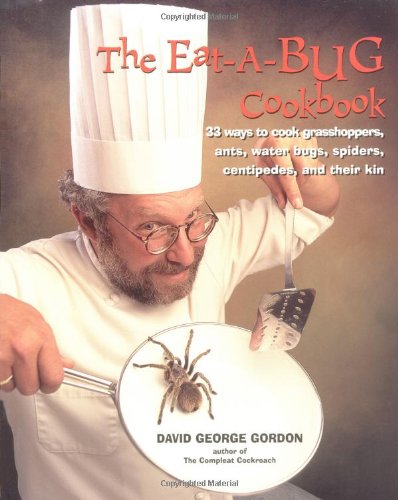
The Essentials of Bug Cookery…From Soup to Gnats
“Waiter, there’s a fly in my soup!” Or wait…maybe it’s a katydid, a silkworm, or a tasty young bee. Anything’s possible at the Eat-A-Bug Cafe, otherwise known as the kitchen of naturalist David George Gordon, entomological epicure extraordinaire.
Gordon has gone to the ends of the earth, to his backyard, and under the refrigerator to find culinary inspiration, and now, after years of experimentation with entomophagy (that’s bug-eating, for those of you in the cheap seats), he presents the results with relish…or at least a light cream sauce.
Now you too can tantalize and terrify your family and friends with Gordon’s one-of-a-kind recipes, including Really Hoppin’ John (grasshoppers add that little extra kick), Pest-O (common garden weevils get their comeuppance in a delicate basil sauce) and Fried Green Tomato Hornworm (the Whistle Stop Cafe was never like this!)
Anecdotes, insights and culinary tips (such as the right wine to serve with scorpions) make this truly a book like no other. Follow the detailed instructions, and your guests will ask for seconds, just like folks at David’s notorious cooking demos. Open your culinary horizons. Buy this book. Eat a bug.
Die Inhaltsangabe kann sich auf eine andere Ausgabe dieses Titels beziehen.
Über die Autorin bzw. den Autor
An award-winning nature writer, David George Gordon is the author of eleven guides to North American wildlife and wild places.
Auszug. © Genehmigter Nachdruck. Alle Rechte vorbehalten.
Part One: Don’t Worry, Be Hoppy
Nine Culinary Leaps of Faith, Using Crickets, Grasshoppers, and Their Kin
There are about 20,000 living species in the order Orthoptera, which, in the words of my favorite know-it-all, the nineteenth-century naturalist Reverend J. G. Wood, contains “some of the finest and, at the same time, the most grotesquely formed members of the insect tribe.”
During Reverend Wood’s time, cockroaches, praying mantises, and stick insects were regarded as card-carrying orthopterans. Today, however, membership has been restricted to crickets, grasshoppers, locusts, and katydids. These animals are easily recognized by their narrow leathery forewings; broad, membranous hind wings; and muscular hind legs that are well-developed for jumping. Of course, there are exceptions, even among this select clan. For example, the mole cricket—a small, brown-bodied burrowing plant pest—more closely resembles a crayfish than Cousin Jiminy.
In some parts of the world, Orthoptera are sources of entertainment as well as food—live dinner theater, if you will. In Japan, for instance, singing katydids and crickets are kept as pets, confined in miniature cages with slender bamboo bars. Throughout the People’s Republic of China, the sport of cricket fighting is guaranteed to draw sizable crowds, with betting far livelier than at horse races or kickboxing events.
Orthoptera are relished by the indigenous people of Africa, Australia, South and Central America, Mexico, the Middle East, and many Pacific islands. Even in the largely unentomophagous United States, there’s been some interest in orthopteran edibles. Many of us fondly remember chocolate-covered grasshoppers, sold in tins by Reese Finer Foods, Inc, during the early 1960s. While these particular treats are no longer commercially available, one can still purchase chocolate-covered crickets, individually wrapped in foil and marketed by Fluker Farms of Port Allen, Louisiana.
The largest insect-rearing operation in the world, Fluker Farms sells over one million house crickets (Acheta domesticus) in a week. Admittedly, most of these are sold as bait for sport fishing and food for pet reptiles and amphibians. Still, a small percentage of the company’s stock is destined for human consumption, primarily at zoo- or museum-sponsored events. According to Fluker’s marketing director Henry “T-Joe” Frank, his company’s clients include at least one restaurant, Typhoon, a pan-Asian eatery at the Santa Monica Airport in California, which features crickets in its Taiwanese stir-fry dishes. An appetizer portion is about six ounces before frying, says Typhoon’s proprietor, Brian Vidor. “We really don’t know what the crickets weigh,” he jokes, “because they hop off the scale too quickly.”
Locusts in Leviticus
Nearly all the Orthoptera are vegetarians, favoring fresh leaves and stems and foregoing any plant (or animal) matter that’s decayed. This dietary preference, which is innately more hygienic than scavenging, may explain why locusts have been branded as kosher (that is, fit for human consumption) in the Old Testament.
In Leviticus, the book of the Bible in which the dietary laws are first addressed, the text plainly states that “all winged insects that go upon all fours are an abomination to you.” But despite this seemingly hard line against bug eating, a few entomophagous alternatives are identified. “These you may eat; the arbeh after his kind, the sal’am after his kind, the chargol after his kind, and the chagav after his kind.”
Most entomologists agree that the arbeh, sal’am, chargol, and chagav are really names for the same critter, the locust, in various stages of development. Some suggest that locusts were included in the list of approved (kosher) foods because they are so easily distinguished from other insects—thus limiting the chances of the devout mistakenly snacking on a species already deemed impure.
Beating the Bush for Big Bugs
Orthoptera, not buffalo, was the seasonal mainstay of many Plains tribes. Harvesting the abundant stocks was often a communal effort, with entire villages-men, women and children-working together to flush the six-legged game.
“They begin by digging a hole, ten or twelve feet in diameter, by four or five deep,” wrote Father de Smet, describing the tactics of the Shoshone in the 1800s:
Then, armed with long branches of artemisia, they surround a field of four or five acres, more or less, according to the number of people who are engaged in it. They stand about twenty feet apart and their whole work is to beat the ground, so as to frighten up the grasshoppers and make them bound forward. They chase them toward the center by degrees-that is, into the hole prepared for their reception. Their number is so considerable that frequently three or four acres furnish grasshoppers sufficient to fill the reservoir or hole.
This orthopteran bounty could then be hastily handpicked and stuffed into sacks, which were then soaked in salt water and—how convenient!—tossed into an oven for ten or fifteen minutes. Other tribes built large fires in their insect-catching pits, creating a bed of coals on which to roast any grasshoppers headed that way. Some tribes simply torched the grasslands and returned once the fires had died down to collect and eat the flame-broiled insects, straight from the scorched earth.
The potential of the various harvest techniques was nicely illustrated by entomologist David Madsen, who, with help for a few peers, rounded up Mormon crickets (Anabrus simplex) along the Utah-Colorado border. Two sweeps of the underbrush brought in batches of 5,652 and 9,876 crickets—an average catch of nearly eighteen and a half pounds. A pound of dried Mormon crickets contains about 1,270 calories, so the nutritional rewards from such a catch were quite large. In one hour, Madsen’s team had amassed the caloric equivalent of forty-three McDonald’s Big Macs, forty-nine slices of pizza, or eighty-nine chili dogs.
Chapter 1: Cooking With Crickets
Gryllus, the scientific name for the field cricket, is an open invitation to catch this insect and cook it. So is the delightfully optimistic chirp produced by this creature and its first cousin, the European house cricket (Acheta domesticus).
The cricket’s reputation as a songster has been celebrated by John Milton (“Far from all resort of mirth, Save the cricket on the hearth”) and Charles Dickens (“I have loved it for the many times I’ve heard it and the many thoughts its harmless music has given me”). While I cook almost exclusively with crickets that have been frozen and thawed, I still like to keep a few live crickets on hand at all times-just to serenade me and my guests.
Where crickets are especially abundant, edible specimens can be most efficiently captured by taking broad, upward swipes at tall grass or shrubbery with a short-handled net, a technique that entomologists call sweeping. A more leisurely approach involves the setting of what are commonly known as pitfall traps.
Here’s how it works: Dig a small hole with a garden trowel and sink a quart mason jar so the top is flush with the surface of the ground. Cover the mouth of the jar with a piece of wood, held a half inch above the ground by pebbles or twigs. Crickets that walk under the wood and into the trap will be unable to hop out and must stay there until you choose to retrieve...
„Über diesen Titel“ kann sich auf eine andere Ausgabe dieses Titels beziehen.
Suchergebnisse für Eat-A-Bug Cookbook

Beispielbild für diese ISBN
Eat-a-bug Cookbook: 33 ways to cook grasshoppers, ants, water bugs, spiders, centipedes, and their kin
Anbieter: World of Books (was SecondSale), Montgomery, IL, USA
Verkäuferbewertung 5 von 5 Sternen

Zustand: Good. Item in good condition. Textbooks may not include supplemental items i.e. CDs, access codes etc. Artikel-Nr. 00100653206
Gebraucht kaufen
EUR 3,92
Versand gratis
Versand innerhalb von USA
Versand innerhalb von USA
Anzahl: 2 verfügbar
Beispielbild für diese ISBN
The Eat-a-Bug Cookbook
Anbieter: Better World Books: West, Reno, NV, USA
Verkäuferbewertung 5 von 5 Sternen
Zustand: Good. First Printing. Pages intact with minimal writing/highlighting. The binding may be loose and creased. Dust jackets/supplements are not included. Stock photo provided. Product includes identifying sticker. Better World Books: Buy Books. Do Good. Artikel-Nr. 5126886-6
Gebraucht kaufen
EUR 6,42
Versand gratis
Versand innerhalb von USA
Versand innerhalb von USA
Anzahl: 2 verfügbar
Beispielbild für diese ISBN
The Eat-a-Bug Cookbook
Anbieter: Better World Books: West, Reno, NV, USA
Verkäuferbewertung 5 von 5 Sternen
Zustand: Good. First Printing. Former library copy. Pages intact with minimal writing/highlighting. The binding may be loose and creased. Dust jackets/supplements are not included. Includes library markings. Stock photo provided. Product includes identifying sticker. Better World Books: Buy Books. Do Good. Artikel-Nr. 8260826-75
Gebraucht kaufen
EUR 6,42
Versand gratis
Versand innerhalb von USA
Versand innerhalb von USA
Anzahl: 1 verfügbar
Beispielbild für diese ISBN
Eat-a-bug Cookbook: 33 ways to cook grasshoppers, ants, water bugs, spiders, centipedes, and their kin
Anbieter: ThriftBooks-Atlanta, AUSTELL, GA, USA
Verkäuferbewertung 5 von 5 Sternen
Paperback. Zustand: Very Good. No Jacket. May have limited writing in cover pages. Pages are unmarked. ~ ThriftBooks: Read More, Spend Less. Artikel-Nr. G0898159776I4N00
Gebraucht kaufen
EUR 6,61
Versand gratis
Versand innerhalb von USA
Versand innerhalb von USA
Anzahl: 1 verfügbar
Beispielbild für diese ISBN
Eat-a-bug Cookbook
Anbieter: AwesomeBooks, Wallingford, Vereinigtes Königreich
Verkäuferbewertung 5 von 5 Sternen
Paperback. Zustand: Very Good. Eat-a-bug Cookbook This book is in very good condition and will be shipped within 24 hours of ordering. The cover may have some limited signs of wear but the pages are clean, intact and the spine remains undamaged. This book has clearly been well maintained and looked after thus far. Money back guarantee if you are not satisfied. See all our books here, order more than 1 book and get discounted shipping. Artikel-Nr. 7719-9780898159776
Gebraucht kaufen
EUR 4,80
EUR 4,81 Versand
Versand von Vereinigtes Königreich nach USA
Versand von Vereinigtes Königreich nach USA
Anzahl: 2 verfügbar
Beispielbild für diese ISBN
The Eat-a-Bug Cookbook
Anbieter: Better World Books Ltd, Dunfermline, Vereinigtes Königreich
Verkäuferbewertung 5 von 5 Sternen
Zustand: Good. First Printing. Pages intact with minimal writing/highlighting. The binding may be loose and creased. Dust jackets/supplements are not included. Stock photo provided. Product includes identifying sticker. Better World Books: Buy Books. Do Good. Artikel-Nr. 5126886-6
Gebraucht kaufen
EUR 5,66
EUR 5,83 Versand
Versand von Vereinigtes Königreich nach USA
Versand von Vereinigtes Königreich nach USA
Anzahl: 1 verfügbar
Beispielbild für diese ISBN
Eat-a-bug Cookbook
Anbieter: Bahamut Media, Reading, Vereinigtes Königreich
Verkäuferbewertung 5 von 5 Sternen
Paperback. Zustand: Very Good. This book is in very good condition and will be shipped within 24 hours of ordering. The cover may have some limited signs of wear but the pages are clean, intact and the spine remains undamaged. This book has clearly been well maintained and looked after thus far. Money back guarantee if you are not satisfied. See all our books here, order more than 1 book and get discounted shipping. Artikel-Nr. 6545-9780898159776
Gebraucht kaufen
EUR 5,16
EUR 8,14 Versand
Versand von Vereinigtes Königreich nach USA
Versand von Vereinigtes Königreich nach USA
Anzahl: 2 verfügbar
Beispielbild für diese ISBN
Eat-a-bug Cookbook
Anbieter: Wormhill Books, Hereford, Vereinigtes Königreich
Verkäuferbewertung 5 von 5 Sternen
Paperback. Zustand: Fine. New copy but the cover is slightly shelf-worn. Priority orders will be dispatched by Royal Mail TRACKED 24 or courier (particularly if over 2kg). Standard mail will be dispatched by Royal Mail TRACKED 48 (up to 2kg), heavier items by courier . Overseas orders will be dispatched by Royal Mail International.Tracked. PLEASE CONTACT ME FOR MY PRIVACY POLICY. Artikel-Nr. mon0000010310
Gebraucht kaufen
EUR 7,48
EUR 22,46 Versand
Versand von Vereinigtes Königreich nach USA
Versand von Vereinigtes Königreich nach USA
Anzahl: 1 verfügbar