
Verwandte Artikel zu Why We Remain Jews: The Path to Faith
Inhaltsangabe
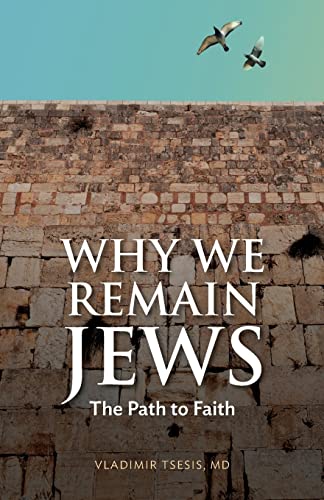
Dr. Tsesis describes the path he traversed from religious ignorance to strong belief in the Jewish religion. Tsesis assigns a special place to the proof of his conclusion that religion and science—especially in light of recent discoveries—are not antagonists, and are, in fact, in complete harmony, supplementing and not excluding each other. In the spirit of ecumenism Tsesis speaks about coexistence of different religions, which share the common objective of assurance of perpetual survival of the human race. The unifying theme of this book, however, is the beauty of the Jewish religion and a possible answer to the question of why we remain Jews.Die Inhaltsangabe kann sich auf eine andere Ausgabe dieses Titels beziehen.
Über die Autorin bzw. den Autor
Vladimir Tsesis grew up in the former Soviet union and practiced general pediatrics there for 10 years before immigration with his wife and son the the USA in 1974.Auszug. © Genehmigter Nachdruck. Alle Rechte vorbehalten.
Why We Remain Jews
The Path to Faith
By Vladimir TsesisChicago Review Press Incorporated
Copyright © 2013 Vladimir Tsesis
All rights reserved.
ISBN: 978-0-89733-717-5All rights reserved.
CHAPTER 1
DENYING GOD
Many highly enlightened acquaintances of mine often wonder why I — "an educated person" — believe so strongly in God. Before giving an answer to such a question I ask my companions to kindly explain what prevents them from believing in God. Their responses vary widely. Some of them flatly reject religion; others keep a mysterious silence or shrug their shoulders.
I am not at all surprised by the reactions of atheists, who reject God's existence out of hand and completely. Indeed, we live in a free country where everyone has a right to hold his own views. Much more amazing to me are the responses of those who might be called skeptics. These are the people who wonder why others believe in God, but at the same time never miss an opportunity to hold religious ceremonies: to celebrate the B'nei Mitzvah of their children, weddings, and the births of babies in their families. Moreover, they show even more respect for religious traditions when they go through trying times. During religious ceremonies, such people always demonstrate their sincere respect for worship and the sermons delivered by rabbis.
It seems to me that these people — on the one hand ignoring religion, and on the other hand professing it — are so busy and involved in the maelstrom of life that, in the daily bustle of reality, they have no time to stop for a minute and realize that "man shall not live by bread alone." (Deuteronomy 8: 2–3).
There is a religious school affiliated with the synagogue where I have been attending services for many years. Children come to this school two or three times a week. As a rule, they are brought there by their parents.
On Sundays, the school time coincides with the morning worship — Shaharit. This service is not long. Since the children are attending religious school, surely, it could be assumed that their parents want them in the future to be religiously educated Jews. Naturally, one is led to think that such parents would be glad to attend the religious service themselves.
However, the parents are very seldom willing to use this ideal opportunity to set a good example for their children. Instead of joining the service, they demonstrate their lack of interest in religion. While the children are getting religious lessons, some of the parents go home or run errands; others stay in the synagogue whiling away the time in different ways — talking with one another, making phone calls, reading books and newspapers.
I have often wanted to ask them one question: why do they bring their children to a religious school if they themselves are obviously not interested in practicing their religion? And, really, are they so naïve that they fail to understand that their children are not stupid, that they see and are influenced by the inconsistent behavior of their beloved parents?
But there is always room for optimism. Some people will always find their way to God, especially if they are exposed to religious values in their childhood.
* * *
My parents were born before the Great October Revolution in Russia and grew up in families where Jewish traditions were observed; they were about ten years old when Lenin's party came to power. Like most people of that time, having suffered the bloody turbulence of revolutionary turmoil, my parents, especially my mother, desperately wanted to adapt to the new lifestyle in order to survive under the new political system.
During the post-revolutionary years, the Soviet government persecuted religious adherents and stifled and suppressed religion by any means available, doing its utmost to connect the idea of God with negative associations.
In order to avoid the risk of disappearing as a result of regular purges, as happened to many people at that time, my parents had no choice but to thoroughly conceal their religious views.
Gradually, a strange phenomenon that was very typical in that period happened: the more they distanced themselves from religion, the more positively they accepted the views imposed on them by the Soviet antireligious propaganda. Eventually, they began to identify themselves with those who continually brainwashed them into believing that the religion of their fathers and mothers was nothing more than a reprehensible and ignorant superstition.
My paternal grandfather was a melamed — a religious teacher of Judaism — and my maternal grandfather was a cantor and a shohet — a ritual slaughterer. Both were killed by German fascists and their local accomplices during the war, so I never had a chance to meet them.
When I asked my father — a communist by necessity — why he refused even to consider the possibility of the existence of God, he told me that it was a result of his life experience. He said that his family was very poor, so to help his parents to make ends meet he had had to work from an early age. One of his jobs was at a coaching inn, where he was an errand boy. There he repeatedly observed priests who came into town from surrounding villages and who were among the most active customers of the local prostitutes. For the rest of his life my father believed that behind the outward holiness of the clergy lurked hypocrisy and deceit.
"How can somebody be religious," he told me, "if the so-called 'holy men' behave worse than the ungodly? What is a religion when there's nothing holy in its holy orders?"
While he was trying to avoid giving me a direct answer, my father could see by the expression on my face that the trivial generalization gathered from his own life experience failed to convince me. After a pause, he continued much more gravely:
"Look, Vovka. I went through the war from the first to the last day, I fought with Germans, many of my friends and fellows were wounded or killed before my eyes. There were times when I met death daily. When you grow up, you will realize that, after going through all that, it was difficult for me to even think about God, to say nothing of talking about Him. Do you understand me? My God is my family, the future of my children, that's all. And let's not discuss the rest, OK?"
CHAPTER 2THERE ARE NO ATHEISTS IN FOXHOLES
When I think about the ambivalent position of many people toward religion, I always remember Sheldon and Gretchen Weisberg, whom I knew for many years.
Sheldon Weisberg was fifteen years older than I was. For many years he was my neighbor in the locker room of the fitness club that we and our wives attended. Prior to retirement, Sheldon had spent many years working as a high-level administrator in the Chicago school system. Because Sheldon was, among other things, an inveterate Jewish liberal, the number of topics we could discuss was not very large. Initially, we talked about — and quickly exhausted — neutral subjects like geography, climate, and the food and customs of Ukraine, where Sheldon's ancestors came from.
Our limited regular dialogue had reached a deadlock when Sheldon, in a solemn manner, revealed to me how incredibly fond he was of communist-era Russia.
He had grown up in a family of American Jewish Communists and imbibed a strong faith in communism with his mother's milk. One summer, when he was already a young man, during his regular visit to a communist camp in Wisconsin Sheldon met his future wife Gretchen, a daughter of non-Jewish German...
„Über diesen Titel“ kann sich auf eine andere Ausgabe dieses Titels beziehen.
Suchergebnisse für Why We Remain Jews: The Path to Faith

Beispielbild für diese ISBN
Why We Remain Jews: The Path to Faith
Verlag:
Academy Chicago Publishers, 2013
ISBN 10: 0897337174
ISBN 13: 9780897337175
Gebraucht
Paperback
Anbieter: World of Books (was SecondSale), Montgomery, IL, USA
Verkäuferbewertung 5 von 5 Sternen

Paperback. Zustand: Good. Dr. Tsesis describes the path he traversed from religious ignorance to strong belief in the Jewish religion. Tsesis assigns a special place to the proof of his conclusion that religion and science--especially in light of recent discoveries--are not antagonists, and are, in fact, in complete harmony, supplementing and not excluding each other. In the spirit of ecumenism Tsesis speaks about coexistence of different religions, which share the common objective of assurance of perpetual survival of the human race. The unifying theme of this book, however, is the beauty of the Jewish religion and a possible answer to the question of why we remain Jews. Artikel-Nr. 00070973683
Gebraucht kaufen
EUR 3,23
Versand gratis
Versand innerhalb von USA
Versand innerhalb von USA
Anzahl: 1 verfügbar
Beispielbild für diese ISBN
Why We Remain Jews: The Path to Faith
Anbieter: Revaluation Books, Exeter, Vereinigtes Königreich
Verkäuferbewertung 5 von 5 Sternen
Paperback. Zustand: Brand New. 254 pages. 8.50x5.50x0.50 inches. In Stock. Artikel-Nr. zk0897337174
Neu kaufen
EUR 30,67
EUR 11,84 Versand
Versand von Vereinigtes Königreich nach USA
Versand von Vereinigtes Königreich nach USA
Anzahl: 1 verfügbar