
Verwandte Artikel zu Lucrezia Floriani
Inhaltsangabe
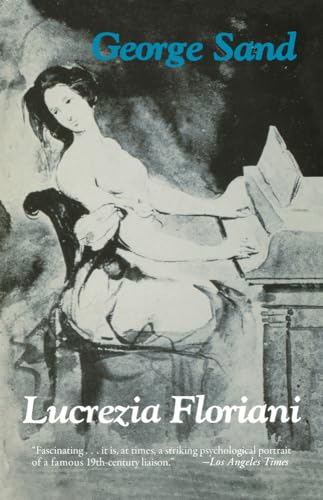
Lucrezia Floriani, a worldly 30-year-old actress and the mother of 4 children with 3 different fathers, meets and falls in love with Prince Karol, a moody, introspective aristocrat.Die Inhaltsangabe kann sich auf eine andere Ausgabe dieses Titels beziehen.
Über die Autorin bzw. den Autor
George Sand is the pen name of Amantine Lucile Aurore Dupin, Baroness Dudevant, a 19th century French novelist and memoirist. Sand is best known for her novels Indiana, L'lia, and Consuelo, and for her memoir A Winter in Majorca, in which she reflects on her time on the island with Chopin in 1838-39. A champion of the poor and working classes, Sand was an early socialist who published her own newspaper using a workers' co-operative and scorned gender conventions by wearing men's clothing and smoking tobacco in public. George Sand died in France in 1876.Auszug. © Genehmigter Nachdruck. Alle Rechte vorbehalten.
Lucrezia Floriani
By George Sand, Julius EkerChicago Review Press Incorporated
Copyright © 1985 Betsy Wing
All rights reserved.
ISBN: 978-0-89733-397-9All rights reserved.
CHAPTER 1
Young Prince Karol de Roswald had just lost his mother when he first met Madame Floriani.
He was still plunged in utter grief and nothing could distract him from it. Princess de Roswald had been a tender and perfect mother. As a child Karol was weak and ailing and she had lavished on him the most constant care and devotion. Brought up under the eye of this good and noble woman the young man had only one real passion in his entire life: filial love. This mutual love between son and mother had made them as it were exclusive, and possibly a little too absolute in their way of seeing and feeling things. It must be said that the Princess was highly educated and possessed a superior mind; the lessons she gave him and her conversations with him seemed capable of satisfying every one of young Karol's needs. His delicate health had resisted the toil, rigour and harshness of classical studies which in themselves are not always as valuable as the lessons of an enlightened mother, but they have the indispensable merit of teaching us to work and are, so to speak, the key to knowledge of life. Acting on the advice of her son's doctors Princess de Roswald had dismissed the idea both of tutors and books and had resolved to form the mind and heart of her son by her conversation, by the stories she narrated, by a kind of insufflation of his moral being which the young man had absorbed with great delight. Thus he had succeeded in acquiring much knowledge without ever having studied anything.
But nothing can replace experience; and the box on the ear which, when I was a child, was given to youngsters to impress on their memories a great emotion, a historical fact, a notorious crime or any other example to follow or avoid, was not so stupid a practice as it appears to us nowadays. We no longer give this box on the ear to our children; they have to seek it elsewhere, and the heavy hand of experience applies it much more harshly than ours would.
So young Karol de Roswald became acquainted with people and life early, possibly too early, – but only in theory.
With the praiseworthy object of elevating his mind his mother only allowed the proximity of distinguished people, whose words and actions could only be salutary to him. He was fully aware that outside there existed knaves and fools, but he was only taught to avoid them, never to get to know them. Of course he had learned to succour the unfortunate; the doors of the palace where he spent his youth were always open to the needy; but while helping them he grew accustomed to despising the cause of their condition and regarding it as an affliction of humanity which was incurable. Disorderliness, idleness, ignorance or lack of judgement, – the fatal causes of aberration and destitution – struck him as being obviously beyond remedy in the individual. He had not been taught to believe that the masses must and can gradually rid themselves of these ills and that by grappling with humanity, chiding and caressing it in turn, like a beloved child, by forgiving it for many lapses so as to gain some little progress, one does more for it than by dropping the limited succour of compassion before its crippled or gangrened limbs.
But it was not so in Karol's case. He learned that the giving of alms was a duty; and one which no doubt will have to be performed as long as the social order makes alms necessary. But this is only one of the duties imposed on us by our concern for this immense human family of ours. There are many others, the principal one being not to pity but to love. He fervently embraced the maxim which told him to detest evil; but he clung to the letter of the law and merely pitied those who commit evil.
But again it must be said: pity is not enough. Above all one must love in order to be just and not to despair of the future. One must not be too delicate in one's sensibilities, nor be lulled to sleep by the flattery of a clear, self-satisfied conscience. This good young man was sufficiently warmhearted not to enjoy his wealth without a feeling of guilt when he remembered that the majority of men lack the necessities of life; but he never applied this pity to the moral destitution of his fellows. He did not possess sufficient mental enlightenment to tell himself that vice can rebound on the innocent, too, and that to wage war on the ills of mankind is the foremost duty of those who have not been afflicted by them.
On the one hand he saw innate aristocracy, distinction of intelligence, purity of morals and nobility of instincts, and he said to himself "Let me be with them." On the other hand he saw degradation, baseness, mental instability, but he did not say "Let me join them, to redeem them, if possible." No, he had been taught to say "They are doomed. Let us give them food and clothes, but let us not compromise ourselves by contact with them. They are hardened and sullied; let us abandon their souls to the mercy of God."
In the long run this habit of self-preservation becomes a kind of egoism and there was indeed a hint of coldness hidden in the princess' heart She employed it on her son's account far more than for herself Skilfully, she isolated him from young men of his own age when once she suspected they were irresponsible or merely frivolous. She feared associations for him with natures which were different from his; yet it is this contact which makes us men, gives us strength and results in the fact that instead of being led astray from the very outset, we can resist the example of evil and retain the power to bring about the triumph of good.
Without being narrowly and aggressively devout, the princess was somewhat rigid in her piety. A sincere and staunch Catholic, she was not blind to certain abuses, but she knew of no other remedy than to tolerate them for the sake of the great cause of the Church. "The Pope may err," she would say, "he is a man; but the Papacy cannot fail; it is a divine institution." As a result, her mind was hardly receptive to ideas on human progress and her son soon learned not to question them and to refuse to hope that the salvation of the human race could be accomplished on earth. Without being as punctual as his mother in the performance of his religious duties (for in spite of everything the youth of to-day soon bursts such bonds) he remained an adherent of the doctrine which saves men of good will and is unable to destroy the ill will of the rest; which is content with a few chosen and is reconciled to the sight of the many called falling into the Gehenna of eternal evil: a sad and dismal belief which agrees perfectly with the concept of nobility and the privileges of fortune. In heaven as on earth, paradise for the few, hell for the majority. Glory, happiness and rewards for the exceptions; shame, abjectness and chastisement for nearly all.
When characters which are naturally kind and noble fall into this error, they are punished for it by being eternally sad It is only the insensitive and the stupid who resign themselves to the inevitable. The Princess de Roswald suffered for this Catholic fatalism whose cruel decrees she could not shake off She had acquired a habit of solemn and sententious gravity which she gradually communicated to her son, inwardly if not outwardly. Thus it was that young Karol knew nothing of the gaiety, the abandon, the blind beneficent confidence of childhood Indeed, he had had no childhood; his thoughts turned towards melancholy, and even when he came to the age of being romantic, his...
„Über diesen Titel“ kann sich auf eine andere Ausgabe dieses Titels beziehen.
Suchergebnisse für Lucrezia Floriani

Beispielbild für diese ISBN
Lucrezia Floriani
Anbieter: World of Books (was SecondSale), Montgomery, IL, USA
Verkäuferbewertung 5 von 5 Sternen

Zustand: Good. Item in good condition. Textbooks may not include supplemental items i.e. CDs, access codes etc. Artikel-Nr. 00109831951
Gebraucht kaufen
EUR 5,49
Versand gratis
Versand innerhalb von USA
Versand innerhalb von USA
Anzahl: 1 verfügbar
Beispielbild für diese ISBN
Lucrezia Floriani
Anbieter: World of Books (was SecondSale), Montgomery, IL, USA
Verkäuferbewertung 5 von 5 Sternen
Zustand: Acceptable. Item in acceptable condition! Textbooks may not include supplemental items i.e. CDs, access codes etc. Artikel-Nr. 00109027314
Gebraucht kaufen
EUR 5,49
Versand gratis
Versand innerhalb von USA
Versand innerhalb von USA
Anzahl: 1 verfügbar
Beispielbild für diese ISBN
Lucrezia Floriani
Anbieter: Revaluation Books, Exeter, Vereinigtes Königreich
Verkäuferbewertung 5 von 5 Sternen
Paperback. Zustand: Brand New. 230 pages. 8.50x5.50x0.75 inches. In Stock. Artikel-Nr. 0897333977
Neu kaufen
EUR 41,50
EUR 11,86 Versand
Versand von Vereinigtes Königreich nach USA
Versand von Vereinigtes Königreich nach USA
Anzahl: 1 verfügbar