
Verwandte Artikel zu Family Web: A Story of India (Sargeant Beef Mystery)
Inhaltsangabe
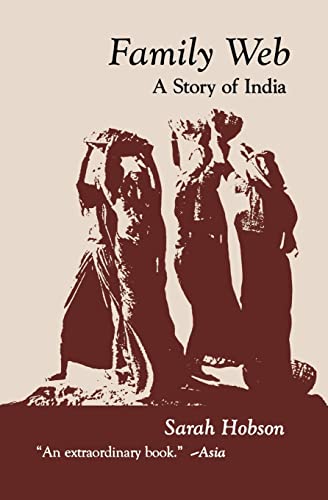
Sarah Hobson lived in a small South Indian Village with a family of twenty-six while researching a film. She observed and recorded the way of life, gaining the close confidence of the women. She reveals the hopes, ambitions and feelings of one Indian family, bringing sharply into focus the intricacy of human relationships and emotions.Die Inhaltsangabe kann sich auf eine andere Ausgabe dieses Titels beziehen.
Über die Autorin bzw. den Autor
Sarah Hobson was born in 1947 and educated in England. She first visited the Middle East at the age of seventeen when she taught English to Arab children in a Russian Orthodox school near Jerusalem. Since then she has travelled widely and grown more and more interested in studying the rural communities of the "developing" countries.
Auszug. © Genehmigter Nachdruck. Alle Rechte vorbehalten.
Case Without a Corpse
By Leo BruceChicago Review Press Incorporated
Copyright © 1937 Leo Bruce
All rights reserved.
ISBN: 978-0-89733-050-3All rights reserved.
CHAPTER 1
IT was, I shall have to admit, a dark and stormy night. I have always thought it odd that so many crimes have taken place to the accompaniment of howling winds and nightmare tempests. It is odd, but not altogether unaccountable, for they are the supremely right accompaniment. And when I look back on the affair which reached its climax that evening, I realize that the weather could not well have been otherwise.
I was staying at Braxham, a country town in one of the home counties. Actually, I like country towns. Most people say dogmatically that they must either have "the real country" or London itself. They affect to find places like Braxham — or Horsham, or Ashford, or Chelmsford or East Grinstead — provincial and dull. But I disagree. There is just enough population to form a self-contained world, and in that world surprising things take place which never reach the London Press, and types and characters develop freely, and situations become tense, and life has a dramatic way of twisting itself about. And it is all visible, audible, notable — the ideal theatre for any one like me, who wants to see things happen.
But I had another reason for staying at Braxham. My old friend Sergeant Beef, after his unexpected solution of the Thurston murder, had been promoted to this larger area. And on the evening in question, Wednesday, February 22nd, I was actually in his excellent company in the public bar of the Mitre.
Now Sergeant Beef was essentially a country policeman. His red-veined face and straggling ginger moustache, his slow movements and deliberate and plodding manner of thought, stamped him as one of those irritating rustic individuals on bicycles who stop your car without apparent provocation, to see whether you have got a mirror. His dialect, too, the mixed and curious Cockney of the districts outside London, was not calculated to assist his promotion in a Force over-run by zestful public school boys, and gentlemen trained at the police college. But there was his record. From the time he had joined the Force, a gaping, ginger-haired youth, until now that he was in his late forties, he had never, it was said, "missed his man." Whether it had been a stolen bicycle in the Sussex village he had ruled, or the murder of a doctor's wife, as in his most recent case, Sergeant Beef had stolidly but relentlessly applied the simple principles of detection he had learnt, and eventually made his arrest. With everything else against him, he had been too successful to pass over, so that here he was, in charge, at the quite important little town of Braxham.
I, personally, was delighted. The Sergeant, for me, represented most that was worth while in the English character. He appeared almost a fool, he was slow and independent, he was quite fearless, and his imagination was of the kind which did not appear till he took an important step. He loved a game and a glass, and he had the awed interest that Englishmen often have in the slick and sinister cleverness of the outwardly brilliant. And he always got there in the end.
That evening he was in mufti, playing darts. Already, I gathered, there had been murmurs in the town that the new Sergeant — he had been at Braxham for a year or more, but he was still "new" there — spent too much of his time in local pubs. The Vicar was quite concerned about it, and talked of "a bad example." There had even been a complaint to the Chief Constable. But Beef went his way. He never, he maintained, neglected his duty, and how he spent his free evenings was his own affair.
He was a passionate dart-player. I use the adjective deliberately. To watch that solid and solemn man standing before the little round board with the three darts in his hand, preparing to score his final double, was a revelation. His glazed eyes were awakened, his impassive face was lit. He was immensely happy. And yet he was no champion. He "played a decent game," people said. He "could hold his own." But his style wasn't spectacular. It was his fervour that was remarkable, not his skill.
That evening he and I had been partners against Fawcett, the postman, and Harold, the publican's son. They had come in early, for the wind and rain which lashed the street had to be faced, and they had wanted to get the walk done with, so that they could settle down by the inn fire. The little public bar was inviting, clean and warm and the dripping overcoats and umbrellas hanging near the door were visibly steaming.
Sergeant Beef and I had lost the first game, and my partner was not pleased. There was a lull in the play while we paid for the customary drinks, and as if to smooth over the slightly irritated atmosphere, Fawcett began to talk.
"I see young Rogers is home again," he said.
Sergeant Beef grunted. It was evident that he did not like "young Rogers."
"Shouldn't mind having his job," Fawcett continued.
"What is it?" I asked.
"He's a steward on one of the liners that go to South America. He gets very good money." Then, turning to Sergeant Beef, he said grinning — "Going to run him in this time, Sergeant?"
Beef, appealed to in his professional capacity, answered in the pompous voice he kept for such moments. "If'e does anything wot calls for it," he said, "'e will be arrested." And he swallowed the rest of his beer.
Fawcett winked to me. "Regular young rascal, this Rogers," he explained. "Always up to something. Last time he was home the Sergeant had him up for being drunk and disorderly. And it's not the first time he's been in trouble."
"Local boy?" I asked.
"He's not so much of a boy. Thirty-five or six, I should say. He's a nephew of Mr. Rogers, the bootmaker, in the High Street. They've only lived here about five years."
"And he's the black sheep of the town?" I suggested.
"He's a real bad hat," said Fawcett. "Not just one of your happy-go-luckies. Why, I could tell you things about him, if we wasn't in the hearing of the Law!" He nodded with a grin at the back of Sergeant Beef. "But his old aunt and uncle's crazy about 'im. They won't hear nothing against him. And he plays them up, of course. Decent old people, they are. It's a shame. But he'll come a cropper one of these days."
The publican, a Mr. Simmons, leaned over the bar. "He was in here today," he said, "not long before we closed at half-past two. He came in with that Fairfax, who stays at the Riverside Hotel."
"That chap who comes down for the fishing?"
"That's him. They came in together, him and young Rogers."
"Go on!" said Fawcett, not very interested but feigning surprise.
"Yes. I couldn't help noticing because while they were in here a foreigner came in."
"A foreigner?" said Beef. All foreigners to him were obviously suspect. "What sort of a foreigner?"
"I didn't like the look of him," said Mr. Simmons. "Dark, he was. Might have been half Indian. He couldn't speak a lot of English."
"There you are!" said Fawcett.
"Well, as soon as young Rogers and Fairfax saw this fellow, they drank up and went out. I shouldn't have noticed it, only when they'd gone the foreigner turned round to me and asks Fairfax's name."
"That's funny," admitted Beef. "Did 'e say any more?"
"No. He was gone in a minute. Almost as though he had gone after them, it was."
"I never much cared for foreigners myself," said Beef. And a moment later we were listening to war-time stories, calculated to rouse our distaste for foreigners of all sorts....
„Über diesen Titel“ kann sich auf eine andere Ausgabe dieses Titels beziehen.
Suchergebnisse für Family Web: A Story of India (Sargeant Beef Mystery)

Beispielbild für diese ISBN
Family Web: A Story of India
Verlag:
Academy Chicago Publishers (edition ), 2005
ISBN 10: 0897330501
ISBN 13: 9780897330503
Gebraucht
Paperback
Anbieter: BooksRun, Philadelphia, PA, USA
Verkäuferbewertung 5 von 5 Sternen

Paperback. Zustand: Fair. The item might be beaten up but readable. May contain markings or highlighting, as well as stains, bent corners, or any other major defect, but the text is not obscured in any way. Artikel-Nr. 0897330501-7-1-13
Gebraucht kaufen
EUR 8,18
Versand gratis
Versand innerhalb von USA
Versand innerhalb von USA
Anzahl: 1 verfügbar
Beispielbild für diese ISBN
Family Web, a story of India
Verlag:
Academy Chicago Publishers, 2005
ISBN 10: 0897330501
ISBN 13: 9780897330503
Gebraucht
Soft cover
Anbieter: N. Fagin Books, Chicago, IL, USA
Verkäuferbewertung 5 von 5 Sternen
Soft cover. Zustand: Good. 1978/1982. Asia. Academy Chicago. Good+ paperback 284p. 11/23. Artikel-Nr. 106016
Gebraucht kaufen
EUR 4,60
EUR 5,36 Versand
Versand innerhalb von USA
Versand innerhalb von USA
Anzahl: 1 verfügbar
Beispielbild für diese ISBN
Family Web : A Story of India
Verlag:
Chicago Review Press, Incorporated, 2005
ISBN 10: 0897330501
ISBN 13: 9780897330503
Gebraucht
Softcover
Anbieter: Better World Books, Mishawaka, IN, USA
Verkäuferbewertung 5 von 5 Sternen
Zustand: Very Good. Former library copy. Pages intact with possible writing/highlighting. Binding strong with minor wear. Dust jackets/supplements may not be included. Includes library markings. Stock photo provided. Product includes identifying sticker. Better World Books: Buy Books. Do Good. Artikel-Nr. 68708749-6
Gebraucht kaufen
EUR 10,11
Versand gratis
Versand innerhalb von USA
Versand innerhalb von USA
Anzahl: 1 verfügbar
Beispielbild für diese ISBN
Family Web: A Story of India
Verlag:
Academy Chicago Publishers, 2005
ISBN 10: 0897330501
ISBN 13: 9780897330503
Gebraucht
Paperback
Anbieter: ThriftBooks-Atlanta, AUSTELL, GA, USA
Verkäuferbewertung 5 von 5 Sternen
Paperback. Zustand: Very Good. No Jacket. May have limited writing in cover pages. Pages are unmarked. ~ ThriftBooks: Read More, Spend Less. Artikel-Nr. G0897330501I4N00
Gebraucht kaufen
EUR 10,22
Versand gratis
Versand innerhalb von USA
Versand innerhalb von USA
Anzahl: 1 verfügbar
Foto des Verkäufers
Family Web - A Story of India
Anbieter: WeBuyBooks, Rossendale, LANCS, Vereinigtes Königreich
Verkäuferbewertung 5 von 5 Sternen
paperback. Zustand: Good. Most items will be dispatched the same or the next working day. A copy that has been read but remains in clean condition. All of the pages are intact and the cover is intact and the spine may show signs of wear. The book may have minor markings which are not specifically mentioned. Artikel-Nr. rev5652648381
Gebraucht kaufen
EUR 5,52
EUR 7,03 Versand
Versand von Vereinigtes Königreich nach USA
Versand von Vereinigtes Königreich nach USA
Anzahl: 1 verfügbar
Beispielbild für diese ISBN
Family Web: A Story of India
Verlag:
Academy Chicago Publishers, 2005
ISBN 10: 0897330501
ISBN 13: 9780897330503
Gebraucht
Paperback
Anbieter: Robinson Street Books, IOBA, Binghamton, NY, USA
Verkäuferbewertung 4 von 5 Sternen

Paperback. Zustand: Very Good. Prompt Shipment, shipped in Boxes, Tracking PROVIDEDName in ink verso front cover else very good. Artikel-Nr. bing86812910
Gebraucht kaufen
EUR 12,41
EUR 8,48 Versand
Versand innerhalb von USA
Versand innerhalb von USA
Anzahl: 1 verfügbar
Foto des Verkäufers
Case without a corpse A Sergeant Beef mystery
Verlag:
Academy Chicago Publishers, U. S. A ., 1982
ISBN 10: 0897330501
ISBN 13: 9780897330503
Gebraucht
Softcover
Erstausgabe
Anbieter: Aucott & Thomas, Ibstock, Vereinigtes Königreich
Verkäuferbewertung 5 von 5 Sternen
Softcover. Zustand: Good. 1st American Paperback Edition. Clean and tightly bound paperback, spine creased, card covers rubbed at edges, no inscriptions. 284 pages. Artikel-Nr. 70334
Gebraucht kaufen
EUR 14,60
EUR 17,72 Versand
Versand von Vereinigtes Königreich nach USA
Versand von Vereinigtes Königreich nach USA
Anzahl: 1 verfügbar