
Verwandte Artikel zu Georges Braque (Modern Masters Series, Band 14)
Inhaltsangabe
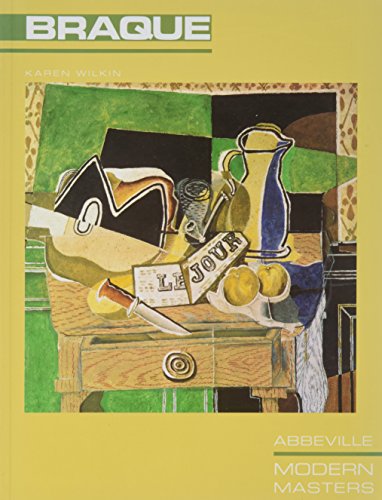
Georges Braque is one of the best-known and least-understood artists of our century. From his friends' affectionate recollections, he emerges as a cheerful and energetic dandy, renowned for his good looks, his skills as an amateur boxer, and his ability to play Beethoven symphonies on the accordion. His art suggests a different persona, however, for he was intensely serious, technically meticulous, and devoted to making thoughtful, deeply felt images—whether as a Fauve, a Cubist, or a mature painter working in his own distinctive style. Both the quiet intelligence of the man and the originality of his passionate yet elegant paintings emerge from Karen Wilkin's perceptive text and astutely chose reproductions. This invaluable study brings a new clarity to Braque's art and art making.
About the Modern Masters series:
With informative, enjoyable texts and over 100 illustrations — approximately 48 in full color — this innovative series offers a fresh look at the most creative and influential artists of the postwar era. The authors are highly respected art historians and critics chosen for their ability to think clearly and write well. Each handsomely designed volume presents a thorough survey of the artist's life and work, as well as statements by the artist, an illustrated chapter on technique, a chronology, lists of exhibitions and public collections, an annotated bibliography, and an index. Every art lover, from the casual museumgoer to the serious student, teacher, critic, or curator, will be eager to collect these Modern Masters. And with such a low price, they can afford to collect them all.
About the Modern Masters series:
With informative, enjoyable texts and over 100 illustrations — approximately 48 in full color — this innovative series offers a fresh look at the most creative and influential artists of the postwar era. The authors are highly respected art historians and critics chosen for their ability to think clearly and write well. Each handsomely designed volume presents a thorough survey of the artist's life and work, as well as statements by the artist, an illustrated chapter on technique, a chronology, lists of exhibitions and public collections, an annotated bibliography, and an index. Every art lover, from the casual museumgoer to the serious student, teacher, critic, or curator, will be eager to collect these Modern Masters. And with such a low price, they can afford to collect them all.
Die Inhaltsangabe kann sich auf eine andere Ausgabe dieses Titels beziehen.
Über die Autorin bzw. den Autor
Karen Wilkin, the author of Abbeville's Stuart Davis and David Smith.
Auszug. © Genehmigter Nachdruck. Alle Rechte vorbehalten.
INTRODUCTION
Georges Braque is one of the best-known and least-understood painters of our century, a paradigmatic modernist who only now, more than a quarter-century after his death, is beginning to be evaluated accurately. Characterized variously as radical innovator or elegant stylist, as serene classicist or temperamental individualist, as Picasso’s sidekick or as the grand old man of French painting, Braque has lacked neither attention nor admiration. Since at least the 1920 he has been regarded as an essential figure in the evolution of art in our time. Art history texts and museum installations have underlined their role as a vital collaborator in the modernist adventure, stressing, in particular, his intimate relationship with Pablo Picasso during the formative years of Cubism. The two artists’ works are hung side by side more often than not, and the phrase “Picasso and Braque” recurs as though it stood for a single being. Braque himself may have encouraged the idea when he said that he and Picasso were “roped together like mountain climbers” during those crucial years, and there are famous stories told by each artist about mistaking the other’s work for his own. While this has assured Braque’s place in the history of twentieth-century art, it has made him seem less interesting and less important in his own right, and his real individuality and real strengths have not always been fully appreciated.
Conversely, if being linked with Picasso has in some ways diminished Braque, his position in his later years as elder statesman of French paining sometimes led to his work’s being esteemed beyond its worth. Braque is unquestionably one of the giants of modern painting, but he produced many failed or weak pictures, often at the same time that he was making masterpieces. Problematic works occur more frequently toward the end of his life, when he was ill and feeble, but it is undeniable that at intervals after the late 1910s he produced ingratiating but second-rate works—pleasant but distinctly minor still lifes, tentative sculptures, uninspiring prints—that undiscriminating collectors have nonetheless found attractive. Acute eyes have always been able to distinguish between Braque’s best and lesser works, but the uncritical acceptance of secondary efforts has done little to enhance his reputation. Yet when Braque fails, he does so primarily in relation to the high standard set by his own finest work, and it is by his own highest level that he must be judged.
Braque is so clearly one of this century’s great painters—quite apart from his historical importance—that it is sometimes difficult to remember that he never laid claim to the popular imagination. He was a quintessentially unspectacular artists’ artist who led a life of exemplary dullness. There was no familial resistance to his wish to be a painter, no years of acute deprivation or struggle for recognition, no flight to exotic parts, no severed ear. Instead, there are charming anecdotes about his sturdy good looks, his prowess as an amateur boxer, his strength and athleticism. He is reported to have been a good musician, a singer with a pleasant voice, and an accomplished, enthusiastic dancer. Photographs and the recollections of his contemporaries bear out these legends. Braque’s dealer, Daniel-Henry Kahnweiler, remembered that he boasted of being able to “play Beethoven symphonies on the accordion.”
Perhaps even more than his musical ability and his strength, Braque’s looks seem to have impressed everyone. Kahnweiler described him as tall, “very handsome,” and “a complete dandy.” “In those days,” Kahnweiler recalled, “he used to wear very simple blue suits with a special cut, which I never saw on anyone but him. He also had black, square-toed shoes that did not have a thick sole, which he said came from Abbeville. Like Max Jacob, he had a black string tie, and he wore all this with a great deal of chic.” Gertrude Stein’s companion, Alice B. Toklas, recalled that when she first met Braque, his robust appearance and carefully chosen workman’s clothes “reminded her so much of an American cowboy that she always had the impression he could understand English, and so was careful in what she talked about.” Braque remained impressive. People who knew him in his old age remember him as “the best looking man in Paris,” with his clear-cut features and silver hair.
From recollections and anecdotes a portrait emerges of a cheerful, energetic artist, but the persona suggested by Braque’s paintings is rather different. He appears to be intensely serious, disciplined—especially in comparison to the mercurial Picasso—relentless in his determination to see his paintings through to the end, meticulous about the physical quality of his pictures. In interview Braque often said that he “always had a feeling for painting,” insisting that he never chose to be an artist but came to it inevitably. “I never had the idea of becoming a painter any more than I had the idea of breathing,” he once said. Yet curiously, he seems to have been anything but a natural, neither a virtuoso draftsman nor, at first, a notable colorist. Despite this apparent lack of early distinction, Braque was encouraged by his family, and by the time he was twenty-two, he had declared himself a full-time artist. Two years later he was exhibiting in the 1906 Salon des Independants for the first time, and a year later, in his second appearance at the show, he sold all six of his submissions. By the time of his first one-man show, at Kahnweiler’s new Paris gallery in 1908, Braque was already part of the circle of artists and writers we now regard as creators of some of the most advanced and provocative art of the early twentieth century—individuals whose work helps to define what we mean by modernism. The poet Guillaume Apollinaire wrote a rapturous introduction to Braque’s exhibition catalog. In spite of Apollinaire’s and Kahnweiler’s enthusiasm, Braque’s commercial success at the 1907 Salon de Independants was not repeated (nor would it be for many years), but he had already begun to attract the attention of a few enlightened observers.
Just as Braque’s early years lack the struggles of the misunderstood artist celebrated in fiction—except, of course, for private self-imposed aesthetic struggles—so, too, is novelistic romance lacking. There is no succession of discarded mistresses in his history, no litigious offspring. Braque married Marcelle Lapre when he was thirty and they remained together, childless, until the end of his life, more than half a century later. All but the first dozen years of their married life were spent in the substantial house and studio, designed by the architect Auguste Perret, that Braque had built on a quiet cul-de-sac (now called rue Georges Braque) near the Parc Montsouris, in Montparnasse. Summers were spent at their house in Varengeville, on the coast of Normandy.
Except for one dreadful incident when he served in World War I, Braque’s life was devoid of conventional drama. Having suffered a severe head wound, First Lieutenant Braque was left for dead on the battlefield. Rescued by stretcher bearers the next day, he remained in a coma for several days, recovering consciousness on his birthday. He is reported to have lost his sight temporarily, and from then on there were no more stories about Braque’s extraordinary strength (although there is a photograph of the painter standing on his head, at the beach, in 1924). For undergoing this ordeal Braque was awarded the Croix de Guerre and made a chevalier of the Legion d’Honneur.
The greatest...
Georges Braque is one of the best-known and least-understood painters of our century, a paradigmatic modernist who only now, more than a quarter-century after his death, is beginning to be evaluated accurately. Characterized variously as radical innovator or elegant stylist, as serene classicist or temperamental individualist, as Picasso’s sidekick or as the grand old man of French painting, Braque has lacked neither attention nor admiration. Since at least the 1920 he has been regarded as an essential figure in the evolution of art in our time. Art history texts and museum installations have underlined their role as a vital collaborator in the modernist adventure, stressing, in particular, his intimate relationship with Pablo Picasso during the formative years of Cubism. The two artists’ works are hung side by side more often than not, and the phrase “Picasso and Braque” recurs as though it stood for a single being. Braque himself may have encouraged the idea when he said that he and Picasso were “roped together like mountain climbers” during those crucial years, and there are famous stories told by each artist about mistaking the other’s work for his own. While this has assured Braque’s place in the history of twentieth-century art, it has made him seem less interesting and less important in his own right, and his real individuality and real strengths have not always been fully appreciated.
Conversely, if being linked with Picasso has in some ways diminished Braque, his position in his later years as elder statesman of French paining sometimes led to his work’s being esteemed beyond its worth. Braque is unquestionably one of the giants of modern painting, but he produced many failed or weak pictures, often at the same time that he was making masterpieces. Problematic works occur more frequently toward the end of his life, when he was ill and feeble, but it is undeniable that at intervals after the late 1910s he produced ingratiating but second-rate works—pleasant but distinctly minor still lifes, tentative sculptures, uninspiring prints—that undiscriminating collectors have nonetheless found attractive. Acute eyes have always been able to distinguish between Braque’s best and lesser works, but the uncritical acceptance of secondary efforts has done little to enhance his reputation. Yet when Braque fails, he does so primarily in relation to the high standard set by his own finest work, and it is by his own highest level that he must be judged.
Braque is so clearly one of this century’s great painters—quite apart from his historical importance—that it is sometimes difficult to remember that he never laid claim to the popular imagination. He was a quintessentially unspectacular artists’ artist who led a life of exemplary dullness. There was no familial resistance to his wish to be a painter, no years of acute deprivation or struggle for recognition, no flight to exotic parts, no severed ear. Instead, there are charming anecdotes about his sturdy good looks, his prowess as an amateur boxer, his strength and athleticism. He is reported to have been a good musician, a singer with a pleasant voice, and an accomplished, enthusiastic dancer. Photographs and the recollections of his contemporaries bear out these legends. Braque’s dealer, Daniel-Henry Kahnweiler, remembered that he boasted of being able to “play Beethoven symphonies on the accordion.”
Perhaps even more than his musical ability and his strength, Braque’s looks seem to have impressed everyone. Kahnweiler described him as tall, “very handsome,” and “a complete dandy.” “In those days,” Kahnweiler recalled, “he used to wear very simple blue suits with a special cut, which I never saw on anyone but him. He also had black, square-toed shoes that did not have a thick sole, which he said came from Abbeville. Like Max Jacob, he had a black string tie, and he wore all this with a great deal of chic.” Gertrude Stein’s companion, Alice B. Toklas, recalled that when she first met Braque, his robust appearance and carefully chosen workman’s clothes “reminded her so much of an American cowboy that she always had the impression he could understand English, and so was careful in what she talked about.” Braque remained impressive. People who knew him in his old age remember him as “the best looking man in Paris,” with his clear-cut features and silver hair.
From recollections and anecdotes a portrait emerges of a cheerful, energetic artist, but the persona suggested by Braque’s paintings is rather different. He appears to be intensely serious, disciplined—especially in comparison to the mercurial Picasso—relentless in his determination to see his paintings through to the end, meticulous about the physical quality of his pictures. In interview Braque often said that he “always had a feeling for painting,” insisting that he never chose to be an artist but came to it inevitably. “I never had the idea of becoming a painter any more than I had the idea of breathing,” he once said. Yet curiously, he seems to have been anything but a natural, neither a virtuoso draftsman nor, at first, a notable colorist. Despite this apparent lack of early distinction, Braque was encouraged by his family, and by the time he was twenty-two, he had declared himself a full-time artist. Two years later he was exhibiting in the 1906 Salon des Independants for the first time, and a year later, in his second appearance at the show, he sold all six of his submissions. By the time of his first one-man show, at Kahnweiler’s new Paris gallery in 1908, Braque was already part of the circle of artists and writers we now regard as creators of some of the most advanced and provocative art of the early twentieth century—individuals whose work helps to define what we mean by modernism. The poet Guillaume Apollinaire wrote a rapturous introduction to Braque’s exhibition catalog. In spite of Apollinaire’s and Kahnweiler’s enthusiasm, Braque’s commercial success at the 1907 Salon de Independants was not repeated (nor would it be for many years), but he had already begun to attract the attention of a few enlightened observers.
Just as Braque’s early years lack the struggles of the misunderstood artist celebrated in fiction—except, of course, for private self-imposed aesthetic struggles—so, too, is novelistic romance lacking. There is no succession of discarded mistresses in his history, no litigious offspring. Braque married Marcelle Lapre when he was thirty and they remained together, childless, until the end of his life, more than half a century later. All but the first dozen years of their married life were spent in the substantial house and studio, designed by the architect Auguste Perret, that Braque had built on a quiet cul-de-sac (now called rue Georges Braque) near the Parc Montsouris, in Montparnasse. Summers were spent at their house in Varengeville, on the coast of Normandy.
Except for one dreadful incident when he served in World War I, Braque’s life was devoid of conventional drama. Having suffered a severe head wound, First Lieutenant Braque was left for dead on the battlefield. Rescued by stretcher bearers the next day, he remained in a coma for several days, recovering consciousness on his birthday. He is reported to have lost his sight temporarily, and from then on there were no more stories about Braque’s extraordinary strength (although there is a photograph of the painter standing on his head, at the beach, in 1924). For undergoing this ordeal Braque was awarded the Croix de Guerre and made a chevalier of the Legion d’Honneur.
The greatest...
„Über diesen Titel“ kann sich auf eine andere Ausgabe dieses Titels beziehen.
Suchergebnisse für Georges Braque (Modern Masters Series, Band 14)

Beispielbild für diese ISBN
Braque (Modern Masters)
Anbieter: WorldofBooks, Goring-By-Sea, WS, Vereinigtes Königreich
Verkäuferbewertung 5 von 5 Sternen

Paperback. Zustand: Very Good. The book has been read, but is in excellent condition. Pages are intact and not marred by notes or highlighting. The spine remains undamaged. Artikel-Nr. GOR002749316
Gebraucht kaufen
EUR 3,85
EUR 6,53 Versand
Versand von Vereinigtes Königreich nach USA
Versand von Vereinigtes Königreich nach USA
Anzahl: 1 verfügbar
Foto des Verkäufers
Braque (Modern Masters)
Anbieter: WeBuyBooks, Rossendale, LANCS, Vereinigtes Königreich
Verkäuferbewertung 5 von 5 Sternen
paperback. Zustand: Very Good. Most items will be dispatched the same or the next working day. A copy that has been read, but is in excellent condition. Pages are intact and not marred by notes or highlighting. The spine remains undamaged. Artikel-Nr. rev3945061187
Gebraucht kaufen
EUR 1,60
EUR 9,27 Versand
Versand von Vereinigtes Königreich nach USA
Versand von Vereinigtes Königreich nach USA
Anzahl: 2 verfügbar
Foto des Verkäufers
Braque (Modern Masters)
Anbieter: WeBuyBooks, Rossendale, LANCS, Vereinigtes Königreich
Verkäuferbewertung 5 von 5 Sternen
paperback. Zustand: Good. Most items will be dispatched the same or the next working day. A copy that has been read but remains in clean condition. All of the pages are intact and the cover is intact and the spine may show signs of wear. The book may have minor markings which are not specifically mentioned. Artikel-Nr. rev6710302876
Gebraucht kaufen
EUR 1,60
EUR 9,27 Versand
Versand von Vereinigtes Königreich nach USA
Versand von Vereinigtes Königreich nach USA
Anzahl: 1 verfügbar
Beispielbild für diese ISBN
Braque (Modern Masters)
Anbieter: Reuseabook, Gloucester, GLOS, Vereinigtes Königreich
Verkäuferbewertung 5 von 5 Sternen
Paperback. Zustand: Used; Very Good. Dispatched, from the UK, within 48 hours of ordering. Though second-hand, the book is still in very good shape. Minimal signs of usage may include very minor creasing on the cover or on the spine. Artikel-Nr. CHL10921558
Gebraucht kaufen
EUR 3,85
EUR 8,16 Versand
Versand von Vereinigtes Königreich nach USA
Versand von Vereinigtes Königreich nach USA
Anzahl: 1 verfügbar
Beispielbild für diese ISBN
Georges Braque
Anbieter: ThriftBooks-Dallas, Dallas, TX, USA
Verkäuferbewertung 5 von 5 Sternen
Paperback. Zustand: Fair. No Jacket. Readable copy. Pages may have considerable notes/highlighting. ~ ThriftBooks: Read More, Spend Less. Artikel-Nr. G0896599477I5N00
Gebraucht kaufen
EUR 12,64
Versand gratis
Versand innerhalb von USA
Versand innerhalb von USA
Anzahl: 1 verfügbar
Beispielbild für diese ISBN
Georges Braque
Verlag:
Abbeville Press, Incorporated, 1991
ISBN 10: 0896599477
ISBN 13: 9780896599475
Gebraucht
Softcover
Anbieter: Better World Books, Mishawaka, IN, USA
Verkäuferbewertung 5 von 5 Sternen
Zustand: Very Good. Former library copy. Pages intact with possible writing/highlighting. Binding strong with minor wear. Dust jackets/supplements may not be included. Includes library markings. Stock photo provided. Product includes identifying sticker. Better World Books: Buy Books. Do Good. Artikel-Nr. GRP77890901
Gebraucht kaufen
EUR 12,73
Versand gratis
Versand innerhalb von USA
Versand innerhalb von USA
Anzahl: 1 verfügbar
Beispielbild für diese ISBN
Georges Braque (Modern Masters Series)
Anbieter: Phatpocket Limited, Waltham Abbey, HERTS, Vereinigtes Königreich
Verkäuferbewertung 5 von 5 Sternen
Zustand: Good. Your purchase helps support Sri Lankan Children's Charity 'The Rainbow Centre'. Ex-library, so some stamps and wear, but in good overall condition. Our donations to The Rainbow Centre have helped provide an education and a safe haven to hundreds of children who live in appalling conditions. Artikel-Nr. Z1-W-007-02373
Gebraucht kaufen
EUR 3,90
EUR 12,40 Versand
Versand von Vereinigtes Königreich nach USA
Versand von Vereinigtes Königreich nach USA
Anzahl: 1 verfügbar
Beispielbild für diese ISBN
Georges Braque (Modern Masters Series)
Verlag:
Abbeville Press, 1991
ISBN 10: 0896599477
ISBN 13: 9780896599475
Gebraucht
Soft cover
Erstausgabe
Anbieter: Bookplate, Chestertown, MD, USA
Verkäuferbewertung 4 von 5 Sternen

Soft cover. Zustand: Very Good. 1st Edition. Fine copy. Very subtle sticker ghost on rear board. BP/ Art by B. Artikel-Nr. ABE-1622919878977
Gebraucht kaufen
EUR 16,30
EUR 7,48 Versand
Versand innerhalb von USA
Versand innerhalb von USA
Anzahl: 1 verfügbar
Beispielbild für diese ISBN
Georges Braque (Modern Masters Series)
Anbieter: medimops, Berlin, Deutschland
Verkäuferbewertung 5 von 5 Sternen
Zustand: good. Befriedigend/Good: Durchschnittlich erhaltenes Buch bzw. Schutzumschlag mit Gebrauchsspuren, aber vollständigen Seiten. / Describes the average WORN book or dust jacket that has all the pages present. Artikel-Nr. M00896599477-G
Gebraucht kaufen
EUR 14,84
EUR 10,00 Versand
Versand von Deutschland nach USA
Versand von Deutschland nach USA
Anzahl: 1 verfügbar
Foto des Verkäufers
GEORGES BRAQUE (Modern Masters Series)
Verlag:
Abbeville Press, New York, 1995
ISBN 10: 0896599477
ISBN 13: 9780896599475
Gebraucht
Original Wraps
Erstausgabe
Anbieter: Orlando Booksellers, Lincoln, Vereinigtes Königreich
Verkäuferbewertung 5 von 5 Sternen
Original Wraps. Zustand: Near Fine. Zustand des Schutzumschlags: No Jacket, as Issued. First UK Simultaneous Paperback Edition. First impression of the true first edition. Large format paperback edition. The book was also issued in a hardback edition. ***Illustrated with black and white and colour plates throughout. ***Near fine in colour-illustrated wrappers. Colour photo-illustrated double-page front and rear free endpapers and pastedowns showing Braque in his studio. No inscriptions. No tears. Pages clean. Spine tight. Spine slightly faded. Front and rear wrappers bright and clean. ***280 x 216 mm. 127 pages including select bibliography and index to rear. ***'Georges Braque is one of the best-known and least-understood artists of our century. From his friends' affectionate recollections, he emerges as a cheerful and energetic dandy, renowned for his good looks, his skills as an amateur boxer, and his ability to play Beethoven symphonies on the accordion. His art suggests a different persona, however, for he was intensely serious, technically meticulous, and devoted to making thoughtful, deeply felt images - whether as a Fauve, a cubist, or a mature painter working in his own distinctive style. Both the quiet intelligence of the man and the originality of his passionate yet elegant paintings emerge from Karen Wilkins' perceptive text and astutely chosen reproductions. This invaluable study brings a new clarity to Braque's art and art making.' (Quote from rear wrapper blurb). ***First impression of the true first edition, wrappers issue, in very nice condition. ***For all our books, postage is charged at cost, allowing for packaging: any shipping rates indicated on ABE are an average only: we will reduce the P & P charge where appropriate - please contact us for postal rates for heavier books and sets etc. Artikel-Nr. 6837
Gebraucht kaufen
EUR 21,61
EUR 23,31 Versand
Versand von Vereinigtes Königreich nach USA
Versand von Vereinigtes Königreich nach USA
Anzahl: 1 verfügbar