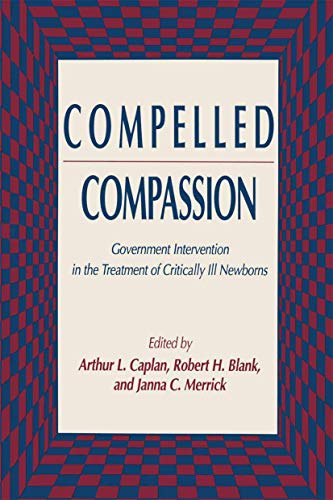
Compelled Compassion: Government Intervention in the Treatment of Critically Ill Newborns (Contemporary Issues in Biomedicine, Ethics, and Society) - Hardcover
Inhaltsangabe
In April 1982, an infant boy was born in Bloomington, Indiana, with Down syndrome and a defective, but surgically correctable, esophagus. His parents refused to consent to surgery or intravenous feeding. The hospital unsuccessfully sought a court order to force treatment, and appeals to higher courts also failed. The child, identified as Baby Doe by the news media, subsequently died. The events in Bloomington became the catalyst for action by the Reagan administration, the courts, and Congress that culminated in a federal policy that makes failure to treat newborns with disabilities a form of child neglect. This book centers on the public policy aspects of withholding treatment from critically ill newborns who are disabled. Specifically, it deals with why the policy was enacted and what impact it has had on health care workers, families, and infants. Some of the contributors to this book spearheaded the early debate on withholding treatment. Anthony Shaw’s New York Times Magazine article in 1972 was the first to address these issues in the popular press. The following year, he published a related article in the New England Journal of Medicine. Also appearing in this same issue of NEJM, was the pathbreaking study, coauthored by A. G. M. Campbell, on withholding treatment in the special care nursery at Yale-New Haven Hospital. Each of these articles promoted much public and professional discussion.
Die Inhaltsangabe kann sich auf eine andere Ausgabe dieses Titels beziehen.
Críticas
...an excellent contribution...a worthwhile addition to any library. -International Digest of Health Legislation
Reseña del editor
In April 1982, an infant boy was born in Bloomington, Indiana, with Down syndrome and a defective, but surgically correctable, esophagus. His parents refused to consent to surgery or intravenous feeding. The hospital unsuccessfully sought a court order to force treatment, and appeals to higher courts also failed. The child, identified as Baby Doe by the news media, subsequently died. The events in Bloomington became the catalyst for action by the Reagan administration, the courts, and Congress that culminated in a federal policy that makes failure to treat newborns with disabilities a form of child neglect. This book centers on the public policy aspects of withholding treatment from critically ill newborns who are disabled. Specifically, it deals with why the policy was enacted and what impact it has had on health care workers, families, and infants. Some of the contributors to this book spearheaded the early debate on withholding treatment. Anthony Shaw's New York Times Magazine article in 1972 was the first to address these issues in the popular press. The following year, he published a related article in the New England Journal of Medicine. Also appearing in this same issue of NEJM, was the pathbreaking study, coauthored by A. G. M. Campbell, on withholding treatment in the special care nursery at Yale-New Haven Hospital. Each of these articles promoted much public and professional discussion.
„Über diesen Titel“ kann sich auf eine andere Ausgabe dieses Titels beziehen.
Weitere beliebte Ausgaben desselben Titels

Suchergebnisse für Compelled Compassion: Government Intervention in the...

Beispielbild für diese ISBN
Compelled Compassion: Government Intervention In The Treatment Of Critically Ill Newborns (Contemporary Issues In Biomedicine, Ethics, And Society)
Anbieter: Romtrade Corp., STERLING HEIGHTS, MI, USA
Verkäuferbewertung 5 von 5 Sternen

Zustand: New. This is a Brand-new US Edition. This Item may be shipped from US or any other country as we have multiple locations worldwide. Artikel-Nr. ABNR-254951
Beispielbild für diese ISBN
Compelled Compassion
Anbieter: Majestic Books, Hounslow, Vereinigtes Königreich
Verkäuferbewertung 4 von 5 Sternen

Zustand: New. pp. 352 52:B&W 6.14 x 9.21in or 234 x 156mm (Royal 8vo) Case Laminate on White w/Gloss Lam. Artikel-Nr. 7594711
Neu kaufen
EUR 41,16
EUR 7,51 shipping
Versand von Vereinigtes Königreich nach USA
Versand von Vereinigtes Königreich nach USA
Anzahl: 1 verfügbar
Beispielbild für diese ISBN
Compelled Compassion
Anbieter: Romtrade Corp., STERLING HEIGHTS, MI, USA
Verkäuferbewertung 5 von 5 Sternen
Zustand: New. This is a Brand-new US Edition. This Item may be shipped from US or any other country as we have multiple locations worldwide. Artikel-Nr. ABNR-83908
Foto des Verkäufers
Compelled Compassion: Government Intervention in the Treatment of Critically Ill Newborns
Anbieter: moluna, Greven, Deutschland
Verkäuferbewertung 4 von 5 Sternen
Gebunden. Zustand: New. In April 1982, an infant boy was born in Bloomington, Indiana, with Down syndrome and a defective, but surgically correctable, esophagus. His parents refused to consent to surgery or intravenous feeding. The hospital unsuccessfully sought a court order to f. Artikel-Nr. 458446059
Neu kaufen
EUR 124,02
EUR 48,99 shipping
Versand von Deutschland nach USA
Versand von Deutschland nach USA
Anzahl: Mehr als 20 verfügbar
Foto des Verkäufers
Compelled Compassion : Government Intervention in the Treatment of Critically Ill Newborns
Anbieter: AHA-BUCH GmbH, Einbeck, Deutschland
Verkäuferbewertung 5 von 5 Sternen
Buch. Zustand: Neu. Neuware - In April 1982, an infant boy was born in Bloomington, Indiana, with Down syndrome and a defective, but surgically correctable, esophagus. His parents refused to consent to surgery or intravenous feeding. The hospital unsuccessfully sought a court order to force treatment, and appeals to higher courts also failed. The child, identified as Baby Doe by the news media, subsequently died. The events in Bloomington became the catalyst for action by the Reagan administration, the courts, and Congress that culminated in a federal policy that makes failure to treat newborns with disabilities a form of child neglect. This book centers on the public policy aspects of withholding treatment from critically ill newborns who are disabled. Specifically, it deals with why the policy was enacted and what impact it has had on health care workers, families, and infants. Some of the contributors to this book spearheaded the early debate on withholding treatment. Anthony Shaw's New York Times Magazine article in 1972 was the first to address these issues in the popular press. The following year, he published a related article in the New England Journal of Medicine. Also appearing in this same issue of NEJM, was the pathbreaking study, coauthored by A. G. M. Campbell, on withholding treatment in the special care nursery at Yale-New Haven Hospital. Each of these articles promoted much public and professional discussion. Artikel-Nr. 9780896032248
Neu kaufen
EUR 153,14
EUR 63,86 shipping
Versand von Deutschland nach USA
Versand von Deutschland nach USA
Anzahl: 2 verfügbar