
Verwandte Artikel zu Exploding Technical Communication: Workplace Literacy...
Exploding Technical Communication: Workplace Literacy Hierarchies and Their Implications for Literacy Sponsorship - Softcover
Buch 40 von 45: Baywood's Technical Communications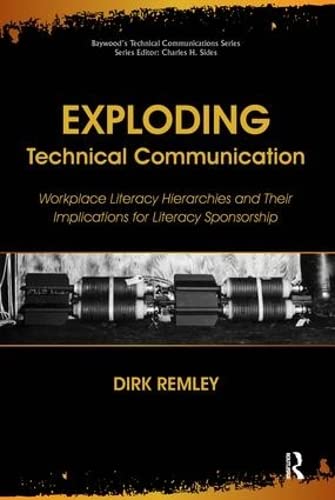
Inhaltsangabe
Within the framework of New Literacy Studies, Dirk Remley presents a historical study of how technical communication practices at a World War II arsenal sponsored literacy within the community in which it operated from 1940 to 1960 and contemporary implications of similar forms of sponsorship. The Training within Industry (TWI) methods developed by the U.S. government and industry at that time included multimodal literate practices, particularly combinations of visual, oral, experiential, and print-linguistic text. Analyses reveal a hierarchy in which print-linguistic literacies were generally esteemed at the workplace and in the community. This literacy hierarchy contributed to a catastrophic accident that killed 11 people, prompting changes in the approach to designing certain training documents. This book links technical communication, especially the multimodal forms of representation commonly found in technical communication and instructional materials, to the concept of literacy sponsorship. The TWI methods used in training and system improvement during World War II are currently applied in business and industry as part of the "lean operating" and "continuous improvement" philosophies. These methods have also become part of the experiential learning philosophy favored in academia. Remley includes examples of current applications of multimodal forms of technical communication similar to those used at the arsenal as well as new media-related applications related to training and instruction. He also discusses their implications for literacy sponsorship. This book provides useful information for technical communication and literacy scholars and educators as well as practical case studies for business leaders, consultants, and practitioners. Intended Audience: Scholars in technical communication and literacy/writing studies; scholars in business (especially management and organizational analysis) and business communication consultants; scholars in history and sociology.
Die Inhaltsangabe kann sich auf eine andere Ausgabe dieses Titels beziehen.
Über die Autorin bzw. den Autor
Dirk Remley has taught business writing and technical writing courses for over 20 years at Kent State University, where he also earned a PhD in rhetoric and composition. His publications pertain to literacy practices and writing pedagogies, particularly those connected to workplace communication. He has published work in the Community Literacy Journal, Across the Disciplines, Computers and Composition Online, Computers and Composition, and Writing and Pedagogy, in addition to multiple handbook chapters. He has also made presentations at numerous national conferences.
Von der hinteren Coverseite
IN PRAISE OF "This is a wonderfully grounded study that shows us where dominant forms of literacy come from, how they change people, and how they have lasting consequences for communities that get caught up in them. Dirk Remley brings much-needed historical—and humanizing—perspective to the state of technical communication today." —Deborah Brandt, University of Wisconsin–Madison "Connections between technical and professional communication and literacy studies have been too infrequent given the overwhelming evidence that in people's lived experience, issues of work, technology, and literacy are variously and persistently braided. Professor Remley's book begins with a bomb-handling accident and, by posing a set of literacy questions related to how and why the accident occurs, takes us on a journey through time in order to historicize the practice of literacy in one community. The book covers a remarkable amount of ground along the way as it considers how particular sponsorship dynamics work to influence what counts as literacy. In so doing, Professor Remley brings the sponsorship conversation to technical and professional communication, disrupts the too-clean distinctions between 'school,' 'workplace,' 'home,' and 'community,' and shows how sponsorship dynamics that start in the workplace influence a local literacy ecology. It is a big book with much to offer a range of audiences." —Jeff Grabill, Michigan State University
Aus dem Klappentext
IN PRAISE OF "This is a wonderfully grounded study that shows us where dominant forms of literacy come from, how they change people, and how they have lasting consequences for communities that get caught up in them. Dirk Remley brings much-needed historical and humanizing perspective to the state of technical communication today." Deborah Brandt, University of Wisconsin Madison "Connections between technical and professional communication and literacy studies have been too infrequent given the overwhelming evidence that in people's lived experience, issues of work, technology, and literacy are variously and persistently braided. Professor Remley's book begins with a bomb-handling accident and, by posing a set of literacy questions related to how and why the accident occurs, takes us on a journey through time in order to historicize the practice of literacy in one community. The book covers a remarkable amount of ground along the way as it considers how particular sponsorship dynamics work to influence what counts as literacy. In so doing, Professor Remley brings the sponsorship conversation to technical and professional communication, disrupts the too-clean distinctions between 'school,' 'workplace,' 'home,' and 'community,' and shows how sponsorship dynamics that start in the workplace influence a local literacy ecology. It is a big book with much to offer a range of audiences." Jeff Grabill, Michigan State University
„Über diesen Titel“ kann sich auf eine andere Ausgabe dieses Titels beziehen.
Suchergebnisse für Exploding Technical Communication: Workplace Literacy...

Foto des Verkäufers
Exploding Technical Communication: Workplace Literacy Hierarchies and Their Implications for Literacy Sponsorship (Baywood's Technical Communications Series)
Anbieter: Our Kind Of Books, Liphook, Vereinigtes Königreich
Verkäuferbewertung 5 von 5 Sternen

Soft cover. Zustand: As New. 1st Edition. This book has been in storage since publication and is unread. Hence the description 'as new'. Artikel-Nr. 2305008
Gebraucht kaufen
EUR 8,53
EUR 26,22 Versand
Versand von Vereinigtes Königreich nach USA
Versand von Vereinigtes Königreich nach USA
Anzahl: 1 verfügbar
Beispielbild für diese ISBN
Exploding Technical Communication
Verlag:
Baywood Publishing Company, Incorporated, 2014
ISBN 10: 0895038900
ISBN 13: 9780895038906
Neu
Softcover
Anbieter: Majestic Books, Hounslow, Vereinigtes Königreich
Verkäuferbewertung 4 von 5 Sternen

Zustand: New. pp. 206. Artikel-Nr. 322551715
Neu kaufen
EUR 74,25
EUR 7,69 Versand
Versand von Vereinigtes Königreich nach USA
Versand von Vereinigtes Königreich nach USA
Anzahl: 3 verfügbar
Beispielbild für diese ISBN
Exploding Technical Communication: Workplace Literacy Hierarchies and Their Implications for Literacy Sponsorship
Anbieter: Revaluation Books, Exeter, Vereinigtes Königreich
Verkäuferbewertung 5 von 5 Sternen
Paperback. Zustand: Brand New. 204 pages. 8.80x5.90x0.50 inches. In Stock. Artikel-Nr. 0895038900
Neu kaufen
EUR 113,76
EUR 11,84 Versand
Versand von Vereinigtes Königreich nach USA
Versand von Vereinigtes Königreich nach USA
Anzahl: 1 verfügbar