
Verwandte Artikel zu A New Science of Life: The Hypothesis of Morphic Resonance
Inhaltsangabe
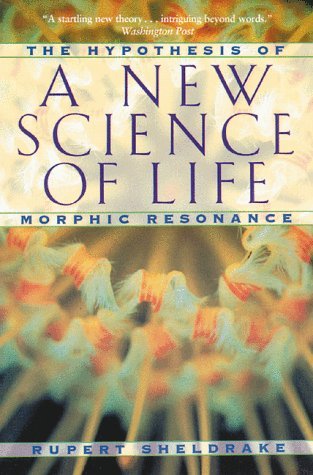
Why do many phenonmena defy the explanations of conventional biology and physics? For instance, when laboratory rats in one place have learned how to navigate a new maze, why do rats elsewhere seem to learn it more easily? Rupert Sheldrake describes this process as morphic resonance: the past forms and behaviors of organisms, he argues, influence organisms in the present through direct connections across time and space. Calling into question many of our fundamental concepts about life and consciousness, Sheldrake reinterprets the regularities of nature as being more like habits than immutable laws.
The first edition of A New Science of Life created a furor when it appeared, provoking the outrage of the old-guard scientific community and the approbation of the new. The British journal Nature called it "the best candidate for burning there has been for many years." A lively debate ensued, as researchers devised experiments testing Sheldrake's hypothesis, including some involving millions of people through the medium of television. These developments are recorded in this revised and expanded edition.
Die Inhaltsangabe kann sich auf eine andere Ausgabe dieses Titels beziehen.
Über die Autorin bzw. den Autor
Rupert Sheldrake , Ph.D., is a former Research Fellow of the Royal Society and was a scholar of Clare College, Cambridge, and a Frank Knox Fellow at Harvard University. His other books include The Presence of the Past, The Rebirth of Nature, and Seven Experiments That Could Change the World. He lives in London with his wife and two sons.
Von der hinteren Coverseite
NEW SCIENCE / BIOLOGY
"As far-reaching in its implications as Darwin's theory of evolution."
--Brain/Mind Bulletin
"An important scientific inquiry into the nature of biological and physical reality."
--New Scientist
"An immensely challenging and stimulating hypothesis, which proposes an unorthodox approach to evolution."
--Arthur Koestler, author of The Lotus and the Robot and The Ghost in the Machine
"Sheldrake is a Cambridge-trained research biologist whose modest proposals. . . have upset scientific orthodoxy"
--Utne Reader
Why do many phenonmena defy the explanations of conventional biology and physics? For instance, when laboratory rats in one place have learned how to navigate a new maze, why do rats elsewhere seem to learn it more easily? Rupert Sheldrake describes this process as morphic resonance: the past forms and behaviors of organisms, he argues, influence organisms in the present through direct connections across time and space. Calling into question many of our fundamental concepts about life and consciousness, Sheldrake reinterprets the regularities of nature as being more like habits than immutable laws.
The first edition of A New Science of Life created a furor when it appeared, provoking the outrage of the old-guard scientific community and the approbation of the new. The British journal Nature called it "the best candidate for burning there has been for many years." A lively debate ensued, as researchers devised experiments testing Sheldrake's hypothesis, including some involving millions of people through the medium of television. These developments are recorded in this revised and expanded edition.
RUPERT SHELDRAKE, Ph.D., is a former Research Fellow of the Royal Society and was a scholar of Clare College, Cambridge, and a Frank Knox Fellow at Harvard University. His other books include The Presence of the Past, The Rebirth of Nature, and Seven Experiments That Could Change the World. He lives in London with his wife and two sons.
„Über diesen Titel“ kann sich auf eine andere Ausgabe dieses Titels beziehen.
Suchergebnisse für A New Science of Life: The Hypothesis of Morphic Resonance

Beispielbild für diese ISBN
A New Science of Life: The Hypothesis of Morphic Resonance
Verlag:
Park Street Pr (edition ), 1995
ISBN 10: 0892815353
ISBN 13: 9780892815357
Gebraucht
Paperback
Anbieter: BooksRun, Philadelphia, PA, USA
Verkäuferbewertung 5 von 5 Sternen

Paperback. Zustand: Very Good. It's a well-cared-for item that has seen limited use. The item may show minor signs of wear. All the text is legible, with all pages included. It may have slight markings and/or highlighting. Artikel-Nr. 0892815353-11-1
Gebraucht kaufen
EUR 11,81
Versand gratis
Versand innerhalb von USA
Versand innerhalb von USA
Anzahl: 2 verfügbar
Beispielbild für diese ISBN
A New Science of Life: The Hypothesis of Morphic Resonance
Verlag:
Park Street Press, Rochester, 1995
ISBN 10: 0892815353
ISBN 13: 9780892815357
Gebraucht
Soft cover
Erstausgabe
Anbieter: Bookplate, Chestertown, MD, USA
Verkäuferbewertung 4 von 5 Sternen

Soft cover. Zustand: Near Fine. 1st Edition. P/O last name to half-title page, else fine copy with sharp edges and crease-free spine. BP/Science/Biology. Artikel-Nr. ABE-1784232257703
Gebraucht kaufen
EUR 18,10
EUR 7,47 Versand
Versand innerhalb von USA
Versand innerhalb von USA
Anzahl: 1 verfügbar
Beispielbild für diese ISBN
A new Science of Life - The Hypothesis of Morphic Resonance.
Verlag:
Rochester, Vermont. Park Street Press. 1995., 1995
ISBN 10: 0892815353
ISBN 13: 9780892815357
Gebraucht
Softcover
Anbieter: Worpsweder Antiquariat, Worpswede, Deutschland
Verkäuferbewertung 5 von 5 Sternen
Card Covers. 272pp. 3rd edition. Large 8vo. Glue marks on the Cover. Pages slightly sunned. slightly used. ISBN 0892815353. Artikel-Nr. 553245
Gebraucht kaufen
EUR 29,00
EUR 48,00 Versand
Versand von Deutschland nach USA
Versand von Deutschland nach USA
Anzahl: 1 verfügbar
Foto des Verkäufers
New Science of Life: The Hypothesis of Morphic Resonance Book by Rupert Sheldrake
Anbieter: West Cove UK, Wellington, Vereinigtes Königreich
Verkäuferbewertung 5 von 5 Sternen
Softcover. Zustand: Like New. Immediate dispatch from Somerset. Book in excellent unread/unused condition. Softcover. English. Pub Year 1995, See images for condition. About the book >.>.> In New Science of Life: The Hypothesis of Morphic Resonance, Rupert Sheldrake, a Cambridge-trained biologist, presents a provocative exploration of how the past influences the present through a concept he terms morphic resonance. Sheldrake posits that the learned behaviours and forms of organisms from the past serve as guiding influences for their contemporary counterparts, challenging conventional biological explanations. His hypothesis addresses phenomena such as why rats that have learnt to navigate a maze seem to have an advantage when similar experiments are conducted elsewhere, suggesting a connection across time and space.The book invites readers to reconsider fundamental assumptions regarding life and consciousness. Sheldrake proposes that natural regularities function more like habits developed over time rather than fixed laws, suggesting a more dynamic interplay between organisms and their environments. This perspective has incited significant debate, provoking both acclaim from progressive scientists and criticism from the established scientific community.The initial release of A New Science of Life caused considerable controversy, with the British journal Nature infamously criticising it as ?the best candidate for burning,? illustrating the polarising nature of Sheldrake's ideas. Through his expansive exploration of morphic resonance, Sheldrake seeks to expand our understanding of biology and consciousness, making a case for a new dimension to scientific inquiry that acknowledges the influences of the past on present behaviours. His work urges readers to explore the boundaries of science, as well as the implications of interconnectedness across time and species. Artikel-Nr. Batch-FM733-LN-14720
Gebraucht kaufen
EUR 51,98
EUR 30,17 Versand
Versand von Vereinigtes Königreich nach USA
Versand von Vereinigtes Königreich nach USA
Anzahl: 1 verfügbar