
Verwandte Artikel zu Differential Geometry and Its Applications (Classroom...
Inhaltsangabe
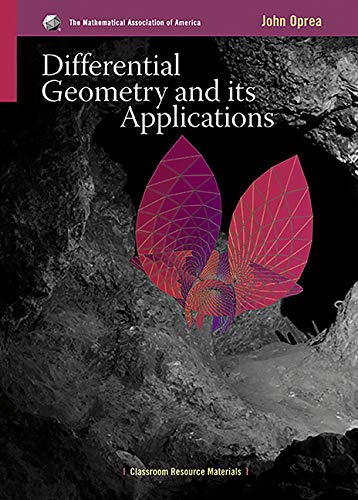
This book studies the differential geometry of surfaces and its relevance to engineering and the sciences.
Die Inhaltsangabe kann sich auf eine andere Ausgabe dieses Titels beziehen.
Über die Autorin bzw. den Autor
John Oprea was born in Cleveland, Ohio and was educated at Case Western Reserve University and at Ohio State University. He received his PhD at OSU in 1982 and, after a post-doc at Purdue university, he began his tenure at Cleveland State in 1985. Oprea is a member of the Mathematical Association of America and the America Mathematical Society. He is an Associate Editor of the Journal of Geometry and Symmetry in Physics. In 1996, Oprea was awarded the MAA’s Lester R. Ford award for his Monthly article, “Geometry and the Foucault Pendulum.” Besides various journal articles on topology and geometry, he is also the author of The Mathematics of Soap Films (AMS Student Math Library, volume 10), Symplectic Manifolds with no Kähler Structure (with A. Tralle, Springer Lecture Notes in Mathematics, volume 1661), Lusternik-Schnirelmann Category (with O. Cornea, G. Lupton and D. Tanré, AMS Mathematical Surveys and Monographs, volume 103) and the forthcoming Algebraic Models in Geometry (with Y. Félix and D. Tanré, for Oxford University Press).
Aus dem Klappentext
Differential geometry has a long, wonderful history it has found relevance in areas ranging from machinery design of the classification of four-manifolds to the creation of theories of natures fundamental forces to the study of DNA. This book studies the differential geometry of surfaces with the goal of helping students make the transition from the compartmentalized courses in a standard university curriculum to a type of mathematics that is a unified whole, it mixes geometry, calculus, linear algebra, differential equations, complex variables, the calculus of variations, and notions from the sciences. Differential geometry is not just for mathematics majors, it is also for students in engineering and the sciences. Into the mix of these ideas comes the opportunity to visualize concepts through the use of computer algebra systems such as Maple. The book emphasizes that this visualization goes hand-in-hand with the understanding of the mathematics behind the computer construction. Students will not only see geodesics on surfaces, but they will also see the effect that an abstract result such as the Clairaut relation can have on geodesics. Furthermore, the book shows how the equations of motion of particles constrained to surfaces are actually types of geodesics. Students will also see how particles move under constraints. The book is rich in results and exercises that form a continuous spectrum, from those that depend on calculation to proofs that are quite abstract.
„Über diesen Titel“ kann sich auf eine andere Ausgabe dieses Titels beziehen.
Suchergebnisse für Differential Geometry and Its Applications (Classroom...

Beispielbild für diese ISBN
Differential Geometry and Its Applications
Verlag:
Mathematical Association of America (MAA), 2007
ISBN 10: 0883857480
ISBN 13: 9780883857489
Gebraucht
Hardcover
Anbieter: ThriftBooks-Atlanta, AUSTELL, GA, USA
Verkäuferbewertung 5 von 5 Sternen

Hardcover. Zustand: Fair. No Jacket. Readable copy. Pages may have considerable notes/highlighting. ~ ThriftBooks: Read More, Spend Less. Artikel-Nr. G0883857480I5N00
Gebraucht kaufen
EUR 39,57
Versand gratis
Versand innerhalb von USA
Versand innerhalb von USA
Anzahl: 1 verfügbar
Foto des Verkäufers
Differential Geometry and its Applications (Mathematical Association of America Textbooks)
Verlag:
The Mathematical Association of America, 2007
ISBN 10: 0883857480
ISBN 13: 9780883857489
Gebraucht
Hardcover
Anbieter: WeBuyBooks, Rossendale, LANCS, Vereinigtes Königreich
Verkäuferbewertung 5 von 5 Sternen
hardcover. Zustand: Like New. Most items will be dispatched the same or the next working day. An apparently unread copy in perfect condition. Dust cover is intact with no nicks or tears. Spine has no signs of creasing. Pages are clean and not marred by notes or folds of any kind. Artikel-Nr. rev5168264300
Gebraucht kaufen
EUR 37,25
EUR 12,59 Versand
Versand von Vereinigtes Königreich nach USA
Versand von Vereinigtes Königreich nach USA
Anzahl: 1 verfügbar
Beispielbild für diese ISBN
Differential Geometry and its Applications. [Mathematical Association of America Textbooks]
Verlag:
The Mathematical Association of America (MAA), 2007
ISBN 10: 0883857480
ISBN 13: 9780883857489
Gebraucht
Hardcover
Anbieter: G. & J. CHESTERS, TAMWORTH, Vereinigtes Königreich
Verkäuferbewertung 5 von 5 Sternen
Hardcover. Zustand: Fine. pp.xxi, 469 pages, a Fine (as new) hardback, publisher's original pictorial laminated boards (no dust-jacket ever issued) [0883857480]. Book is completely clean (and shining) - probably never used as the Mathematics was too complex for the previous book owner. Artikel-Nr. 65626
Gebraucht kaufen
EUR 61,20
EUR 8,14 Versand
Versand von Vereinigtes Königreich nach USA
Versand von Vereinigtes Königreich nach USA
Anzahl: 1 verfügbar