
Verwandte Artikel zu The Social Contract (Great Books in Philosophy)
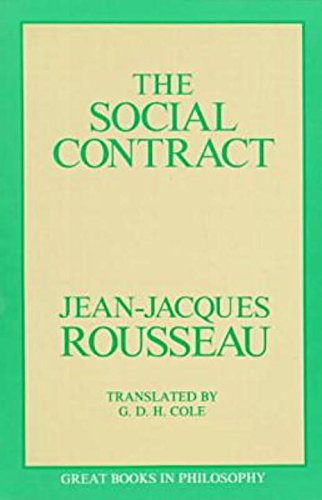
Inhaltsangabe
With the publication of The Social Contract in 1761, Jean-Jacques Rousseau took his place among the leading political philosophers of the Enlightenment. Like his contractarian predecessors (Thomas Hobbes and John Locke), Rousseau sought to ground his political theory in an understanding of human nature, which he believed to be basically good but corrupted by the conflicting interests within society. Here self-interest degenerated into a state of war from which humanity could only be extricated by the imposition of a contract. As a party to the compact, each individual would find his true interest served within the political expression of the community of man, or the "general will."
What is the content of human nature and how does it compel mankind to come together to create a civil society? What form does this society take? What benefits does it offer its citizens, and what must each individual sacrifice to reap its rewards? How does sovereign power manifest itself, and what consequences follow for those who choose not to abide by the "general will"? Does Rousseau's political theory set forth a blueprint for democracy -- one that results in equality, universal suffrage, and popular sovereignty -- or is it a recipe for central state totalitarianism? These are just a few of the complex questions that will confront readers of The Social Contract.
Whatever their intent or ultimate result, Jean-Jacques Rousseau's views on the state and man's relationship to it have culminated in one of the most powerful and compelling pieces of political philosophy ever written.
Die Inhaltsangabe kann sich auf eine andere Ausgabe dieses Titels beziehen.
Über die Autorin bzw. den Autor
JEAN-JACQUES ROUSSEAU was born in Geneva on June 28, 1712, and raised by his father after his mother died giving him life. The reproachment Rousseau experienced at his father's hand produced feelings of guilt and inferiority that were to haunt him throughout his life. During his youth, Rousseau wandered throughout Europe from job to job. Having moved to Paris from the city of Lyon in 1742, Rousseau sought the intellectual life and soon became associated with Denis Diderot and the philosophes.
Rousseau's literary career began with his entry in an essay contest in 1749 on the subject of the relationship of science and the arts to morals. His winning essay, Discourses on Sciences and the Arts, soon became the foundation for his later work entitled the Discourse on the Origin of Inequality (1753). With its publication, he became a figure of some controversy in France. Ideological differences between his views and those of his Enlightenment contemporaries soon surfaced, and Rousseau once again found himself alienated from the intellectual establishment.
His differences with the philosophes proved to be the impetus for Rousseau's future work on the content of human nature and man's relationship to society and the state. Contrary to the individualism and intellectual enlightenment advocated by his contemporaries, Rousseau sought to sublimate individuality in the security of the collective personality known as the general will. This new society would be typified by concern for the community and would be ruled by laws developed through a plan of controlled participation. Rousseau's social theory was developed in his work Julie, ou la Nouvelle Heloise (1761) and in Emile (1762). The institutional structure was constructed in The Social Contract (1761).
In Emile, Rousseau presents his utopian vision of child-centered education, full of the sentiments of Romanticism, a movement that Rousseau inspired.
Rousseau's later years were spent fighting off persecution, both real and imaginary. He died near Paris on July 2, 1778.
Auszug. © Genehmigter Nachdruck. Alle Rechte vorbehalten.
The Social Contract
By Jean Jacques RousseauPrometheus Books
Copyright © 1988 Jean Jacques RousseauAll right reserved.
ISBN: 9780879754440
Introduction
Rousseau's Political Triptych SUSAN DUNNIs there any deed more shocking, more hateful, more infamous than the willful burning of a library? Is there any blow more devastating to the core of human civilization? In the mid-eighteenth century, Jean-Jacques Rousseaustartled - and excited - his readers by praising Caliph Omar, who in the year 650 ordered the incineration of the glorious library in Alexandria.
In his first important work, The Discourse on the Sciences and Arts (1750), also known as the First Discourse, Rousseau held that the search for knowledge was so socially and morally destructive that book burning and the subsequent return to ignorance, innocence, and poverty would be a step forward rather than a step backward in the history of civilization. He was convinced that only cultural and material regression could accompany the movement of society toward morality. The entire rational enterprise of the Enlightenment found itself unexpectedly under fierce and principled attack.
When Rousseau burst upon the intellectual scene, the philosophers and writers of eighteenth-century France had for decades been passionately engaged in an audacious, innovative project: the questioning and dismantlingof all the traditional underpinnings of their society. Their daring charge entailed exposing to the light of reason all preconceived ideas, supernatural dogmas and superstitious beliefs, all political and social assumptions.Intellectuals were challenging the theological foundation of monarchy, the privileges of the aristocracy, the doctrines of Catholicism. Having wiped their intellectual slate as clean as they could, men of letters in France embarked upon the bold plan of using human reason to address people's needs: how they should live, govern themselves, organize society, and conceive morality. Their goal was a rational society dedicated to equality,freedom, and happiness. Life had become an intellectual adventure, and people were optimistic that they could shape their own destinies.
Rousseau had once participated in this luminous and probing culture. He too had wanted to embrace all knowledge; he too had known the joy of intellectual curiosity, the bliss of creativity. Mingling and collaborating with artists, musicians, philosophers, and writers - the great philosopheVoltaire, the composer Rameau, the versatile man of letters Diderot, the witty playwright Marivaux, the philosophe Fontenelle - he had reveled in the aristocratic world of brilliant salons, where luxury, elegance, and genius combined to make life a joy for the mind and the senses.
But his fascination with the sophisticated world of the Enlightenment was also colored by bitterness and resentment, the result of his humiliating experience in 1743 working as the secretary for the French Ambassador in Venice; by his disappointments in life, especially his dismay in 1745 at not having received more recognition for his part in a musical collaboration with Voltaire and Rameau; and by his own deep insecurities and demons, his paranoid feeling that he was the target of various cabals conspiring to undermine and discredit him. Suddenly his eyes bore into the heart of this dazzling culture. He judged. He condemned. Behind the splendid facade, he concluded, lay a world that was superficial, corrupt, and cruel.
Astonishingly, Rousseau turned against the entire Enlightenment project.He branded the daring intellectual, scientific, and artistic culture of eighteenth-century France a lie, a vast devolution, a symptom of alarming moral decline. Nothing more than a fake veneer, the century's worldly accomplishments were all the more perfidious because they masked so effectively the deep corruption of a decadent, unequal society. The quest for knowledge and intellectual advancement was a superficial luxury that, insteadof serving society, reinforced its self-indulgence and decay. "We have physicists, geometers, chemists, astronomers, poets, musicians, painters," he remarked, adding tellingly that "we no longer have citizens."
People, Rousseau was convinced, had been deceived, seduced, and corruptedby the radiance of the Enlightenment. And what was worse, they cherished their corruption, for it seemed to mark the summit of progress and civilization. Everywhere Rousseau saw educated individuals who resembled"happy slaves," preferring the glitter of high culture to true freedom and happiness. The search for knowledge had merely taken on a life of its own, divorced from the real needs of society and citizens.
Skepticism and vain inquiry attracted people more than a search for a meaningful life. People believed that they knew everything, Rousseau remarked,but they did not know the meaning of the words magnanimity, equity, temperance, humanity, courage, fatherland, and God. Overwhelmed by pretension, affectation, and deceit, the values that create robust citizensand a healthy society - self-sacrifice, sincere friendships, love of country - had disappeared.
The principles of science and philosophy and the decadent values implicitin the arts on the one hand and the requirements of a healthy societyon the other, Rousseau insisted, are irremediably at odds with one another. Whereas science searches for the truth by fostering doubt and undermining faith and virtue, a vigorous, patriotic society, Rousseau contended, requires assent to the principles of its foundation.
What then is the mission of the intellectual in society? The proper, socially useful role of philosophers and men of letters, according to Rousseau,was not to spread mistrust, not to make piecemeal proposals for incremental reform, not to seek fame and glory for themselves through their intellectual acrobatics, but rather to offer, as he himself would, a radical prescription for the complete social and political overhaul of the nation and for the moral regeneration of its citizens.
In his mind's eye, he saw, in the place of a decadent culture that valued superficial luxury, prosperity, and free though vain inquiry, a muscular, Spartan society that imposed rules and discipline and asked its citizens for sacrifice. In such a polity, virtuous citizens would have no need for futile intellectual pursuits. Indeed, Spartan virtue itself is anti-intellectual. Derivedfrom the Latin word for "man," vir, virtue implied not just moral goodness, but rather strength, courage, and, above all, self-sacrifice and self-discipline.
Even so, Rousseau was not suggesting that French men and women rush out and torch the libraries of France - or copies of his own book. On the contrary, in an already unhealthy, decadent society, science and philosophy might, to some extent, be useful. Certain great individuals - such as Bacon, Descartes, Newton - might serve as guides for humanity, and a few others might be permitted to follow in their footsteps and even outdistance them. In an already corrupt society, the arts and sciences, harmful for "average" people, could, in the hands of a few people of genius, perhaps bring some true enlightenment to all.
The Discourse on the Sciences and Arts won first prize in the Dijon Academy's intellectual competition, a contest that had asked writers and philosophers to respond to the question, "Has the revival of sciences and arts contributed to improving morality?" With Rousseau's friend Diderot having arranged for the essay's...
„Über diesen Titel“ kann sich auf eine andere Ausgabe dieses Titels beziehen.
Suchergebnisse für The Social Contract (Great Books in Philosophy)

Beispielbild für diese ISBN
The Social Contract (Great Books in Philosophy)
Anbieter: World of Books (was SecondSale), Montgomery, IL, USA
Verkäuferbewertung 5 von 5 Sternen

Zustand: Very Good. Item in very good condition! Textbooks may not include supplemental items i.e. CDs, access codes etc. Artikel-Nr. 00097033078
Gebraucht kaufen
EUR 6,15
Versand gratis
Versand innerhalb von USA
Versand innerhalb von USA
Anzahl: 2 verfügbar
Beispielbild für diese ISBN
The Social Contract
Anbieter: ThriftBooks-Dallas, Dallas, TX, USA
Verkäuferbewertung 5 von 5 Sternen
Paperback. Zustand: Good. No Jacket. Pages can have notes/highlighting. Spine may show signs of wear. ~ ThriftBooks: Read More, Spend Less. Artikel-Nr. G0879754443I3N00
Gebraucht kaufen
EUR 6,16
Versand gratis
Versand innerhalb von USA
Versand innerhalb von USA
Anzahl: 1 verfügbar
Beispielbild für diese ISBN
Social Contract
Verlag:
Prometheus Books, Publishers, 1988
ISBN 10: 0879754443
ISBN 13: 9780879754440
Gebraucht
Softcover
Anbieter: Better World Books, Mishawaka, IN, USA
Verkäuferbewertung 5 von 5 Sternen
Zustand: Good. New Ed. Pages intact with minimal writing/highlighting. The binding may be loose and creased. Dust jackets/supplements are not included. Stock photo provided. Product includes identifying sticker. Better World Books: Buy Books. Do Good. Artikel-Nr. 4228132-6
Gebraucht kaufen
EUR 6,16
Versand gratis
Versand innerhalb von USA
Versand innerhalb von USA
Anzahl: 2 verfügbar
Beispielbild für diese ISBN
The Social Contract (Great Books in Philosophy)
Anbieter: Wonder Book, Frederick, MD, USA
Verkäuferbewertung 5 von 5 Sternen
Zustand: Good. Good condition. A copy that has been read but remains intact. May contain markings such as bookplates, stamps, limited notes and highlighting, or a few light stains. Artikel-Nr. N14M-02011
Gebraucht kaufen
EUR 6,40
Versand gratis
Versand innerhalb von USA
Versand innerhalb von USA
Anzahl: 1 verfügbar
Beispielbild für diese ISBN
The Social Contract (Great Books in Philosophy)
Anbieter: AwesomeBooks, Wallingford, Vereinigtes Königreich
Verkäuferbewertung 5 von 5 Sternen
Paperback. Zustand: Very Good. The Social Contract (Great Books in Philosophy) This book is in very good condition and will be shipped within 24 hours of ordering. The cover may have some limited signs of wear but the pages are clean, intact and the spine remains undamaged. This book has clearly been well maintained and looked after thus far. Money back guarantee if you are not satisfied. See all our books here, order more than 1 book and get discounted shipping. Artikel-Nr. 7719-9780879754440
Gebraucht kaufen
EUR 4,84
EUR 4,85 Versand
Versand von Vereinigtes Königreich nach USA
Versand von Vereinigtes Königreich nach USA
Anzahl: 2 verfügbar
Beispielbild für diese ISBN
Social Contract
Verlag:
Prometheus Books, Publishers, 1988
ISBN 10: 0879754443
ISBN 13: 9780879754440
Gebraucht
Softcover
Anbieter: Better World Books Ltd, Dunfermline, Vereinigtes Königreich
Verkäuferbewertung 5 von 5 Sternen
Zustand: Good. New Ed. Former library copy. Pages intact with minimal writing/highlighting. The binding may be loose and creased. Dust jackets/supplements are not included. Includes library markings. Stock photo provided. Product includes identifying sticker. Better World Books: Buy Books. Do Good. Artikel-Nr. 10366128-6
Gebraucht kaufen
EUR 5,70
EUR 5,88 Versand
Versand von Vereinigtes Königreich nach USA
Versand von Vereinigtes Königreich nach USA
Anzahl: 1 verfügbar
Beispielbild für diese ISBN
The Social Contract (Great Books in Philosophy)
Anbieter: Bahamut Media, Reading, Vereinigtes Königreich
Verkäuferbewertung 4 von 5 Sternen

Paperback. Zustand: Very Good. This book is in very good condition and will be shipped within 24 hours of ordering. The cover may have some limited signs of wear but the pages are clean, intact and the spine remains undamaged. This book has clearly been well maintained and looked after thus far. Money back guarantee if you are not satisfied. See all our books here, order more than 1 book and get discounted shipping. Artikel-Nr. 6545-9780879754440
Gebraucht kaufen
EUR 5,20
EUR 8,21 Versand
Versand von Vereinigtes Königreich nach USA
Versand von Vereinigtes Königreich nach USA
Anzahl: 2 verfügbar
Beispielbild für diese ISBN
The Social Contract
Anbieter: PBShop.store US, Wood Dale, IL, USA
Verkäuferbewertung 5 von 5 Sternen
PAP. Zustand: New. New Book. Shipped from UK. Established seller since 2000. Artikel-Nr. CX-9780879754440
Beispielbild für diese ISBN
The Social Contract
Anbieter: PBShop.store UK, Fairford, GLOS, Vereinigtes Königreich
Verkäuferbewertung 5 von 5 Sternen
PAP. Zustand: New. New Book. Shipped from UK. Established seller since 2000. Artikel-Nr. CX-9780879754440
Neu kaufen
EUR 17,63
EUR 3,87 Versand
Versand von Vereinigtes Königreich nach USA
Versand von Vereinigtes Königreich nach USA
Anzahl: 15 verfügbar
Beispielbild für diese ISBN
The Social Contract
Anbieter: Roundabout Books, Greenfield, MA, USA
Verkäuferbewertung 4 von 5 Sternen
paperback. Zustand: New. Condition Notes: New from the publisher. Artikel-Nr. 1602141