
Verwandte Artikel zu The Book of Black Magic: Including the Rites and Mysteries...
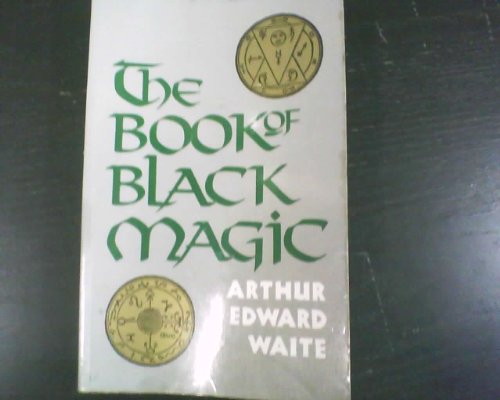
The Book of Black Magic: Including the Rites and Mysteries of Goetic Theurgy, Sorcery, and Infernal Necromancy - Softcover
Inhaltsangabe
The Secret Tradition in Goetia, including the rites and mysteries of Goetic therugy, sorcery and infernal necromancy. Completely illustrated with the original magical figures. Partial Contents: Antiquity of Magical Rituals; Rituals of Transcendental Magic; Composite Rituals; Key of Solomon; Lesser Key of Solomon; Rituals of Black Magic; Complete Grimoire; Preparation of the Operator; Initial Rites and Ceremonies; Descending Hierarchy; Mysteries of Goetic Theurgy; Mystery of the Sanctum Regnum; Method of Honorius.
Die Inhaltsangabe kann sich auf eine andere Ausgabe dieses Titels beziehen.
Über die Autorin bzw. den Autor
A.E. Waite (1857-1942) is one of the bestknown authors and translators of magic and the occult. He is the creator of the Rider-Waite tarot and is the author of several books including Book of Black Magic and Pictorial Keys to the Tarot.
Auszug. © Genehmigter Nachdruck. Alle Rechte vorbehalten.
THE BOOK OF BLACK MAGIC
Including the Rites and Mysteries of Goetic Theurgy, Sorcery, and Infernal Necromancy
By Arthur Edward WaiteRed Wheel/Weiser, LLC
Copyright © 2013 Arthur Edward Waite
All rights reserved.
ISBN: 978-0-87728-207-5All rights reserved.
Contents
| PREFACE | |
| PART I THE LITERATURE OF CEREMONIAL MAGIC | |
| CHAPTER I The Antiquity of Magical Rituals | |
| CHAPTER II The Rituals of Transcendental Magic | |
| CHAPTER III Composite Rituals | |
| CHAPTER IV The Rituals of Black Magic | |
| PART II THE COMPLETE GRIMOIRE | |
| CHAPTER I The Preparation of the Operator | |
| CHAPTER II The Initial Rites and Ceremonies | |
| CHAPTER III Concerning the Descending Hierarchy | |
| CHAPTER IV The Mysteries of Goetic Theurgy According to the Leaser Key of Solomon the King | |
| CHAPTER V Concerning the Mystery of the Sanctum Regnum, or the Government of Evil Spirits; Being the Rite of Conjuration According to the Grimorium Verum | |
| CHAPTER VI The Mysteries of Infernal Evocation According to the Grand Grimoire | |
| CHAPTER VII | |
| CHAPTER VIII Miscellaneous and Minor Processes | |
| CHAPTER IX |
CHAPTER 1
THE ANTIQUITY OF MAGICAL RITUALS
§ 1. The Importance of Ceremonial Magic.
The ordinary fields of phychological inquiry, largely in possession of thepathologist, are fringed by a borderland of transcendental experiment into whichpathologists may occasionally venture, but it is left for the most part tounchartered explorers. Beyond these fields and this borderland there lies thelegendary wonder-world of Mysticism, Magic, and Sorcery, a world of fascinationor terror, as the mind which regards it is tempered, but in either case theantithesis of admitted possibility. There all paradoxes seem to obtain actually,contradictions logically coexist, the effect is greater than the cause, and theshadow more than the substance. Therein the visible melts into the unseen, theinvisible is manifested openly, motion from place to place is accomplishedwithout traversing the intervening distance, matter passes through matter. Theretwo straight lines may enclose a space; space has a fourth dimension, andfurther possibilities beyond it; without metaphor and without evasion, thecircle is mathematically squared. There life is prolonged, youth renewed,physical immortality secured. There earth becomes gold, and gold earth. Therewords and wishes possess creative power, thoughts are things, desire realisesits object. There, also, the dead live, and the hierarchies of extra-mundaneintelligence are within easy communication, and become ministers or tormentors,guides or destroyers, of man. There the Law of Continuity is suspended by theinterference of the higher Law of Fantasia.
But, unhappily, this domain of enchantment is in all respects comparable to thegold of Faerie, which is presumably its medium of exchange. It cannot withstanddaylight, the test of the human eye, or the scale of reason. When these areapplied, its paradox becomes an anticlimax, its antithesis ludicrous; itscontradictions are without genius; its mathematical marvels end in a verbalquibble; its elixirs fail even as purges; its transmutations do not needexposure at the assayer's hands; its marvel-working words prove barbarousmutilations of dead languages, and are impotent from the moment that they areunderstood; departed friends, and even planetary intelligences, must not beseized by the skirts, for they are apt to desert their draperies, and these arenot like the mantle of Elijah.
The little contrast here instituted will serve to exhibit that there are atleast two points of view regarding Magic and its mysteries—the simple andhomogeneous view, prevailing within that charmed circle among the few survivalswhom reason has not hindered from entering, and that of the world without, whichis more complex, more composite, but sometimes more reasonable only byimputation. There is also a third view, in which legend is checked by legend andwonder substituted for wonder. Here it is not the Law of Continuity persistingin its formulae despite the Law of Fantasia; it is Croquemetaine explained byDiabolus, the runes of Elf-land read with the interpretation of Infernus; it isthe Law of Bell and Candle, the Law of Exorcism, and its final expression is inthe terms of the audo-da-fé. For this view the wonder-world exists without anyquestion, except that of the Holy Tribunal; it is not what it seems, but isadjustable to the eye of faith in the light from the Lamp of the Sanctuaries; ina word, its angels are demons, its Melusines stryges, its phantoms vampires, itsspells and mysteries the Black Science. Here Magic itself rises up and respondsthat there is a Black and a White art, an art of Hermes and an art of Canida, aScience of the Height and a Science of the Abyss, of Metatron and Belial. Inthis manner a fourth point of view emerges; they are all, however, illusive;there is the positive illusion of the legend, affirmed by the remainingadherents of its literal sense, and the negative illusion which denies thelegend crassly without considering that there is a possibility behind it; thereis the illusion which accounts for the legend by an opposite hypothesis, and theillusion of the legend by an opposite hypothesis, and the illusion of the legendwhat literature will prove to rule also in its history; have been disposed of,there remain two really important questions—the question of the Mystics and thequestion of history and literature. To a very large extent the first is closedto discussion, but, so far as may be possible, it will be dealt with a littlelater on. As regards the second, it is the sole concern and purpose of thisinquiry, and the limits of its importance may therefore be shortly stated.
There can be no extensive literatures without motives proportionate to accountfor them. If we take the magical literature of Western Europe from the MiddleAges and onward, we shall find that it is exceedingly large. Now, the actingprinciples in the creation of which reaffirms itself with a distinction. Whenthese what is obscure in the one may be understood by help of the other; eachreacted upon each; as the literature grew, it helped to make the history, andthe new history was so much additional material for further literature. Therewere, of course, many motive principles at work, for the literature and historyof Magic are alike exceedingly intricate, and there are many interpretations ofprinciples which are apt to be confused with the principles, as, for example,the influence of what is loosely called superstition upon ignorance; these andany interpretations must be ruled out of an inquiry like the present. The mainprinciples are summed in the conception of a number of mysterious forces in theuniverse which could be put in operation by man, or at least followed in theirsecret processes. In the ultimate, however, they could all be renderedsecondary, if not passive, to the will of man; for even in astrology, which wasthe discernment of forces regarded as peculiarly fatal, there was an art ofruling, and sapiens dominabitur astris became an axiom of the science. Thisconception culminated or centred in the doctrine of unseen, intelligent powers,with whom it was possible for prepared persons to communicate; the methods...
„Über diesen Titel“ kann sich auf eine andere Ausgabe dieses Titels beziehen.
Suchergebnisse für The Book of Black Magic: Including the Rites and Mysteries...

Beispielbild für diese ISBN
The Book of Black Magic
Anbieter: World of Books (was SecondSale), Montgomery, IL, USA
Verkäuferbewertung 5 von 5 Sternen

Paperback. Zustand: Good. The Secret Tradition in Goetia, including the rites and mysteries of Goetic therugy, sorcery and infernal necromancy. Completely illustrated with the original magical figures. Artikel-Nr. 00108923774
Gebraucht kaufen
EUR 9,26
Versand gratis
Versand innerhalb von USA
Versand innerhalb von USA
Anzahl: 1 verfügbar
Beispielbild für diese ISBN
The Book of Black Magic
Anbieter: World of Books (was SecondSale), Montgomery, IL, USA
Verkäuferbewertung 5 von 5 Sternen
Paperback. Zustand: Very Good. The Secret Tradition in Goetia, including the rites and mysteries of Goetic therugy, sorcery and infernal necromancy. Completely illustrated with the original magical figures. Artikel-Nr. CIN0877282072VG
Gebraucht kaufen
EUR 12,84
Versand gratis
Versand innerhalb von USA
Versand innerhalb von USA
Anzahl: 1 verfügbar
Beispielbild für diese ISBN
The Book of Black Magic
Anbieter: Revaluation Books, Exeter, Vereinigtes Königreich
Verkäuferbewertung 5 von 5 Sternen
Paperback. Zustand: Brand New. american ed edition. 326 pages. 8.25x5.75x1.00 inches. In Stock. Artikel-Nr. __0877282072
Neu kaufen
EUR 24,17
EUR 11,84 Versand
Versand von Vereinigtes Königreich nach USA
Versand von Vereinigtes Königreich nach USA
Anzahl: 1 verfügbar
Beispielbild für diese ISBN
The Book of Black Magic
Anbieter: WorldofBooks, Goring-By-Sea, WS, Vereinigtes Königreich
Verkäuferbewertung 5 von 5 Sternen
Paperback. Zustand: Very Good. The book has been read, but is in excellent condition. Pages are intact and not marred by notes or highlighting. The spine remains undamaged. Artikel-Nr. GOR001891110
Gebraucht kaufen
EUR 30,48
EUR 6,63 Versand
Versand von Vereinigtes Königreich nach USA
Versand von Vereinigtes Königreich nach USA
Anzahl: 1 verfügbar
Beispielbild für diese ISBN
The Book of Black Magic
Anbieter: Majestic Books, Hounslow, Vereinigtes Königreich
Verkäuferbewertung 4 von 5 Sternen

Zustand: New. pp. 328 Illus. Artikel-Nr. 7919262
Neu kaufen
EUR 42,32
EUR 7,69 Versand
Versand von Vereinigtes Königreich nach USA
Versand von Vereinigtes Königreich nach USA
Anzahl: 1 verfügbar
Foto des Verkäufers
The Book of Black Magic
Anbieter: AHA-BUCH GmbH, Einbeck, Deutschland
Verkäuferbewertung 5 von 5 Sternen
Taschenbuch. Zustand: Neu. Neuware - From one of the most important figures in Western occultism, a reference book on ritual magic compiling a number of nineteenth-century French grimoires. The Secret Tradition in Goetia, including the rites and mysteries of Goetic therugy, sorcery and infernal necromancy. Completely illustrated with the original magical figures. Partial contents: Antiquity of Magical Rituals; Rituals of Transcendental Magic; Composite Rituals; Key of Solomon; Lesser Key of Solomon; Rituals of Black Magic; Complete Grimoire; Preparation of the Operator; Initial Rites and Ceremonies; Descending Hierarchy; Mysteries of Goetic Theurgy; Mystery of the Sanctum Regnum; Method of Honorius. Artikel-Nr. 9780877282075
Neu kaufen
EUR 37,16
EUR 35,00 Versand
Versand von Deutschland nach USA
Versand von Deutschland nach USA
Anzahl: 1 verfügbar
Foto des Verkäufers
The Book of Black Magic
Verlag:
RED WHEEL WEISER, 2004
ISBN 10: 0877282072
ISBN 13: 9780877282075
Neu
Kartoniert / Broschiert
Anbieter: moluna, Greven, Deutschland
Verkäuferbewertung 5 von 5 Sternen
Kartoniert / Broschiert. Zustand: New. Über den AutorA.E. Waite (1857-1942) is one of the bestknown authors and translators of magic and the occult. He is the creator of the RiderWaite tarot and is the author of several books including Book of Black Magic a. Artikel-Nr. 595121211
Neu kaufen
EUR 27,75
EUR 48,99 Versand
Versand von Deutschland nach USA
Versand von Deutschland nach USA
Anzahl: 1 verfügbar