
Verwandte Artikel zu From Assimilation to Antisemitism: The "Jewish...
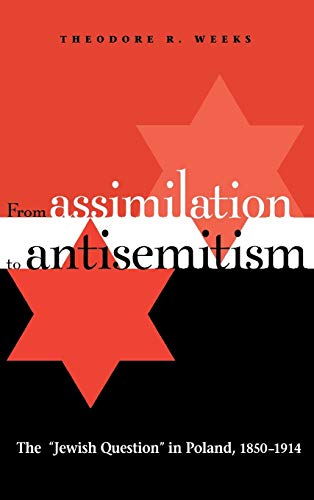
From Assimilation to Antisemitism: The "Jewish Question" in Poland, 1850-1914 (Niu Slavic, East European, and Eurasian Studies) - Hardcover
Inhaltsangabe
Before the mid-nineteenth century, Jews in the Polish lands led lives quite separate from their Christian neighbors. As modern ideologies of nationalism gained strength, however, Jewish separateness came to be seen as a problem, even a threat, to the Polish nation. Assimilation, a process by which Jews would become Poles in all but their religious practices, was the solution most often presented by liberal Poles from the late eighteenth century—when the "Jewish question" was first seriously debated in Polish society—until the late nineteenth century. This solution foresaw the cultural, linguistic, and external differences between Catholic Poles and Jews diminishing, thereby allowing Polish-speaking, European-clad Jews to take their appropriate place within the Polish nation.
As Russian cultural and linguistic domination threatened both Polish society and Jews, assimilation was also seen as a means of strengthening the Polish nation. Unfortunately, however, closer relations between Poles and Jews led to increased frictions and even strife between them. In the final decades of the nineteenth century, the solution of assimilation was called into question more and more both by Polish antisemites and by Jewish nationalists. By 1914 the gap between "Polish" and "Jewish" had become so great that many declared it impossible to simultaneously be a "good Jew" and a "good Pole."
Weeks examines how the ideal of assimilation was gradually replaced by more exclusionary and aggressive ideologies, culminating in the early twentieth century in widespread Polish antisemitism. He argues that several long-term factors—economic change, political and cultural repression, the general intensification of national consciousness at the time, and the Revolution of 1905—played a part in the deterioration of Polish-Jewish relations. As the hope for Polish cultural and political autonomy dwindled, Jews became an easy target for Poles.
Die Inhaltsangabe kann sich auf eine andere Ausgabe dieses Titels beziehen.
Über die Autorinnen und Autoren
Theodore R. Weeks is Associate Professor of History at Southern Illinois University at Carbondale and is the author of Nation and State in Late Imperial Russia.
Theodore R. Weeks is Associate Professor of History at Southern Illinois University at Carbondale and is the author of Nation and State in Late Imperial Russia.
„Über diesen Titel“ kann sich auf eine andere Ausgabe dieses Titels beziehen.
Suchergebnisse für From Assimilation to Antisemitism: The "Jewish...

Beispielbild für diese ISBN
From Assimilation to Antisemitism
Verlag:
Northern Illinois University Press, 2005
ISBN 10: 0875803520
ISBN 13: 9780875803524
Neu
Hardcover
Anbieter: PBShop.store UK, Fairford, GLOS, Vereinigtes Königreich
Verkäuferbewertung 5 von 5 Sternen

HRD. Zustand: New. New Book. Shipped from UK. Established seller since 2000. Artikel-Nr. FW-9780875803524
Neu kaufen
EUR 57,24
EUR 5,85 Versand
Versand von Vereinigtes Königreich nach USA
Versand von Vereinigtes Königreich nach USA
Anzahl: 1 verfügbar
Beispielbild für diese ISBN
From Assimilation to Antisemitism: The "Jewish Question" in Poland, 1850-1914 (NIU Series in Slavic, East European, and Eurasian Studies)
Verlag:
Northern Illinois University Press, 2005
ISBN 10: 0875803520
ISBN 13: 9780875803524
Neu
Hardcover
Anbieter: Ria Christie Collections, Uxbridge, Vereinigtes Königreich
Verkäuferbewertung 5 von 5 Sternen
Zustand: New. In English. Artikel-Nr. ria9780875803524_new
Neu kaufen
EUR 58,51
EUR 13,96 Versand
Versand von Vereinigtes Königreich nach USA
Versand von Vereinigtes Königreich nach USA
Anzahl: 1 verfügbar
Beispielbild für diese ISBN
From Assimilation to Antisemitism: The "Jewish Question" in Poland, 1850-1914
Verlag:
Northern Illinois University Press, 2005
ISBN 10: 0875803520
ISBN 13: 9780875803524
Neu
Hardcover
Anbieter: Kennys Bookstore, Olney, MD, USA
Verkäuferbewertung 5 von 5 Sternen
Zustand: New. 2005. 1st Edition. hardcover. . . . . . Books ship from the US and Ireland. Artikel-Nr. V9780875803524
Neu kaufen
EUR 79,45
EUR 9,03 Versand
Versand innerhalb von USA
Versand innerhalb von USA
Anzahl: 1 verfügbar
Beispielbild für diese ISBN
From Assimilation to Antisemitism The "Jewish Question" in Poland, 18501914
Anbieter: Revaluation Books, Exeter, Vereinigtes Königreich
Verkäuferbewertung 5 von 5 Sternen
Hardcover. Zustand: Brand New. 1st edition. 252 pages. 9.00x6.25x1.00 inches. In Stock. Artikel-Nr. x-0875803520
Neu kaufen
EUR 86,72
EUR 14,56 Versand
Versand von Vereinigtes Königreich nach USA
Versand von Vereinigtes Königreich nach USA
Anzahl: 2 verfügbar
Foto des Verkäufers
From Assimilation to Antisemitism : The "Jewish Question" in Poland, 18501914
Verlag:
Cornell University Press Dez 2005, 2005
ISBN 10: 0875803520
ISBN 13: 9780875803524
Neu
Hardcover
Anbieter: AHA-BUCH GmbH, Einbeck, Deutschland
Verkäuferbewertung 5 von 5 Sternen
Buch. Zustand: Neu. Neuware - The large number of Jews living in Polish lands had lived as a separate estate from the Poles until the mid-nineteenth century. Focusing on many long-term factors and one major event - the Revolution of 1905 - this book traces Poland's failed attempts to integrate its Jewish communities into the country's social fabric. Artikel-Nr. 9780875803524
Neu kaufen
EUR 90,07
EUR 62,67 Versand
Versand von Deutschland nach USA
Versand von Deutschland nach USA
Anzahl: 1 verfügbar
Beispielbild für diese ISBN
From Assimilation to Antisemitism: The "Jewish Question" in Poland, 1850-1914 (Niu Slavic, East European, and Eurasian Studies)
Anbieter: Buchmarie, Darmstadt, Deutschland
Verkäuferbewertung 4 von 5 Sternen

Zustand: Good. Artikel-Nr. 3314858_220_3x
Gebraucht kaufen
EUR 109,88
EUR 105,00 Versand
Versand von Deutschland nach USA
Versand von Deutschland nach USA
Anzahl: 1 verfügbar
Beispielbild für diese ISBN
From Assimilation to Antisemitism: The "Jewish Question" in Poland, 1850-1914 (Niu Slavic, East European, and Eurasian Studies) Weeks, Theodore R.
Anbieter: BUCHSERVICE / ANTIQUARIAT Lars Lutzer, Wahlstedt, Deutschland
Verkäuferbewertung 5 von 5 Sternen
Zustand: gut. From Assimilation to Antisemitism: The "Jewish Question" in Poland, 1850-1914 (Niu Slavic, East European, and Eurasian Studies) In englischer Sprache. pages. Artikel-Nr. BN411155
Gebraucht kaufen
EUR 179,95
EUR 39,95 Versand
Versand von Deutschland nach USA
Versand von Deutschland nach USA
Anzahl: 1 verfügbar