
Verwandte Artikel zu Paths Beyond Ego: The Transpersonal Vision (New Consciousnes...
Inhaltsangabe
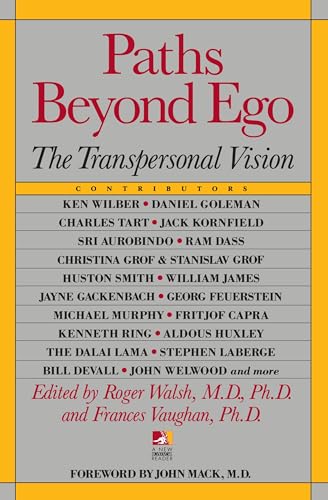
This book is a clarion call for an expanded vision of human possibilities. In it, many of the best thinkers of our day ask us to renew the perennial search for self-knowledge and to discover the deeper meaning of our lives.
For this, they offer the transpersonal perspective -- which extends beyond consciousness in its myriad forms, including altered states, yoga, dreams, and contemplation. This marriage of psychology and science with the spiritual traditions has borne ripe fruit: the transpersonal vision, which offers a uniquely generous and encompassing view of human nature.
The fifty essays that make up Paths Beyond Ego apply transpersonal thinking to individual growth, psychotherapy, meditation, dreams, psychedelics, science, ethics, philosophy, ecology, and service. The result is an integrated and comprehensive overview of the many dimensions of human experience.
In clear, accessible writing, the contributors suggest that our potential for enhancing human abilities is much greater than previously suspected and that our tools for this grand undertaking are widely available today. The transpersonal vision offers great hope for the future -- and links us to the timeless wisdom of the ages.
Die Inhaltsangabe kann sich auf eine andere Ausgabe dieses Titels beziehen.
Über die Autorin bzw. den Autor
Roger Walsh, M.D., Ph.D.is professor of psychiatry, philosophy, and anthropology at the University of California at Irvine. He has published over a hundred articles and twelve books on science, philosophy, religion, and ecological issues, and his work has received over a dozen national and international awards.
Auszug. © Genehmigter Nachdruck. Alle Rechte vorbehalten.
Foreword
John E. Mack, M.D.
We are witnessing a battle for the human soul between two opposing ontologies. In one view, the physical or material world is the ultimate, if not the only, reality, and the behaviors and experiences of living organisms, including ourselves, can be understood within the framework of potentially identifiable mechanisms. In this worldview consciousness is a function of the human brain, and its farthest reaches and greatest depths are, in theory, fathomable through the researches of neuroscience and psychodynamic formulations. In this view, life, in James Carse's words, is a finite game.
In the transpersonal view, the physical world and all its laws represent only one of an indeterminable number of possible realities whose qualities we can only begin to apprehend through the evolution of our consciousness. In this view, consciousness pervades all realities and is the primary source or creative principle of existence, including the energy-matter of the physical world. Until recently, Western philosophy and science, including psychology, have been dominated by the first view. The transpersonal vision is opening our minds, hearts, and spirits to the second. In this view, life is an infinite game.
Each worldview, the materialist and the transpersonal, has its accompanying epistemology (way of acquiring knowledge), and each has its consequences for human well-being and the fate of the earth. In the materialist universe we know the world at a distance, through our senses and the machines and instruments through which we can extend their reach, and by reasoned analysis of the observations that our empirical enterprises yield. We take pride in the objectivity that this way of knowing reflects, and we are suspicious of subjectivity and emotion, which are thought to distort the truth. In this framework, we rely on ordinary consciousness for information about ourselves and the surrounding environment and regard nonordinary states principally as exotic, pathological, or interesting for recreational purposes.
In the transpersonal universe or universes, we seek to know our worlds close up, relying on feeling and contemplation, as well as observation and reason, to gain information about a range of possible realities. In this universe we take subjectivity for granted and depend on direct experience, intuition, and imagination for discoveries about the inner and outer worlds. A transpersonal epistemology appreciates the necessity of ordinary states of consciousness for mapping the terrain of the physical universe, but nonordinary states are seen as powerful means of extending our knowledge beyond the four dimensions of the Newtonian/Einsteinian universe.
The consequences of the materialist worldview are all too familiar. By restricting the scope of reality and the domain of personal fulfillment to the physical world, while excluding from consciousness the power of spiritual realms, human beings are ravishing the earth and massacring one another with instruments of ever greater technological sophistication in the quest for power, dominance, and material satisfaction. The outcome of the continued enactment of this view will be the breakdown of the earth's living systems and the termination of human life as we know it. Psychology, in this paradigm, has limited its healing potential by following a therapeutic model in which one person treats the illness or problems of another, separate, individual, whose relevant world is confined to a few principle relationships.
The transpersonal vision offers the possibility of a different future for humankind and other living creatures. Through a deeper exploration of ourselves and the worlds in which we participate, transpersonal psychology enables human beings to discover their inseparability from all life and their appropriate place in the great chain of being. Central to this unfolding awareness is the rediscovery of the power of ancient methods of achieving altered states of consciousness, such as meditation, yoga, shamanic journeys, and the judicious use of psychedelic plants. New methods of self-exploration, such as the Grof holotropic breathwork method and modified forms of hypnosis, enable many people to experience realms of the unconscious and the mythic and spiritual universes from which we have cut ourselves off. Transpersonal psychology certainly has therapeutic applications. But its greater focus is upon healing, transformation, personal growth, and spiritual opening.
The poet Rilke once wrote that the senses by which we could grasp the spirit world have atrophied. The transpersonal vision, as set forth by its pioneers in this book, shows the way that these senses might be reawakened and opened to domains of being of which we have perhaps never before been conscious. If and when this occurs, we may again discover the sacred in ourselves and nature. It will then become unthinkable to foul the earth-nest of creation that has been mysteriously lent to each of us for such a brief time. For as we explore the multiple dimensions of universes of unlimited possibility, we may at the same time learn to participate in a harmonious relationship with our fellow human beings and other living species through a consciousness that is forever evolving.
Preface
When in the late 1970s we began preparing Beyond Ego: Transpersonal Dimensions in Psychology, our goal was to provide the first comprehensive overview of the exciting new field of transpersonal psychology. One of our challenges was to find enough review articles. Our challenge in editing a new overview for the nineties and the twenty-first century has been quite different: both easier and more difficult. It has been easier in the sense that the transpersonal field has expanded dramatically and good papers are abundant; it has been harder in that selecting among them is more challenging.
It rapidly became clear that transpersonal exploration has expanded far beyond its foundation discipline of psychology to encompass fields such as transpersonal psychiatry, anthropology, sociology, and ecology, thereby creating a multidisciplinary, transpersonal movement. It also became clear that in order to reflect this dramatic growth, more than a new edition of Beyond Ego was required; what was called for was a new book. The result is this book: Paths Beyond Ego: The Transpersonal Vision.
In preparing Paths Beyond Ego we had several aims. First, we wanted to provide an easily readable introduction. Transpersonal studies are of potential interest to an exceptionally wide range of people, from medical and mental health practitioners, researchers, and clinicians to social scientists, philosophers, theologians, and spiritual practitioners. We therefore wanted to provide a clear introduction to the field that required a minimum of specialized knowledge and would be accessible to readers from diverse backgrounds.
Within the available space we sought to provide as comprehensive an overview as possible. Therefore, we tried to include outstanding reviews of all the major transpersonal areas. In order to include as many areas and articles as possible, articles have been edited and condensed. Readers who want more detailed discussions of particular topics can consult the original articles as well as the recommended reading list.
We certainly hoped to convey a sense of the excitement of cutting-edge work in this field. We therefore sought articles that build on the foundation of earlier work and also point to fascinating emerging possibilities.
In addition to an introduction and overview, we also wanted to provide an integration of the field. We therefore chose articles of broad integrative scope and attempted to write introductions that point to connections and common themes wherever possible. Such an attempt seems particularly important for a field that stands at the...
„Über diesen Titel“ kann sich auf eine andere Ausgabe dieses Titels beziehen.
Suchergebnisse für Paths Beyond Ego: The Transpersonal Vision (New Consciousnes...

Beispielbild für diese ISBN
Paths Beyond Ego: The Transpersonal Vision
Anbieter: World of Books (was SecondSale), Montgomery, IL, USA
Verkäuferbewertung 5 von 5 Sternen

Paperback. Zustand: Good. This book is a clarion call for an expanded vision of human possibilities. In it, many of the best thinkers of our day ask us to renew the perennial search for self-knowledge and to discover the deeper meaning of our lives. For this, they offer the transpersonal perspective -- which extends beyond consciousness in its myriad forms, including altered states, yoga, dreams, and contemplation. This marriage of psychology and science with the spiritual traditions has borne ripe fruit: the transpersonal vision, which offers a uniquely generous and encompassing view of human nature. The fifty essays that make up Paths Beyond Ego apply transpersonal thinking to individual growth, psychotherapy, meditation, dreams, psychedelics, science, ethics, philosophy, ecology, and service. The result is an integrated and comprehensive overview of the many dimensions of human experience. In clear, accessible writing, the contributors suggest that our potential for enhancing human abilities is much greater than previously suspected and that our tools for this grand undertaking are widely available today. The transpersonal vision offers great hope for the future -- and links us to the timeless wisdom of the ages. Artikel-Nr. 00108692441
Gebraucht kaufen
EUR 4,64
Versand gratis
Versand innerhalb von USA
Versand innerhalb von USA
Anzahl: 4 verfügbar
Beispielbild für diese ISBN
Paths Beyond Ego: The Transpersonal Vision
Anbieter: World of Books (was SecondSale), Montgomery, IL, USA
Verkäuferbewertung 5 von 5 Sternen
Paperback. Zustand: Fair. This book is a clarion call for an expanded vision of human possibilities. In it, many of the best thinkers of our day ask us to renew the perennial search for self-knowledge and to discover the deeper meaning of our lives. For this, they offer the transpersonal perspective -- which extends beyond consciousness in its myriad forms, including altered states, yoga, dreams, and contemplation. This marriage of psychology and science with the spiritual traditions has borne ripe fruit: the transpersonal vision, which offers a uniquely generous and encompassing view of human nature. The fifty essays that make up Paths Beyond Ego apply transpersonal thinking to individual growth, psychotherapy, meditation, dreams, psychedelics, science, ethics, philosophy, ecology, and service. The result is an integrated and comprehensive overview of the many dimensions of human experience. In clear, accessible writing, the contributors suggest that our potential for enhancing human abilities is much greater than previously suspected and that our tools for this grand undertaking are widely available today. The transpersonal vision offers great hope for the future -- and links us to the timeless wisdom of the ages. Artikel-Nr. 00110285728
Gebraucht kaufen
EUR 4,64
Versand gratis
Versand innerhalb von USA
Versand innerhalb von USA
Anzahl: 2 verfügbar
Beispielbild für diese ISBN
Paths Beyond Ego : The Transpersonal Vision
Verlag:
Penguin Publishing Group, 1993
ISBN 10: 0874776783
ISBN 13: 9780874776782
Gebraucht
Softcover
Anbieter: Better World Books, Mishawaka, IN, USA
Verkäuferbewertung 5 von 5 Sternen
Zustand: Good. Pages intact with minimal writing/highlighting. The binding may be loose and creased. Dust jackets/supplements are not included. Stock photo provided. Product includes identifying sticker. Better World Books: Buy Books. Do Good. Artikel-Nr. GRP96971126
Gebraucht kaufen
EUR 6,09
Versand gratis
Versand innerhalb von USA
Versand innerhalb von USA
Anzahl: 1 verfügbar
Beispielbild für diese ISBN
Paths Beyond Ego : The Transpersonal Vision
Verlag:
Penguin Publishing Group, 1993
ISBN 10: 0874776783
ISBN 13: 9780874776782
Gebraucht
Softcover
Anbieter: Better World Books, Mishawaka, IN, USA
Verkäuferbewertung 5 von 5 Sternen
Zustand: Good. Former library copy. Pages intact with minimal writing/highlighting. The binding may be loose and creased. Dust jackets/supplements are not included. Includes library markings. Stock photo provided. Product includes identifying sticker. Better World Books: Buy Books. Do Good. Artikel-Nr. 7459395-6
Gebraucht kaufen
EUR 6,09
Versand gratis
Versand innerhalb von USA
Versand innerhalb von USA
Anzahl: 2 verfügbar
Foto des Verkäufers
Paths Beyond Ego: The Transpersonal Vision (New Consciousness Reader)
Anbieter: Dream Books Co., Denver, CO, USA
Verkäuferbewertung 5 von 5 Sternen
Zustand: good. Gently used with minimal wear on the corners and cover. A few pages may contain light highlighting or writing, but the text remains fully legible. Dust jacket may be missing, and supplemental materials like CDs or codes may not be included. May be ex-library with library markings. Ships promptly! Artikel-Nr. DBV.0874776783.G
Gebraucht kaufen
EUR 6,37
Versand gratis
Versand innerhalb von USA
Versand innerhalb von USA
Anzahl: 1 verfügbar
Beispielbild für diese ISBN
Paths Beyond Ego: The Transpersonal Vision
Anbieter: ThriftBooks-Atlanta, AUSTELL, GA, USA
Verkäuferbewertung 5 von 5 Sternen
Paperback. Zustand: Good. No Jacket. Pages can have notes/highlighting. Spine may show signs of wear. ~ ThriftBooks: Read More, Spend Less. Artikel-Nr. G0874776783I3N00
Gebraucht kaufen
EUR 6,40
Versand gratis
Versand innerhalb von USA
Versand innerhalb von USA
Anzahl: 1 verfügbar
Beispielbild für diese ISBN
Paths Beyond Ego: The Transpersonal Vision
Anbieter: ThriftBooks-Atlanta, AUSTELL, GA, USA
Verkäuferbewertung 5 von 5 Sternen
Paperback. Zustand: Fair. No Jacket. Former library book; Readable copy. Pages may have considerable notes/highlighting. ~ ThriftBooks: Read More, Spend Less. Artikel-Nr. G0874776783I5N10
Gebraucht kaufen
EUR 6,40
Versand gratis
Versand innerhalb von USA
Versand innerhalb von USA
Anzahl: 1 verfügbar
Beispielbild für diese ISBN
Paths Beyond Ego: The Transpersonal Vision
Anbieter: ThriftBooks-Dallas, Dallas, TX, USA
Verkäuferbewertung 5 von 5 Sternen
Paperback. Zustand: Fair. No Jacket. Readable copy. Pages may have considerable notes/highlighting. ~ ThriftBooks: Read More, Spend Less. Artikel-Nr. G0874776783I5N00
Gebraucht kaufen
EUR 6,40
Versand gratis
Versand innerhalb von USA
Versand innerhalb von USA
Anzahl: 1 verfügbar
Beispielbild für diese ISBN
Paths Beyond Ego: The Transpersonal Vision
Anbieter: ThriftBooks-Dallas, Dallas, TX, USA
Verkäuferbewertung 5 von 5 Sternen
Paperback. Zustand: Very Good. No Jacket. May have limited writing in cover pages. Pages are unmarked. ~ ThriftBooks: Read More, Spend Less. Artikel-Nr. G0874776783I4N00
Gebraucht kaufen
EUR 6,40
Versand gratis
Versand innerhalb von USA
Versand innerhalb von USA
Anzahl: 1 verfügbar
Beispielbild für diese ISBN
Paths Beyond Ego: The Transpersonal Vision (New Consciousness Reader)
Anbieter: WorldofBooks, Goring-By-Sea, WS, Vereinigtes Königreich
Verkäuferbewertung 5 von 5 Sternen
Paperback. Zustand: Very Good. The book has been read, but is in excellent condition. Pages are intact and not marred by notes or highlighting. The spine remains undamaged. Artikel-Nr. GOR002813305
Gebraucht kaufen
EUR 8,15
EUR 6,50 Versand
Versand von Vereinigtes Königreich nach USA
Versand von Vereinigtes Königreich nach USA
Anzahl: 2 verfügbar