
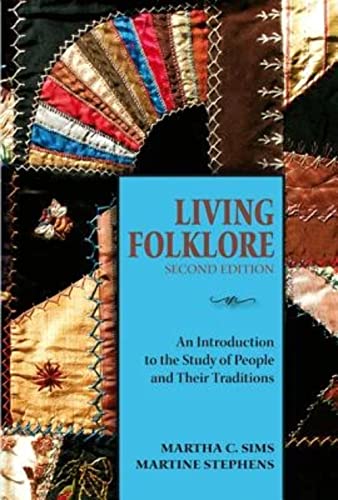
Living Folklore, 2nd Edition: An Introduction to the Study of People and Their Traditions - Hardcover
Inhaltsangabe
Living Folklore is a comprehensive, straightforward introduction to folklore as it is lived, shared and practiced in contemporary settings. Drawing on examples from diverse American groups and experiences, this text gives the student a strong foundation—from the field's history and major terms to theories and interpretive approaches.
Living Folklore moves beyond genres and classifications, and encourages students who are new to the field to see the study of folklore as a unique approach to understanding people, communities, and day-to-day artistic communication.
This revised edition incorporates new examples, research, and theory along with added discussion of digital and online folklore.
Die Inhaltsangabe kann sich auf eine andere Ausgabe dieses Titels beziehen.
Auszug. © Genehmigter Nachdruck. Alle Rechte vorbehalten.
Living Folklore
An Introduction to the Study of People and Their TraditionsBy Martha C. Sims Martine StephensUtah State University Press
Copyright © 2011 Utah State University PressAll right reserved.
ISBN: 978-0-87421-844-2
Contents
Acknowledgments...............................................ixPreface.......................................................xii1 Folklore....................................................12 Groups......................................................303 Tradition...................................................694 Ritual......................................................985 Performance.................................................1306 Approaches to Interpreting Folklore.........................1807 Fieldwork and Ethnography...................................2068 Examples of Folklore Projects...............................2329 Suggestions for Activities and Projects.....................300Notes.........................................................309References....................................................314Index.........................................................322
Chapter One
Folklore
We know you have heard it before: "It's just folklore." We hear it when newscasters are announcing the report of a popular home remedy that does not really cure people (and may actually harm them). We hear it—or might even say it—when a friend is telling a story about the haunted house on the winding street in our neighborhood. People often call something "folklore" to dismiss the validity of the subject they have been discussing.
To some people, the term folklore commonly suggests something untrue, not real—just a story or an old-fashioned belief. But that is a misconception. Some people come to folklore study expecting to learn only about quaint cultures from the past or contemporary cultures of those who are less educated, less fortunate, and less sophisticated than they are—primitive or simpler groups. That, too, is a misconception.
In the following sections we will clear up misconceptions about folklore by considering what folklore is and isn't. We will also look at genres and important concepts of text and context and offer a short history of the study of folklore as a foundation for our own exploration.
What is Folklore?
A Working Definition
Folklore is many things, and it's almost impossible to define succinctly. It's both what folklorists study and the name of the discipline they work within. Yes, folklore is folk songs and legends. It's also quilts, Boy Scout badges, high school marching band initiations, jokes, online avatars, chain letters, nicknames, holiday food, and many other things you might or might not expect. Folklore exists in cities, suburbs, and rural villages; in families, work groups, and residents of college dormitories. Folklore is present in many kinds of informal communication, whether verbal (oral and written texts), customary (behaviors and rituals), or material (physical objects). It exists in the physical world and in virtual settings online. It involves values, traditions, and ways of thinking and behaving. It's about art. It's about people and the way people learn. It helps us learn who we are and how to derive meaning from the world around us.
As we explore some attempts to define the field of folklore, we want to ask you to expand your concept of folklore or at least to let go of any preconceived ideas of what folklore means. One of the most useful ways we have found to clarify these distinctions is to talk about what folklore is not.
Folklore is not necessarily untrue or old fashioned. Have you ever eaten pan de muerto on the Day of the Dead? Sent an email chain letter to everyone in your address book? Carried a special object or worn a particular article of clothing to bring you luck? Made a wish before blowing out candles on your birthday cake? These are all examples of folklore. Some have been around for many generations; some are relatively new. Some are meaningful to large groups of people; some are relevant only to a few people. First, whether or not these examples are true isn't relevant. In what way could a loaf of sweet bread be true? And it doesn't have to be true that special clothing will help someone win a race for a track star to wear the same socks to every meet. Second, these examples are not possessed or performed only by simple, primitive people, nor are they quaint or old fashioned. The fact that you recognize the above examples—or know other similar examples—illustrates that folklore is not simply the historical behaviors of other cultures; folklore is alive, developing, and changing in our lifetimes. Every one of us experiences and shares folklore.
Folklorists avoid the use of terminology such as "true," "primitive," or "simple" when they talk about folklore. These terms imply that folklore is fake or exists only in old-fashioned, nonliterate cultures. For example, some people might see quilts made by hand rather than by machine as simple, or they might consider paintings and sculptures by poor, rural, unschooled artists as primitive, but these labels assume a hierarchical value related to formal education systems. When we don't evaluate it by outside standards, we can see that this kind of art is simply the creation of artists who have ideas and values they wish to express within (or about) their own group or community. Folklorists go into the field in contemporary societies to observe, record, and write about people and what we do, what we believe, and how we communicate right now—the culture of our lives.
Folklore is not just another form of anthropology or literary study. The study of folklore touches on every dimension of human experience and artistic expression. It has grown out of the study of literature, has roots in anthropology, and contains elements of psychology and sociology. In many ways, it is the study of culture—visual and performing arts, sculpture, architecture, music, theater, literature, linguistics, and history rolled into one. The discipline of folklore has evolved into a way of thinking about how people learn, share knowledge, and form their identity. Studying folklore is a way of learning about people, of thinking about how we communicate and make meaning. It is different from its related disciplines in its approach and focus. As Richard Dorson explains, folklorists
are concerned with the study of traditional culture, or the unofficial culture, or the folk culture, as opposed to the elite culture, not for the sake of proving a thesis but to learn about the mass of [humanity] overlooked by the conventional disciplines. Historians write histories of the elite, the successful, the visible; literary scholars study elitist writings; and the critics of the arts confine their attention to the fine arts. Anthropologists venture far off the beaten track, and sociologists look at people statistically. (1976, 117)
While the field borrows, both theoretically and in practice, from the disciplines of history, literary study, anthropology, and sociology, folklorists use a different lens. Folklore differs from these fields in the way in which it looks at everyday, unofficial, expressive communication. Folklorists study how members of a group communicate creatively with each other, as well as what—and to whom—they communicate.
Folklore is not high art or part of official culture....
„Über diesen Titel“ kann sich auf eine andere Ausgabe dieses Titels beziehen.
Suchergebnisse für Living Folklore, 2nd Edition: An Introduction to the...

Beispielbild für diese ISBN
Living Folklore: An Introduction to the Study of People and Their Traditions
Verlag:
Utah State University Press, 2011
ISBN 10: 0874218446
ISBN 13: 9780874218442
Gebraucht
Hardcover
Anbieter: ThriftBooks-Dallas, Dallas, TX, USA
Verkäuferbewertung 5 von 5 Sternen

Hardcover. Zustand: Fair. No Jacket. Readable copy. Pages may have considerable notes/highlighting. ~ ThriftBooks: Read More, Spend Less. Artikel-Nr. G0874218446I5N00
Gebraucht kaufen
EUR 20,36
Versand gratis
Versand innerhalb von USA
Versand innerhalb von USA
Anzahl: 1 verfügbar
Beispielbild für diese ISBN
Living Folklore, 2nd Edition : An Introduction to the Study of People and Their Traditions
Verlag:
University Press of Colorado, 2011
ISBN 10: 0874218446
ISBN 13: 9780874218442
Gebraucht
Hardcover
Anbieter: Better World Books, Mishawaka, IN, USA
Verkäuferbewertung 5 von 5 Sternen
Zustand: Good. Pages intact with minimal writing/highlighting. The binding may be loose and creased. Dust jackets/supplements are not included. Stock photo provided. Product includes identifying sticker. Better World Books: Buy Books. Do Good. Artikel-Nr. 5468293-75
Gebraucht kaufen
EUR 21,91
Versand gratis
Versand innerhalb von USA
Versand innerhalb von USA
Anzahl: 2 verfügbar
Beispielbild für diese ISBN
Living Folklore, 2nd Edition : An Introduction to the Study of People and Their Traditions
Verlag:
University Press of Colorado, 2011
ISBN 10: 0874218446
ISBN 13: 9780874218442
Gebraucht
Hardcover
Anbieter: Better World Books, Mishawaka, IN, USA
Verkäuferbewertung 5 von 5 Sternen
Zustand: Fine. Used book that is in almost brand-new condition. May contain a remainder mark. Better World Books: Buy Books. Do Good. Artikel-Nr. 12070365-6
Gebraucht kaufen
EUR 21,91
Versand gratis
Versand innerhalb von USA
Versand innerhalb von USA
Anzahl: 3 verfügbar
Beispielbild für diese ISBN
Living Folklore, 2nd Edition : An Introduction to the Study of People and Their Traditions
Verlag:
University Press of Colorado, 2011
ISBN 10: 0874218446
ISBN 13: 9780874218442
Gebraucht
Hardcover
Anbieter: Better World Books, Mishawaka, IN, USA
Verkäuferbewertung 5 von 5 Sternen
Zustand: Very Good. Pages intact with possible writing/highlighting. Binding strong with minor wear. Dust jackets/supplements may not be included. Stock photo provided. Product includes identifying sticker. Better World Books: Buy Books. Do Good. Artikel-Nr. 4029859-75
Gebraucht kaufen
EUR 21,91
Versand gratis
Versand innerhalb von USA
Versand innerhalb von USA
Anzahl: 4 verfügbar
Beispielbild für diese ISBN
Living Folklore An Introductio
Verlag:
Utah State University Press, 2011
ISBN 10: 0874218446
ISBN 13: 9780874218442
Gebraucht
Hardcover
Anbieter: World of Books (was SecondSale), Montgomery, IL, USA
Verkäuferbewertung 5 von 5 Sternen
Zustand: Very Good. Item in very good condition! Textbooks may not include supplemental items i.e. CDs, access codes etc. Artikel-Nr. 00105484856
Gebraucht kaufen
EUR 26,04
Versand gratis
Versand innerhalb von USA
Versand innerhalb von USA
Anzahl: 1 verfügbar
Beispielbild für diese ISBN
Living Folklore: An Introduction to the Study of People and Their Traditions
Anbieter: Revaluation Books, Exeter, Vereinigtes Königreich
Verkäuferbewertung 5 von 5 Sternen
Hardcover. Zustand: Brand New. 2nd edition. 344 pages. 9.25x6.25x1.25 inches. In Stock. Artikel-Nr. 0874218446
Neu kaufen
EUR 63,63
EUR 14,65 Versand
Versand von Vereinigtes Königreich nach USA
Versand von Vereinigtes Königreich nach USA
Anzahl: 1 verfügbar
Beispielbild für diese ISBN
Living Folklore
Anbieter: Kennys Bookstore, Olney, MD, USA
Verkäuferbewertung 5 von 5 Sternen
Zustand: New. Num Pages: 342 pages, black & white halftones, figures. BIC Classification: JFHF; JHBT. Category: (G) General (US: Trade). Dimension: 229 x 152 x 28. Weight in Grams: 708. . 2011. 2 Rev ed. Hardback. . . . . Books ship from the US and Ireland. Artikel-Nr. V9780874218442
Neu kaufen
EUR 69,42
EUR 9,20 Versand
Versand innerhalb von USA
Versand innerhalb von USA
Anzahl: 15 verfügbar