
Verwandte Artikel zu Dynamics Of Folklore
Inhaltsangabe
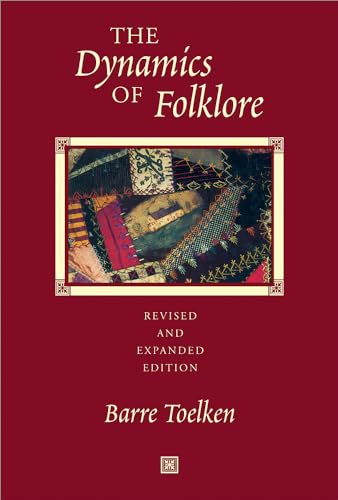
One of the most comprehensive and widely praised introductions to folklore ever written. Toelken's discussion of the history and meaning of folklore is delivered in straightforward language, easily understood definitions, and a wealth of insightful and entertaining examples.
Toelken emphasizes dynamism and variety in the vast array of folk expressions he examines, from "the biology of folklore," to occupational and ethnic lore, food ways, holidays, personal experience narratives, ballads, myths, proverbs, jokes, crafts, and others. Chapters are followed by bibliographical essays, and over 100 photographs illustrate the text. This new edition is accessible to all levels of folklore study and an essential text for classroom instruction.
Die Inhaltsangabe kann sich auf eine andere Ausgabe dieses Titels beziehen.
Über die Autorin bzw. den Autor
Barre Toelken was a longtime director of the Utah State University Folklore Program. He also held positions on the Folk Arts Panel for the National Endowment for the Arts, and in the American Folklore Society, Western Folklife Center, and American Folklife Center. He has edited Northwest Folklore, the Journal of American Folklore, and Western Folklore.
Auszug. © Genehmigter Nachdruck. Alle Rechte vorbehalten.
The Dynamics of Folklore
By Barre ToelkenUniversity Press of Colorado
Copyright © 1996 Utah State University Press
All rights reserved.
ISBN: 978-0-87421-203-7All rights reserved.
Contents
Illustrations,
Preface,
INTRODUCTION: INTO FOLKLORISTICS WITH GUN AND CAMERA,
BIBLIOGRAPHICAL NOTES,
THE FOLKLORE PROCESS,
THE EDUCATIVE MATRIX,
DESCRIBING FOLKLORE,
MODE AND MOVEMENT IN FOLKLORE,
CULTURAL SELECTION AND CHANGE,
BIBLIOGRAPHICAL NOTES,
DYNAMICS OF THE FOLK GROUP,
THE LIVE CONTEXT,
THE MULTIPLICITY OF TRADITION,
BIBLIOGRAPHICAL NOTES,
THE FOLK PERFORMANCE,
PERFORMANCE IN PLACE,
TINA'S PROVERB,
AUDIENCE,
BIBLIOGRAPHICAL NOTES,
DIMENSIONS OF THE FOLK EVENT,
INVENTORY,
STUDYING THE EVENT,
FOLK EVENTS: AN OVERVIEW,
BIBLIOGRAPHICAL NOTES,
AESTHETICS AND REPERTOIRE,
GENRE AND FOCUS,
MULTILATERAL LEARNING,
MULTIFORM FOLK IDEAS,
A MATTER OF TASTE: FOLK AESTHETICS,
BIBLIOGRAPHICAL NOTES,
FOLKLORE AND CONNOTATION,
PLAYING WITH LANGUAGE,
INTENTIONAL CONNOTATION: IMAGERY,
CONNOTATIVE STRUCTURE,
BIBLIOGRAPHICAL NOTES,
FOLKLORE AND CULTURAL WORLDVIEW,
CULTURE AND MEANING,
WORLDVIEWS IN MULTICULTURAL AMERICA,
TECHNOLOGY AND WORLDVIEW,
BIBLIOGRAPHICAL NOTES,
SURROUNDED BY FOLKLORE,
EVERYFOLK,
THE INTENTIONAL FOLKLORIST,
RESPONSIBILITIES,
BIBLIOGRAPHICAL NOTES,
FOLKLORE RESEARCH,
FOLKLORE FIELDWORK,
FOLKLORE ARCHIVES,
BIBLIOGRAPHICAL NOTES,
APPLICATIONS OF FOLKLORE,
FOLKLORE AND LITERARY CRITICISM,
FOLKLORE AND HISTORY,
FOLKLORE AND PSYCHOLOGY,
APPLIED FOLKLORE AS A BASIS FOR ACTION,
BIBLIOGRAPHICAL NOTES,
Index,
CHAPTER 1
THE FOLKLORE PROCESS
Folklore comes early and stays late in the lives of all OF US. IN SPITE OF the combined forces of technology, science, television, religion, urbanization, and creeping literacy, we prefer our closest cultural associations as the basis for learning about life's normalities and transmitting important observations and expressions. From the childhood rhythms of "Patty Cake" to the joy of humorous graces ("Good bread, good meat, good God, let's eat") to the imagined sophistication of drinking games ("Cardinal Puff," "Fuzz-Buzz"); from courtship protocol to showers to wedding customs (like wearing a wedding ring) to birth cigars; from birthday spanks and presents to tree house clubs to stag and hen parties; from the Tooth Fairy to the Birthday Girl to Santa Claus; from African American dozens to Native American "forty- nine" songs to curanderismo; from Valentine's candy to Easter eggs to firecrackers to pumpkins to turkey to fruit-cake to Tom-and-Jerries; from riddles to barroom jokes to epitaphs, funeral customs, and placing flowers on a grave; from wart cures to waiting twenty minutes for a full professor; from vanishing hitchhikers, exploding poodles and over-cooked clients in tanning salons to miraculous carburetors (kept off the market by the auto industry) and death cars for sale (cheap); from the pink and blue of the nursery through the white of the wedding to the black of the funeral, we continue to wend our traditional way through life. To the surprise of those who thought (and perhaps hoped) that folklore was a part of the disappearing rural scene, city children turn out to have more children's folklore than rural children do. The offspring of educated parents often are found to be more avid carriers of popular belief ("superstition") than others. Folklore is not dying out, nor is it to be found only in the backwoods or among illiterates. One ballad may go out of oral existence over here, but a hundred ethnic jokes spring up over there.
THE EDUCATIVE MATRIX
Clearly, folklore is alive and well. It constitutes a basic and important educative and expressive setting in which individuals learn how to see, act, respond, and express themselves by the empirical observation of close human interactions and expressions in their immediate society (that is, the family, occupational or religious group, ethnic or regional community). Folklore structures the world-view through which a person is educated into the language and logic systems of these close societies. It provides ready formulas for the expression of cultural norms in ways useful and pleasurable to us and to any group with which we share close and informal expressive interactions.
Folk Language
Very early in life, long before we have come under the well-intentioned influence of professional teachers, we have learned the basic structure and meaning of an entire language. Past this point we refine it and add to its vocabulary. Before we are four years old, using rules we know mostly by inference, we create new sentences we have never before heard, continually guided by the recognition and responses of those around us whose very speech we have used as the pattern for our own learning. If we say something they do not understand, we try again or in another way. If we say something they like very much we are likely to keep it "on file" for further pleasurable use (we sometimes retain baby talk when encouraged by the laughter of our doting parents). We do not need language instruction, and except in those settings where the passing of grammar quizzes has become an important activity, we do not require any further training in the grammar we already know how to use. Language is a traditional frame for learning, a basis for human interaction, a form of practical or pleasurable expression, and a way of structuring and placing meaning on the myriad experiences coming at us from our world. Yet languages are not all alike: Japanese, Navajo, and English differ not only in grammar and vocabulary, but in the ways they envision — and thus describe — the world. A language not only communicates; it articulates a worldview.
In addition to spoken language, we use gesture, facial expression, body position, tone of voice, proximity to others, and a large and complex vocabulary of options that tell us not only what to say on certain occasions but when not to say anything, or when it is necessary to change the "dialect" to something more appropriate (such as when Great Aunt Martha enters the room while we are telling a travelling salesman joke). As we mature, we are taught several more formal or technical languages as the need arises. In addition to the gestures we have picked up by observation (for example, shrugging the shoulders in some cultures means "I don't know"), we also must learn a number of arbitrary and formal gestures (such as those we must know if we are to become ballet dancers, baseball umpires, opera singers, traffic police officers, basketball referees, or teachers of sign language to the deaf). The informal gestures learned from those close around us are always open to continual modification according to their use and context at a particular moment, but the more formal gestures are less open to change, for they are parts of a language "dialect" used in dealing with outsiders. We use different words and gestures in a joke than in a graduation speech; we speak to friends in slang, but write for strangers in standard English. Deaf people who communicate by signing also have a vivid vocabulary of gestural slang learned from each other, not from instruction books.
Folk Learning and Logic
In Western cultures children usually learn music harmony the same way they learn their early language: they pick it up. They come to know how to harmonize even though they cannot articulate the technical rules in musicians' terms. Some never learn and are encouraged to keep quiet. But how does someone learn to harmonize? And why do we learn? And why is it pleasant for us to harmonize with others when they are singing? After all, many cultures do not use harmony at all. These questions cause us to become conscious of what people learn in a close society, how they come to learn it, why, and from whom. The study of folklore leads us to recognize that there may be an assumption about one kind of harmony in one culture, another kind in another culture, and none at all in still another. In fact, all forms of culture-based expression are likely to vary from one human communicative network to another, yet within each system there is an internal consistency, a logic. Most people growing up in a given culture will learn to harmonize, so to speak, on all levels of human interaction, and they will not require an anthropology text or a music teacher in order to do so. What is appropriate and normal in the local tradition at the moment will determine the nature of the folk expression, and since the expression is thus culturally meaningful, we can say that doing it is a kind of performance for a discerning, close audience. And most of us have mastered the logic of it — what "works" and what doesn't — by the age of seven.
Learning Styles and Clusters
In many cultures telling jokes is a prominent kind of vernacular expression. We will return to it in another chapter, because joke telling represents a culturally important medium of learning and expression. At this point it is enough to use joke telling simply as a means of discovering some bases of our own expertise in folklore, our dynamic application of cultural logic. Anyone who has listened to jokes and has later told them knows that, generally speaking, we need to hear a joke only once in order to "have" it. We do not memorize the joke verbatim, nor do we take lecture notes on it. In fact, if someone tells the joke as if it has been memorized word for word, the audience will not like it. When we tell a joke, we are reshaping and recomposing clusters of ideas that we have heard expressed in a similar context at another time, but we are arranging them according to an understood — though unarticulated — cultural logic.
A learning process has taken place, and it is now followed by an expressive event, a performance, but only if we judge the context to be right. If the setting is appropriate and the joke performance is well executed, the joke teller will notice the pleasure of his companions, reinforcing his own pleasure in telling the joke. At this point, the joke telling has become another educative experience, and the joke has solidified itself into a cluster of potential ingredients in the mind of the teller; but no matter how many times the same person tells the same joke, it will seldom, if ever, be performed exactly the same way twice, for a dynamic process (dependent on context, mood, intonation, and reason for telling) is now in motion as that first event is continually reshaped, rephrased, and re-experienced in the mind and actions of the performer. Moreover, the performer will try to work within that set of expectations shared by the audience of the joke. All of these factors work simultaneously as a joke (or any other kind of folklore) is being heard, appreciated, learned, and, later, performed in another analogous setting.
But this process is far more subtle than it initially seems because a joke almost never openly articulates what it is that is funny. That is, the joke is a loaded reference to assumptions and concerns shared by the teller and the audience. In order for a joke to "work" logically, this reference has to be understood by everyone in terms of its appropriateness (often ironic) to the way in which the joke is phrased (its punch line, its vocabulary, its innuendo). Thus, the "meaning" of a joke is almost never in the text, but resides in what the performance can touch off among those who are present. And some people just never get it, which may be a barometric reading on their abilities to be fully competent in their own culture or language. Three examples may suffice at this point to illustrate the way in which jokes trigger off shared associations which are not overtly stated in the "text":
1. "The Dream"
I collected this story in December of 1966 from Matthew Yellowman, who was then about twelve years old. His father had been telling Coyote stories, which can be told only in winter (in Navajo terms: between the first killing frost and the first thunderstorm). During a pause in the narration, his son volunteered this joke. An accurate phrase-by-phrase translation of the text as it was told at that time (transcribed from the tape recording) reads as follows:
Long ago, they say,
A man (on the side over there) said,
"Which of you had a dream last night?" he said
Another said, "I didn't; I don't know."
"I had a dream last night," another one said;
"Last night I dreamed I was sitting on four bird eggs,
and three of them weren't mine;
only one was mine," he said.
In order to discover the meaning of this brief narrative, we need to ask at least two questions which do not arise directly from the text, but which derive from our observation of the performance: a) why did the Navajos laugh (that is, what is there about this dramatized conversation that has the capacity to invoke or provoke laughter)? and b) why — even with an immediate translation — do non-Navajos not find the narrative funny?
If the humor is based on absurdity (say, the clear oddity of a person sitting on eggs), then we would imagine the absurdity to be equally visible to all intelligent human beings. We could then conclude our speculation by observing that absurdity is apparently not registered alike by all cultures, just as, for example, slipping on a banana peel, which is thought of as a very funny accident in American comics, might be seen by another culture as a serious warning from God. According to this approach, Navajos think dreaming of sitting on eggs is funny while the rest of us do not. But this "explanation" abandons us right where we began — with a vivid realization that cultures are different. And as a discussion of humor it is virtually worthless, for it leaves important questions unanswered while avoiding the problem of meaning altogether.
For purposes of our discussion, it would be interesting to find some equivalencies, some ideas (not topics, per se) which are in some way emotionally parallel to what happens in a Euro-American joke. And there is such a parallel: talking about dreams in the company of strangers is — for the Navajo — something like discussing racial differences or sexuality in the company of strangers is for Whites. That is, the subject is one of those areas of belief and cultural value which are "under stress," so to speak — controlled by taboo and anxiety. Normally, Navajos would not talk about their dreams in the company of strangers since most memorable dreams are associated with "nightmares," or "Alpträume," and are thus inescapably connected with beliefs about yenaaldlooshi, the "skinwalkers" who represent witchcraft in the Navajo belief system. Discussing them with strangers (who might actually be skinwalkers) would produce considerable anxiety.
Recognizing this allows us now to ask a number of questions which might not have been initially possible: Why did Matthew Yellowman suddenly volunteer a joke on such a "loaded" subject? How was this subject appropriate to the general conversation? In what way(s) did it help to articulate something which was not being articulated in other ways? And what is there about the narrative as Matthew told it that makes it funny rather than outrageous?
As far as the text itself is concerned, we are in position to react to the narrative more intelligently, for we know that the opening line brings up a topic of anxiety for the Navajos. The first response, from an anonymous character, is that he does not remember his dream, or at least declines to talk about it — and from the normal Navajo viewpoint this would be a proper answer to the leading question. The last respondent remembers his dream and — contrary to everyday custom — is willing to reveal it to others; instead of sharing the anticipated nightmare, however, he tantalizes everyone's anxiety by giving an account of a dream image just loaded with natural contradictions:
a) a human is apparently shown doing something only a bird can do;
b) a heavy object is shown doing something only a light object can do;
c) a male is shown doing something only a female should do.
In the Navajo language, some of these absurdities are richer than one can translate. For example, Navajos are matriarchal, matrilineal, and matrilocal; women are central to the culture, and they own the children outright. Thus, a male providing the female role of nurturing is a reversal of nature. Additionally, birds and people fall into two distinct categories in Navajo ("those who cry out" and "those who articulate"), and the crossover here between the two — combined with implied differences in size, weight, and gender — provides an image so impossible that it would be either terrifying or funny. There is also the possibility that the dreamer might be suggesting that he has had to raise four children, only one of whom was his own (but since Navajo children belong to their mothers and trace their descent through their mothers, the discrepancy here would be in a man's concern over a question which is none of his business).
Without another modifying element, all of the above discrepancies have the capacity to suggest disharmony, imbalance in nature, and therefore mental and physical sickness (for Navajos, health is the central concern of religious ritual, and health is seen as based primarily on natural harmony and balance). So indeed, all of the absurdities mentioned above are not necessarily funny for Navajos; indeed, the potential is for anxiety — a "stress" introduced into culturally charged values.
(Continues...)
Excerpted from The Dynamics of Folklore by Barre Toelken. Copyright © 1996 Utah State University Press. Excerpted by permission of University Press of Colorado.
All rights reserved. No part of this excerpt may be reproduced or reprinted without permission in writing from the publisher.
Excerpts are provided by Dial-A-Book Inc. solely for the personal use of visitors to this web site.
„Über diesen Titel“ kann sich auf eine andere Ausgabe dieses Titels beziehen.
Suchergebnisse für Dynamics Of Folklore

Beispielbild für diese ISBN
Dynamics Of Folklore: Revised and Expanded Edition
Verlag:
Utah State University Press, 1996
ISBN 10: 0874212030
ISBN 13: 9780874212037
Gebraucht
Softcover
Anbieter: World of Books (was SecondSale), Montgomery, IL, USA
Verkäuferbewertung 5 von 5 Sternen

Zustand: Acceptable. Item in acceptable condition! Textbooks may not include supplemental items i.e. CDs, access codes etc. Artikel-Nr. 00099704958
Gebraucht kaufen
EUR 7,57
Versand gratis
Versand innerhalb von USA
Versand innerhalb von USA
Anzahl: 1 verfügbar
Beispielbild für diese ISBN
Dynamics Of Folklore: Revised and Expanded Edition
Verlag:
Utah State University Press, 1996
ISBN 10: 0874212030
ISBN 13: 9780874212037
Gebraucht
Softcover
Anbieter: World of Books (was SecondSale), Montgomery, IL, USA
Verkäuferbewertung 5 von 5 Sternen
Zustand: Good. Good condition ex-library book with usual library markings and stickers. Artikel-Nr. 00100889064
Gebraucht kaufen
EUR 7,57
Versand gratis
Versand innerhalb von USA
Versand innerhalb von USA
Anzahl: 1 verfügbar
Beispielbild für diese ISBN
Dynamics Of Folklore: Revised and Expanded Edition
Verlag:
Utah State University Press, 1996
ISBN 10: 0874212030
ISBN 13: 9780874212037
Gebraucht
Soft cover
Erstausgabe
Anbieter: Saint Georges English Bookshop, Berlin, Deutschland
Verkäuferbewertung 4 von 5 Sternen

Soft cover. Zustand: Very Good. 1st Edition. Privately owned, unmarked text, uncreased spine, light edge wear, ships from Berlin Bookshop Bxn08082026. Artikel-Nr. 195157255
Gebraucht kaufen
EUR 35,00
EUR 16,00 Versand
Versand von Deutschland nach USA
Versand von Deutschland nach USA
Anzahl: 1 verfügbar