
Verwandte Artikel zu What's Good: Notes on Rap and Language
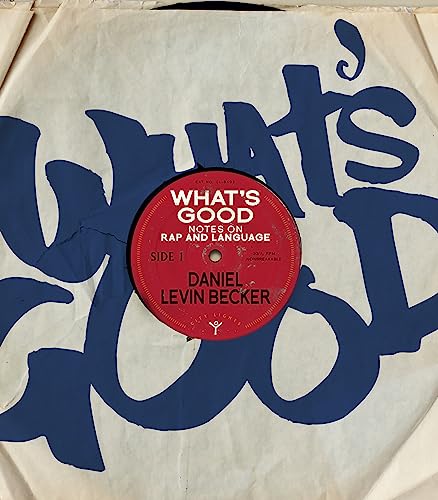
Inhaltsangabe
A NEW YORKER & GLOBE AND MAIL BEST BOOK OF THE YEAR
A love letter to the verbal artistry of hip-hop, What's Good is a work of passionate lyrical analysis
"What's Good is, among a great many other things, a byproduct of joyful obsession and immersion into both language and sound, an intersection that offers a rich and expansive land upon which to play." —Hanif Abdurraqib, author of A Little Devil in America: Notes in Praise of Black Performance
" . . . an often hilarious, surprisingly moving and always joyful paean to rap’s relationship to words."—Jayson Greene, The New York Times
"Rap, he is not afraid to say, is as close to a universal tongue as we have."—Adam Gopnik, The New Yorker
What's Good is a work of passionate lyrical analysis, a set of freewheeling liner notes, and a love letter to the most vital American art form of the last half century. Over a series of short chapters, each centered on a different lyric, Daniel Levin Becker considers how rap's use of language operates and evolves at levels ranging from the local (slang, rhyme) to the analytical (quotation, transcription) to the philosophical (morality, criticism, irony), celebrating the pleasures and perils of any attempt to decipher its meaning-making technologies.
Ranging from Sugarhill Gang to UGK to Young M.A, Rakim to Rick Ross to Rae Sremmurd, Jay-Z to Drake to Snoop Dogg, What's Good reads with the momentum of a deftly curated mixtape, drawing you into the conversation and teaching you to read it as it goes. A book for committed hip-hop heads, curious neophytes, armchair linguists, and everyone in between.
"For those of us who love rap, What's Good is a gift. The book offers a new set of eyes and ears through which to see and to hear the language of rap. Its brief and brilliant chapters are like the best kinds of freestyles: spontaneous and structured, startling and profound. A remarkable achievement." —Adam Bradley, author of Book of Rhymes: The Poetics of Hip Hop
"Could this be the rap equivalent of Lewis Hyde's The Gift or Marina Warner's Once Upon A Time? Anyhow, it's an electrifying book, full of wild epiphanies and provocations, an exhibition of a critical mind in full and open contact with their subject at the highest level, with a winning streak of confessional intimacy as well." —Jonathan Lethem, author of The Arrest: A Novel
"What's Good is a feat of critical precision and personal obsession: Daniel Levin Becker's deep appreciation for rap is rangy and illuminating, and his delight in language is infectious. What a thrill to swing so gracefully from Lil Wayne to Mary Ruefle to the lyrical evolution of 'tilapia'; pure pleasure. A generous, joyful exegesis."—Anna Wiener, author of Uncanny Valley: A Memoir
Die Inhaltsangabe kann sich auf eine andere Ausgabe dieses Titels beziehen.
Über die Autorin bzw. den Autor
An early contributor to the groundbreaking lyrics site Rap Genius (now known as Genius), Daniel Levin Becker is an American critic, translator, and editor, and the youngest member of the Oulipo literary collective. He is the author of Many Subtle Channels: In Praise of Potential Literature (Harvard UP, 2012) and the translator of, among others, Georges Perec’s La Boutique Obscure (Melville House, 2013) and Eduardo Berti’s An Ideal Presence (Fern Books, 2021), and co-translator of Frédéric Forte’s Minute-Operas (Burning Deck, 2015) and All That Is Evident Is Suspect: Readings from the Oulipo 1963–2018 (McSweeney’s, 2018). He is a contributing editor to The Believer, senior editor at McSweeney’s Publishing, and English editor for the French nonfiction publisher Odile Jacob. He lives in Paris.
Auszug. © Genehmigter Nachdruck. Alle Rechte vorbehalten.
PREFACE
If you’re reading this, no Drake, it’s too late. Rap has moved on. This book cannot be held responsible for or looked to for comment on who is newly canonized or canceled or dearly departed, who’s just been handed a jail sentence or an honorary Ivy League degree, how we’re currently feeling about Kanye West. This book wishes those people the best in whatever awaits them, but it has no insight into the future, which is to say your present. At most it has modest hopes and expectations—that words like opp and twelve will sound as canonically worn-out to your ear as sucker and five-o do to mine, that you have come to lionize Dreezy and Kash Doll and think Desiigner is a typo and need someone to explain the Drake thing (read on)—but it doesn’t know anything beyond its now, the end of 2020. We can’t move through time that way, this book and I, and I bring it up because one of the magical and confounding things about rap music is that somehow it can.
This book is, was destined all along to be, the product of a moment: an interval of joyous immersion and contemplation and study that lasted the better part of a decade but whose subject spills past its temporal limits in both directions. My intent was less to write anything definitive or exhaustive than to propose a sort of interpretive mesh whose specific examples—novel vegetal euphemisms for marijuana, best practices for credit card scams—could be replaced intuitively, productively, by fresher material. “Write like something you don’t mean to be erased but one day know will,” as Kevin Young writes in The Grey Album: “then let them try.” I wanted to highlight, in between the specifics I did manage to inventory, some things that seem to me to be timeless in rap, transcendent or unchanging or in permanent flux. I wanted to think out loud about why I can’t get them out of my head, about how they work and what they mean about language, that amber in which timelessness is visible when you squint.
I finished fussing over the mesh some time in 2018. The world continued to spin. I had written about the weird life some rap lyrics come to lead when commodified beyond context, and about Jay-Z’s wanton borrowings from other people’s raps, and then Jay sued an Australian company called The Little Homie over a book called A B to Jay-Z, which contained the line If you’re having alphabet problems I feel bad for you son, I got 99 problems but my ABCs ain’t one. (The Little Homie pointed out, craftily, that Jay-Z had appropriated those words from Ice-T. You probably know better than I how the case ended.) I had written about the worrisome trend of criminal courts in America admitting rap lyrics as evidence, and then I learned that rappers in England were getting court orders amounting to five-year censorship sentences. At some point Donald Trump pulled some strings to get A$AP Rocky out of jail in Sweden; later his reelection campaign scored endorsements from Ice Cube and Kodak Black and Lil Wayne, who praised his criminal reform efforts. At some point Kanye, who appears here in a song glorifying the Grammy Awards, tweeted a video of himself pissing on one. At some point opp was an answer in a Times crossword. I could go on listing these screw-turns of complexity, these slippages of reality from where I left it, but my point is that eventually the list will just be this book itself. So it goes. I’ve expanded or nuanced or corrected some things, but even now what follows feels like a time capsule from a time remembered only distantly.
At the end of this book I wonder about the notion that we speak a common language in America, about whether we can really take it on faith that we do if “black lives matter” is a controversial sentence and Eric Garner can say I can’t breathe plainly, repeatedly, and still be choked to death by police. And then this year George Floyd was murdered in the same way, in spite of saying the same words. A grim slippage, a terrible kind of rhyme. By then, and ever since, rap had begun to seem like a smaller and smaller subplot in a story about the world. Has it always been irresponsible to conflate rap with the black experience in America? Is it frivolous to think it can help us learn to understand each other? Maybe, maybe not. But rap is always present, its language, its attitude, its technologies of storytelling and misdirection and economy, the way it dramatizes pleasure and sadness and anger and pain. It finds its way into everything. It’s history telling itself in real time, it’s a telescope and a megaphone. It’s a loop, at least for me, that makes the present that much richer, that much more intelligible.
Floyd was a rapper too, for a time. He didn’t make a career of it, but he made some moves in one of the most magnetic and strange rap scenes of the twentieth century, and if his talents were modest he still fit in perfectly there, sounded buoyant and airy and free even over the glacial grind of a DJ Screw beatscape. The thing is he still sounds that way now, however many years hence. His loss is senseless and tragic, and neither this book nor I need to see the future to know it will still be true at the moment you’re reading this, no matter many new bad things have happened since. No matter how late it’s gotten. But what a joyous, generous, weightless way for his voice to stay alive. What a place to spend forever.
dlb, December 2020
*********
WORD MACHINES
Coke like a caterpillar, I make butter fly
Cam’ron, in Clipse, “Popular Demand (Popeyes)” (2009)
**
As promised, we’ll start small. Poetry, said Mallarmé, is made of words, not ideas; so too is it too with rap. I know I said there was so much more to rap than words, but that was pages ago. We’ve all grown so much since then.
Lots of the lyrics that commandeer my rewind button are what you’d call one-liners: they’re self-contained thoughts, single servings of imagery and wit rather than subordinate parts of a larger rhetorical proposition. (Lots of great rap songs, in fact, are sprawling assemblages of essentially unrelated one-liners.) Coke like a caterpillar, I make butter fly is a good example; I’m coming after you like the letter V is another, one that in fact so fully assumes its one-linerness that I’ve forgotten the line it rhymes with. I know it comes toward the end of a seven-minute Midwest-rap posse cut, but I’ve retained little else, and in a way that’s exactly what I’m talking about: one line from a rap song may be a single brick in an entire wall, but one brick can be the reason we take note of the wall in the first place, remember it when we don’t even remember what rhymed with letter V.
The funny thing about one-liners—funnier, at times, than the one-liners themselves—is that as a rule they take several lines of explanation to unpack with any precision or utility. They’re mechanisms that require more energy to assemble than to release. I’m coming after you like the letter V is not a particularly complex construction, meaning-wise: the pronoun you sounds like the letter U, which the letter V comes after in the Roman alphabet, much as one might vengefully come after an enemy, that enemy being you, the pronoun, and voilà, sentence diagrammed, joke autopsied, spring-loaded snake...
„Über diesen Titel“ kann sich auf eine andere Ausgabe dieses Titels beziehen.
Suchergebnisse für What's Good: Notes on Rap and Language

Beispielbild für diese ISBN
What's Good: Notes on Rap and Language
Anbieter: ThriftBooks-Dallas, Dallas, TX, USA
Verkäuferbewertung 5 von 5 Sternen

Paperback. Zustand: Very Good. No Jacket. May have limited writing in cover pages. Pages are unmarked. ~ ThriftBooks: Read More, Spend Less. Artikel-Nr. G0872868761I4N00
Gebraucht kaufen
EUR 6,10
Versand gratis
Versand innerhalb von USA
Versand innerhalb von USA
Anzahl: 1 verfügbar
Beispielbild für diese ISBN
What's Good: Notes on Rap and Language
Anbieter: ThriftBooks-Dallas, Dallas, TX, USA
Verkäuferbewertung 5 von 5 Sternen
Paperback. Zustand: Very Good. No Jacket. Former library book; May have limited writing in cover pages. Pages are unmarked. ~ ThriftBooks: Read More, Spend Less. Artikel-Nr. G0872868761I4N10
Gebraucht kaufen
EUR 6,10
Versand gratis
Versand innerhalb von USA
Versand innerhalb von USA
Anzahl: 1 verfügbar
Beispielbild für diese ISBN
What's Good : Notes on Rap and Language
Anbieter: Better World Books: West, Reno, NV, USA
Verkäuferbewertung 5 von 5 Sternen
Zustand: Good. Former library copy. Pages intact with minimal writing/highlighting. The binding may be loose and creased. Dust jackets/supplements are not included. Includes library markings. Stock photo provided. Product includes identifying sticker. Better World Books: Buy Books. Do Good. Artikel-Nr. 48520428-6
Gebraucht kaufen
EUR 6,64
Versand gratis
Versand innerhalb von USA
Versand innerhalb von USA
Anzahl: 1 verfügbar
Beispielbild für diese ISBN
What's Good : Notes on Rap and Language
Anbieter: Better World Books, Mishawaka, IN, USA
Verkäuferbewertung 5 von 5 Sternen
Zustand: Good. Former library copy. Pages intact with minimal writing/highlighting. The binding may be loose and creased. Dust jackets/supplements are not included. Includes library markings. Stock photo provided. Product includes identifying sticker. Better World Books: Buy Books. Do Good. Artikel-Nr. 48520428-6
Gebraucht kaufen
EUR 6,64
Versand gratis
Versand innerhalb von USA
Versand innerhalb von USA
Anzahl: 1 verfügbar
Beispielbild für diese ISBN
What's Good: Notes on Rap and Language
Verlag:
City Lights Publishers (edition ), 2022
ISBN 10: 0872868761
ISBN 13: 9780872868762
Gebraucht
Paperback
Anbieter: BooksRun, Philadelphia, PA, USA
Verkäuferbewertung 5 von 5 Sternen
Paperback. Zustand: Very Good. It's a well-cared-for item that has seen limited use. The item may show minor signs of wear. All the text is legible, with all pages included. It may have slight markings and/or highlighting. Artikel-Nr. 0872868761-8-1
Gebraucht kaufen
EUR 6,73
Versand gratis
Versand innerhalb von USA
Versand innerhalb von USA
Anzahl: 1 verfügbar
Beispielbild für diese ISBN
What's Good : Notes on Rap and Language
Anbieter: Better World Books Ltd, Dunfermline, Vereinigtes Königreich
Verkäuferbewertung 5 von 5 Sternen
Zustand: Good. Pages intact with minimal writing/highlighting. The binding may be loose and creased. Dust jackets/supplements are not included. Stock photo provided. Product includes identifying sticker. Better World Books: Buy Books. Do Good. Artikel-Nr. 55310843-20
Gebraucht kaufen
EUR 10,25
EUR 5,82 Versand
Versand von Vereinigtes Königreich nach USA
Versand von Vereinigtes Königreich nach USA
Anzahl: 1 verfügbar
Beispielbild für diese ISBN
What's Good
Anbieter: PBShop.store US, Wood Dale, IL, USA
Verkäuferbewertung 5 von 5 Sternen
PAP. Zustand: New. New Book. Shipped from UK. Established seller since 2000. Artikel-Nr. CW-9780872868762
Beispielbild für diese ISBN
What's Good
Anbieter: PBShop.store UK, Fairford, GLOS, Vereinigtes Königreich
Verkäuferbewertung 5 von 5 Sternen
PAP. Zustand: New. New Book. Shipped from UK. Established seller since 2000. Artikel-Nr. GB-9780872868762
Neu kaufen
EUR 21,05
EUR 5,84 Versand
Versand von Vereinigtes Königreich nach USA
Versand von Vereinigtes Königreich nach USA
Anzahl: 6 verfügbar
Beispielbild für diese ISBN
What's Good?: Liner Notes on Rap and Language Paperback ? February 15, 2022
Anbieter: Majestic Books, Hounslow, Vereinigtes Königreich
Verkäuferbewertung 4 von 5 Sternen

Zustand: New. Artikel-Nr. 379288967
Neu kaufen
EUR 23,10
EUR 7,56 Versand
Versand von Vereinigtes Königreich nach USA
Versand von Vereinigtes Königreich nach USA
Anzahl: 3 verfügbar
Beispielbild für diese ISBN
What's Good: Notes on Rap and Language
Anbieter: Revaluation Books, Exeter, Vereinigtes Königreich
Verkäuferbewertung 5 von 5 Sternen
Paperback. Zustand: Brand New. 299 pages. 8.25x7.25x1.00 inches. In Stock. Artikel-Nr. __0872868761
Neu kaufen
EUR 20,99
EUR 11,63 Versand
Versand von Vereinigtes Königreich nach USA
Versand von Vereinigtes Königreich nach USA
Anzahl: 2 verfügbar