
Verwandte Artikel zu Getting to Commitment: Overcoming the 8 Greatest Obstacles...
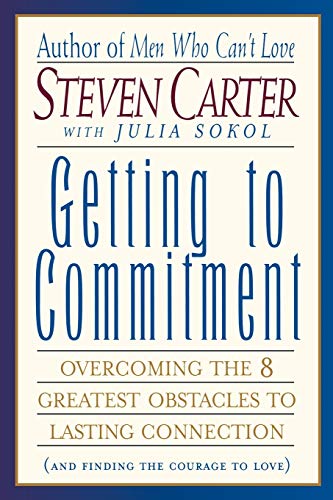
Getting to Commitment: Overcoming the 8 Greatest Obstacles to Lasting Connection (And Finding the Courage to Love) - Softcover
Inhaltsangabe
Getting to Commitment offers understanding, inspiration, and a concrete plan of action for any woman, man, or couple who is ready to tackle the eight most destructive demons that make people run from loving relationships.
Die Inhaltsangabe kann sich auf eine andere Ausgabe dieses Titels beziehen.
Über die Autorin bzw. den Autor
By Steven Carter - With Julia Sokol
Auszug. © Genehmigter Nachdruck. Alle Rechte vorbehalten.
Getting to Commitment
Overcoming the 8 Greatest Obstacles to Lasting Connection (and Finding the Courage to Love)By Steven CarterM. Evans and Company
Copyright © 2000 Steven CarterAll right reserved.
ISBN: 9780871319050
Chapter One
I'm standing in front of a small audience of very well intentionedwomen, and men, who are investing their time, theirmoney, and their hopes to attend a lecture on commitment andcommitment conflicts. As always I have asked members of theaudience to write down three questions that they would hope tohave answered before the end of the evening. While they are signingin, I look at the questions. I do this carefully even though Iprobably already know them by heart. As much as I appreciate thateach question reflects the unique personality and dilemma of theindividual questioner, the truth is that the questions I'm asked arealways fundamentally the same.
"How can I deal with a partner who is afraid to commit ... a partnerwho doesn't let me get close ... a partner who avoids intimacy?"
"Why do I get scared in relationships?"
"How do I know whether I'm afraid of commitment in general,or just this specific relationship?"
"I keep choosing people who are afraid of commitment. Whatdoes this say about me?"
"What can I do to help a partner who says he/she is scared?"
"One of us always seems to be afraid of moving forward. Howcan we break this pattern?"
Every time I schedule one of these talks and look at these questions,I wonder what I can say to make a difference to these people.I know what kind of disappointment and pain brings a person toone of these lectures. I know how hard it is to expose one's personallife to a group of strangers. I know how much work goes into havinga good relationship. What I don't know is whether people areprepared to do the work that is required. I know for sure that fastanswers are simply not enough. There are no quick fixes.
Sometimes as I stand in front of these men and women, I wantto say, "Even if I share everything I know as honestly and openly aspossible, are you really sure you want to know what I know? Willthat help you? Because if you are sincere, then you have a problem:You will have to do something with this new information. You willhave to change the way you think and act. You will have to dosomething differently in your relationship with yourself as well asyour relationships with others. This takes time and work, and itisn't always pleasant."
During the nineties, many of us got into the habit of watchingSeinfeld. Each week, we looked at George Costanza, and welaughed at the consistency of his problems. One thing we couldcount on was that George was not going to change. I rememberone episode in particular: George fell in love with a woman inprison; her situation made her the ultimate in unavailable partners.How typical! By definition the relationship was limited andwould put few demands on George. Of course, he was enthralled.And, of course the relationship fell apart as soon as the womangot out of jail. As always nothing changed. We can laugh atGeorge, but often our behavior is just as predictable. In our relationships,we follow the same patterns time and time again. Weeither make the wrong choices or we mess up potentially goodrelationships. But in real life, it's just not funny. We can laughthrough our tears, but the tears are still there. I believe there islittle that feels more empty and painful than being incapable offorging a working commitment with another person. It implies alifetime of missed opportunities, first dates, and failed connections.How dissatisfying.
The message is that for most of us, the "eyes-closed thing" isn'tworking any more. We keep bumping into the same objects andending up in the same dark places. All we have to show for ourefforts are the bumps and bruises that come from repeatedly hittingthe familiar walls and experiencing the same negativeemotions. If old patterns haven't worked in the past, what makes usthink they will work in the future? They didn't get us into the openspaces of relationships; they didn't help us find the love we want.
Ten years ago, I knew everything there was to know about notmaking a commitment. I knew everything about romantic fear--everynuance, every gesture, all of the language and all of thebehavior. I was an expert, if notthe expert on fear. A thousandand one different ways to runaway from love. For a while in mylife, running away from love hadit's own appeal; sometimes it was even fun. Fun to be ducking,dodging, and dating. Then it became awful. I wanted long-term love.I wanted a real life. I wanted to be able to share a deep commitmentwith another human being. I wanted to be able to fall in love andstay in love. I wanted to be able to make a real commitment.
Some people may honestly believe that they can live very happylives without having a stable relationship. They say commitment isnot an essential ingredient in their lives; they say this is not howeverybody wants to live. I agree. Not everybody does. But it's how Iwanted to live, and if you have picked up this book, a committedrelationship must certainly be something that you desire. Now, youprobably want to know how you can get from that place of desireto a place where you have the relationship you want.
My job is to help you get down the road. My job is to demystifythe process, familiarize you with your options and tell you aboutthe common pitfalls so you don't veer too far off the path. Thetough stuff is up to you. There is only one difference between thosewho make it through and those who do not. One single difference,and it has nothing to do with your age, history, or desire. The onesingle difference is courage.
Examining My Own Fear of Commitment
One hot summer day more than ten years ago, I found myself inChicago, sitting on stage at the Oprah Winfrey Show, waiting forthe cameras to start rolling tape again after the commercial break.The subject of the show was "commitmentphobia."
The show was going out live to much of the country, and forthe first thirty minutes, several men sat on stage and spilledtheir insides to an audience of riveted viewers. It gave theappearance of an on-air confession, and it was coming from agroup of normal looking guys who were acknowledging theirproblems with romantic commitment and long-term love.Talking about their relationships and their problems withwomen, these men were taking responsibility for their share ofbroken promises, broken dreams, and broken hearts. The studioaudience was surprisingly sympathetic. The women particularlyseemed grateful for the honesty as well as appreciative for thenew insight and understanding into a problem that had touchedmany of them personally.
Then it was my turn to talk. But I was not there to tell mystory. I was there for a different reason. I was there because I hadjust published a book called Men Who Can't Love. In this book myco-author, Julia Sokol, and I coined the term commitmentphobiato describe people who have a claustrophobic response to intimacy.This book, which offers a self-protective message for womeninvolved with commitmentphobic men, is devoted to understandingthis problem.
I remember that day vividly. On stage, with Oprah Winfrey infront...
„Über diesen Titel“ kann sich auf eine andere Ausgabe dieses Titels beziehen.
Suchergebnisse für Getting to Commitment: Overcoming the 8 Greatest Obstacles...

Foto des Verkäufers
Getting to Commitment: Overcoming the 8 Greatest Obstacles to Lasting Connection (And Finding the Courage to Love)
Anbieter: Dream Books Co., Denver, CO, USA
Verkäuferbewertung 5 von 5 Sternen

Zustand: good. Gently used with minimal wear on the corners and cover. A few pages may contain light highlighting or writing, but the text remains fully legible. Dust jacket may be missing, and supplemental materials like CDs or codes may not be included. May be ex-library with library markings. Ships promptly! Artikel-Nr. DBV.0871319055.G
Gebraucht kaufen
EUR 3,64
Versand gratis
Versand innerhalb von USA
Versand innerhalb von USA
Anzahl: 1 verfügbar
Beispielbild für diese ISBN
Getting to Commitment: Overcoming the 8 Greatest Obstacles to Lasting Connection (And Finding the Courage to Love)
Anbieter: World of Books (was SecondSale), Montgomery, IL, USA
Verkäuferbewertung 5 von 5 Sternen
Zustand: Very Good. Item in very good condition! Textbooks may not include supplemental items i.e. CDs, access codes etc. Artikel-Nr. 00107892490
Gebraucht kaufen
EUR 3,69
Versand gratis
Versand innerhalb von USA
Versand innerhalb von USA
Anzahl: 1 verfügbar
Beispielbild für diese ISBN
Getting to Commitment: Overcoming the 8 Greatest Obstacles to Lasting Connection (And Finding the Courage to Love)
Anbieter: World of Books (was SecondSale), Montgomery, IL, USA
Verkäuferbewertung 5 von 5 Sternen
Zustand: Good. Item in good condition. Textbooks may not include supplemental items i.e. CDs, access codes etc. Artikel-Nr. 00067032473
Gebraucht kaufen
EUR 3,69
Versand gratis
Versand innerhalb von USA
Versand innerhalb von USA
Anzahl: 6 verfügbar
Beispielbild für diese ISBN
Getting to Commitment: Overcoming the 8 Greatest Obstacles to Lasting Connection (And Finding the Courage to Love)
Verlag:
M. Evans & Company (edition ), 2000
ISBN 10: 0871319055
ISBN 13: 9780871319050
Gebraucht
Paperback
Anbieter: BooksRun, Philadelphia, PA, USA
Verkäuferbewertung 5 von 5 Sternen
Paperback. Zustand: Very Good. It's a well-cared-for item that has seen limited use. The item may show minor signs of wear. All the text is legible, with all pages included. It may have slight markings and/or highlighting. Artikel-Nr. 0871319055-11-1
Gebraucht kaufen
EUR 4,27
Versand gratis
Versand innerhalb von USA
Versand innerhalb von USA
Anzahl: 1 verfügbar
Beispielbild für diese ISBN
Getting to Commitment: Overcoming the 8 Greatest Obstacles to Lasting Connection (And Finding the Courage to Love)
Anbieter: World of Books (was SecondSale), Montgomery, IL, USA
Verkäuferbewertung 5 von 5 Sternen
Zustand: Good. Item in good condition. Textbooks may not include supplemental items i.e. CDs, access codes etc. Artikel-Nr. 00063213378
Gebraucht kaufen
EUR 4,50
Versand gratis
Versand innerhalb von USA
Versand innerhalb von USA
Anzahl: 6 verfügbar
Beispielbild für diese ISBN
Getting to Commitment : Overcoming the 8 Greatest Obstacles to Lasting Connection (And Finding the Courage to Love)
Verlag:
Evans & Company, Incorporated, M., 2000
ISBN 10: 0871319055
ISBN 13: 9780871319050
Gebraucht
Softcover
Anbieter: Better World Books, Mishawaka, IN, USA
Verkäuferbewertung 5 von 5 Sternen
Zustand: Good. 0th Edition. Pages intact with minimal writing/highlighting. The binding may be loose and creased. Dust jackets/supplements are not included. Stock photo provided. Product includes identifying sticker. Better World Books: Buy Books. Do Good. Artikel-Nr. 3585983-6
Gebraucht kaufen
EUR 5,93
Versand gratis
Versand innerhalb von USA
Versand innerhalb von USA
Anzahl: 2 verfügbar
Beispielbild für diese ISBN
Getting to Commitment: Overcoming the 8 Greatest Obstacles to Lasting Connection (And Finding the Courage to Love)
Anbieter: Wonder Book, Frederick, MD, USA
Verkäuferbewertung 5 von 5 Sternen
Zustand: Very Good. Very Good condition. A copy that may have a few cosmetic defects. May also contain light spine creasing or a few markings such as an owner's name, short gifter's inscription or light stamp. Bundled media such as CDs, DVDs, floppy disks or access codes may not be included. Artikel-Nr. Q15N-00047
Gebraucht kaufen
EUR 6,16
Versand gratis
Versand innerhalb von USA
Versand innerhalb von USA
Anzahl: 1 verfügbar
Beispielbild für diese ISBN
Getting to Commitment: Overcoming the 8 Greatest Obstacles to Lasting Connection (and Finding the Courage to Love)
Anbieter: ThriftBooks-Dallas, Dallas, TX, USA
Verkäuferbewertung 5 von 5 Sternen
Paperback. Zustand: Very Good. No Jacket. May have limited writing in cover pages. Pages are unmarked. ~ ThriftBooks: Read More, Spend Less. Artikel-Nr. G0871319055I4N00
Gebraucht kaufen
EUR 6,17
Versand gratis
Versand innerhalb von USA
Versand innerhalb von USA
Anzahl: 1 verfügbar
Beispielbild für diese ISBN
Getting to Commitment: Overcoming the 8 Greatest Obstacles to Lasting Connection (and Finding the Courage to Love)
Anbieter: ThriftBooks-Dallas, Dallas, TX, USA
Verkäuferbewertung 5 von 5 Sternen
Paperback. Zustand: Very Good. No Jacket. Former library book; May have limited writing in cover pages. Pages are unmarked. ~ ThriftBooks: Read More, Spend Less. Artikel-Nr. G0871319055I4N10
Gebraucht kaufen
EUR 6,17
Versand gratis
Versand innerhalb von USA
Versand innerhalb von USA
Anzahl: 1 verfügbar
Beispielbild für diese ISBN
Getting to Commitment: Overcoming the 8 Greatest Obstacles to Lasting Connection (and Finding the Courage to Love)
Anbieter: ThriftBooks-Phoenix, Phoenix, AZ, USA
Verkäuferbewertung 5 von 5 Sternen
Paperback. Zustand: Very Good. No Jacket. May have limited writing in cover pages. Pages are unmarked. ~ ThriftBooks: Read More, Spend Less. Artikel-Nr. G0871319055I4N00
Gebraucht kaufen
EUR 6,17
Versand gratis
Versand innerhalb von USA
Versand innerhalb von USA
Anzahl: 1 verfügbar