
Verwandte Artikel zu Suburban Nation: The Rise of Sprawl and the Decline...
Inhaltsangabe
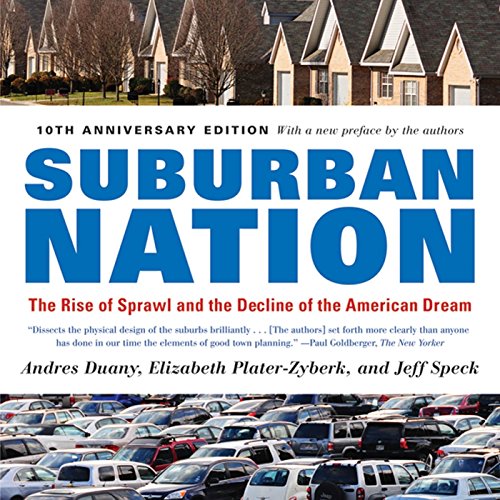
For a decade, Suburban Nation has given voice to a growing movement in North America to put an end to suburban sprawl and replace the last century's automobile-based settlement patterns with a return to more traditional planning. Founders of the Congress for the New Urbanism, Andres Duany and Elizabeth Plater-Zyberk are at the forefront of the movement, and even their critics, such as Fred Barnes in The Weekly Standard, recognized that "Suburban Nation is likely to become this movement's bible." A lively lament about the failures of postwar planning, this is also that rare book that offers solutions: "an essential handbook" (San Francisco Chronicle).
This tenth anniversary edition includes a new preface by the authors.Die Inhaltsangabe kann sich auf eine andere Ausgabe dieses Titels beziehen.
Über die Autorinnen und Autoren
Andres Duany, with Elizabeth Plater-Zyberk, leads a firm that has designed more than 200 new neighborhoods and community revitalization plans, most notably Seaside, Florida. He is co-author of Suburban Nation.
Andres Duany and Elizabeth Plater-Zyberk lead a firm that has designed more than 200 new neighborhoods and community revitalization plans, most notably Seaside, Florida.
Jeff Speck, coauthor of the landmark bestseller Suburban Nation, is a city planner who advocates for smart growth and sustainable design. As the former director of design at the National Endowment for the Arts, he oversaw the Mayors' Institute on City Design, where he worked with dozens of American mayors on their most pressing city planning challenges. He leads a design practice based in Washington, D.C.
Auszug. © Genehmigter Nachdruck. Alle Rechte vorbehalten.
Suburban Nation (10th Anniversary Edition)
The Rise of Sprawl and the Decline of the American DreamBy Andres DuanyNorth Point Press
Copyright © 2010 Andres DuanyAll right reserved.
ISBN: 9780865477506
1
WHAT IS SPRAWL, AND WHY?
TWO WAYS TO GROW; THE FIVE COMPONENTS OF SPRAWL;
A BRIEF HISTORY OF SPRAWL; WHY VIRGINIA BEACH IS NOT
ALEXANDRIA; NEIGHBORHOOD PLANS VERSUS SPRAWL PLANS
WHAT IS SPRAWL, AND WHY?
TWO WAYS TO GROW; THE FIVE COMPONENTS OF SPRAWL;
A BRIEF HISTORY OF SPRAWL; WHY VIRGINIA BEACH IS NOT
ALEXANDRIA; NEIGHBORHOOD PLANS VERSUS SPRAWL PLANS
The cities will be part of the country; I shall live 30 miles from my office in one direction, under a pine tree; my secretary will live 30 miles away from it too, in the other direction, under another pine tree. We shall both have our own car.
We shall use up tires, wear out road surfaces and gears, consume oil and gasoline. All of which will necessitate a great deal of work . . . enough for all.
--LE CORBUSIER, THE RADIANT CITY (1967)
We shall use up tires, wear out road surfaces and gears, consume oil and gasoline. All of which will necessitate a great deal of work . . . enough for all.
--LE CORBUSIER, THE RADIANT CITY (1967)
TWO WAYS TO GROW
This book is a study of two different models of urban growth: the traditional neighborhood and suburban sprawl. They are polar opposites in appearance, function, and character: they look different, they act differently, and they affect us in different ways.
The traditional neighborhood was the fundamental form of European settlement on this continent through the Second World War, from St. Augustine to Seattle. It continues to be the dominant pattern of habitation outside the United States, as it has been throughout recorded history. The traditional neighborhood--represented by mixed-use, pedestrian-friendly communities of varied population, either standing free as villages or grouped into towns and cities--has proved to be a sustainable form of growth. It allowed us to settle the continent without bankrupting the country or destroying the countryside in the process.
This book is a study of two different models of urban growth: the traditional neighborhood and suburban sprawl. They are polar opposites in appearance, function, and character: they look different, they act differently, and they affect us in different ways.
The traditional neighborhood was the fundamental form of European settlement on this continent through the Second World War, from St. Augustine to Seattle. It continues to be the dominant pattern of habitation outside the United States, as it has been throughout recorded history. The traditional neighborhood--represented by mixed-use, pedestrian-friendly communities of varied population, either standing free as villages or grouped into towns and cities--has proved to be a sustainable form of growth. It allowed us to settle the continent without bankrupting the country or destroying the countryside in the process.
The traditional neighborhood: naturally occurring, pedestrian-friendly, and diverse. Daily needs are located within walking distance
Suburban sprawl, now the standard North American pattern of growth, ignores historical precedent and human experience. It is an invention, conceived by architects, engineers, and planners, and promoted by developers in the great sweeping aside of the old that occurred after the Second World War. Unlike the traditional neighborhood model, which evolved organically as a response to human needs, suburban sprawl is an idealized artificial system. It is not without a certain beauty: it is rational, consistent, and comprehensive. Its performance is largely predictable. It is an outgrowth of modern problem solving: a system for living. Unfortunately, this system is already showing itself to be unsustainable. Unlike the traditional neighborhood, sprawl is not healthy growth; it is essentially self-destructive. Even at relatively low population densities, sprawl tends not to pay for itself financially and consumes land at an alarming rate, while producing insurmountable traffic problems and exacerbating social inequity and isolation. These particular outcomes were not predicted. Neither was the toll that sprawl exacts from America's cities and towns, which continue to decant slowly into the countryside. As the ring of suburbia grows around most of our cities, so grows the void at the center. Even while the struggle to revitalize deteriorated downtown neighborhoods and business districts continues, the inner ring of suburbs is already at risk, losing residents and businesses to fresher locations on a new suburban edge.*
Suburban sprawl, now the standard North American pattern of growth, ignores historical precedent and human experience. It is an invention, conceived by architects, engineers, and planners, and promoted by developers in the great sweeping aside of the old that occurred after the Second World War. Unlike the traditional neighborhood model, which evolved organically as a response to human needs, suburban sprawl is an idealized artificial system. It is not without a certain beauty: it is rational, consistent, and comprehensive. Its performance is largely predictable. It is an outgrowth of modern problem solving: a system for living. Unfortunately, this system is already showing itself to be unsustainable. Unlike the traditional neighborhood, sprawl is not healthy growth; it is essentially self-destructive. Even at relatively low population densities, sprawl tends not to pay for itself financially and consumes land at an alarming rate, while producing insurmountable traffic problems and exacerbating social inequity and isolation. These particular outcomes were not predicted. Neither was the toll that sprawl exacts from America's cities and towns, which continue to decant slowly into the countryside. As the ring of suburbia grows around most of our cities, so grows the void at the center. Even while the struggle to revitalize deteriorated downtown neighborhoods and business districts continues, the inner ring of suburbs is already at risk, losing residents and businesses to fresher locations on a new suburban edge.*
Suburban sprawl: an invention, an abstract system of carefully separated pods of single use. Daily needs are located within driving distance
THE FIVE COMPONENTS OF SPRAWL
If sprawl truly is destructive, why is it allowed to continue? The beginning of an answer lies in sprawl's seductive simplicity, the fact that it consists of very few homogeneous components--five in all--which can be arranged in almost any way. It is appropriate to review these parts individually, since they always occur independently. While one component may be adjacent to another, the dominant characteristic of sprawl is that each component is strictly segregated from the others.
Housing subdivisions, also called clusters and pods. These places consist only of residences. They are sometimes called villages, towns, and neighborhoods by their developers, which is misleading, since those terms denote places which are not exclusively residential and which provide an experiential richness not available in a housing tract. Subdivisions can be identified as such by their contrived names, which tend toward the romantic--Pheasant Mill Crossing--and often pay tribute to the natural or historic resource they have displaced.?
THE FIVE COMPONENTS OF SPRAWL
If sprawl truly is destructive, why is it allowed to continue? The beginning of an answer lies in sprawl's seductive simplicity, the fact that it consists of very few homogeneous components--five in all--which can be arranged in almost any way. It is appropriate to review these parts individually, since they always occur independently. While one component may be adjacent to another, the dominant characteristic of sprawl is that each component is strictly segregated from the others.
Housing subdivisions, also called clusters and pods. These places consist only of residences. They are sometimes called villages, towns, and neighborhoods by their developers, which is misleading, since those terms denote places which are not exclusively residential and which provide an experiential richness not available in a housing tract. Subdivisions can be identified as such by their contrived names, which tend toward the romantic--Pheasant Mill Crossing--and often pay tribute to the natural or historic resource they have displaced.?
A residential subdivision: houses and parking
Shopping centers, also called strip centers, shopping malls, and big-box retail. These are places exclusively for shopping. They come in every size, from the Quick Mart on the corner to the Mall of America, but they are all places to which one is unlikely to walk. The conventional shopping center can be easily distinguished from its traditional main-street counterpart by its lack of housing or offices, its single-story height, and its parking lot between the building and the roadway.
Shopping centers, also called strip centers, shopping malls, and big-box retail. These are places exclusively for shopping. They come in every size, from the Quick Mart on the corner to the Mall of America, but they are all places to which one is unlikely to walk. The conventional shopping center can be easily distinguished from its traditional main-street counterpart by its lack of housing or offices, its single-story height, and its parking lot between the building and the roadway.
A strip center: stores and parking
Office parks and business parks. These are places only for work. Derived from the modernist architectural vision of the building standing free in the park, the contemporary office park is usually made of boxes in parking lots. Still imagined as a pastoral workplace isolated in nature, it has kept its idealistic name and also its quality of isolation, but in practice it is more likely to be surrounded by highways than by countryside.
Office parks and business parks. These are places only for work. Derived from the modernist architectural vision of the building standing free in the park, the contemporary office park is usually made of boxes in parking lots. Still imagined as a pastoral workplace isolated in nature, it has kept its idealistic name and also its quality of isolation, but in practice it is more likely to be surrounded by highways than by countryside.
A corporate park: offices and parking
Civic institutions. The fourth component of suburbia is public buildings: the town halls, churches, schools, and other places where people gather for communication and culture. In traditional neighborhoods, these buildings often serve as neighborhood focal points, but in suburbia they take an altered form: large and infrequent, generally unadorned owing to limited funding, surrounded by parking, and located nowhere in particular. The school pictured here shows what a dramatic evolution this building type has undergone in the past thirty years. A comparison between the size of the parking lot and the size of the building is revealing: this is a school to which no child will ever walk. Because pedestrian access is usually nonexistent, and because the dispersion of surrounding homes often makes school buses impractical, schools in the new suburbs are designed based on the assumption of massive automotive transportation.
Civic institutions. The fourth component of suburbia is public buildings: the town halls, churches, schools, and other places where people gather for communication and culture. In traditional neighborhoods, these buildings often serve as neighborhood focal points, but in suburbia they take an altered form: large and infrequent, generally unadorned owing to limited funding, surrounded by parking, and located nowhere in particular. The school pictured here shows what a dramatic evolution this building type has undergone in the past thirty years. A comparison between the size of the parking lot and the size of the building is revealing: this is a school to which no child will ever walk. Because pedestrian access is usually nonexistent, and because the dispersion of surrounding homes often makes school buses impractical, schools in the new suburbs are designed based on the assumption of massive automotive transportation.
A public high school: classrooms and parking
Roadways. The fifth component of sprawl consists of the miles of pavement that are necessary to connect the other four disassociated components. Since each piece of suburbia serves only one type of activity, and since daily life involves a wide variety of activities, the residents of suburbia spend an unprecedented amount of time and money moving from one place to the next. Since most of this motion takes place in singly occupied automobiles, even a sparsely populated area can generate the traffic of a much larger traditional town.
Roadways. The fifth component of sprawl consists of the miles of pavement that are necessary to connect the other four disassociated components. Since each piece of suburbia serves only one type of activity, and since daily life involves a wide variety of activities, the residents of suburbia spend an unprecedented amount of time and money moving from one place to the next. Since most of this motion takes place in singly occupied automobiles, even a sparsely populated area can generate the traffic of a much larger traditional town.
The modern city: low density, high dependence on automotive infrastructure
The traffic load caused by the many disassociated pieces of suburbia is most clearly visible from above. As seen in this image of Palm Beach County, Florida, the amount of pavement (public infrastructure) per building (private structure) is extremely high, especially when compared to the efficiency of a section of an older city like...
The traffic load caused by the many disassociated pieces of suburbia is most clearly visible from above. As seen in this image of Palm Beach County, Florida, the amount of pavement (public infrastructure) per building (private structure) is extremely high, especially when compared to the efficiency of a section of an older city like...
„Über diesen Titel“ kann sich auf eine andere Ausgabe dieses Titels beziehen.
Suchergebnisse für Suburban Nation: The Rise of Sprawl and the Decline...

Beispielbild für diese ISBN
Suburban Nation: The Rise of Sprawl and the Decline of the American Dr
Anbieter: World of Books (was SecondSale), Montgomery, IL, USA
Verkäuferbewertung 5 von 5 Sternen

Paperback. Zustand: Good. For a decade, Suburban Nation has given voice to a growing movement in North America to put an end to suburban sprawl and replace the last century's automobile-based settlement patterns with a return to more traditional planning. Founders of the Congress for the New Urbanism, Andres Duany and Elizabeth Plater-Zyberk are at the forefront of the movement, and even their critics, such as Fred Barnes in The Weekly Standard, recognized that "Suburban Nation is likely to become this movement's bible." A lively lament about the failures of postwar planning, this is also that rare book that offers solutions: "an essential handbook" (San Francisco Chronicle). This tenth anniversary edition includes a new preface by the authors. Artikel-Nr. CIN0865477507G
Gebraucht kaufen
EUR 6,55
Versand gratis
Versand innerhalb von USA
Versand innerhalb von USA
Anzahl: 1 verfügbar
Beispielbild für diese ISBN
Suburban Nation : The Rise of Sprawl and the Decline of the American Dream
Verlag:
Farrar, Straus & Giroux, 2010
ISBN 10: 0865477507
ISBN 13: 9780865477506
Gebraucht
Softcover
Anbieter: Better World Books: West, Reno, NV, USA
Verkäuferbewertung 5 von 5 Sternen
Zustand: Very Good. Former library copy. Pages intact with possible writing/highlighting. Binding strong with minor wear. Dust jackets/supplements may not be included. Includes library markings. Stock photo provided. Product includes identifying sticker. Better World Books: Buy Books. Do Good. Artikel-Nr. 11134789-6
Gebraucht kaufen
EUR 8,57
Versand gratis
Versand innerhalb von USA
Versand innerhalb von USA
Anzahl: 1 verfügbar
Beispielbild für diese ISBN
Suburban Nation : The Rise of Sprawl and the Decline of the American Dream
Verlag:
Farrar, Straus & Giroux, 2010
ISBN 10: 0865477507
ISBN 13: 9780865477506
Gebraucht
Softcover
Anbieter: Better World Books, Mishawaka, IN, USA
Verkäuferbewertung 5 von 5 Sternen
Zustand: Good. Pages intact with minimal writing/highlighting. The binding may be loose and creased. Dust jackets/supplements are not included. Stock photo provided. Product includes identifying sticker. Better World Books: Buy Books. Do Good. Artikel-Nr. 5447104-6
Gebraucht kaufen
EUR 8,57
Versand gratis
Versand innerhalb von USA
Versand innerhalb von USA
Anzahl: 2 verfügbar
Beispielbild für diese ISBN
Suburban Nation : The Rise of Sprawl and the Decline of the American Dream
Verlag:
Farrar, Straus & Giroux, 2010
ISBN 10: 0865477507
ISBN 13: 9780865477506
Gebraucht
Softcover
Anbieter: Better World Books, Mishawaka, IN, USA
Verkäuferbewertung 5 von 5 Sternen
Zustand: Good. Former library copy. Pages intact with minimal writing/highlighting. The binding may be loose and creased. Dust jackets/supplements are not included. Includes library markings. Stock photo provided. Product includes identifying sticker. Better World Books: Buy Books. Do Good. Artikel-Nr. 16966008-75
Gebraucht kaufen
EUR 8,57
Versand gratis
Versand innerhalb von USA
Versand innerhalb von USA
Anzahl: 1 verfügbar
Beispielbild für diese ISBN
Suburban Nation: The Rise of Sprawl and the Decline of the American Dream
Verlag:
North Point Press (edition 10th Anniversary), 2010
ISBN 10: 0865477507
ISBN 13: 9780865477506
Gebraucht
Paperback
Anbieter: BooksRun, Philadelphia, PA, USA
Verkäuferbewertung 5 von 5 Sternen
Paperback. Zustand: Very Good. 10th Anniversary. It's a well-cared-for item that has seen limited use. The item may show minor signs of wear. All the text is legible, with all pages included. It may have slight markings and/or highlighting. Artikel-Nr. 0865477507-11-1
Gebraucht kaufen
EUR 8,65
Versand gratis
Versand innerhalb von USA
Versand innerhalb von USA
Anzahl: 3 verfügbar
Beispielbild für diese ISBN
Suburban Nation: The Rise of Sprawl and the Decline of the American Dream
Anbieter: ThriftBooks-Atlanta, AUSTELL, GA, USA
Verkäuferbewertung 5 von 5 Sternen
Paperback. Zustand: Fair. No Jacket. Readable copy. Pages may have considerable notes/highlighting. ~ ThriftBooks: Read More, Spend Less. Artikel-Nr. G0865477507I5N00
Gebraucht kaufen
EUR 10,21
Versand gratis
Versand innerhalb von USA
Versand innerhalb von USA
Anzahl: 1 verfügbar
Beispielbild für diese ISBN
Suburban Nation: The Rise of Sprawl and the Decline of the American Dream
Anbieter: ThriftBooks-Reno, Reno, NV, USA
Verkäuferbewertung 5 von 5 Sternen
Paperback. Zustand: Fair. No Jacket. Readable copy. Pages may have considerable notes/highlighting. ~ ThriftBooks: Read More, Spend Less. Artikel-Nr. G0865477507I5N00
Gebraucht kaufen
EUR 10,21
Versand gratis
Versand innerhalb von USA
Versand innerhalb von USA
Anzahl: 1 verfügbar
Beispielbild für diese ISBN
Suburban Nation: The Rise of Sprawl and the Decline of the American Dream
Anbieter: ThriftBooks-Dallas, Dallas, TX, USA
Verkäuferbewertung 5 von 5 Sternen
Paperback. Zustand: Very Good. No Jacket. May have limited writing in cover pages. Pages are unmarked. ~ ThriftBooks: Read More, Spend Less. Artikel-Nr. G0865477507I4N00
Gebraucht kaufen
EUR 10,21
Versand gratis
Versand innerhalb von USA
Versand innerhalb von USA
Anzahl: 1 verfügbar
Beispielbild für diese ISBN
Suburban Nation: The Rise of Sprawl and the Decline of the American Dream
Anbieter: ThriftBooks-Dallas, Dallas, TX, USA
Verkäuferbewertung 5 von 5 Sternen
Paperback. Zustand: Fair. No Jacket. Readable copy. Pages may have considerable notes/highlighting. ~ ThriftBooks: Read More, Spend Less. Artikel-Nr. G0865477507I5N00
Gebraucht kaufen
EUR 10,21
Versand gratis
Versand innerhalb von USA
Versand innerhalb von USA
Anzahl: 1 verfügbar
Beispielbild für diese ISBN
Suburban Nation: The Rise of Sprawl and the Decline of the American Dream
Anbieter: Magers and Quinn Booksellers, Minneapolis, MN, USA
Verkäuferbewertung 5 von 5 Sternen
paperback. Zustand: Very Good. May have light to moderate shelf wear and/or a remainder mark. Complete. Clean pages. Artikel-Nr. 1090579
Gebraucht kaufen
EUR 10,34
EUR 3,56 Versand
Versand innerhalb von USA
Versand innerhalb von USA
Anzahl: 2 verfügbar