
Verwandte Artikel zu Sonnets To Orpheus
Inhaltsangabe
Breathing, you invisible poem!
World-space in pure continuous interchange
with my own being. Equipose
in which I rhythmically transpire.
Die Inhaltsangabe kann sich auf eine andere Ausgabe dieses Titels beziehen.
Über die Autorin bzw. den Autor
Susanne Petermann is a poet, editor, and personal organizer. She lives in Southern Oregon.
Auszug. © Genehmigter Nachdruck. Alle Rechte vorbehalten.
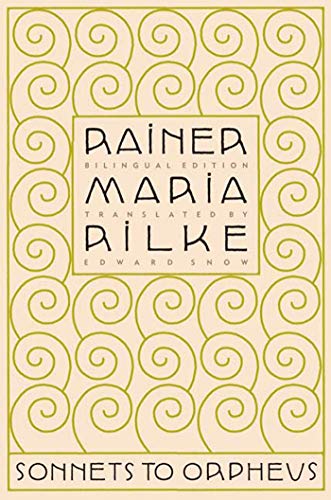
Sonnets to Orpheus
By Rainer Maria Rilke, Edward SnowFarrar, Straus and Giroux
Copyright © 2004 Rainer Maria Rilke
All rights reserved.
ISBN: 978-0-86547-721-6All rights reserved.
Contents
Title Page,
Copyright Notice,
Introduction,
Erster Teil / First Part,
Zweiter Teil / Second Part,
Also by Edward Snow,
About the Authors,
Copyright,
CHAPTER 1
Erster Teil / First Part
1
Da stieg ein Baum. O reine Übersteigung!
O Orpheus singt! O hoher Baum im Ohr!
Und alles schwieg. Doch selbst in der Verschweigung
ging neuer Anfang, Wink und Wandlung vor.
Tiere aus Stille drangen aus dem klaren
gelösten Wald von Lager und Genist;
und da ergab sich, daß sie nicht aus List
und nicht aus Angst in sich so leise waren,
sondern aus Hören. Brüllen, Schrei, Geröhr
schien klein in ihren Herzen. Und wo eben
kaum eine Hütte war, dies zu empfangen,
ein Unterschlupf aus dunkelstem Verlangen
mit einem Zugang, dessen Pfosten beben, —
da schufst du ihnen Tempel im Gehör.
1
A tree arose. O pure transcendence!
O Orpheus sings! O tall tree within the ear!
And all was silent. Yet in that silence
pulsed new genesis, new signaling, new change.
Creatures of stillness thronged out of the clear
disentangled forest, from nest and lair;
and it wasn't cunning, wasn't heed or fright
that put such softness in their step,
but listening. Bellow, shriek, and roar
seemed small inside their hearts. And where once
there'd scarcely been a hut to take this in,
a hidden refuge made of darkest longing
with an entranceway whose braces shook, —
you built temples for them in their hearing.
2
Und fast ein Mädchen wars und ging hervor
aus diesem einigen Glück von Sang und Leier
und glänzte klar durch ihre Frühlingsschleier
und machte sich ein Bett in meinem Ohr.
Und schlief in mir. Und alles war ihr Schlaf.
Die Bäume, die ich je bewundert, diese
fühlbare Ferne, die gefühlte Wiese
und jedes Staunen, das mich selbst betraf.
Sie schlief die Welt. Singender Gott, wie hast
du sie vollendet, daß sie nicht begehrte,
erst wach zu sein? Sieh, sie erstand und schlief.
Wo ist ihr Tod? O, wirst du dies Motiv
erfinden noch, eh sich dein Lied verzehrte? —
Wo sinkt sie hin aus mir? ... Ein Mädchen fast ...
2
And almost a girl it was and came forth
from this glad unity of song and lyre
and shone brightly through her springtime veils
and made herself a bed within my ear.
And slept in me. And all things were her sleep.
The trees I forever marvel at, these
palpable distances, the deep-felt meadows,
and an entire life's astonishments.
She slept the world. Singing god, how did you
so perfect her that she never once
had need to be awake? Look, she arose and slept.
Where is her death? Ah, will you introduce
that theme before your song expires? —
I can feel her drifting off ... to where? ... A girl almost ...
3
Ein Gott vermags. Wie aber, sag mir, soll
ein Mann ihm folgen durch die schmale Leier?
Sein Sinn ist Zwiespalt. An der Kreuzung zweier
Herzwege steht kein Tempel für Apoll.
Gesang, wie du ihn lehrst, ist nicht Begehr,
nicht Werbung um ein endlich noch Erreichtes;
Gesang ist Dasein. Für den Gott ein Leichtes.
Wann aber sind wir? Und wann wendet er
an unser Sein die Erde und die Sterne?
Dies ists nicht, Jüngling, daß du liebst, wenn auch
die Stimme dann den Mund dir aufstößt, — lerne
vergessen daß du aufsangst. Das verrinnt.
In Wahrheit singen, ist ein andrer Hauch.
Ein Hauch um nichts. Ein Wehn im Gott. Ein Wind.
3
A god can do it. But how, tell me, could
a man follow him through the narrow lyre?
His mind divides. Where two heart-roads cross
there can be no temple for Apollo.
Singing, as you teach it, is not desire,
not the courting of some end to be attained.
Singing is Being. Easy, for a god.
But for us, when are we? And when does he
cast all the earth and stars upon our lives?
It's not, youth, when you're in love, even if
then your voice forces open your mouth, —
learn to forget those songs. They elapse.
True singing is a different breath.
A breath serving nothing. A gust in the god. A wind.
4
O ihr Zärtlichen, tretet zuweilen
in den Atem, der euch nicht meint,
laßt ihn an eueren Wangen sich teilen,
hinter euch zittert er, wieder vereint.
O ihr Seligen, o ihr Heilen,
die ihr der Anfang der Herzen scheint.
Bogen der Pfeile und Ziele von Pfeilen,
ewiger glänzt euer Lächeln verweint.
Fürchtet euch nicht zu leiden, die Schwere,
gebt sie zurück an der Erde Gewicht;
schwer sind die Berge, schwer sind die Meere.
Selbst die als Kinder ihr pflanztet, die Bäume,
wurden zu schwer längst; ihr trüget sie nicht.
...
„Über diesen Titel“ kann sich auf eine andere Ausgabe dieses Titels beziehen.
Suchergebnisse für Sonnets To Orpheus

Beispielbild für diese ISBN
Sonnets to Orpheus
Anbieter: Ria Christie Collections, Uxbridge, Vereinigtes Königreich
Verkäuferbewertung 5 von 5 Sternen

Zustand: New. In English. Artikel-Nr. ria9780865477216_new
Neu kaufen
EUR 13,71
EUR 11,13 Versand
Versand von Vereinigtes Königreich nach USA
Versand von Vereinigtes Königreich nach USA
Anzahl: Mehr als 20 verfügbar
Beispielbild für diese ISBN
Sonnets to Orpheus
Anbieter: Majestic Books, Hounslow, Vereinigtes Königreich
Verkäuferbewertung 4 von 5 Sternen

Zustand: New. pp. 144. Artikel-Nr. 7926275
Neu kaufen
EUR 18,25
EUR 7,72 Versand
Versand von Vereinigtes Königreich nach USA
Versand von Vereinigtes Königreich nach USA
Anzahl: 1 verfügbar
Beispielbild für diese ISBN
Sonnets to Orpheus: Bilingual Edition
Anbieter: Revaluation Books, Exeter, Vereinigtes Königreich
Verkäuferbewertung 5 von 5 Sternen
Paperback. Zustand: Brand New. bilingual edition. 122 pages. 8.00x5.50x0.75 inches. In Stock. Artikel-Nr. x-0865477213
Neu kaufen
EUR 16,95
EUR 11,88 Versand
Versand von Vereinigtes Königreich nach USA
Versand von Vereinigtes Königreich nach USA
Anzahl: 2 verfügbar