Inhaltsangabe
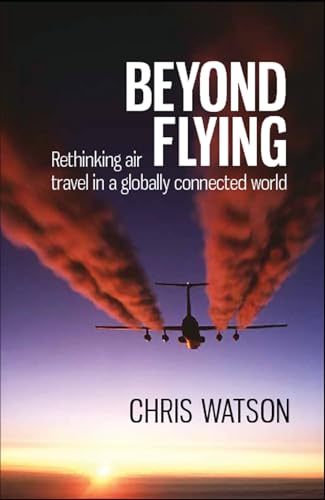
Fourteen inspiring travellers from around the world share stories of reducing their air travel to minimise their part in climate change.
Die Inhaltsangabe kann sich auf eine andere Ausgabe dieses Titels beziehen.
Über die Autorinnen und Autoren
Chris Watson is an architect specialising in user-friendliness of buildings. He usually assists large organisations with large property portfolios or special buildings to ensure that their functionality supports organisations' objectives.
Chris co-edited Enhancing Building Performance (2012) and has published various conference papers and journal articles on the evaluation of buildings/architecture. He grew up in an airline family, giving him an interest in aviation which, combined with his passion for eco-friendly design, has inspired him to also write about personal emissions management.
Chris Brazier started his journalistic career at the rock music weekly Melody Maker in the late 1970s. Since 1984 he has been a co-editor at New Internationalist Publications, working on its monthly magazine about global justice issues as well as on its books. He writes regularly for UNICEF's State of the World's Children report and has authored books on topics as wide-ranging as The No-Nonsense Guide to World History and Trigger Issues: Football.
Rob Hopkins is the co-founder of Transition Town Totnes and of the Transition Network. His achievements include setting up a permaculture course at Kinsale Further Education College, and coordinating the first eco-village development in Ireland to be granted planning permission. He is author of The Transition Handbook and The Transition Companion, among other publications.
Rob is the winner of the 2008 Schumacher Award, is an Ashoka Fellow and a Fellow of the Post Carbon Institute. He previously served as a Soil Association Trustee, and was named by the Independent as one of the UK's top 100 environmentalists. Rob is the winner of the 2009 Observer Ethical Award in the Grassroots Campaigner category, and was voted the Energy Saving Trust / Guardian's 'Green Community Hero'. He has completed a PhD on Transition and Resilience at Plymouth University.
Saci Lloyd is a children's writer and teacher. She was born in Manchester and raised in Anglesey, Wales. After leaving university for a life of glamour, she has worked at various times as a very bad cartoonist, toured the USA in a straightedge band, run an interactive media team at an advertising agency, co-founded a film company and finally wound up as head of media at a sixth form college in east London. Lloyd's first novels, the Carbon Diaries series, met with critical acclaim. She is the author of Momentum and Quantum Drop.
John Stewart has been an environmental campaigner for over thirty years, specialising
in transport and noise. In 2008 he was voted by the Independent on Sunday newspaper as the UK's 'most effective environmentalist'. He is the author of Why Noise Matters, published in 2011 by Earthscan. He chaired the coalition that defeated plans for a third runway at London's Heathrow Airport. He chairs the UK Noise Association and for many years chaired the UK's leading transport NGO, the Campaign for Better Transport.
Auszug. © Genehmigter Nachdruck. Alle Rechte vorbehalten.
Beyond Flying
Rethinking Air Travel in a Globally Connected World
By Chris WatsonUIT Cambridge Ltd
Copyright © 2014 UIT Cambridge Ltd.
All rights reserved.
ISBN: 978-0-85784-209-1All rights reserved.
Contents
Title Page,
Dedication,
Friends of the Earth: rethinking travel,
Foreword by Peter McManners,
Preface,
Introduction,
Part 1 Thinking beyond flying,
1. To fly or not to fly? Chris Brazier,
2. Deciding never to fly again Rob Hopkins,
3. Young people and climate change Saci Lloyd,
4. Waking up to the downsides of flying John Stewart,
5. Slow and low – the way to go: a systems view of travel emissions Kevin Anderson,
Part 2 Business beyond flying,
6. A green travel experiment Chris Watson,
7. Trains versus planes: building a low-carbon travel agency Kate Andrews,
8. Going cold turkey: a law practice without any flights Tom Bennion,
9. The no-flying conference: Signs of Change Susan Krumdieck,
10. Slowlier than thou: why flight-free travel is about better, not less Ed Gillespie,
Part 3 Savouring the journey,
11. The human engine: bicycling to Beijing Chris Smith,
12. Walking distance Adam Weymouth,
13. bike2oz: the world going through you instead of around you Lowanna Doye,
14. A small matter of distance: trying not to fly to climate talks Nic Seton,
15. Travel on a hot planet: exploring the global tourist industry overland Anirvan Chatterjee and Barnali Ghosh,
How to fly less,
Index,
About Green Books,
Copyright,
CHAPTER 1
To fly or not to fly?
Chris Brazier
This chapter originally appeared as an article in New Internationalist magazine (Issue 409, 1 March 2008), www.newint.org
Chris Brazier started his journalistic career at the rock music weekly Melody Maker in the late 1970s. Since 1984 he has been a co-editor at New Internationalist Publications, working on its monthly magazine about global justice issues as well as on its books. He writes regularly for UNICEF's State of the World's Children report and has authored books on topics as wide-ranging as The No-Nonsense Guide to World History and Trigger Issues: Football.
The plane is over the English Channel when the pilot's voice crackles over the loudspeakers. 'Just to warn you that there's been a bit of trouble at Heathrow with people protesting about the impact of air travel on climate change. Nothing to worry about, but when we land you may see a bigger police presence at the airport than you would normally expect.' The tone is jocular and clearly intended to draw us all together into a kind of community of 'sensible' travellers who might have to suffer the disruption of 'extremist' campaigners.
So what exactly am I doing here, in August 2007, given that I feel a much greater sense of kinship with the Climate Camp protesters below than with the pilot's cosy set of assumptions? It's a good question. My family and I are on our way back from a holiday in Italy. Last time we went, a few years ago, we drove there and back, via Luxembourg and Switzerland, taking our time and making many stop-offs on the way to break the journey. This time when we booked, almost a year in advance, we knew our holiday would be squeezed between work commitments and being back for our daughter's exam results. So, not without qualms, we took advantage of ludicrously cheap flights that would get us there in a couple of hours rather than a couple of days.
I tell you this to indicate my starting point when I began to research for this piece – for all that I bike to work, compost like crazy and am vegetarian, I am far from being in the environmental vanguard, and certainly don't feel able to lecture people about what they should or should not do.
Given this, I was not exactly burning to pick up the topic of ethical travel. I had no problem considering the effects of tourism on the Majority World (the so-called 'developing world'). But since most tourism depends on air travel, I knew I was likely to find myself in the unenviable position of having to offer readers some guidance on when flying is acceptable and when it isn't. And the more I sounded people out, the more my suspicions were confirmed. People are concerned and looking for guidance on an issue which has leapt to public attention in recent years – at least in Britain, where the debate about flying rages much hotter than it does in Australasia or North America.
Mind-boggling statistics
My early research left me shocked by the statistics on aviation emissions. Put simply, jet aircraft not only emit carbon from vast quantities of kerosene fuel, they also do it at high altitudes, where it has a much greater warming effect than it would in the lower atmosphere. In addition, jets emit other greenhouse gases, including nitrous oxide and water vapour ('contrails'). The Intergovernmental Panel on Climate Change (IPCC) estimates the net effect of all these emissions from jet aircraft at 2.7 times the carbon consumed in the fuel. An individual's share of carbon emitted on a return flight from London to New York (equivalent to 1,700 kg of CO2) exceeds the carbon emitted by six months' worth of modest driving in an average car in the USA (equivalent to 1,650 kg of CO2).
How such statistics are calculated is always a contentious issue. But the exact numbers are less interesting than the broad-brush comparisons: you can easily dump more carbon into the atmosphere from one return flight than from the gas and electricity you use in your house for an entire year. This was, to be frank, a mind-boggling discovery for me, which couldn't help but challenge my attitude to flying. Travel has played an enormous part in my life. I cannot easily conceive what kind of person I would be, had I not been able to board an aeroplane. But I do recognize that the profound implications of climate change (and the fight to prevent it) are going to force us all to take stock of our lives and challenge all our assumptions. Just how far, I wonder, are we prepared to go in challenging the flying culture?
My tentative proposal to the New Internationalist editorial team was that we should oppose the expansion of aviation – especially the development of new airports or runways – and encourage readers to reduce the amount they fly. But we should stop well short of calling for an end to all holiday flights.
A great deal of heat was generated in the discussion that ensued, but not a lot of light. It soon became plain that the issue of flying is a particularly thorny one, in which emotions are perhaps too readily engaged. And this was despite the fact that, perhaps surprisingly, there was no one in the room arguing that the magazine should rule out altogether flying for leisure or experience. One or two people argued that it would be so impossible to pin down reliable estimates of the emissions of various forms of transport that we would be treading on dodgy ground even to enter the flying debate.
There was also an argument that for the New Internationalist to concentrate its attention on individual behaviour – when and whether people should be travelling by plane – would be a mistake. There are much more important battles to be fought in the war on climate change, ran this strand of thought, than that of encouraging people to think about their 'carbon footprint'. I invited one of my editorial colleagues, Adam Ma'anit, to lay out this...
„Über diesen Titel“ kann sich auf eine andere Ausgabe dieses Titels beziehen.
Suchergebnisse für Beyond Flying: Rethinking air travel in a globally...

Beispielbild für diese ISBN
Beyond Flying: Rethinking air travel in a globally connected world
Anbieter: AwesomeBooks, Wallingford, Vereinigtes Königreich
Verkäuferbewertung 5 von 5 Sternen

Zustand: Very Good. This book is in very good condition and will be shipped within 24 hours of ordering. The cover may have some limited signs of wear but the pages are clean, intact and the spine remains undamaged. This book has clearly been well maintained and looked after thus far. Money back guarantee if you are not satisfied. See all our books here, order more than 1 book and get discounted shipping. . Artikel-Nr. 7719-9780857842091
Gebraucht kaufen
EUR 11,82
EUR 5,74 Versand
Versand von Vereinigtes Königreich nach USA
Versand von Vereinigtes Königreich nach USA
Anzahl: 1 verfügbar
Beispielbild für diese ISBN
Beyond Flying: Rethinking air travel in a globally connected world
Anbieter: Bahamut Media, Reading, Vereinigtes Königreich
Verkäuferbewertung 4 von 5 Sternen

Zustand: Very Good. Shipped within 24 hours from our UK warehouse. Clean, undamaged book with no damage to pages and minimal wear to the cover. Spine still tight, in very good condition. Remember if you are not happy, you are covered by our 100% money back guarantee. Artikel-Nr. 6545-9780857842091
Gebraucht kaufen
EUR 11,82
EUR 8,03 Versand
Versand von Vereinigtes Königreich nach USA
Versand von Vereinigtes Königreich nach USA
Anzahl: 1 verfügbar
Beispielbild für diese ISBN
Beyond Flying: Rethinking air travel in a globally connected world
Verlag:
Bloomsbury Publishing PLC, United Kingdom, 2014
ISBN 10: 0857842099
ISBN 13: 9780857842091
Gebraucht
Paperback
Anbieter: WorldofBooks, Goring-By-Sea, WS, Vereinigtes Königreich
Verkäuferbewertung 5 von 5 Sternen
Paperback. Zustand: Very Good. Is flying an irreplaceable part of 21st-century life? Can businesses succeed in a globalised world without international air travel? What about love miles visiting friends and family overseas? Architect and writer Chris Watson grew up in an airline family, passionate about aviation and how it allows us to explore the world, share knowledge and create more diverse communities. But this freedom has come at a cost for the environment. Aviation is a significant factor in climate change - and one that's been steadily growing in both developed and undeveloped countries, burning fossil fuels and emitting harmful greenhouse gases. Flying is never zero-carbon, so can we reduce it, or even do without it? Fourteen remarkable travellers from around the world share their stories with Chris about how they came to the conclusion that reducing their air travel was necessary to lower their personal emissions. From backgrounds as diverse as commercial, professional, academic, NGOs, literature and science, they have found easy and better ways of living and working, saving what few flights they do take for emergencies and 'love miles'. Their stories look at how our modern, globalised world offers more alternatives to keep in touch with people around the world without contributing to the aviation industrys ever-increasing emissions. Filled with success stories and practical guidance to help people make more informed decisions, this book is a must-read for any frequent flyer - or for anyone involved in a global business. Beyond Flying demonstrates that even the toughest of environmental challenges can be addressed. The book has been read, but is in excellent condition. Pages are intact and not marred by notes or highlighting. The spine remains undamaged. Artikel-Nr. GOR006425236
Gebraucht kaufen
EUR 25,85
EUR 6,44 Versand
Versand von Vereinigtes Königreich nach USA
Versand von Vereinigtes Königreich nach USA
Anzahl: 2 verfügbar