
Verwandte Artikel zu Walking the Tree
Inhaltsangabe
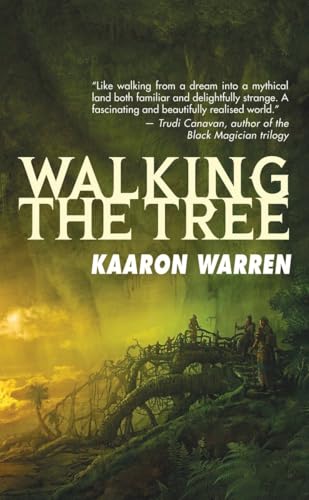
Botanica is an island, but almost all of the island is taken up by the Tree.
Little knowing how they came to be here, small communities live around the coast line. The Tree provides them shelter, kindling, medicine – and a place of legends, for there are ghosts within the trees who snatch children and the dying.
Lillah has come of age and is now ready to leave her community and walk the tree for five years, learning all Botanica has to teach her. Before setting off, Lillah is asked by the dying mother of a young boy to take him with her. In a country where a plague killed half the population, Morace will otherwise be killed in case he has the same disease. But can Lillah keep the boy’s secret, or will she have to resort to breaking the oldest taboo on Botanica?
Another astonishingly imaginative novel from the acclaimed author of Slights.
FILE UNDER: Fantasy [A Stunning World / An Epic Journey / A Terrifying Secret / Ghosts in the Tree]
Die Inhaltsangabe kann sich auf eine andere Ausgabe dieses Titels beziehen.
Über die Autorin bzw. den Autor
KAARON WARREN’s award-winning short fiction has appeared in Year’s Best Horror & Fantasy, the Poe and Haunted Legends anthologies, Fantasy magazine, and many other venues in the US, Europe and Australia. Her short story “A Positive” has been made into a film called Patience. Her first novel, Slights, has been nominated for a Bram Stoker Award, and has been shortlisted for an Aurealis Award.
Auszug. © Genehmigter Nachdruck. Alle Rechte vorbehalten.
Prologue
Formation of the Island of Botanica
The rising tide swallowed many islands as the third millennium closed. By then, humankind had returned to basic survival. Hand to mouth subsistence farming. The Spikes epidemic, which took ninety percent of the population in the years between 2107 and 2212, had died with its last victim, but the rise of the animals and insects made human life precarious. Plant life was at risk through disease and the needs of the food chain. Plagues of locusts, intent on survival, roared through food crops. Domesticated cattle chewed grass to the ground and tore out the roots with their flat teeth.
In some areas volcanic mud spewed for centuries, and in others new land masses were thrown up by the shifting plates.
In 2519 a group of scientists, the last existing perhaps, set sail for what they had identified as the highest point in the Pacific, an island perhaps five hundred years old and approximately 800,000 km², the size of Turkey, filled with a legendary, ancient Tree. They were botanists and plant biologists and they took with them a Noah’s Ark of seeds. They did not bother with animals, wanting to avoid the virulent nature of breeding and the future temptation to farm animals for food. Spikes had come from abusive animal consumption and other manipulations.
The island of Botanica was only sparsely inhabited; most of the area’s people believing it to be filled with spirits.
The cause of fear was the massive Tree which almost filled the island. Such a monstrous thing in nature must have grown on the spirits of man; most people would not step foot on the land, or even sail close to shore.
Rainfall was adequate on the island and the Tree itself grew year by year.
The inhabitants were an undeveloped, disparate group living at far extremes in small communities. With the Tree filling most of the island, there was no cross-country travel and very little circumnavigation.
When the colonists arrived, life changed.
Laburnum OMBU Aloes
○○○
The community of Ombu awoke to the sound of Leaffall. The soft early fall of leaves meant soon the Tree would let enough light through to dapple the sand and it would be time to choose the teachers.
Lillah’s father began the selection process, collecting seawater in a large, leaf-lined wooden bowl. He covered this tightly with more leaves and tied it securely with a strong strip of bark. He placed the bowl in the roots, where the water drew strength from the Tree for ten days, after which enough sweet water had formed to wash the faces of the ten young women seeking testing.
Lillah collected the bowl then took it to the nine other girls up for selection. They sat in the moonlight and bathed each other’s faces. The water would keep their skin honest, and in the morning, when they faced the fathers, only truth would be shown.
“This is nice,” Lillah said. “You’re gentle.”
Melia laughed. “Lillah likes a woman’s touch. She’s going to be disappointed at the touch of a man.”
The girls laughed, teasing and poking each other. Melia jumped up and spoke in a deep voice. “Are there any girls here who can match my virility? Any of you?”
“Oh, Melia,” Thea said. “You will have some fun if they send you.”
“They might send us all. You never know with the fathers.”
“What are you saying about the fathers?” Melia’s mother, Cynthia, came upon them. “The fathers are having a good rest in readiness for tomorrow. You would be sensible to do the same. Have you washed your faces?”
The girls nodded. Melia’s mother’s croaky voice made them listen, feel lucky. In her home Order of Parana, young people burned throats with an ember. When she whispered, the croakiness was not so awful, so she mostly whispered.
Whispering can be very strong.
“And the sap is prepared for the morning? Softening?”
Melia gave her mother a hug. “We are ready, as every group has been ready before us. We’ll be fine. We are magnificent.”
The girls giggled again and Melia’s mother shook her head. “Bed, girls,” she said. She was far more restrained than once she was. When she had first arrived she had been wilder. Life had tamed her. People said she had watched her own brother die in a terrible way. Sea monster? Deep black hole? Ghost cave? And that she had never recovered from this tragedy.
Lillah walked to her father’s home, feeling her skin tingle on her cheeks. Living arrangements were fluid in the Order of Ombu. Lillah, Melia and Thea shared a house sometimes. Lillah otherwise shared a house with her father, or Logan and Magnolia. Melia shared with three, four, or five other young women. Thea lived with her brother Dickson and some of the young men. They treated her like a boy. But beds could shift. Lillah could wake to find Agara sleeping on the floor, or one of the children.
Lillah had moved in with her friends two years earlier, when she was nineteen. It seemed time to give her father space, and it was important to know the girls she would hopefully become teachers with; know what they were like to live with, so there would be less of a transition.
The sunlight dappled through. It was a wonderful time of year. Everyone was warmer without the constant shadow of the Tree. And with the shadow not constant, it seemed to the people that the sentinel nature of the Tree was at rest.
This enlivened the people. The sun on them in the daytime, the Treeshadow lessened. It seemed a good time for the teachers to be chosen and the school to leave. Time for the people to make their own decisions, not led by the nature of the Tree. Sometimes, in the wet season, water seeped up through the sand as far up as the roots of the Tree. Salty water, no good for growing food. Light bounced off the water and made the undergrowth seem brighter. Sand soft and warm and the sap running smooth from the Trunk, uncut, flowing uncalled for but precious down the Trunk.
Myrist, Lillah’s father, speaking loudly over Leaffall, said, “Good you are here. Stay the night. I’ll feed you and you will be full of energy for tomorrow. Though I may not be able to attend with you. I may not be able to watch the testing.”
Lillah put her arm around him. “You have to be there! I will lose belief in myself otherwise.”
“It will depend on Magnolia, Lillah. Her pains are starting to come through and if she is ready to give child tomorrow, I will be with her.”
“I will be with her, too.”
He shook his head. “No, Lillah. You will not be needed then. Afterwards, yes. But selection is all that matters to you tomorrow. You glow. You are beautiful,” her father said.
Lillah felt beautiful and capable of all things. “I hope they will choose me for my looks, then. Is my dress finished?”
“A new dress is not going to get you a job as a teacher.” Her father sounded tired: a deep bone weariness that seemed to come across men once their children were grown. His words were interrupted by a rain of leaves on the roof. The leaves had been dropping for six days now, and were stored to be used as plates, climbing shoes, buckets, spades, funnels, hats.
Lillah’s father was right: the dress would not sway any opinions, not at this stage.
Lillah felt she had a good chance. She had passed the learning tests easily.
For the emotion test the fathers presented the girls with options. They told a story and the girls had to describe how the characters would be...
„Über diesen Titel“ kann sich auf eine andere Ausgabe dieses Titels beziehen.
Suchergebnisse für Walking the Tree

Beispielbild für diese ISBN
Walking the Tree
Verlag:
HarperCollins Publishers Limited, 2010
ISBN 10: 0857660438
ISBN 13: 9780857660435
Gebraucht
Softcover
Anbieter: Better World Books, Mishawaka, IN, USA
Verkäuferbewertung 5 von 5 Sternen

Zustand: Good. Bridges, Greg (illustrator). Reprint. Pages intact with minimal writing/highlighting. The binding may be loose and creased. Dust jackets/supplements are not included. Stock photo provided. Product includes identifying sticker. Better World Books: Buy Books. Do Good. Artikel-Nr. 14557377-6
Gebraucht kaufen
EUR 6,94
Versand gratis
Versand innerhalb von USA
Versand innerhalb von USA
Anzahl: 1 verfügbar
Beispielbild für diese ISBN
Walking the Tree
Verlag:
HarperCollins Publishers Limited, 2010
ISBN 10: 0857660438
ISBN 13: 9780857660435
Gebraucht
Softcover
Anbieter: Better World Books, Mishawaka, IN, USA
Verkäuferbewertung 5 von 5 Sternen
Zustand: Good. Bridges, Greg (illustrator). Reprint. Former library copy. Pages intact with minimal writing/highlighting. The binding may be loose and creased. Dust jackets/supplements are not included. Includes library markings. Stock photo provided. Product includes identifying sticker. Better World Books: Buy Books. Do Good. Artikel-Nr. GRP77615498
Gebraucht kaufen
EUR 6,94
Versand gratis
Versand innerhalb von USA
Versand innerhalb von USA
Anzahl: 1 verfügbar
Beispielbild für diese ISBN
Walking the Tree
Anbieter: ThriftBooks-Atlanta, AUSTELL, GA, USA
Verkäuferbewertung 5 von 5 Sternen
Unknown. Zustand: Good. No Jacket. Bridges, Greg (illustrator). Pages can have notes/highlighting. Spine may show signs of wear. ~ ThriftBooks: Read More, Spend Less. Artikel-Nr. G0857660438I3N00
Gebraucht kaufen
EUR 7,99
Versand gratis
Versand innerhalb von USA
Versand innerhalb von USA
Anzahl: 1 verfügbar
Beispielbild für diese ISBN
Walking the Tree
Anbieter: ThriftBooks-Dallas, Dallas, TX, USA
Verkäuferbewertung 5 von 5 Sternen
Unknown. Zustand: Good. No Jacket. Bridges, Greg (illustrator). Pages can have notes/highlighting. Spine may show signs of wear. ~ ThriftBooks: Read More, Spend Less. Artikel-Nr. G0857660438I3N00
Gebraucht kaufen
EUR 7,99
Versand gratis
Versand innerhalb von USA
Versand innerhalb von USA
Anzahl: 1 verfügbar