
Verwandte Artikel zu A New India?: Critical Reflections in the Long Twentieth...
A New India?: Critical Reflections in the Long Twentieth Century (India and Asia in the Global Economy) - Hardcover
Buch 3 von 4: India and Asia in the Global Economy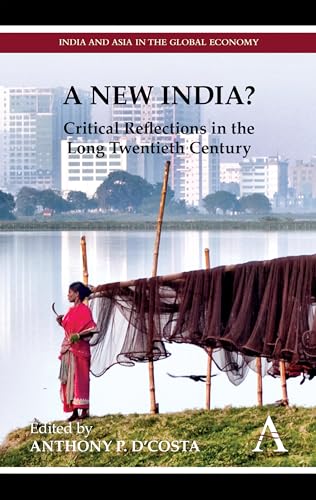
Inhaltsangabe
This volume critically examines the notion of a ‘new' India by acknowledging that India is changing remarkably and by indicating that in the overzealous enthusiasm about the new India, there is collective amnesia about the other, older India. The book argues that the increasing consolidation of capitalist markets of commodity production and consumption has unleashed not only economic growth and social change, but has also introduced new contradictions associated with market dynamics in the material and social as well as intellectual spheres.
Die Inhaltsangabe kann sich auf eine andere Ausgabe dieses Titels beziehen.
Über die Autorin bzw. den Autor
Anthony P. D’Costa is a Professor in Indian Studies and Research Director at the Asia Research Centre, Copenhagen Business School. He has written extensively on the global steel, Indian automobile, and IT industries, globalization, development, innovations, and industrial restructuring. He is currently working on globalization and the international mobility of IT workers, and editing volumes on Asian economic nationalism and the development experiences of India and China.
Auszug. © Genehmigter Nachdruck. Alle Rechte vorbehalten.
A New India?
Critical Reflections in the Long Twentieth Century
By Anthony P. D'CostaWimbledon Publishing Company
Copyright © 2010 Anthony P. D'Costa editorial matter and selection
All rights reserved.
ISBN: 978-0-85728-664-2All rights reserved.
Contents
List of Tables and Figures, vii,
Foreword by Deepak Nayyar, xi,
Preface and Acknowledgements, xvii,
Chapter 1. What is this 'New' India? An Introduction Anthony P. D'Costa, 1,
Chapter 2. New Interpretations of India's Economic Growth in the Twentieth Century Kunal Sen, 23,
Chapter 3. Continuity and Change: Notes on Agriculture in 'New India' R. Ramakumar, 43,
Chapter 4. An Uneasy Coexistence: The New and the Old in Indian Industry and Services, 71,
Chapter 5. Is the New India Bypassing Women? Gendered Implications of India's Growth Nitya Rao, 99,
Chapter 6. The 'New' Non-Residents of India: A Short History of the NRI Sareeta Amrute, 127,
Chapter 7. Revivalism, Modernism and Internationalism: Finding the Old in the New India Rebecca M. Brown, 151,
Chapter 8. Creative Tensions: Contemporary Fine Art in the 'New' India Nina Poulsen, 179,
List of Contributors, 195,
Index, 199,
CHAPTER 1
WHAT IS THIS 'NEW' INDIA? AN INTRODUCTION
Anthony P. D'Costa
Nayi Indian, Nayi Deluxe Bike ('New Indian, New Bike', a fading advertisement on a brick wall in Bansberia, West Bengal, December 2009)
Introduction
The labels 'new India' and 'new Indian' are now commonplace. Businesses hawking products or journalists and social commentators reporting on contemporary India use the label lavishly. There is a new India, which is different from what it was before, an unstated 'old India'. Presumably there is also a new Indian, who is assumed to enjoy the fruits of a modern, industrial, dynamic India, neither bound by the past nor by provincial thinking. India and Indians are now modern and global. A street advertisement in the up-and-coming Salt Lake residential area outside Kolkata shows high–rise apartment buildings and makes no bones about exhorting passers-by to 'live like the world does', an oblique reference to the nouveau riche, whose financial standing is seen as no different from that of the citizens of affluent countries.
What reads like a caricature has been repeatedly reported by the popular and business press, nationally and internationally. The New York Times has made liberal use of the prefix 'new' to describe India, as in 'the high life of young, exuberant New India' (Sengupta 2008). The new India refers to the country's stirring middle class, its new-found wealth, changing consumption patterns that mimic Western lifestyles, and India's technological sophistication (Simmons and Kahn 2009a, 2009b). In Amitabh Bachchan's video clip 'The New India', the mega Bollywood star metaphorically refers to India as a dog on a leash–the new India waiting to spring forward while the other India, the leash itself, holds it back.
So strong is this sentiment of newness that the international success of the movie Slumdog Millionaire upset many Indians as it did not represent the 'new India', but rather depicted the poverty, grime, slums and thugs (Sengupta 2009b) associated with the 'old India'. Of course not all commentators are mesmerized by this new India. Aravind Adiga's The White Tiger (2008), winner of the Man Booker Prize, pointedly illustrated the glaring inequality that this new India has spawned. The international press has frequently reported on India's grotesque wealth and income disparities, with malnutrition and female foeticide on the one hand and embarrassing riches on the other (Rieff 2009; Mishra 2006; Sengupta 2009a).
There is no doubt that a different India is emerging, although when it began and what has changed is difficult to pin down. The one common thread that binds the new and the other India is the increasing consolidation of capitalist markets of commodity production and consumption, à la modernity, which unleashes economic growth and social change and introduces new contradictions associated with market dynamics. There is already an ideological shift toward freer markets in Indian government policy and business preferences when compared to an earlier India. And in this context, new economic, social and intellectual contradictions have emerged, in agrarian crisis, slow growth of employment, and the persistence of low caste exploitation.
Contradictions of course do not imply that capitalist markets, modernity, or change per se have not produced greater wealth, more liberty, better welfare, and increasing choice for some. Rather, contradictions suggest that the other India is lost in the shuffle of the new India – a quintessential problem of modernity (Connerton 2009: 3, 142). In the thick of the excitement about a new India, there is 'collective amnesia' about the other India. By underreporting the contradictions generated by change, the social and political tensions in a rapidly modernizing, globalizing, and increasingly polarized India are also underestimated.
As markets have become global, the Indian state has also become more flexible to extract benefits from the world economy (D'Costa 2009). A new relationship between the state and its diaspora, especially the highly visible technology entrepreneurs with high disposable incomes, has been forged to garner capital, knowledge and entrepreneurship for the new India (Sidel 2007, 30). The Indian government has had to shift from a rigid notion of citizenship and national identity to one encompassing non-resident Indians and persons of Indian origin living abroad. This has introduced an uncharted and tenuous relationship between India, its boundaries and its citizens at home and abroad. With the resources of the state stretched, markets have been promoted through which citizens are expected to fend for themselves. Consequently, greater responsibilities have been conferred upon individuals and markets to facilitate participation in well-paying professional sectors such as medical, managerial, technical, and IT. At the same time, upwardly mobile Indians look outward and imagine themselves as part of an expanded globalized national space even as they cohabit with the other India that lives in its shadow.
There are other developments in a new India that encompass a quiet but perceptible shift that is both consistent with an unfolding India and jarring with the other India (see Luce 2006). Take for instance architecture and art. India is pulled in different directions by its own traditions and European-inspired modernism. In both art and architecture such tensions are inherent. But architecture, perhaps more than art, has been engaged with economic and political realities in India. It has depended on government and industry commissions in ways that aimed to address India's economic and social plight, even as it tried to maintain its vernacular influences. Architecture is now engaged in transforming India into an IT valley with corporate campuses, appealing to a Westernized audience of technology entrepreneurs at home and abroad. This is an outcome that is not different from Connerton's (2009) homogenization of space brought on by modern architecture.
In contemporary art markets in India, the story is less familiar. Art is driven by commodity fetishism, the market catering to the new middle classes spawned by the global and Indian technology revolution. Yet, such markets and the extraordinary economic values they command seem to jar with the grim...
„Über diesen Titel“ kann sich auf eine andere Ausgabe dieses Titels beziehen.
Suchergebnisse für A New India?: Critical Reflections in the Long Twentieth...

Beispielbild für diese ISBN
A New India?: Critical Reflections in the Long Twentieth Century (India and Asia in the Global Economy)
Anbieter: Books From California, Simi Valley, CA, USA
Verkäuferbewertung 4 von 5 Sternen

Hardcover. Zustand: Very Good. Artikel-Nr. mon0003152133
Gebraucht kaufen
EUR 56,80
EUR 4,31 Versand
Versand innerhalb von USA
Versand innerhalb von USA
Anzahl: 2 verfügbar
Beispielbild für diese ISBN
A New India?
Anbieter: PBShop.store UK, Fairford, GLOS, Vereinigtes Königreich
Verkäuferbewertung 5 von 5 Sternen

HRD. Zustand: New. New Book. Shipped from UK. Established seller since 2000. Artikel-Nr. CX-9780857286642
Neu kaufen
EUR 76,79
EUR 7,90 Versand
Versand von Vereinigtes Königreich nach USA
Versand von Vereinigtes Königreich nach USA
Anzahl: 15 verfügbar
Beispielbild für diese ISBN
A New India?: Critical Reflections in the Long Twentieth Century (India and Asia in the Global Economy)
Anbieter: Ria Christie Collections, Uxbridge, Vereinigtes Königreich
Verkäuferbewertung 5 von 5 Sternen
Zustand: New. In. Artikel-Nr. ria9780857286642_new
Neu kaufen
EUR 91,97
EUR 14,00 Versand
Versand von Vereinigtes Königreich nach USA
Versand von Vereinigtes Königreich nach USA
Anzahl: 3 verfügbar
Beispielbild für diese ISBN
A New India?
Anbieter: PBShop.store US, Wood Dale, IL, USA
Verkäuferbewertung 5 von 5 Sternen
HRD. Zustand: New. New Book. Shipped from UK. Established seller since 2000. Artikel-Nr. CX-9780857286642
Neu kaufen
EUR 106,10
Versand gratis
Versand innerhalb von USA
Versand innerhalb von USA
Anzahl: 15 verfügbar
Beispielbild für diese ISBN
A New India?: Critical Reflections in the Long Twentieth Century
Anbieter: Revaluation Books, Exeter, Vereinigtes Königreich
Verkäuferbewertung 5 von 5 Sternen
Hardcover. Zustand: Brand New. 180 pages. 9.50x6.25x0.75 inches. In Stock. Artikel-Nr. x-0857286641
Neu kaufen
EUR 168,51
EUR 14,61 Versand
Versand von Vereinigtes Königreich nach USA
Versand von Vereinigtes Königreich nach USA
Anzahl: 2 verfügbar