
Verwandte Artikel zu Beyond Access: Transforming Policy and Practice for...
Inhaltsangabe
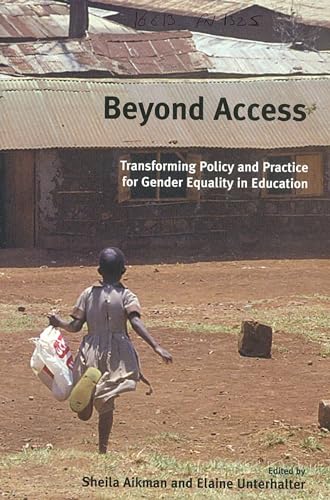
In a world in which poverty, social prejudice and poor-quality provision cause an estimated 100 million girls to drop out of school before completing their primary education, it is not enough for governments to pledge themselves to increase girls' access to school. This book presents a vision of a transformational education which would promote social change, enable girls to achieve their full potential and contribute to the creation of a just and democratic society. Contributors to this book examine the extent and causes of gender-based inequality in education, analyse government policies and their implications for women's empowerment and report on original field-work in a range of local contexts where gender-equality initiatives have flourished. In their introduction and their concluding chapter Sheila Aikman and Elaine Unterhalter consider the challenges that confront policy makers, practitioners, campaigners and researchers if they are to make real progress towards gender equality in education, in the context of the Millennium Development Goals.
Die Inhaltsangabe kann sich auf eine andere Ausgabe dieses Titels beziehen.
Über die Autorinnen und Autoren
Sheila Aikman has worked with a wide range of NGOs from community-based and regional federations of indigenous peoples in South America to international NGOs such as the International Work Group for Indigenous Affairs, Copenhagen, and Oxfam GB where she held the post of Global Education Policy Adviser prior to joining UEA and DEV in March 2008.
Elaine Unterhalter is a reader in Education and International Development at the Institute of Education, University of London. Together with Sheila Aikman she co-ordinates the 'Beyond Access: Gender, Education and Development' project. Her books include Gender, Schooling and Global Social Justice (Routledge, 2006), Beyond Access (with Sheila Aikman, Oxfam, 2005) and Amartya Sen's Capability Approach and Social Justice in Education (with Melanie Walker, Palgrave, 2007).
Auszug. © Genehmigter Nachdruck. Alle Rechte vorbehalten.
Beyond Access
Transforming Policy and Practice for Gender Equality in Education
By Sheila Aikman, Elaine UnterhalterOxfam Publishing
Copyright © 2005 Oxfam GB
All rights reserved.
ISBN: 978-0-85598-529-5All rights reserved.
Contents
Acknowledgements, vii,
Introduction Sheila Aikman and Elaine Unterhalter, 1,
Part One: The Challenges for Gender Equality in Education,
1 Fragmented frameworks? Researching women, gender, education, and development Elaine Unterhalter, 15,
2 Ensuring a fair chance for girls Global Campaign for Education, 36,
3 Measuring gender equality in education Elaine Unterhalter, Chloe Challender, and Rajee Rajagopalan, 60,
Part Two: Transforming Action – Changing Policy through Practice,
4 Educating girls in Bangladesh: watering a neighbour's tree? Janet Raynor, 83,
5 The challenge of educating girls in Kenya Elimu Yetu Coalition, 106,
6 Learning to improve policy for pastoralists in Kenya Ian Leggett, 128,
7 When access is not enough: educational exclusion of rural girls in Peru Patricia Ames, 149,
8 Crossing boundaries and stepping out of purdah in India Mora Oommen, 166,
9 Pastoralist schools in Mali: gendered roles and curriculum realities Salina Sanou and Sheila Aikman, 181,
Part Three: The Challenge of Local Practices – Doing Policy Differently?,
10 Learning about HIV/AIDS in schools: does a gender-equality approach make a difference? Mark Thorpe, 199,
11 Gender, education, and Pentecostalism: the women's movement within the Assemblies of God in Burkina Faso Alicia Zents, 212,
12 Enabling education for girls: the Loreto Day School Sealdah, India Ruth Doggett, 227,
13 Conclusion: policy and practice change for gender equality Sheila Aikman and Elaine Unterhalter, 245,
Index, 250,
CHAPTER 1
Fragmented frameworks? Researching women, gender, education, and development
Elaine Unterhalter
This chapter critically reviews contrasting frameworks which present different ways of understanding the nature of the challenge to achieve gender equality in education. Different meanings of gender equality and schooling have consequences for our understanding of two Millennium Development Goals (MDGs): MDG 2, which is concerned with gender equality in schooling, and MDG 3, concerned with the empowerment of women. Different meanings entail different actions, and, as will be shown, organisations have interpreted gender, education, development, empowerment, and equality in very different ways. These interpretations are underpinned by different approaches to research and analysis: how one undertakes research on gender and women will determine the conclusions. This chapter examines different meanings of the challenge for gender equality in education and evaluates the implications of each approach for policy and practice.
Four approaches to gender equality in education
Table 1 summarises the four approaches and main phases of thinking and action concerning gender education, development, and equality that have prevailed since approximately 1970. (For a fuller discussion of some of the theoretical issues raised, see Unterhalter 2003a, 2005a.)
In practice there are considerable overlaps between the four approaches, but I have separated them out analytically to emphasise some of their key differences. The WID (women in development) framework, with its stress on expansion of education for girls and women, linked to efficiency and economic growth, is the framework with the longest history and the most powerful advocates in governments, inter-government organisations, and NGOs. It is the framework that views gender in relatively uncomplicated ways and generates clear policy directives regarding, for example, the employment of more women teachers to reassure parents about girls' safety at school.
The GAD (gender and development) framework considers gender as part of complex and changing social relations. Influential for more than twenty years among women's organisations concerned with development, GAD has only slowly made an impact on the thinking of some governments and education NGOs. Because GAD is alert to complex processes entailed in the reproduction and transformation of gendered relations, it is less easily translatable into simple policy demands. However, GAD approaches have had some impact on practice, particularly with regard to teachers' understanding of work in a gendered classroom, women's organisations' linking of education-related demands to wider demands for empowerment, and the ways in which advocates of gender equality work in institutions.
The post-structuralist approach questions the stability of definitions of gender, paying particular attention to fluid processes of gendered identification and shifting forms of action. While the issues raised by this approach have not influenced government policies directly, they have put on the agenda the affirmation of subordinated identities, and they have made some impact on the development of learning materials and forms of organisation that recognise the complexity of social identities.
The final framework analysed is concerned with human development and human rights in development. In some ways this is a meta-theory, working at a higher level of abstraction, and suggesting not concrete policies or forms of practice but rather a framework in which these can be developed ethically. However, the human-development approach also differs significantly from the other three with regard to how gender and education are understood, and some of the processes entailed in developing policy. It thus allows us to see the three other approaches in a somewhat different light.
I now want to look in more depth at the assumptions and research base of each approach, drawing out its policy and practice implications, its achievements, and some associated problems and questions.
Bringing girls and women into school: the dominance of the WID approach
The WID framework, with its emphasis on bringing women into development, and thus girls and women into school, has links to aspects of liberal feminism in Northern contexts. It stresses the importance of including women in development planning to improve efficiency, but not necessarily challenging the multiple sources of women's subordination. Histories of the WID approach point to its beginnings in the early 1970s with the work of Ester Boserup, which illustrated how women, who do the bulk of farming in Africa, were neglected in rural development projects (Boserup 1970; Moser 1994).
WID has had the strongest resonance for analysts of education in governments and inter-government organisations. The most influential policy thinking on gender, education, and development in the 1990s drew on this approach, expressed most clearly in a collection of papers edited by King and Hill and first published in mimeographed form in 1991 for the World Bank. This was to have enormous influence on governments, and on large-scale development assistance projects. King and Hill emphasised the importance of counting girls and women inside and outside schooling, overcoming the barriers to access, and realising the social benefits of their presence in school: increased GDP per capita, reduced birth rates and infant mortality, and increased longevity (King and Hill 1991; 1993). This analysis was framed in key policy documents throughout the 1990s, including the World Bank's Priorities and Strategies in Education and UNESCO's Delors Commission Report...
„Über diesen Titel“ kann sich auf eine andere Ausgabe dieses Titels beziehen.
Suchergebnisse für Beyond Access: Transforming Policy and Practice for...

Beispielbild für diese ISBN
Beyond Access: Transforming Policy and Practice for Gender Equality in Education
Anbieter: ThriftBooks-Atlanta, AUSTELL, GA, USA
Verkäuferbewertung 5 von 5 Sternen

Paperback. Zustand: Good. No Jacket. Pages can have notes/highlighting. Spine may show signs of wear. ~ ThriftBooks: Read More, Spend Less. Artikel-Nr. G0855985291I3N00
Gebraucht kaufen
EUR 14,79
Versand gratis
Versand innerhalb von USA
Versand innerhalb von USA
Anzahl: 1 verfügbar
Beispielbild für diese ISBN
Beyond Access: Transforming Policy and Practice for Gender Equality in Education
Anbieter: Anybook.com, Lincoln, Vereinigtes Königreich
Verkäuferbewertung 5 von 5 Sternen
Zustand: Good. This is an ex-library book and may have the usual library/used-book markings inside.This book has soft covers. Clean From Markings. In good all round condition. Please note the Image in this listing is a stock photo and may not match the covers of the actual item,550grams, ISBN:9780855985295. Artikel-Nr. 9561113
Gebraucht kaufen
EUR 4,00
EUR 15,38 Versand
Versand von Vereinigtes Königreich nach USA
Versand von Vereinigtes Königreich nach USA
Anzahl: 1 verfügbar
Beispielbild für diese ISBN
Beyond Access
Anbieter: PBShop.store US, Wood Dale, IL, USA
Verkäuferbewertung 5 von 5 Sternen
PAP. Zustand: New. New Book. Shipped from UK. Established seller since 2000. Artikel-Nr. CX-9780855985295
Beispielbild für diese ISBN
Beyond Access
Anbieter: PBShop.store UK, Fairford, GLOS, Vereinigtes Königreich
Verkäuferbewertung 5 von 5 Sternen
PAP. Zustand: New. New Book. Shipped from UK. Established seller since 2000. Artikel-Nr. CX-9780855985295
Neu kaufen
EUR 33,55
EUR 4,91 Versand
Versand von Vereinigtes Königreich nach USA
Versand von Vereinigtes Königreich nach USA
Anzahl: 15 verfügbar
Beispielbild für diese ISBN
Beyond Access: Transforming Policy and Practice for Gender Equality in Education
Anbieter: Revaluation Books, Exeter, Vereinigtes Königreich
Verkäuferbewertung 5 von 5 Sternen
Paperback. Zustand: Brand New. 172 pages. 9.00x5.75x0.50 inches. In Stock. Artikel-Nr. x-0855985291
Neu kaufen
EUR 37,74
EUR 11,80 Versand
Versand von Vereinigtes Königreich nach USA
Versand von Vereinigtes Königreich nach USA
Anzahl: 2 verfügbar
Beispielbild für diese ISBN
Beyond Access: Transforming Policy and Practice for Gender Equality in Education
Anbieter: Ria Christie Collections, Uxbridge, Vereinigtes Königreich
Verkäuferbewertung 5 von 5 Sternen
Zustand: New. In English. Artikel-Nr. ria9780855985295_new
Neu kaufen
EUR 41,72
EUR 13,32 Versand
Versand von Vereinigtes Königreich nach USA
Versand von Vereinigtes Königreich nach USA
Anzahl: Mehr als 20 verfügbar