
Verwandte Artikel zu Development, Ngo's and Civil Society: Selected...
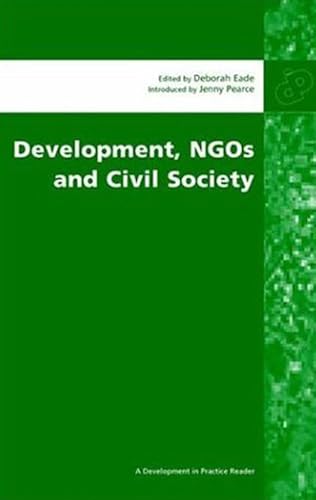
Development, Ngo's and Civil Society: Selected Essays from Development in Practice (Development in Practice Readers Series) - Softcover
Inhaltsangabe
Experienced practitioners and academics provide an insightful look into the limitations of NGOs in claiming to represent and assist 'civil society'. Changes in approaches to development are situated within changes in global political economy. Relations between donors, states and NGOs are also considered in specific contexts. The volume outlines many of the tensions NGOs face in claiming to speak for the poor while also remaining accountable to national and international actors. Together the authors provide an excellent overview of these important issues.
Die Inhaltsangabe kann sich auf eine andere Ausgabe dieses Titels beziehen.
Über die Autorin bzw. den Autor
Deborah Eade was Editor-in-Chief of Development in Practice from 1991 to 2010, prior to which she worked for 10 years in Latin America. She is now an independent writer on development and humanitarian issues, based near Geneva.
Auszug. © Genehmigter Nachdruck. Alle Rechte vorbehalten.
Development, NGOs, and Civil Society
Selected Essays from Development in Practice
By Jenny Pearce, Deborah EadeOxfam Publishing
Copyright © 2000 Oxfam GB
All rights reserved.
ISBN: 978-0-85598-442-7All rights reserved.
Contents
Contributors, 5,
Preface Deborah Eade, 9,
Development, NGOs, and civil society: the debate and its future Jenny Pearce, 15,
Scaling up NGO impact on development: learning from experience Michael Edwards and David Hulme, 44,
Help yourself by helping The Poor Gino Lofredo, 64,
NGOs: ladles in the global soup kitchen? Stephen Commins, 70,
Collaboration with the South: agents of aid or solidarity? Firoze Manji, 75,
Corporate governance for NGOs? Mick Moore and Sheelagh Stewart, 80,
'Dancing with the prince': NGOs' survival strategies in the Afghan conflict Jonathan Goodhand with Peter Chamberlain, 91,
NGOs and the State: a case-study from Uganda Christy Cannon, 109,
NGOs, the poor, and local government Christopher Collier, 115,
Let's get civil society straight: NGOs, the state, and political theory Alan Whaites, 124,
Depoliticising development: the uses and abuses of participation Sarah C. White, 142,
Birds of a feather? UNDP and Action Aid implementation of Sustainable Human Development Lilly Nicholls, 156,
Strengthening civil society: participatory action research in a militarised state Amina Mama, 175,
Annotated bibliography, 190,
Addresses of publishers and other organisations, 206,
CHAPTER 1
Development, NGOs, and civil society: the debate and its future
Jenny Pearce
Introduction
In reviewing the contributions to this Reader, I was struck by three things. First, by the wealth of empirically informed conceptual analysis that they offer, succinctly addressing many of the key issues that emerged in the 1990s on the theme of development, NGOs, and civil society. Second, by the mix of scholar-activist-practitioner authors, for whom the issues discussed really matter, because if they were clarified the world might become a better place. But third, and despite the quality and relevance of the papers selected for this volume, by the difficulty of generating wider debate about their content.
This is certainly not the fault of the contributions: on the contrary, they cover the range of issues admirably. The problem is that they are appearing in a world in which the collapse of intellectual and political reference points has prompted an eclectic outpouring of ideas and views, without organised and coherent debate. As a result, good thinking and writing is lost; much is duplicated and reinvented; people talk but do not listen; people write and do not read; and vice versa. At the start of the new millennium, development debates — if they can be called that — are like concentric circles, orbiting each other but without touching. These circles appear to share a centre, in that the same language and concepts are used by all, from the World Bank to Southern NGOs and grassroots movements. The reluctance to clarify the distinct meanings invested in these concepts, however, reflects collective collusion in the myth that a consensus on development exists, or even that some clear conclusions have been reached about how to deal with global poverty. Take, for instance, a headline in the International Herald Tribune of 7 January 2000: 'Concept of Poverty Undergoes Radical Shift: Now a Solution Seems Possible'.
Not only is there very little consensus, but the real world of development NGOs and official donors is characterised by mistrust, and by fierce competition over resources and protagonism, all of which are very damaging to the anti-poverty cause. The inadequacy of responses to global poverty is only too apparent. UNDP's 1997 Human Development Report gave a measured overview of progress and setbacks in addressing global poverty in the twentieth century, and a quantitative and qualitative picture of the scale of the problem still to be tackled (UNDP 1997, especially pp24–60). While there have been notable achievements, these have been neither continuous nor equally distributed. The economic restructuring of the 1980s and 1990s reflects what UNDP calls the 'ascents/descents' character of development processes. The suggestion is that economic liberalisation has widened existing inequalities, even when it encourages growth and accumulation for those already strong in the marketplace. Such strength may derive from legally acquired wealth, but also from coercive power and illegal dealings. Criminal mafias, of which there are now many in the South and in post-communist transition countries, have expanded with the relaxation of global financial and trade controls. Between 1987 and 1993, the number of people with an income of less than US$1 a day increased by almost 100 million to 1.3 billion people, one-third of the population of the 'developing world'. Yet, between 1989 and 1996, the number of billionaires increased from 157 to 447. The value of their combined assets exceeded the combined incomes of half of the poorest of the world's poor (UNDP 1997: 38 and 110). Since the early 1980s, more than 100 developing and transition countries have suffered cuts in living standards and failures of growth more prolonged than anything experienced by the industrialised countries during the Great Depression of the 1930s (UNDP 1997: 7).
If one looks at the global picture, rather than that of the 'developing world' in isolation, the problem of human poverty assumes much greater proportions than is suggested by statistics which show that one-third of the population in the South is income-poor and one-quarter is poor in terms of the UNDP's Human Development Index. More than 100 million people in the industrialised countries, for example, also live below the income-poverty line (UNDP 1997: 34). But human poverty is not just a question of the number of people living below an agreed minimum: a category of poor on the wrong side of the relatively recent exclusion/inclusion dichotomy. Nor is it enough to consider that millions who are not in fact below the 'line' live on its borders in constant fear of crossing over, suffering not just the threat of actual indigence but conditions of daily exploitation. Rather, the issue is whether the 'inclusion' side of the border is worth preserving, and whether what it claims to offer can really be made universally available. There are cogent thinkers in the South today who, along with their Northern intellectual allies, argue for an end to 'development' as an idea. Majid Rahnema suggests that 'development' could never offer a sustainable option to all the people on the planet, even if it were successfully delivered:
The failures of development can no longer be attributed solely to the inability of the governments, institutions and people in charge of implementing it. In fact, if they had been successful in fulfilling all the promises they made to their peoples, and had there been enough money and resources to bring about the development of all the so-called underdeveloped countries of the world to the level of the 'most advanced', the resulting deadlocks and tensions would perhaps have taken an even more dramatic turn. For example, it has been estimated that a single edition of the New York Times eats up 150 acres of forest land. Other figures suggest that, were the rest of the world to consume paper, including recycled paper, at the same rate as the United States (with six per cent of the world's population),...
„Über diesen Titel“ kann sich auf eine andere Ausgabe dieses Titels beziehen.
Suchergebnisse für Development, Ngo's and Civil Society: Selected...

Beispielbild für diese ISBN
Development, NGOs and Civil Society (Development in Practice)
Anbieter: Singing Saw Books, Portland, OR, USA
Verkäuferbewertung 5 von 5 Sternen

Paperback. Zustand: Fair. Contains underlining. Ships fast! Artikel-Nr. 131120369
Gebraucht kaufen
EUR 6,15
EUR 4,45 Versand
Versand innerhalb von USA
Versand innerhalb von USA
Anzahl: 1 verfügbar
Beispielbild für diese ISBN
Development, NGOs and Civil Society
Anbieter: Better World Books Ltd, Dunfermline, Vereinigtes Königreich
Verkäuferbewertung 5 von 5 Sternen
Zustand: Good. Former library copy. Pages intact with minimal writing/highlighting. The binding may be loose and creased. Dust jackets/supplements are not included. Includes library markings. Stock photo provided. Product includes identifying sticker. Better World Books: Buy Books. Do Good. Artikel-Nr. GRP90981989
Gebraucht kaufen
EUR 7,17
EUR 5,94 Versand
Versand von Vereinigtes Königreich nach USA
Versand von Vereinigtes Königreich nach USA
Anzahl: 1 verfügbar
Beispielbild für diese ISBN
Eade, D: Development, NGOs and Civil Society (Development in Practice Readers Series)
Anbieter: medimops, Berlin, Deutschland
Verkäuferbewertung 5 von 5 Sternen
Zustand: good. Befriedigend/Good: Durchschnittlich erhaltenes Buch bzw. Schutzumschlag mit Gebrauchsspuren, aber vollständigen Seiten. / Describes the average WORN book or dust jacket that has all the pages present. Artikel-Nr. M00855984422-G
Gebraucht kaufen
EUR 3,34
EUR 10,00 Versand
Versand von Deutschland nach USA
Versand von Deutschland nach USA
Anzahl: 1 verfügbar
Beispielbild für diese ISBN
Development, NGOs, and Civil Society
Anbieter: Anybook.com, Lincoln, Vereinigtes Königreich
Verkäuferbewertung 5 von 5 Sternen
Zustand: Fair. This is an ex-library book and may have the usual library/used-book markings inside.This book has soft covers. In fair condition, suitable as a study copy. Please note the Image in this listing is a stock photo and may not match the covers of the actual item,350grams, ISBN:9780855984427. Artikel-Nr. 9018874
Gebraucht kaufen
EUR 3,06
EUR 15,49 Versand
Versand von Vereinigtes Königreich nach USA
Versand von Vereinigtes Königreich nach USA
Anzahl: 1 verfügbar
Beispielbild für diese ISBN
Development, Ngos and Civil Society
Anbieter: PBShop.store US, Wood Dale, IL, USA
Verkäuferbewertung 5 von 5 Sternen
PAP. Zustand: New. New Book. Shipped from UK. Established seller since 2000. Artikel-Nr. CX-9780855984427
Beispielbild für diese ISBN
Development, NGOs and Civil Society
Anbieter: PBShop.store UK, Fairford, GLOS, Vereinigtes Königreich
Verkäuferbewertung 5 von 5 Sternen
PAP. Zustand: New. New Book. Shipped from UK. Established seller since 2000. Artikel-Nr. CX-9780855984427
Neu kaufen
EUR 29,07
EUR 4,94 Versand
Versand von Vereinigtes Königreich nach USA
Versand von Vereinigtes Königreich nach USA
Anzahl: 15 verfügbar
Beispielbild für diese ISBN
Development, Ngo's and Civil Society: Selected Essays from Development in Practice
Anbieter: Revaluation Books, Exeter, Vereinigtes Königreich
Verkäuferbewertung 5 von 5 Sternen
Paperback. Zustand: Brand New. 192 pages. 8.50x5.00x0.50 inches. In Stock. Artikel-Nr. x-0855984422
Neu kaufen
EUR 26,91
EUR 11,88 Versand
Versand von Vereinigtes Königreich nach USA
Versand von Vereinigtes Königreich nach USA
Anzahl: 2 verfügbar
Beispielbild für diese ISBN
Development, NGOs and Civil Society (Development in Practice Reader)
Anbieter: Ria Christie Collections, Uxbridge, Vereinigtes Königreich
Verkäuferbewertung 5 von 5 Sternen
Zustand: New. In English. Artikel-Nr. ria9780855984427_new
Neu kaufen
EUR 37,35
EUR 11,13 Versand
Versand von Vereinigtes Königreich nach USA
Versand von Vereinigtes Königreich nach USA
Anzahl: Mehr als 20 verfügbar