
Verwandte Artikel zu Microtas 2004: Volume 2 (Special Publications, Band...
Inhaltsangabe
This volume is the second in a two volume set, a valuable reference collection to all working in this field.
Die Inhaltsangabe kann sich auf eine andere Ausgabe dieses Titels beziehen.
Auszug. © Genehmigter Nachdruck. Alle Rechte vorbehalten.
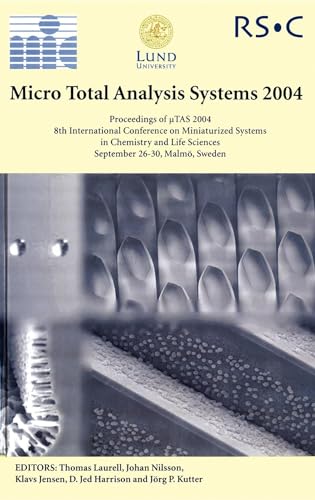
Micro Total Analysis Systems 2004 Volume 2
Proceedings of µTAS 2004 8th International Conference on Miniaturized Systems for Chemistry and Life Sciences
By Thomas Laurell, Johan Nilsson, Klavs Jensen, D. Jed Harrison, Jörg P. KutterThe Royal Society of Chemistry
Copyright © 2004 The Royal Society of Chemistry
All rights reserved.
ISBN: 978-0-85404-896-0All rights reserved.
Contents
Volume 2,
Day 2 - Tuesday, September 28,2004,
Tuesday Poster Session - MEMS Technology I,
Tuesday Poster Session - Materials,
Tuesday Session A - Pumping,
Tuesday Session B - Protein Crystallization,
Day 3 - Wednesday, September 29,2004,
Plenary V,
Wednesday Session A - Cell Lysis,
Wednesday Session B - Separation,
Wednesday Session A - Gene Analysis,
Wednesday Session B - NMR,
Wednesday Plenary VI,
Wednesday Poster Session - Applications III,
Wednesday Poster Session - MEMS Technology II,
Wednesday Session A - Two-Phase Systems,
Wednesday Session B - Coupling to MS,
Day 4 - Thursday, September 30,2004,
Thursday Session A - Cell Culture I1,
Thursday Session B - Analysis,
Thursday Session A - Microfluidics, Others,
Thursday Session B - On-Chip Monitoring,
AUTHOR INDEX, 587,
KEY WORD INDEX, 596,
CHAPTER 1
FABRICATING A THREE-DIMENSIONAL CHANNEL FOR MICRO-FLUIDIC DEVICES BY LASER ABLATION
Yoshikazu Yoshida, Tsutomu Neichi, Retsu Tahara, Jun Yamada, Hiroyuki Yamada and Nobuyuki Terada
Toyo University, 2100 Kujirai, Kawagoe, Saitama 350-8585 Yamanashi Pref. Industrial Technology Center, 2094 Kofu, Yamanashi 400-0055, Japan University of Yamanashi, 1110 Tamaho, Nakakoma, Yamanashi 409-3898, Japan
Abstract
This paper describes the fabrication in resin of micro-channels for micro-fluidic devices such as the µTAS (Micro Total Analysis System) by UV laser ablation process. A number of heat-hardening resin-films are layered on a soda glass. A laser fabricates a part of the channel on each film for every lamination. Then three-dimensional (3-D) confluence channels are fabricated. The fabricated channels are 45-180 µm in depth and 50-300 µm in width. The through holes are made in the laminate film with a laser. An inlet pipe for a micro-pump is inserted into the hole.
Keywords: µTAS, UV laser, lamination, resin-films, blood
1. Introduction
Recently, in various fields the necessity for small and highly sensitive micro-fluidic analysis systems has increase. Therefore a µTAS has received considerable attention. The µTAS is the size of a card, and has miniaturized channels, detectors, and other elements for fluidic analysis. The advantages of this system are the reduced need of fluidic samples, reagents, and hours of detection. The size of the fluidic analysis elements on the µTAS is a few score micrometers. There are many fabrication methods of micro-channels through semiconductor technology, plastic molding, and laser fabrication of resins. The laser fabrication method has recently been receiving much attention. The advantages of this method are: one stroke fabrication of grooves for channels, an easy change of groove patterns, and 3-D fabrication to allow grooves with slopes and differences in levels. We have been proposing the method which uses silicon or quartz as the substrate part of µTAS, build the micro working parts and electrode in advance onto the substrate, then create the flow path and cistern on the resin part formed on the substrate, An ultraviolet pulse laser was used to form such items as the flow path. A number of heat-hardening resin-films were layered on a soda glass. A laser fabricated a part of the channel on each film for every lamination, and then a 3-D micro-channel structure was fabricated. Two types of flow path, a plane and an overpass, are fabricated.
2. Experiment equipment
The substrate is soda glass laminated by heat-hardening resin-film. This film is made of two films, one of 25µm thick polyimide and the other 20µm thick epoxy. Channels are fabricated by a pulse Nd:YAG laser system (Brilliant; Quantel) and a KrF excimer laser system (LPX220; Lambda Physik, AG). For the experiment condition, the YAG has a wavelength of 266nm, pulse energy of 3.1mJ, pulse width of 4.3nsec, and repetition rate of 10Hz. The laser beam is fixed, and the substrate is moved in the XY stage. This stage has a positional bi-directional repeatability of [+ or -] 5pm. The excimer has a wavelength of 248nm, output energy of 8-80W, maximum pulse energy of 450mJ, pulse width of 10-20nsec, and repetition rate of 25-200Hz. A mask is used to shape the laser beam into a square shape to allow fabrication with smooth wall surfaces at low overlap rate conditions. The laser beam is focused to the width of a groove.
3. Results and discussion
3.1 Three-pronged channel
Combining of laminar flows in a micro-channel makes possible the study of blood cell analysis. Figure 1 shows an optical photomicrograph of three-pronged grooves without cover film fabricated by the excimer laser. Channels have a width of 50pm and a depth of 45µm in three-pronged parts, and a width of 150µm in a confluence part. Blood is injected at a low flow rate between two rapidly flowing streams of physiological salt solution. The width of the stream of blood can be controlled by the height difference between a blood reservoir and solution reservoir, that is potential energy. The width narrows as it climbs to the speed of the neighboring streams. The width decreases with the increasing height difference. The cells velocity increases with the increasing height difference. In this experiment, the channel substrate is placed horizontally on a microscope stand, and the reservoir made from a connector between a syringe and a needle is connected to the channel inlet with Silicon tube. This tube has an external diameter of 1mm and an inside diameter of 0.3mm. Figure 2 shows a focused picture of blood when the blood reservoir is 200mm high and the solution is 400mm high from the channel. The cells velocity is almost 15.5mm/s. It is almost 9mm/s when the height difference is nearly zero. As shown in Fig.2 (b), blood cells can be measured individually.
3.2 Three-dimensional channels
Figure 3 shows the optical photomicrograph of a channel made on the second film by the YAG laser. The laser scanning distance is 150µm. The second film is peeled off from the first one by the scanning. The film placed between the scanning is removed from the substrate. The space caused by removal of the film is used as a channel space. The film peelings on the channel side are removed with the following laminating process.
Figure 4 shows the production process of the steric mixture flow path used to branch. There are 3-D pattern diagrams and optical photomicrographs each time a lamination is done. First, the channel element of the first layer is made for the film on the glass by the laser (Fig.4 (a)). After that, the second film is laminated on the first one, and the channel element is made on the film (b). These processes are iterated several times, and the 3-D confluence channel is fabricated. The channel is closed because the groove is treated with laminate processing, and liquid can't enter into the groove. Therefore it is necessary to make a perforated hole in the flow path to insert liquid inside, and connect the tube. The diameter of the hole is 150pm, and formed on the laminate film by laser drilling....
„Über diesen Titel“ kann sich auf eine andere Ausgabe dieses Titels beziehen.
Suchergebnisse für Microtas 2004: Volume 2 (Special Publications, Band...

Beispielbild für diese ISBN
Micro Total Analysis Systems 2004
Anbieter: Romtrade Corp., STERLING HEIGHTS, MI, USA
Verkäuferbewertung 5 von 5 Sternen

Zustand: New. This is a Brand-new US Edition. This Item may be shipped from US or any other country as we have multiple locations worldwide. Artikel-Nr. ABBB-3689
Beispielbild für diese ISBN
Micro Total Analysis System 2004
Anbieter: Romtrade Corp., STERLING HEIGHTS, MI, USA
Verkäuferbewertung 5 von 5 Sternen
Zustand: New. This is a Brand-new US Edition. This Item may be shipped from US or any other country as we have multiple locations worldwide. Artikel-Nr. ABBB-187360
Beispielbild für diese ISBN
Microtas 2004: Volume 2 (special Publication)
Anbieter: Romtrade Corp., STERLING HEIGHTS, MI, USA
Verkäuferbewertung 5 von 5 Sternen
Zustand: New. This is a Brand-new US Edition. This Item may be shipped from US or any other country as we have multiple locations worldwide. Artikel-Nr. ABBB-141797
Beispielbild für diese ISBN
Microtas 2004
Anbieter: PBShop.store US, Wood Dale, IL, USA
Verkäuferbewertung 5 von 5 Sternen
HRD. Zustand: New. New Book. Shipped from UK. Established seller since 2000. Artikel-Nr. GB-9780854048960
Beispielbild für diese ISBN
Microtas 2004
Anbieter: PBShop.store UK, Fairford, GLOS, Vereinigtes Königreich
Verkäuferbewertung 5 von 5 Sternen
HRD. Zustand: New. New Book. Shipped from UK. Established seller since 2000. Artikel-Nr. GB-9780854048960
Neu kaufen
EUR 121,98
EUR 7,88 Versand
Versand von Vereinigtes Königreich nach USA
Versand von Vereinigtes Königreich nach USA
Anzahl: 2 verfügbar
Beispielbild für diese ISBN
Microtas 2004: Volume 2 (Special Publications)
Anbieter: Ria Christie Collections, Uxbridge, Vereinigtes Königreich
Verkäuferbewertung 5 von 5 Sternen
Zustand: New. In English. Artikel-Nr. ria9780854048960_new
Neu kaufen
EUR 128,62
EUR 17,42 Versand
Versand von Vereinigtes Königreich nach USA
Versand von Vereinigtes Königreich nach USA
Anzahl: 4 verfügbar
Beispielbild für diese ISBN
MICROTAS 2004
Anbieter: Speedyhen, Hertfordshire, Vereinigtes Königreich
Verkäuferbewertung 5 von 5 Sternen
Zustand: NEW. Artikel-Nr. NW9780854048960
Neu kaufen
EUR 107,63
EUR 47,81 Versand
Versand von Vereinigtes Königreich nach USA
Versand von Vereinigtes Königreich nach USA
Anzahl: 2 verfügbar
Foto des Verkäufers
Microtas 2004: Volume 2
Anbieter: moluna, Greven, Deutschland
Verkäuferbewertung 5 von 5 Sternen
Zustand: New. This volume is the second in a two volume set, a valuable reference collection to all working in this field.InhaltsverzeichnisParticle Sorting Motormolecules Cell Positioning MEMS Applications I Microfluidics I Nanotechnology . Artikel-Nr. 595098368
Neu kaufen
EUR 133,04
EUR 48,99 Versand
Versand von Deutschland nach USA
Versand von Deutschland nach USA
Anzahl: 2 verfügbar
Beispielbild für diese ISBN
Microtas 2004: Volume 2 (Special Publication)
Anbieter: Kennys Bookstore, Olney, MD, USA
Verkäuferbewertung 5 von 5 Sternen
Zustand: New. 2004. 1st Edition. Hardcover. This volume is the second in a two volume set, a valuable reference collection to all working in this field. Editor(s): Laurell, Thomas; Nilsson, Johan; Harrison, Jed; Jensen, Klavs F.; Kutter, J.P. Series: Special Publication. Num Pages: 642 pages, Illustrations. BIC Classification: PS; TDC. Category: (P) Professional & Vocational. Dimension: 241 x 160 x 41. Weight in Grams: 1060. Series: Special Publication. 642 pages, Illustrations. Editor(s): Laurell, Thomas; Nilsson, Johan; Harrison, Jed; Jensen, Klavs F.; Kutter, J.P. This volume is the second in a two volume set, a valuable reference collection to all working in this field. Cateogry: (P) Professional & Vocational. BIC Classification: PS; TDC. Dimension: 241 x 160 x 41. Weight: 1060. . . . . . Books ship from the US and Ireland. Artikel-Nr. V9780854048960
Neu kaufen
EUR 181,43
EUR 9,14 Versand
Versand innerhalb von USA
Versand innerhalb von USA
Anzahl: 2 verfügbar
Beispielbild für diese ISBN
Micro Total Analysis Systems 2004: Proceedings of Utas 2004, 8th International Conference on Miniaturized Systems for Chemistry and Life Sciences, Malmo, Sweden, September 26-30, 2004: Vol 2
Anbieter: Revaluation Books, Exeter, Vereinigtes Königreich
Verkäuferbewertung 5 von 5 Sternen
Hardcover. Zustand: Brand New. 1st edition. 606 pages. 9.25x6.25x1.75 inches. In Stock. Artikel-Nr. x-0854048960
Neu kaufen
EUR 192,40
EUR 17,49 Versand
Versand von Vereinigtes Königreich nach USA
Versand von Vereinigtes Königreich nach USA
Anzahl: 2 verfügbar