
Verwandte Artikel zu Molecular Biology and Biotechnology
Inhaltsangabe
The 3rd Edition of this immensely popular textbook brings readers up to date with the latest advances in this rapidly developing field. It has been thoroughly revised and expanded, combining entirely new chapters on current hot topics with existing chapters that have been rewritten and extended. Molecular Biology and Biotechnology 3rd Edition provides real breadth of coverage, taking account of both molecular biology and industrial applications. It also gives in depth coverage of key areas, resulting in a uniquely comprehensive publication. Highlights of this 3rd Edition include increased coverage of the cloning of yeast and animal cells and plant genetic engineering, and new coverage of polymerase chain reactions, DNA fingerprinting, transgenesis and vaccine development, reflecting the rapid growth of interest in these areas. The book presents the information in an easily assimilated form and makes an ideal undergraduate text. It will be of particular interest to students of biology and chemistry, as well as to scientific workers from outside the field who need a rapid introduction to the subject. Molecular Biology and Biotechnology primarily has a teaching function and as such should prove invaluable.
Die Inhaltsangabe kann sich auf eine andere Ausgabe dieses Titels beziehen.
Auszug. © Genehmigter Nachdruck. Alle Rechte vorbehalten.
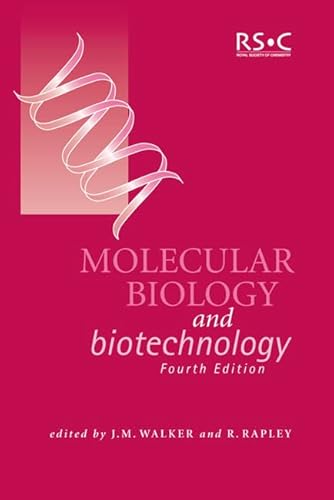
Molecular Biology and Biotechnology
By John M. Walker, Ralph RapleyThe Royal Society of Chemistry
Copyright © 2000 The Royal Society of Chemistry
All rights reserved.
ISBN: 978-0-85404-606-5All rights reserved.
Contents
Chapter 1 Fermentation Technology Peter F. Stanbury, 1,
Chapter 2 Molecular Analysis and Amplification Techniques Ralph Rapley, 25,
Chapter 3 Recombinant DNA Technology Ralph Rapley, 67,
Chapter 4 The Expression of Foreign DNA in Bacteria Robert J. Slater and D. Ross Williams, 125,
Chapter 5 Yeast Cloning and Biotechnology Brendan P.G. Curran and Virginia C. Bugeja, 155,
Chapter 6 Cloning Genes in Mammalian Cell-lines Edward J. Murray, 177,
Chapter 7 Plant Biotechnology Michael G.K, Jones, 203,
Chapter 8 Molecular, Structural and Chemical Biology in Pharmaceutical Research Tomi K. Sawyer, 237,
Chapter 9 Genetically Modified Foods Rosa K. Pawsey, 261,
Chapter 10 Molecular Diagnosis of Inherited Disease Elizabeth Green, 279,
Chapter 11 DNA in Forensic Science Paul Debenham and Peter D. Martin, 295,
Chapter 12 Vaccination and Gene Manipulation Michael Mackett, 317,
Chapter 13 Transgenesis Linda J. Mullins and John J. Mullins, 357,
Chapter 14 Protein Engineering John R. Adair, 379,
Chapter 15 Bioinformatics Peter M. Woollard, 405,
Chapter 16 Immobilization of Biocatalysts Gordon F. Bickerstaff, 433,
Chapter 17 Downstream Processing: Protein Extraction and Purification Mike D. Scawen and P.M. Hammond, 461,
Chapter 18 Monoclonal Antibodies Christopher J. Dean, 497,
Chapter 19 Biosensors Martin F. Chaplin, 521,
Subject Index, 555,
CHAPTER 1
Fermentation Technology
PETER F. STANBURY
INTRODUCTION
Microorganisms are capable of growing on a wide range of substrates and can produce a remarkable spectrum of products. The relatively recent advent of in vitro genetic manipulation has extended the range of products that may be produced by microorganisms and has provided new methods for increasing the yields of existing ones. The commercial exploitation of the biochemical diversity of microorganisms has resulted in the development of the fermentation industry and the techniques of genetic manipulation have given this well-established industry the opportunity to develop new processes and to improve existing ones. The term fermentation is derived from the Latin verb fervere, to boil, which describes the appearance of the action of yeast on extracts of fruit or malted grain during the production of alcoholic beverages. However, fermentation is interpreted differently by microbiologists and biochemists. To a microbiologist the word means any process for the production of a product by the mass culture of microorganisms. To a biochemist, however, the word means an energy-generating process in which organic compounds act as both electron donors and acceptors, that is, an anaerobic process where energy is produced without the participation of oxygen or other inorganic electron acceptors. In this chapter fermentation is used in its broader, microbiological context.
MICROBIAL GROWTH
The growth of a microorganism may result in the production of a range of metabolites but to produce a particular metabolite the desired organism must be grown under precise cultural conditions at a particular growth rate. If a microorganism is introduced into a nutrient medium that supports its growth, the inoculated culture will pass through a number of stages and the system is termed batch culture. Initially, growth does not occur and this period is referred to as the lag phase and may be considered a period of adaptation. Following an interval during which the growth rate of the cells gradually increases, the cells grow at a constant, maximum rate and this period is referred to as the log or exponential phase, which may be described by the equation
dx/dt = µx (1)
where x is the cell concentration (mg ml-1), t is the time of incubation (h), and µ the specific growth rate (h). On integration equation (1) gives
xt = x0eµt (2)
where x0 is the cell concentration at time zero and xt is the cell concentration after a time interval, t h.
Thus, a plot of the natural logarithm of the cell concentration against time gives a straight line, the slope of which equals the specific growth rate. The specific growth rate during the exponential phase is the maximum for the prevailing conditions and is described as the maximum specific growth rate, or µmax. Equations (1) and (2) ignore the facts that growth results in the depletion of nutrients and the accumulation of toxic by-products and thus predict that growth continues indefinitely. However, in reality, as substrate (nutrient) is exhausted and toxic products accumulate, the growth rate of the cells deviates from the maximum and eventually growth ceases and the culture enters the stationary phase. After a further period of time, the culture enters the death phase and the number of viable cells declines. This classic representation of microbial growth is illustrated in Figure 1. It should be remembered that this description refers to the behaviour of both unicellular and mycelial (filamentous) organisms in batch culture, the growth of the latter resulting in the exponential addition of viable biomass to the mycelial body rather than the production of separate, discrete unicells.
As already stated, the cessation of growth in a batch culture may be due to the exhaustion of a nutrient component or the accumulation of a toxic product. However, provided that the growth medium is designed such that growth is limited by the availability of a medium component, growth may be extended by addition of an aliquot of fresh medium to the vessel. If the fresh medium is added continuously, at an appropriate rate, and the culture vessel is fitted with an overflow device, such that culture is displaced by the incoming fresh medium, a continuous culture may be established. The growth of the cells in a continuous culture of this type is controlled by the availability of the growth limiting chemical component of the medium and, thus, the system is described as a chemostat. In this system a steady-state is eventually achieved and the loss of biomass via the overflow is replaced by cell growth. The flow of medium through the system is described by the term dilution rate, D, which is equal to the rate of addition of medium divided by the working volume of the culture vessel. The balance between growth of cells and their loss from the system may be described as
dt/dt = growth - output
or
dx/dt = µx - Dx
Under steady-state conditions,
dx/dt = 0
and, therefore, µx = Dx and µ = D.
Hence, the growth rate of the organisms is controlled by the dilution rate, which is an experimental variable. It will be recalled that under batch culture conditions an organism will grow at its maximum specific growth rate and, therefore, it is obvious that a continuous culture may be operated only at dilution rates below the maximum specific growth rate. Thus, within certain limits, the dilution rate may be used to control the growth rate of a chemostat culture.
The mechanism underlying the controlling effect of the dilution rate is essentially the relationship between µ specific growth rate, and s, the limiting substrate concentration in the chemostat, demonstrated by Monod in 1942:
µ = µmaxS/(Ks + s) (3)
where Ks is the utilization or...
„Über diesen Titel“ kann sich auf eine andere Ausgabe dieses Titels beziehen.
Suchergebnisse für Molecular Biology and Biotechnology

Beispielbild für diese ISBN
Molecular Biology and Biotechnology
Verlag:
Royal Society of Chemistry, The, 2000
ISBN 10: 0854046062
ISBN 13: 9780854046065
Gebraucht
Softcover
Anbieter: Better World Books Ltd, Dunfermline, Vereinigtes Königreich
Verkäuferbewertung 5 von 5 Sternen

Zustand: Good. 4th ed. Pages intact with minimal writing/highlighting. The binding may be loose and creased. Dust jackets/supplements are not included. Stock photo provided. Product includes identifying sticker. Better World Books: Buy Books. Do Good. Artikel-Nr. GRP104912988
Gebraucht kaufen
EUR 8,43
EUR 5,82 Versand
Versand von Vereinigtes Königreich nach USA
Versand von Vereinigtes Königreich nach USA
Anzahl: 1 verfügbar
Beispielbild für diese ISBN
Molecular Biology and Biotechnology
Verlag:
Royal Society of Chemistry, The, 2000
ISBN 10: 0854046062
ISBN 13: 9780854046065
Gebraucht
Softcover
Anbieter: Better World Books Ltd, Dunfermline, Vereinigtes Königreich
Verkäuferbewertung 5 von 5 Sternen
Zustand: Very Good. 4th ed. Former library copy. Pages intact with possible writing/highlighting. Binding strong with minor wear. Dust jackets/supplements may not be included. Includes library markings. Stock photo provided. Product includes identifying sticker. Better World Books: Buy Books. Do Good. Artikel-Nr. GRP79255521
Gebraucht kaufen
EUR 8,43
EUR 5,82 Versand
Versand von Vereinigtes Königreich nach USA
Versand von Vereinigtes Königreich nach USA
Anzahl: 1 verfügbar
Beispielbild für diese ISBN
Molecular Biology and Biotechnology
Verlag:
Royal Society of Chemistry, 2001
ISBN 10: 0854046062
ISBN 13: 9780854046065
Gebraucht
Paperback
Anbieter: ThriftBooks-Dallas, Dallas, TX, USA
Verkäuferbewertung 5 von 5 Sternen
Paperback. Zustand: Good. No Jacket. Pages can have notes/highlighting. Spine may show signs of wear. ~ ThriftBooks: Read More, Spend Less. Artikel-Nr. G0854046062I3N00
Gebraucht kaufen
EUR 17,95
Versand gratis
Versand innerhalb von USA
Versand innerhalb von USA
Anzahl: 1 verfügbar
Beispielbild für diese ISBN
Molecular Biology and Biotechnology (4th Edn)
Verlag:
Royal Society Of Chemistry, 2000
ISBN 10: 0854046062
ISBN 13: 9780854046065
Gebraucht
Softcover
Anbieter: Anybook.com, Lincoln, Vereinigtes Königreich
Verkäuferbewertung 5 von 5 Sternen
Zustand: Poor. This is an ex-library book and may have the usual library/used-book markings inside.This book has soft covers. In poor condition, suitable as a reading copy. Please note the Image in this listing is a stock photo and may not match the covers of the actual item,950grams, ISBN:9780854046065. Artikel-Nr. 7093921
Gebraucht kaufen
EUR 3,00
EUR 15,83 Versand
Versand von Vereinigtes Königreich nach USA
Versand von Vereinigtes Königreich nach USA
Anzahl: 1 verfügbar
Beispielbild für diese ISBN
Molecular Biology and Biotechnology. 4th Edition
Verlag:
Royal Society of Chemistry, 2000
ISBN 10: 0854046062
ISBN 13: 9780854046065
Gebraucht
Softcover
Anbieter: Munster & Company LLC, ABAA/ILAB, Corvallis, OR, USA
Verkäuferbewertung 5 von 5 Sternen
Zustand: Good. Royal Society of Chemistry, 2000. Cover lightly rubbed /creased; corners lightly rubbed/bumped, spine ends slightly bumped; edges lightly soiled; binding tight; cover and interior intact and clean; text block exceptionally clean. paperback. Good. Artikel-Nr. 586664
Gebraucht kaufen
EUR 35,48
EUR 1,68 Versand
Versand innerhalb von USA
Versand innerhalb von USA
Anzahl: 1 verfügbar
Beispielbild für diese ISBN
Molecular Biology and Biotechnology.
Verlag:
London: Royal Society of Chemistry, 2000
ISBN 10: 0854046062
ISBN 13: 9780854046065
Gebraucht
Paperback
Anbieter: Plurabelle Books Ltd, Cambridge, Vereinigtes Königreich
Verkäuferbewertung 5 von 5 Sternen
Paperback. Zustand: Very Good. 563p red paperback, near fine condition, slight creasing on cover, otherwise as new, pages appear unopened, various contributors, diagrams index Language: English. Artikel-Nr. 103916
Gebraucht kaufen
EUR 38,36
EUR 13,97 Versand
Versand von Vereinigtes Königreich nach USA
Versand von Vereinigtes Königreich nach USA
Anzahl: 1 verfügbar
Beispielbild für diese ISBN
Molecular Biology And Biotechnology
Anbieter: Romtrade Corp., STERLING HEIGHTS, MI, USA
Verkäuferbewertung 5 von 5 Sternen
Zustand: New. This is a Brand-new US Edition. This Item may be shipped from US or any other country as we have multiple locations worldwide. Artikel-Nr. ABBB-187457
Beispielbild für diese ISBN
Molecular Biology and Biotechnology
Anbieter: Majestic Books, Hounslow, Vereinigtes Königreich
Verkäuferbewertung 4 von 5 Sternen

Zustand: New. pp. 588 Illus. Artikel-Nr. 7547714
Neu kaufen
EUR 46,62
EUR 7,57 Versand
Versand von Vereinigtes Königreich nach USA
Versand von Vereinigtes Königreich nach USA
Anzahl: 1 verfügbar
Beispielbild für diese ISBN
Molecular Biology and Biotechnology
Anbieter: Revaluation Books, Exeter, Vereinigtes Königreich
Verkäuferbewertung 5 von 5 Sternen
Paperback. Zustand: Brand New. 4th edition. 588 pages. 8.75x5.75x1.50 inches. In Stock. Artikel-Nr. zk0854046062
Neu kaufen
EUR 91,03
EUR 17,46 Versand
Versand von Vereinigtes Königreich nach USA
Versand von Vereinigtes Königreich nach USA
Anzahl: 1 verfügbar