
Verwandte Artikel zu Compendium of Polymer Terminology and Nomenclature:...
Compendium of Polymer Terminology and Nomenclature: IUPAC Recommendations 2008 Edition (International Union of Pure and Applied Chemistry) - Hardcover
Inhaltsangabe
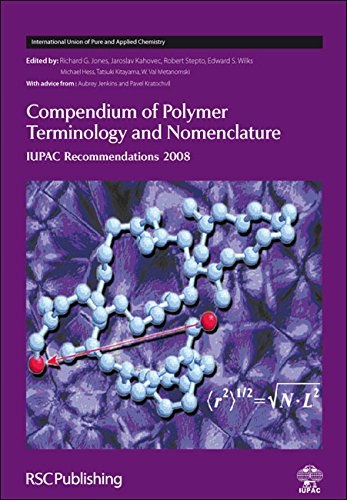
<p>One of a series issued by the International Union of Pure and Applied Chemistry (IUPAC), it covers the terminology used in many and varied aspects of polymer science as well as the nomenclature of several different types of polymer including regular and irregular single-strand organic polymers, copolymers and regular double-strand (ladder and spiro) organic polymers.</p> <p>The IUPAC system of polymer nomenclature has aided the generation of unambiguous names that re ect the historical development of chemistry. However, the explosion in the circulation of information and the globalization of human activities mean that it is now necessary to have a common language for use in legal situations, patents, export-import regulations, and environmental health and safety information. Rather than recommending a ‘unique name’ for each structure, rules have been developed for assigning ‘preferred IUPAC names’, while continuing to allow alternatives in order to preserve the diversity and adaptability of nomenclature.<br>Compendium of Polymer Terminology and Nomenclature is the only publication to collect the most important work on this subject into a single volume. It serves as a handy compendium for scientists and removes the need for time consuming literature searches. One of a series issued by the International Union of Pure and Applied Chemistry (IUPAC), it covers the terminology used in many and varied aspects of polymer science as well as the nomenclature of several di erent types of polymer including regular and irregular single-strand organic polymers, copolymers and regular double-strand (ladder and spiro) organic polymers.</p>
Die Inhaltsangabe kann sich auf eine andere Ausgabe dieses Titels beziehen.
Von der hinteren Coverseite
The IUPAC system of polymer nomenclature has aided the generation of unambiguous names that re ect the historical development of chemistry. However, the explosion in the circulation of information and the globalization of human activities mean that it is now necessary to have a common language for use in legal situations, patents, export-import regulations, and environmental health and safety information. Rather than recommending a ‘unique name’ for each structure, rules have been developed for assigning ‘preferred IUPAC names’, while continuing to allow alternatives in order to preserve the diversity and adaptability of nomenclature.
Compendium of Polymer Terminology and Nomenclature is the only publication to collect the most important work on this subject into a single volume. It serves as a handy compendium for scientists and removes the need for time consuming literature searches. One of a series issued by the International Union of Pure and Applied Chemistry (IUPAC), it covers the terminology used in many and varied aspects of polymer science as well as the nomenclature of several di erent types of polymer including regular and irregular single-strand organic polymers, copolymers and regular double-strand (ladder and spiro) organic polymers.
Auszug. © Genehmigter Nachdruck. Alle Rechte vorbehalten.
Compendium of Polymer Terminology and Nomenclature
IUPAC Recommendations 2008
By Richard G. Jones, Edward S. Wilks, W. Val Metanomski, Jaroslav Kahovec, Michael Hess, Robert Stepto, Tatsuki KitayamaThe Royal Society of Chemistry
Copyright © 2009 International Union of Pure and Applied Chemistry
All rights reserved.
ISBN: 978-0-85404-491-7All rights reserved.
Contents
Preface, V,
IUPAC Polymer Division (IV): History of IUPAC Polymer Terminology and Nomenclature, ix,
Membership of the Sub-commission on Nomenclature (1952 to 1967), xiii,
Membership of the Commission on Macromolecular Nomenclature (1968 to 2001), xiii,
Membership of the Sub-committee on Macromolecular Terminology (2002 to 2005) and of the Sub-committee on Polymer Terminology (from 2005), xv,
Meeting Locations of the Commission on Macromolecular Nomenclature (1968-2001) and of the Sub-committees on Macromolecular Terminology and Polymer Terminology (2002-2006), xvi,
References, xvii,
TERMINOLOGY, 1,
1 Glossary of Basic Terms in Polymer Science (1996), 3,
2 Stereochemical Definitions and Notations Relating to Polymers (1980), 22,
3 Definitions of Terms Relating to Individual Macromolecules, their Assemblies, and Dilute Polymer Solutions (1988), 44,
4 Basic Classification and Definitions of Polymerization Reactions (1994), 70,
5 Definitions Relating to Stereochemically Asymmetric Polymerizations (2002), 73,
6 Definitions of Terms Relating to Crystalline Polymers (1988), 80,
7 Definitions of Terms Relating to Low-Molar-Mass and Polymer Liquid Crystals (2001), 93,
8 Definitions of Terms Relating to the Non-Ultimate Mechanical Properties of polymers (1997), 146,
9 Definitions of Terms Related to Polymer Blends, Composites, and Multiphase Polymeric Materials (2004), 186,
10 Terminology of Polymers Containing Ionizable or Ionic Groups and of Polymers Containing Ions (2006), 205,
11 Definitions of Terms Relating to the Structure and Processing of Sols, Gels, Networks and Inorganic-Organic Hybrid Materials (2007), 211,
12 Definitions of Terms Relating to Reactions of Polymers and to Functional Polymeric Materials (2003), 237,
13 Definitions of Terms Relating to Degradation, Aging, and Related Chemical Transformations of Polymers (1996), 251,
NOMENCLATURE, 259,
14 Introduction to Polymer Nomenclature, 261,
15 Nomenclature of Regular Single-Strand Organic Polymers (2002), 280,
16 Nomenclature of Regular Double-Strand (Ladder and Spiro) Organic Polymers (1993), 318,
17 Structure-Based Nomenclature for Irregular Single-Strand Organic Polymers (1994), 336,
18 Graphic Representations (Chemical Formulae) of Macromolecules (1994), 350,
19 Source-Based Nomenclature for Copolymers (1985), 368,
20 Source-Based Nomenclature for Non-Linear Macromolecules and Macromolecular Assemblies (1997), 382,
21 Generic Source-Based Nomenclature for Polymers (2001), 394,
22 Abbreviations, 403,
APPENDIX,
Bibliography of Biopolymer-Related IUPAC-IUBMB Nomenclature Recommendations, 408,
INDEX, 411,
CHAPTER 1
1: Glossary of Basic Terms in Polymer Science
CONTENTS
Preamble
1. Molecules and molecular structure
2. Substances
3. Reactions
Alphabetical index of terms
PREAMBLE
In order to present clear concepts it is necessary that idealized definitions be adopted but it is recognized that the realities of polymer science must be faced. Deviations from ideality arise with polymers at both molecular and bulk levels in ways that have no parallel with the ordinary small molecules of organic or inorganic chemistry. Although such deviations are not explicitly taken into account in the definitions below, the terms recommended can usefully be applied to the predominant structural features of real polymer molecules, if necessary with self-explanatory, if imprecise, qualifications such as 'essentially....', 'almost completely....', or 'highly....'. Although such expressions lack the rigour beloved by the purist, every experienced polymer scientist knows that communication in this discipline is impossible without them.
Conventionally, the word polymer used as a noun is ambiguous; it is commonly employed to refer to both polymer substances and polymer molecules. Henceforth, macromolecule is used for individual molecules and polymer is used to denote a substance composed of macromolecules. Polymer may also be employed unambiguously as an adjective, according to accepted usage, e.g., polymer blend, polymer molecule.
1 MOLECULES AND MOLECULAR STRUCTURE
1.1 macromolecule
polymer molecule
Molecule of high relative molecular mass, the structure of which essentially comprises the multiple repetition of units derived, actually or conceptually, from molecules of low relative molecular mass.
Note 1: In many cases, especially for synthetic polymers, a molecule can be regarded as having a high relative molecular mass if the addition or removal of one or a few of the units has a negligible effect on the molecular properties. This statement fails in the case of certain properties of macromolecules which may be critically dependent on fine details of the molecular structure, e.g., the enzymatic properties of polypeptides.
Note 2: If a part or the whole of the molecule has a high relative molecular mass and essentially comprises the multiple repetition of units derived, actually or conceptually, from molecules of low relative molecular mass, it may be described as either macromolecular or polymeric, or by polymer used adjectivally.
Note 3: In most cases, the polymer can actually be made by direct polymerization of its parent monomer but in other cases, e.g., poly(vinyl alcohol), the description 'conceptual' denotes that an indirect route is used because the nominal monomer does not exist.
1.2 oligomer molecule
Molecule of intermediate relative molecular mass, the structure of which essentially comprises a small plurality of units derived, actually or conceptually, from molecules of lower relative molecular mass.
Note 1: A molecule is regarded as having an intermediate relative molecular mass if it has properties which do vary significantly with the removal of one or a few of the units.
Note 2: If a part or the whole of the molecule has an intermediate relative molecular mass and essentially comprises a small plurality of units derived, actually or conceptually, from molecules of lower relative molecular mass, it may be described as oligomeric, or by oligomer used adjectivally.
1.3 monomer molecule
Molecule which can undergo polymerization, thereby contributing constitutional units to the essential structure of a macromolecule.
1.4 regular macromolecule
Macromolecule, the structure of which essentially comprises the repetition of a single constitutional unit with all units connected identically with respect to directional sense.
1.5 irregular macromolecule
Macromolecule, the structure of which essentially comprises the repetition of more than one type of constitutional unit, or a macromolecule the structure of which comprises constitutional units not all connected identically with respect to directional sense.
1.6 linear macromolecule
Macromolecule, the structure of which essentially comprises the...
„Über diesen Titel“ kann sich auf eine andere Ausgabe dieses Titels beziehen.
Suchergebnisse für Compendium of Polymer Terminology and Nomenclature:...

Beispielbild für diese ISBN
COMPENDIUM OF POLYMER TERMINOLOGY AND NOMENCLATURE
Anbieter: Romtrade Corp., STERLING HEIGHTS, MI, USA
Verkäuferbewertung 5 von 5 Sternen

Zustand: New. This is a Brand-new US Edition. This Item may be shipped from US or any other country as we have multiple locations worldwide. Artikel-Nr. ABBB-235237
Beispielbild für diese ISBN
Compendium Of Polymer Terminology And Nomenclature: Iupac Recommendations 2008 (International Union Of Pure And Applied Chemistry)
Anbieter: Romtrade Corp., STERLING HEIGHTS, MI, USA
Verkäuferbewertung 5 von 5 Sternen
Zustand: New. This is a Brand-new US Edition. This Item may be shipped from US or any other country as we have multiple locations worldwide. Artikel-Nr. ABBB-184331
Beispielbild für diese ISBN
Compendium of Polymer Terminology and Nomenclature
Anbieter: Majestic Books, Hounslow, Vereinigtes Königreich
Verkäuferbewertung 4 von 5 Sternen

Zustand: New. pp. xix + 443 Illus. Artikel-Nr. 7348457
Neu kaufen
EUR 128,07
EUR 7,75 Versand
Versand von Vereinigtes Königreich nach USA
Versand von Vereinigtes Königreich nach USA
Anzahl: 4 verfügbar