
Verwandte Artikel zu Developments and Applications in Solubility
Inhaltsangabe
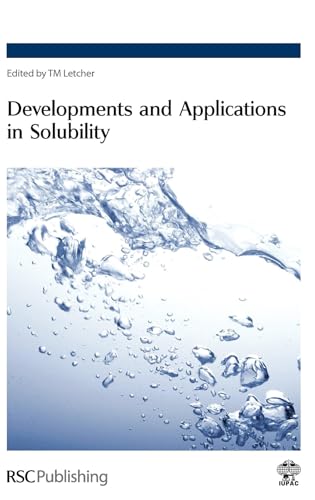
This new book discusses important topics on one of the most basic of thermodynamic properties, namely SOLUBILITY - a property which underlies most industrial processes. The objective of the book is to bring together new, exciting and disparate topics, all related to Solubility, in a single volume, so that readers can extend their horizons and relate hitherto unrelated topics, leading to innovative and creative ideas. The book is a definitive and comprehensive reference to what is new in solubility and is ideal for research scientists, industrialists and academics
Die Inhaltsangabe kann sich auf eine andere Ausgabe dieses Titels beziehen.
Von der hinteren Coverseite
This new book discusses important topics on one of the most basic of thermodynamic properties, namely SOLUBILITY - a property which underlies most industrial processes. The objective of the book is to bring together new, exciting and disparate topics, all related to Solubility, in a single volume, so that readers can extend their horizons and relate hitherto unrelated topics, leading to innovative and creative ideas. The book is a definitive and comprehensive reference to what is new in solubility and is ideal for research scientists, industrialists and academics
Auszug. © Genehmigter Nachdruck. Alle Rechte vorbehalten.
Developments and Applications in Solubility
By TM LetcherThe Royal Society of Chemistry
Copyright © 2007 The Royal Society of Chemistry
All rights reserved.
ISBN: 978-0-85404-372-9All rights reserved.
Contents
Chapter 1 Thermodynamics of Nonelectrolyte Solubility Emmerich Wilhelm,
Chapter 2 Thermodynamics of Electrolyte Solubility Earle Waghorne,
Chapter 3 Experimental, Calculated and Predicted Solubilities – Basis for the Synthesis and Design of Thermal Separation Processes Jürgen Gmehling and Wilfried Cordes,
Chapter 4 Solubility of Gases in Ionic Liquids, Aqueous Solutions, and Mixed Solvents Gerd Maurer and Álvaro Pérez-Salado Kamps,
Chapter 5 Solubility Phenomena in "Green" Quaternary Mixtures (Ionic liquid + water + alcohol + CO2)Manuel Nunes da Ponte and Luís P.N. Rebelo,
Chapter 6 The Solubility of Gases in Water and Seawater Rubin Battino and H. Lawrence Clever,
Chapter 7 Isotope Effects on Solubility W. Alexander Van Hook and Luís P.N. Rebelo,
Chapter 8 Solubility of Organic Solids for Industry Urszula Domanska,
Chapter 9 CO2 Solubility in Alkylimidazolium-Based Ionic Liquids Alireza Shariati, Sona Raeissi and Cor J. Peters,
Chapter 10 Solubility and Molecular Modelling Margarida F. Costa Gomes and Agílio A.H. Pádua,
Chapter 11 Molecular Simulation Approaches to Solubility Kelly E. Anderson and J. Ilja Siepmann,
Chapter 12 Prediction of Solubility with COSMO-RS Frank Eckert,
Chapter 13 Solubility of Impurities in Cryogenic Liquids Vania De Stefani and Dominique Richon,
Chapter 14 Solubility of BTEX and Acid Gases in Alkanolamine Solutions in Relation to the Environment Christophe Coquelet and Dominique Richon,
Chapter 15 Solubility of Solids in Bayer Liquors Erich H. Königsberger, Glenn Hefter and Peter M. May,
Chapter 16 Solubility of Gases in Polymers Jean-Pierre E. Grolier and Severine A.E. Boyer,
Chapter 17 Solubility in the Hydrometallurgical Leaching Process Toni Kaskiala, Petri Kobylin and Justin Salminen,
Chapter 18 Solubility Related to Reaction and Process Design Ralf Dohrn, Ricarda Leiberich and Ljudmila Fele Zilnik,
Chapter 19 Measurements and Modelling Solid Solubilities in Supercritical Phases: Application to a Pharmaceutical Molecule, Eflucimibe M. Sauceau and J. Fages,
Chapter 20 Solubility in Food, Pharmaceutical, and Cosmetic Industries Simão Pedro Pinho and Eugénia Almeida Macedo,
Chapter 21 Solubility of Solids in Radioactive Waste Repositories Wolfgang Hummel,
Chapter 22 Carbon Dioxide in Chemical Processes Justin Salminen and John Prausnitz,
Chapter 23 Solubility and the Oil Industry Anthony R.H. Goodwin, Kenneth N. Marsh and Cor J. Peters,
Chapter 24 Solubility of Inorganic Salts and their Industrial Importance Wolfgang Voigt,
Subject Index 407,
CHAPTER 1
Thermodynamics of Nonelectrolyte Solubility
EMMERICH WILHELM Institute of Physical Chemistry, University of Wien, Währinger Straße 42, Wien (Vienna) A-1090, Austria
Magic means rather different things to different people. Brigadier Donald Ffellowes in "The Kings of the Sea", by S.E. Lanier, The Magazine of Fantasy & Science Fiction, November 1968.
1.1 Introduction
The liquid state is one of the three principal states of matter. The majority of chemical synthesis reactions are carried out in the liquid state, and separation processes usually involve liquid/fluid states, i.e. solutions. Thus, not surprisingly, for a century and a half experimental investigations of physical properties of solutions and of phase equilibria involving solutions (vapour–liquid equilibrium: VLE; liquid–liquid equilibrium: LLE; solid–liquid equilibrium: SLE; solid–vapour equilibrium: SVE) have held a prominent position in physical chemistry. The scientific insights gained in these studies can hardly be overrated, and have been of immense value for the development of the highly formalized, general discipline of mixture thermodynamics, for instance by providing idealized solution models, such as the one based on the Lewis–Randall (LR) rule, or the one based on Henry's law (HL). In addition to its profound theoretical interest, this topic includes many important practical, industrial applications in chemical process design, in the environmental sciences, in geochemistry, in biomedical technology and so forth. Water is the most abundant liquid on the earth, and because it sustains life as we know it, it is also the most important liquid solvent. The preponderance of scientific papers dealing with aqueous solutions is thus not surprising. We note that the study of the solubility in water of the rare gases and of simple hydrocarbons have provided fundamental information on hydrophobic effects that are thought to be of pivotal importance for the formation and stability of higher order structures of biological substances, such as proteins, nucleic acids, and cell membranes.
Evidently, this short review cannot possibly be comprehensive, and I shall focus on just a few topics which reflect my current research interests and idiosyncrasies. For instance, VLE with supercritical solutes, that is the solubility of gases in liquids, will be discussed in some detail, and so will the van't Hoff type analysis of high-precision solubility data. SLE and SVE will not be considered at all. Almost inevitably, pride of place will be given to the Henry fugacity, or Henry's law constant, which is one of most misunderstood thermodynamic quantities. The goal is to clarify some points often overlooked, and to dispel misconceptions frequently encountered in the literature.
1.2 Thermodynamics
In this section I will present a brief overview of classical thermodynamics applicable to nonelectrolyte solutions in general, and to solutions of gases in liquids in particular.' When discussing solutions, one is either interested in single-phase properties, such as partial molar volumes, or in quantities which characterize the equilibrium solubility itself, for instance the amount of substance i, the solute, dissolved in a given amount of solvent j in the presence of both coexisting phases. The equations governing VLE and LLE will be considered first. For details see refs. 1 and 2.
A general criterion for phase equilibrium at temperature T and pressure P is the equality of the chemical potential μπ[i] of each constituent component i in all coexisting phases π, or equivalently, the equality of the fugacity fπi of each component in all coexisting phases. Thus, for the specific case of VLE (π = V or L),
[MATHEMATICAL EXPRESSION NOT REPRODUCIBLE IN ASCII] (1)
where N is the number of components present, each with mole fraction XVi in the vapour phase and XLi in the liquid phase. Similarly, for LLE (π = L' or L")
[MATHEMATICAL EXPRESSION NOT REPRODUCIBLE IN ASCII] (2)
From now on, however, I shall confine attention to binary systems, where i = 1 or 2.
Two entirely equivalent formal procedures are commonly used to establish the link with experimental reality:
(I) When using the fugacity coefficient of component i in solution in phase π, which quantity is defined by
[MATHEMATICAL EXPRESSION NOT REPRODUCIBLE IN ASCII] (3)
and adopting the convenient notation XVi = yi,...
„Über diesen Titel“ kann sich auf eine andere Ausgabe dieses Titels beziehen.
Suchergebnisse für Developments and Applications in Solubility

Beispielbild für diese ISBN
Developments and Applications in Solubility
Anbieter: PBShop.store US, Wood Dale, IL, USA
Verkäuferbewertung 5 von 5 Sternen

HRD. Zustand: New. New Book. Shipped from UK. Established seller since 2000. Artikel-Nr. CX-9780854043729
Neu kaufen
EUR 186,95
Versand gratis
Versand innerhalb von USA
Versand innerhalb von USA
Anzahl: 15 verfügbar
Beispielbild für diese ISBN
Developments and Applications in Solubility
Anbieter: PBShop.store UK, Fairford, GLOS, Vereinigtes Königreich
Verkäuferbewertung 5 von 5 Sternen
HRD. Zustand: New. New Book. Shipped from UK. Established seller since 2000. Artikel-Nr. CX-9780854043729
Neu kaufen
EUR 180,44
EUR 6,83 Versand
Versand von Vereinigtes Königreich nach USA
Versand von Vereinigtes Königreich nach USA
Anzahl: 15 verfügbar
Beispielbild für diese ISBN
Developments and Applications in Solubility
Anbieter: Ria Christie Collections, Uxbridge, Vereinigtes Königreich
Verkäuferbewertung 5 von 5 Sternen
Zustand: New. In English. Artikel-Nr. ria9780854043729_new
Neu kaufen
EUR 218,99
EUR 13,13 Versand
Versand von Vereinigtes Königreich nach USA
Versand von Vereinigtes Königreich nach USA
Anzahl: Mehr als 20 verfügbar
Foto des Verkäufers
Developments and Applications in Solubility
Anbieter: moluna, Greven, Deutschland
Verkäuferbewertung 5 von 5 Sternen
Zustand: New. Solubility is fundamental to most areas of chemistry and is one of the most basic of thermodynamic properties.InhaltsverzeichnisrnrnPart One: THEORY, TECHNIQUES AND RESULTS Chapter 1: Thermodynamics of Nonelectrolyte Solubility 1: Introduc. Artikel-Nr. 595098129
Neu kaufen
EUR 194,16
EUR 48,99 Versand
Versand von Deutschland nach USA
Versand von Deutschland nach USA
Anzahl: Mehr als 20 verfügbar
Beispielbild für diese ISBN
Developments and Applications in Solubility
Anbieter: Revaluation Books, Exeter, Vereinigtes Königreich
Verkäuferbewertung 5 von 5 Sternen
Hardcover. Zustand: Brand New. 1st edition. 385 pages. 9.25x6.25x1.25 inches. In Stock. Artikel-Nr. x-0854043721
Neu kaufen
EUR 263,00
EUR 14,53 Versand
Versand von Vereinigtes Königreich nach USA
Versand von Vereinigtes Königreich nach USA
Anzahl: 2 verfügbar
Foto des Verkäufers
Developments and Applications in Solubility
Anbieter: AHA-BUCH GmbH, Einbeck, Deutschland
Verkäuferbewertung 5 von 5 Sternen
Buch. Zustand: Neu. Neuware - This new book discusses important topics on one of the most basic of thermodynamic properties, namely SOLUBILITY - a property which underlies most industrial processes. The objective of the book is to bring together new, exciting and disparate topics, all related to Solubility, in a single volume, so that readers can extend their horizons and relate hitherto unrelated topics, leading to innovative and creative ideas. The book is a definitive and comprehensive reference to what is new in solubility and is ideal for research scientists, industrialists and academics. Artikel-Nr. 9780854043729
Neu kaufen
EUR 247,51
EUR 35,00 Versand
Versand von Deutschland nach USA
Versand von Deutschland nach USA
Anzahl: 2 verfügbar