
Verwandte Artikel zu Carbohydrate Chemistry: Volume 30 (Specialist Periodical...
Inhaltsangabe
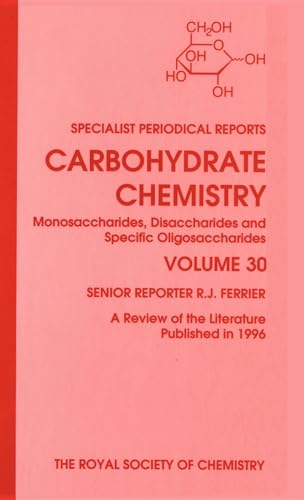
Carbohydrate Chemistry provides review coverage of all publications relevant to the chemistry of monosaccharides and oligosaccharides in a given year. The amount of research in this field appearing in the organic chemical literature is increasing because of the enhanced importance of the subject, especially in areas of medicinal chemistry and biology. In no part of the field is this more apparent than in the synthesis of oligosaccharides required by scientists working in glycobiology. Clycomedicinal chemistry and its reliance on carbohydrate synthesis is now very well established, for example, by the preparation of specific carbohydrate- based antigens, especially cancer-specific oligosaccharides and glycoconjugates. Coverage of topics such as nucleosides, amino-sugars, alditols and cyclitols also covers much research of relevance to biological and medicinal chemistry. Each volume of the series brings together references to all published work in given areas of the subject and serves as a comprehensive database for the active research chemist Specialist Periodical Reports provide systematic and detailed review coverage in major areas of chemical research. Compiled by teams of leading authorities in the relevant subject areas, the series creates a unique service for the active research chemist, with regular, in-depth accounts of progress in particular fields of chemistry. Subject coverage within different volumes of a given title is similar and publication is on an annual or biennial basis.
Die Inhaltsangabe kann sich auf eine andere Ausgabe dieses Titels beziehen.
Auszug. © Genehmigter Nachdruck. Alle Rechte vorbehalten.
Carbohydrate Chemistry Volume 30
Monosaccharides, Disaccharides and Specific Oligosaccharides
By R.J. FerrierThe Royal Society of Chemistry
Copyright © 1998 The Royal Society of Chemistry
All rights reserved.
ISBN: 978-0-85404-218-0All rights reserved.
Contents
Chapter 1 Introduction and General Aspects, 1,
Chapter 2 Free Sugars, 2,
Chapter 3 Glycosides and Disaccharides, 14,
Chapter 4 Oligosaccharides, 62,
Chapter 5 Ethers and Anhydro-sugars, 90,
Chapter 6 Acetals, 97,
Chapter 7 Esters, 103,
Chapter 8 Halogeno-sugars, 118,
Chapter 9 Amino-sugars, 123,
Chapter 10 Miscellaneous Nitrogen-Containing Derivatives, 141,
Chapter 11 Thio- and Seleno-sugars, 159,
Chapter 12 Deoxy-sugars, 168,
Chapter 13 Unsaturated Derivatives, 173,
Chapter 14 Branched-chain Sugars, 185,
Chapter 15 Aldosuloses and Other Dicarbonyl Compounds, 199,
Chapter 16 Sugar Acids and Lactones, 203,
Chapter 17 Inorganic Derivatives, 215,
Chapter 18 Alditols and Cyclitols, 223,
Chapter 19 Antibiotics, 253,
Chapter 20 Nucleosides, 268,
Chapter 21 NMR Spectroscopy and Conformational Features, 316,
Chapter 22 Other Physical Methods, 329,
Chapter 23 Separatory and Analytical Methods, 350,
Chapter 24 Synthesis of Enantiomerically Pure Non-carbohydrate, 354,
Author Index, 401,
CHAPTER 1
Introduction and General Aspects
The very unusual absence of a new volume of Advances in Carbohydrate Chemistry and Biochemistry limits the number of quality reviews to have been published this year, and those that have appeared tend to be referred to at the beginnings of relevant chapters. This chapter is therefore unusually brief.
Danishefsky and Roberge have summarized the Sloan-Kettering work on the use of glycals as glycosyl donors and acceptors in the synthesis of oligosaccharides of glycoconjugates. The use of enzymically derived cis-dihydroxylated aromatics as starting materials for the iterative preparation of oligo- nor-saccharides, -inositols and pseudo-sugars has been surveyed.
In the field of origin of life studies Eschenmoser and Kisakürek have discussed the potential biogenic relationship between hexose- and pentose-based nucleic acids, and a paper has appeared from the same group on the base pairing between oligonucleotides comprising pentopyranosyl D- and L-nucleotides.
CHAPTER 2Free Sugars
1 Theoretical Aspects
Molecular dynamics simulation calculations aimed at providing better understanding of the relative sweetness of β-D-glucopyranose, β-D-galactopyranose, and α- and β-D-mannopyranose failed to verify the hydrophobic G site hypothesis proposed by Tinti and Nofre (ACS Symp. Ser., 1991, 450, Chapter 15).
2 Synthesis
A comprehensive review (260 refs.) on the synthesis of carbohydrates from non-carbohydrate sources covers the use of benzene-derived diols and products of Sharpless asymmetric oxidation as starting materials, Dodoni's thiazole and Vogel's 'naked sugar' approaches, as well as the application of enzyme-catalysed aldol condensations. The preparation of monosaccharides by enzyme-catalysed aldol condensations is also discussed in a review on recent advances in the chemoenzymic synthesis of carbohydrates and carbohydrate mimetics, in parts of reviews on the formation of carbon-carbon bonds by enzymic asymmetric synthesis and on carbohydrate-mediated biochemical recognition processes as potential targets for drug development, as well as in connection with the introduction of three 'Aldol Reaction Kits' that provide dihydroxyacetone phosphate-dependent aldolases (27 refs.). A further review deals with the synthesis of carbohydrates by application of the nitrile oxide 1,3-dipolar cycloaddition (13 refs.).
A newly discovered NAD-dependent hydrogenase from celery oxidizes D-mannitol to D-mannose; several other pentitols and hexitols, especially those with the same absolute configuration at C-2 as that of D-mannitol, are oxidized to the corresponding aldoses at a slower rate.
2.1 Tetroses and Pentoses – 4-O-t -Butyldimethylsilyl-2,3-O-isopropylidene-D-threose (1) has been prepared in seven efficient steps from D-xylose. 3,4-O-Isopropylidene-D-eythrulose (4) has been synthesized from the known tetritol derivative 2 by primary protection as the silyl ether 3, followed by Dess-Martin oxidation and desilylation. Compound 2 was derived from D-isoascorbic acid (see Vol. 22, p. 178, refs. 9,10). In a similar reaction sequence, the enantiomer 5 has been obtained from L-ascorbic acid. The dehomologation of several di-O-isopropylidenehexofuranoses (e.g.,6 [right arrow] 7) has been carried out in two steps without intermediate purification, by successive treatment with periodic acid in ethyl acetate, followed by sodium borohydride in ethanol. Selective reduction of 3-deoxy-D-glycero-pentos-2-ulose (8) to 3-deoxy-D-glycero-pent-2-ose (9) has been achieved enzymically with aldose reductase and NADPH. 4-Isopropyl-2-oxazolin-5-one (10) is a masked formaldehyde equivalent that is easily converted to an anion and demasked by mild acid hydrolysis. One of the three examples of its use in the synthesis of monosaccharides is shown in Scheme 1.
The synthesis of [5-13C]D-ribose from D-ribose involved diol cleavage of the original C-4-C-5 bond and formation of a new C-4-C-5 bond using a 13C-enriched Wittig reagent. 3,4,5,5-d14 -DL-Ribose (12) has been obtained from dg-glycerol (11), as outlined in Scheme 2.
2.2 Hexoses – The synthesis of hexoseptanose derivatives by ring expansion of uloses, Baeyer Villiger oxidation of inositols, or Baeyer-Fischer reaction of sugar dialdehydes has been reviewed.
The methyl β-L-idoseptanoside derivative 14 was produced by oxidation/reduction (Ru2O-NaIO4/NaBH4) of the corresponding methyl β-D-glucoseptanoside 13. On transmetalation with InCl3, δ-oxygenated allylic stannanes undergo in situ addition to aldehydes furnishing predominantly anti products. This method has been applied to the synthesis of D-altrose as shown in Scheme 3. A similar route to α-L-daunosamine hydrochloride is covered in Chapter 9. The chemoenzymic synthesis of 6-substituted D-fructose analogues by use of epoxide 15 is referred to in Chapters 7, 8, 9 and 10, and that of 6-deoxy-L-sorbose in Chapter 12.
The best conditions for producing glucose with close to 100% H-isotope labelling at C-1, with negligible formation of labelled by-products, by exchange with deuterium or tritium gas in aqueous solution have been determined. Various 2H-labelled D-mannoses, as well as 2,3,4,5,6-d5- and 1,1,2,3,4,5,6,6-d8-D -mannitol, were obtained by ozonolysis/sodium borohydride reduction of the functionalized cyclohexene 16, which was obtained in enantiomerically pure form from 2H5-chlorobenzene following biological hydroxylation.
D-Tagatose 3-epimerase immobilized on Chitopearl beads effected the isomerization of L-sorbose and L-psicose to L-tagatose and L-fructose in 20 and 65% yield, respectively. Sequential use of pyranose 2-oxidase and hydrogen over palladium permitted the one-pot chemoenzymatic conversion of D-galactose to D-tagatose in 30% yield, whereas sodium borohydride reduction followed by microbial oxidation furnished D-sorbose from D-gulonolactone with high efficiency. A...
„Über diesen Titel“ kann sich auf eine andere Ausgabe dieses Titels beziehen.
Suchergebnisse für Carbohydrate Chemistry: Volume 30 (Specialist Periodical...

Beispielbild für diese ISBN
Carbohydrate Chemistry, Volume 30: Monosaccharides, Disaccharides and Specific Oligosaccharides (A Review of the Literature Published in 1996)
Verlag:
The Royal Society of Chemistry, United Kingdom, 1998
ISBN 10: 0854042180
ISBN 13: 9780854042180
Gebraucht
Hardcover
Anbieter: BookOrders, Russell, IA, USA
Verkäuferbewertung 5 von 5 Sternen

Hard Cover. Zustand: Very Good. No Jacket. The pages are very clean and tight. Binding is good. Cover shows very minimal wear. 436 pages. Artikel-Nr. 115508
Gebraucht kaufen
EUR 55,09
EUR 3,57 Versand
Versand innerhalb von USA
Versand innerhalb von USA
Anzahl: 1 verfügbar
Beispielbild für diese ISBN
Carbohydrate Chemistry
Anbieter: PBShop.store UK, Fairford, GLOS, Vereinigtes Königreich
Verkäuferbewertung 5 von 5 Sternen
HRD. Zustand: New. New Book. Shipped from UK. Established seller since 2000. Artikel-Nr. CX-9780854042180
Neu kaufen
EUR 400,03
EUR 7,00 Versand
Versand von Vereinigtes Königreich nach USA
Versand von Vereinigtes Königreich nach USA
Anzahl: 15 verfügbar
Beispielbild für diese ISBN
Carbohydrate Chemistry
Anbieter: PBShop.store US, Wood Dale, IL, USA
Verkäuferbewertung 5 von 5 Sternen
HRD. Zustand: New. New Book. Shipped from UK. Established seller since 2000. Artikel-Nr. CX-9780854042180
Neu kaufen
EUR 422,45
Versand gratis
Versand innerhalb von USA
Versand innerhalb von USA
Anzahl: 15 verfügbar
Foto des Verkäufers
Carbohydrate Chemistry
Anbieter: moluna, Greven, Deutschland
Verkäuferbewertung 5 von 5 Sternen
Gebunden. Zustand: New. Carbohydrate Chemistry provides review coverage of all publications relevant to the chemistry of monosaccharides and oligosaccharides in a given year.InhaltsverzeichnisIntroduction and general aspects free sugars glycocides and dis. Artikel-Nr. 595098007
Neu kaufen
EUR 441,52
EUR 48,99 Versand
Versand von Deutschland nach USA
Versand von Deutschland nach USA
Anzahl: Mehr als 20 verfügbar
Beispielbild für diese ISBN
Carbohydrate Chemistry: Volume 30 (Specialist Periodical Reports - Carbohydrate Chemistry, Volume 30)
Anbieter: Ria Christie Collections, Uxbridge, Vereinigtes Königreich
Verkäuferbewertung 5 von 5 Sternen
Zustand: New. In English. Artikel-Nr. ria9780854042180_new
Neu kaufen
EUR 491,20
EUR 13,46 Versand
Versand von Vereinigtes Königreich nach USA
Versand von Vereinigtes Königreich nach USA
Anzahl: Mehr als 20 verfügbar
Foto des Verkäufers
Carbohydrate Chemistry : Volume 30
Verlag:
Royal Society Of Chemistry Dez 1998, 1998
ISBN 10: 0854042180
ISBN 13: 9780854042180
Neu
Hardcover
Anbieter: AHA-BUCH GmbH, Einbeck, Deutschland
Verkäuferbewertung 5 von 5 Sternen
Buch. Zustand: Neu. Neuware - Carbohydrate Chemistry provides review coverage of all publications relevant to the chemistry of monosaccharides and oligosaccharides in a given year. The amount of research in this field appearing in the organic chemical literature is increasing because of the enhanced importance of the subject, especially in areas of medicinal chemistry and biology. In no part of the field is this more apparent than in the synthesis of oligosaccharides required by scientists working in glycobiology. Clycomedicinal chemistry and its reliance on carbohydrate synthesis is now very well established, for example, by the preparation of specific carbohydrate- based antigens, especially cancer-specific oligosaccharides and glycoconjugates. Coverage of topics such as nucleosides, amino-sugars, alditols and cyclitols also covers much research of relevance to biological and medicinal chemistry. Each volume of the series brings together references to all published work in given areas of the subject and serves as a comprehensive database for the active research chemist Specialist Periodical Reports provide systematic and detailed review coverage in major areas of chemical research. Compiled by teams of leading authorities in the relevant subject areas, the series creates a unique service for the active research chemist, with regular, in-depth accounts of progress in particular fields of chemistry. Subject coverage within different volumes of a given title is similar and publication is on an annual or biennial basis. Artikel-Nr. 9780854042180
Neu kaufen
EUR 586,93
EUR 35,00 Versand
Versand von Deutschland nach USA
Versand von Deutschland nach USA
Anzahl: 2 verfügbar
Beispielbild für diese ISBN
Carbohydrate Chemistry: Vol 30
Anbieter: Revaluation Books, Exeter, Vereinigtes Königreich
Verkäuferbewertung 5 von 5 Sternen
Hardcover. Zustand: Brand New. 450 pages. 8.66x5.75x1.42 inches. In Stock. Artikel-Nr. x-0854042180
Neu kaufen
EUR 614,26
EUR 14,91 Versand
Versand von Vereinigtes Königreich nach USA
Versand von Vereinigtes Königreich nach USA
Anzahl: 2 verfügbar