
Verwandte Artikel zu The Awake Project: Uniting Against the African AIDS...
Inhaltsangabe
Five AIDS victims die every minute. What can you do to help?
"Today, this very day, 5,500 Africans will die of AIDS. If this isn't emergency, what is?" -Bono (U2)
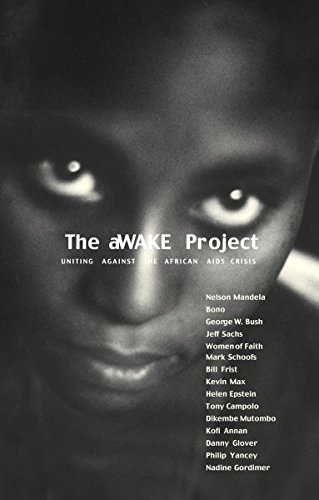
The aWAKE Project is a collection of stories and essays geared toward educating and mobilizing Americans to help with the AIDS crisis in Africa. Action is needed for a continent on which five people die every minute from the deadly AIDS virus. aWAKE stands for: AIDS-Working toward Awareness, Knowledge and Engagement. Compiled of articles written by significant speakers on the AIDS issue, ranging from Nelson Mandela to Kevin Max, The aWAKE Project provides poignant stories and compelling statistics, encouraging the reader to care and even take action to battle this horrific crisis.
A significant portion of the proceeds from The aWAKE Project will be donated to Jubilee 2000 and World Vision's Hope Iniative for Africa.
Contributors include: Johanna McGreary, Nelson Mandela, Senator Bill Frist, Mary Graham, Desmond Tutu, Margaret Becker, Jimmy Carter, Jeffrey Sachs, Kevin Max, Jesse Helms, Kofi Annan, Out of Eden, Dikembe Mutombo, Luci Swindoll, Michael Tait, Charlie Peacock, President Olusegun Obsanjo of Nigeria, Bono, Nadine Gordimer, President George W. Bush, Danny Glover, Ambassador Rachel Gbenyon-Diggs, Mark Schoofs, Greg Barz, Paul O'Neill, Noelina Nakumisa, World Bank Report, and others.
"As featured on the official U2 website."
Die Inhaltsangabe kann sich auf eine andere Ausgabe dieses Titels beziehen.
Auszug. © Genehmigter Nachdruck. Alle Rechte vorbehalten.
Rich Stearns
President, World Vision
Speech at Forum 2002
Widows and Orphans-the Hidden Faces of AIDSMay 18, 2002
How does one try to 'put in perspective' a tragedy with the dimensions of the AIDS crisis in Africa? How does one say something comforting about the needs of thirteen million orphans, the deaths of twenty million victims, the despair of ten million widows, and the relentless spread of a virus that infects fourteen thousand new people every day and more than five million every year. Almost any conclusion I might offer tonight would be trite, inadequate and unsatisfying.
And how can we return to our lives with any sense of normalcy, given the knowledge we now have? What must we do with our worldviews to accommodate such an enormous reality? How can the Christian community continue to be relevant and legitimate in a world that holds such horrors and poses such grand questions?
It is not overly dramatic to see the AIDS epidemic as the enormous white elephant sitting in the corner of every Christian church and every Christian's living room demanding to be acknowledged and not ignored, demanding some kind of response theologically, emotionally and practically. How will the church deal with the knowledge of something as apocalyptic as AIDS, indeed how will the world?
I believe that we stand at one of those few crossroads in history. A crossroads after which nothing will again be the same and toward which historians will someday point as a fundamental turning point in world events. This is not just another social problem like racism or war or poverty-this is something we have never seen before . . . something without precedent . . . and in one hundred years, the twenty-first century will be studied through the lens of the AIDS pandemic, and by how the world responded.I don't know about you, but when I am confronted with an issue that is so much larger than I am, I find that I have to break it down into simple and practical concepts in order to process it. And I also find that the Scriptures are the place where I usually find my confusion turned into clarity. Tonight I want to use one of the simplest and yet most profound parables in all of scripture to help each of us come to terms with the AIDS epidemic: the parable of the Good Samaritan. I want to look at the main characters in this story: the victim, the priest and Levite, and lastly, the Samaritan himself.
Let me say up front that just as Jesus used this parable to challenge the religious establishment of the day, we too, must be willing to let it challenge our community of faith today. But we also need to acknowledge that many churches and Christians are doing the right things in the fight against AIDS, even as we also acknowledge that they are in the minority and that the body of Christ still needs to hear and respond to a call to greater action.
The story begins in Luke chapter 10 verse 25 when we are told that an 'expert in the law' challenged Jesus with a theological question: What must I do to inherit eternal life? My picture of this encounter is that of a scholarly theologian challenging and testing the rather unorthodox and controversial Jesus to a battle of wits and intellect. It is doubtful that he really wanted an answer to this question but rather wanted to expose Jesus' theology as, in some way, defective.
He was not really asking what he could do to be a better person at a practical level, but as we will see, Jesus quickly took this man from the arena of intellectual knowledge and theology to the realm of practice and action. The Pharisees of the day were quite adept at creating elaborate legal systems that had no love or compassion at their heart, the letter of the law, but without a sense of the spirit of the law.
Jesus in return asks this expert in the law, What is written in the law? His answer was a conventional reference to the Old Testament law from Leviticus and Deuteronomy-Love the Lord your God with all your heart and with all your soul and with all your strength and Love your neighbor as yourself.
Then Jesus says, You have answered correctly, do this and you will live.
Here Jesus brought the debate from the thinking to the doing. In other words, right thinking must be accompanied by right doing. This troubled the man enough to follow up with another question. The passage goes on to say "But he wanted to justify himself and so he asked Jesus, "And who is my neighbor?" It seems to me that he was trying to fit Jesus' answer into his system of belief and behavior. He wanted to justify himself, meaning that he wanted to justify his current beliefs and current behavior. Apparently he was troubled by Jesus' suggestion that he must do something differently.
This question-Who is my neighbor?-is perhaps one of the most profound in all of Scripture, and even today it is one of the defining distinctive of truly Christian communities around the world. Who is my neighbor? Jesus' answer, in the form of the parable of the Good Samaritan also reverberates across the centuries as one of the most foundational and universal tenets of moral law.
Let's first look at the victim in this story, the man who was beaten by robbers. One thing that is clear is that he was in dire need: beaten, wounded and bleeding, and possibly in jeopardy of dying. We don't know his ethnicity or nationality for sure-and we don't know how he came to be beaten.
This is an important question that we need to ponder for a moment. Was he an innocent victim who was unjustly attacked, or was he himself perhaps a robber who had been beaten by his fellow thieves? Perhaps he was engaged in some illicit activity and was beaten as a result. Or perhaps he was just careless and had irresponsibly traveled alone at night along a dangerous road. The point is that we do not know. Jesus did not feel that it was relevant whether the man who had been beaten was at fault.
Here is raised one of the critical moral questions with regard to the victims of AIDS. Should we distinguish between those who became victims because of sinful behavior-and those who were innocent victims? One of our goals this week was to draw attention to what we have called "The Hidden Faces of AIDS" - the widows and the orphans, the millions of victims who have become the passive victims in this holocaust through no behavioral conduct that we might deem sinful or irresponsible.
We have done this intentionally because we wanted to remove the stigma of judgment from the HIV/AIDS debate. Sadly, one of the reasons the Christian community has not taken the lead in the fight against AIDS is this issue of judgment. When AIDS burst into our consciousness in the 1980s, it presented itself as a disease confined to the homosexual and intravenous drug user communities. Some Christians saw this as a judgment of God upon sinful lifestyles and behaviors-and they faced off in what was seen to be another battle in the culture wars. As they judged the sins that had led to AIDS, they failed to show any compassion toward those who suffered from it.
Many in the Christian community largely turned their backs on this issue in the 1980s and now, almost twenty years later, are waking up to see that millions of innocent women and children have become victims and that an entire continent is perishing. As we will see in the story of the Good Samaritan, the only judgment pronounced by Jesus was not upon the victim himself, but was a judgment upon those who failed to help.
Let's now turn our attention to the priest and the Levite. These two represented the religious establishment of the day. Today they might be a pastor and a seminary professor, practitioners of the faith and well-schooled in the law. We are told that they saw the man and yet they passed by on the other side of the road, unwilling to help.
Here is the crux of the...
„Über diesen Titel“ kann sich auf eine andere Ausgabe dieses Titels beziehen.
Suchergebnisse für The Awake Project: Uniting Against the African AIDS...

Beispielbild für diese ISBN
The aWAKE Project : Uniting against the African AIDS Crisis
Anbieter: ThriftBooks-Atlanta, AUSTELL, GA, USA
Verkäuferbewertung 5 von 5 Sternen

Paperback. Zustand: As New. No Jacket. Pages are clean and are not marred by notes or folds of any kind. ~ ThriftBooks: Read More, Spend Less. Artikel-Nr. G0849944090I2N00
Gebraucht kaufen
EUR 6,40
Versand gratis
Versand innerhalb von USA
Versand innerhalb von USA
Anzahl: 1 verfügbar
Beispielbild für diese ISBN
The aWAKE Project : Uniting against the African AIDS Crisis
Anbieter: Wonder Book, Frederick, MD, USA
Verkäuferbewertung 5 von 5 Sternen
Zustand: Very Good. Very Good condition. A copy that may have a few cosmetic defects. May also contain light spine creasing or a few markings such as an owner's name, short gifter's inscription or light stamp. Artikel-Nr. L19A-03489
Gebraucht kaufen
EUR 6,43
Versand gratis
Versand innerhalb von USA
Versand innerhalb von USA
Anzahl: 1 verfügbar
Beispielbild für diese ISBN
The aWAKE Project : Uniting against the African AIDS Crisis
Anbieter: Wonder Book, Frederick, MD, USA
Verkäuferbewertung 5 von 5 Sternen
Zustand: Good. Good condition. A copy that has been read but remains intact. May contain markings such as bookplates, stamps, limited notes and highlighting, or a few light stains. Artikel-Nr. U11C-05669
Gebraucht kaufen
EUR 6,43
Versand gratis
Versand innerhalb von USA
Versand innerhalb von USA
Anzahl: 1 verfügbar
Beispielbild für diese ISBN
The AWAKE Project
Verlag:
W Pub Group, 2002
ISBN 10: 0849944090
ISBN 13: 9780849944093
Gebraucht
Softcover
Erstausgabe
Anbieter: The Book Scouts, Hamilton, ON, Kanada
Verkäuferbewertung 4 von 5 Sternen

Softcover. Zustand: Fine. First Edition. We're always buying collectible book collections. Contact us for details. We're happy to provide pictures of any book priced at $10 or more, please just ask! American SOFT COVERED first edition, first printing. Contains number line 1 2 3 4 5. Virtually no wear to covers. The book itself is in Near Fine condition. The binding is straight and tight. NO remainder mark. Artikel-Nr. sku520008362
Gebraucht kaufen
EUR 4,12
EUR 8,92 Versand
Versand von Kanada nach USA
Versand von Kanada nach USA
Anzahl: 1 verfügbar
Beispielbild für diese ISBN
The Awake Project : Uniting Against The African Aids Crisis
Anbieter: SZ Global, Toronto, ON, Kanada
Verkäuferbewertung 5 von 5 Sternen
Paperback. Zustand: Collectible-Like New. Five AIDS victims die every minute. What can you do to help?'Today, this very day, 5,500 Africans will die of AIDS. If this isn't emergency, what is?' -Bono (U2)The aWAKE Project is a collection of stories and essays geared toward educating and mobilizing Americans to help with the AIDS crisis in Africa. Action is needed for a continent on which five people die every minute from the deadly AIDS virus. aWAKE stands for: AIDS-Working toward Awareness, Knowledge and Engagement. Compiled of articles written by significant speakers on the AIDS issue, ranging from Nelson Mandela to Kevin Max, The aWAKE Project provides poignant stories and compelling statistics, encouraging the reader to care and even take action to battle this horrific crisis.A significant portion of the proceeds from The aWAKE Project will be donated to Jubilee 2000 and World Vision's Hope Iniative for Africa.Contributors include: Johanna McGreary, Nelson Mandela, Senator Bill Frist, Mary Graham, Desmond Tutu, Margaret Becker, Jimmy Carter, Jeffrey Sachs, Kevin Max, Jesse Helms, Kofi Annan, Out of Eden, Dikembe Mutombo, Luci Swindoll, Michael Tait, Charlie Peacock, President Olusegun Obsanjo of Nigeria, Bono, Nadine Gordimer, President George W. Bush, Danny Glover, Ambassador Rachel Gbenyon-Diggs, Mark Schoofs, Greg Barz, Paul O'Neill, Noelina Nakumisa, World Bank Report, and others.'As featured on the official U2 website.'. Artikel-Nr. 9780849944093
Gebraucht kaufen
EUR 28,56
EUR 34,11 Versand
Versand von Kanada nach USA
Versand von Kanada nach USA
Anzahl: 1 verfügbar
Beispielbild für diese ISBN
The aWAKE Project : Uniting against the African AIDS Crisis
Verlag:
W Pub Group, 2002
ISBN 10: 0849944090
ISBN 13: 9780849944093
Gebraucht
Softcover
Erstausgabe
Anbieter: Wonder Book, Frederick, MD, USA
Verkäuferbewertung 5 von 5 Sternen
Zustand: As New. INSCRIBED! Nashville, TN: W Publishing Group, 2002. 1st edition. 8vo paperback. xxi+297pp. B/W photos. Inscribed by U2 frontman and aWAKE project contributing author, Bono, on inside front cover. Fine book. (AIDS, Africa, Public Welfare) Inquire if you need further information. Artikel-Nr. CA01C-00150
Gebraucht kaufen
EUR 66,31
Versand gratis
Versand innerhalb von USA
Versand innerhalb von USA
Anzahl: 1 verfügbar