
What Difference Do It Make?: Stories of Hope and Healing - Hardcover
Buch 2 von 3: Same Kind of Different as Me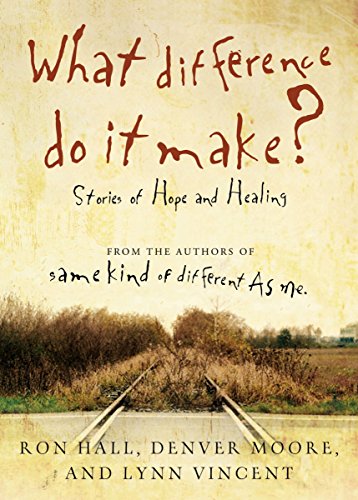
Inhaltsangabe
New thoughts and reflections from the authors of the inspirational New York Times bestseller Same Kind of Different as Me.
The more than four hundred thousand readers stirred by the story of Ron Hall and Denver Moore will resonate with the all new, stand-alone true stories of hope and healing offered in this intimate, authentic follow-up to the New York Times bestseller Same Kind of Different as Me.
With new "Denverisms" and reflections from Denver on his personal dealings with homelessness and disrespect from others, additional insights from Ron on what we can learn from people not like us and from those dealing with a terminal illness, and the stories of readers who have been impacted by the book's central themes, this inspirational reader will generate a host of new fans. Topics include:
- Faith and friendship
- Racial reconciliation
- Community outreach
- Compassion
- Healing
Die Inhaltsangabe kann sich auf eine andere Ausgabe dieses Titels beziehen.
Über die Autorinnen und Autoren
Ron Hall has dedicated much of the last ten years of his life to speaking on behalf of, and raising money for, the homeless. Formerly an international art dealer, Ron is a #1 New York Times bestselling author and writer/producer of the Paramount/Pure Flix film Same Kind of Different as Me. A Texas Christian University graduate, Ron was honored in 2017 with the Distinguished Alumni Award. In addition to traveling and speaking, Ron and his wife, Beth, run the Same Kind of Different as Me foundation (SKODAM.org), which meets emergency needs for those who are less fortunate.
Denver Moore served as a volunteer at the Fort Worth Union Gospel Mission until his death in March 2012.
Lynn Vincent is the New York Times best-selling writer ofHeaven Is for Real and Same Kind of Different As Me. The author or coauthor of ten books, Lynn has sold 12 million copies since 2006. She worked for eleven years as a writer and editor at the national news biweekly WORLD magazine and is a U.S. Navy veteran.
Auszug. © Genehmigter Nachdruck. Alle Rechte vorbehalten.
What difference do it make?
Stories of Hope and HealingBy Ron Hall Denver Moore Lynn VincentThomas Nelson
Copyright © 2009 Ron Hall, Denver Moore, and Lynn VincentAll right reserved.
ISBN: 978-0-8499-2019-6
Chapter One
Ron
Tennessee sour-mash whiskey defined my daddy. He pledged a lifetime of allegiance to Jim Beam, and ol' Jim never had a more loyal friend. As a boy, tucked into bed in a ratty blue-collar town outside of Fort Worth, I sometimes cried myself to sleep wishing my daddy loved me and my brother, John, as much as he loved Jim.
My father's given name was Earl F. Hall. The F didn't stand for anything, but over the years I assigned it lots of unprintable meanings. Earl was a chain-smoking, chain-drinking ladies' man, who slicked back his wavy brown hair with Vitalis and favored wife-beater T-shirts, pleated gabardine slacks, and wing-tip shoes. He was not a mean drunk and most of the time could walk a straight line and recite the alphabet if he had to. Once he even recited poetry till he sobered up.
When my daddy came home from World War II in '45, we all lived in his mama's little shack in Denton, Texas, until he could find a job. After a few months he found one working for Curtiss Candy, driving a 1947 GMC panel truck painted red and white like a Baby Ruth wrapper. Not long after that, we piled our meager belongings into the candy truck and moved them over to a one-bedroom bungalow in the West Fourth Street slums near downtown Fort Worth. The neighborhood was planted smack in the geographic center of a shabby circle formed by a rail yard, a hobo camp, a gravel pit, a junkyard, a dog-food factory, and a sewage plant.
Our neighbors were mostly workaday folks, bagging kibble at the plant or spelunking in the sewer lines. Except for Andy, who lived across the street. Andy was a Harley-riding professional wrestler who stayed home all day and wrestled at night. When he wasn't wrestling in the ring, he wrestled naked in his living room with his redheaded bombshell wife, Rusty Fay. For some reason Rusty Fay had never gotten around to hanging curtains in the front room, so the picture window that faced our street drew neighborhood boys like the hootchy-cootchy tent at an old-time carnival. We never could figure out how little Rusty Fay always managed to pin her big, brawny husband and wind up on top, but we all thought it was the best show in town.
From a boy's perspective, that was about the only thing my neighborhood had going for it. For one thing, the place stunk to high heaven. Smelly emissions from the sewage facility and the dog-food plant settled in the trees like an invisible fog with a combined scent that reminded me of a roomful of old men after a chili cook-off. Those fumes competed with equally un pleasant ones from hobo campfires, backyard chicken droppings, and the working outhouse that our next-door neighbors kept out back. Once, on a school field trip, I smelled the warm, cinnamon scent of a bakery and was jealous of any kids fortunate enough to live nearby.
Our house sat near a rail yard with acres of tracks planted like row crops that produced a year-round yield of multicolored boxcars and a round-the-clock clang of crossing bells. Day and night, the cars collided in a steady, drum-like rhythm as screeching engines slammed them together to form mile-long strings that chugged out of the yard with hobos in hot pursuit. (The good news about the rail yard was that my friends and I, through many scientific trials, disproved the old wives' tale that a single penny on the tracks can derail a moving train.)
Playing second fiddle to the rail-yard symphony were the grain elevators and the dog-food plant, each of which produced an uninterrupted, high-pitched whine. But none of these noises was as obnoxious or caustic as my parents' constant fighting.
I have heard it said that a thin line exists between love and hate. From the epithets I often heard floating through the open windows into the front yard, I thought Earl and Tommye Hall were hell-bent on erasing the line entirely.
Most of their screaming matches took place in mornings and afternoons since most nights Daddy hid out at the Tailless Monkey Bar. Then, just before midnight, he'd call home and make Mama come and get him. She'd wake us up and drive the mile or so to the Tailless Monkey. She'd honk, and he'd stumble out. After we were old enough to walk and talk, John and I would fight until the loser had to go in and get him. Earl would usually be sitting with his buddies at a table, sometimes with a woman on his lap. Daddy was handsome and attracted the barflies like ants to a family picnic.
"Gimme some sugar," he would slur, trying to kiss me on the mouth. I'd wiggle out of his grip and turn my head because I hated the way beer and smoke smelled on his breath.
Daddy didn't set out to destroy me, and I didn't let him, though there was no avoiding his influence. I promised myself I'd never drink or smoke, and I managed to make it to age five before I started smoking grapevine and age six before I started smoking Kool menthols stolen from Elizabeth Henson's daddy, who drove a dump truck for the neighborhood gravel pit. I had my first drink, a Pabst Blue Ribbon, at the age of fourteen. It is sometimes a sad irony of boyhood that sons can emulate their fathers and simultaneously loathe them.
Chapter Two
Denver
Lotta times, people look at homeless folks the way they used to look at me: they'd kinda eyeball me up and down, and I could see them wheels turnin in their heads, wonderin, how'd that fella get that way?
See, that ain't the right question to be askin 'cause it might be that ain't none a' our business. Our business is to find out is there anything we can do to bring a change in their life. To bring opportunity. To bring hope. Sometimes that might mean gettin a man off liquor or drugs. It might mean helpin him find a job.
Here's my story. When I showed up in Fort Worth, Texas, I couldn't read, couldn't write, and couldn't do a lick a' rithmetic. I had growed up on a plantation in the Deep South and never went to school a day in my life.
I was born in Red River Parish, Louisiana, in 1937, a time when whites was white and blacks was "colored." Officially, there wadn't no slavery, but that didn't mean there wadn't no slaves. All around the South we had what we called sharecroppers. Now, my daddy, BB, wadn't no sharecropper. He was a railroad worker, I think-I never did know for sure-and a ladies' man that couldn't set foot in the New Mary Magdelene Baptist Church on Sundays 'cause he'd been steppin out with some of the women in the congregation. But BB got stabbed to death one night in Grand Bayou right out there by Highway 1. My grandma, Big Mama, had already burned up in a house fire by then, and me and brother, Thurman, went to live with my Aunt Etha and Uncle James. They was sharecroppin on a plantation down there near Coushatta.
When you is croppin, here's how it works. The Man that own the plantation give you everthing you need to make a cotton crop, 'cept he give it to you on credit. Then you plant and plow and chop that cotton till pickin time. And when you bring in that cotton, you s'posed to split that crop down the middle, or maybe 60/40, and the Man take his share and you take yours. 'Cept somehow it never did work out that way 'cause by the time you pay the man back for all he done loaned you on credit, ain't nothin left outta your share a' the crop. In fact, most a' the time, you in the hole, so you got to work another season...
„Über diesen Titel“ kann sich auf eine andere Ausgabe dieses Titels beziehen.
Weitere beliebte Ausgaben desselben Titels

Suchergebnisse für What Difference Do It Make?: Stories of Hope and Healing

Beispielbild für diese ISBN
What Difference Do It Make?: Stories of Hope and Healing
Anbieter: World of Books (was SecondSale), Montgomery, IL, USA
Verkäuferbewertung 5 von 5 Sternen

Zustand: Good. Item in good condition. Textbooks may not include supplemental items i.e. CDs, access codes etc. Artikel-Nr. 00082559057
Gebraucht kaufen
EUR 3,33
Versand gratis
Versand innerhalb von USA
Versand innerhalb von USA
Anzahl: 14 verfügbar
Beispielbild für diese ISBN
What Difference Do It Make?: Stories of Hope and Healing
Anbieter: World of Books (was SecondSale), Montgomery, IL, USA
Verkäuferbewertung 5 von 5 Sternen
Zustand: Acceptable. Item in good condition. Textbooks may not include supplemental items i.e. CDs, access codes etc. Artikel-Nr. 00063824297
Gebraucht kaufen
EUR 3,33
Versand gratis
Versand innerhalb von USA
Versand innerhalb von USA
Anzahl: 2 verfügbar
Beispielbild für diese ISBN
What Difference Do It Make?: Stories of Hope and Healing
ISBN 10: 0849920191
ISBN 13: 9780849920196
Gebraucht
Hardcover
Anbieter: BooksRun, Philadelphia, PA, USA
Verkäuferbewertung 5 von 5 Sternen
Hardcover. Zustand: Fair. First Edition / First Printing. With dust jacket. The item might be beaten up but readable. May contain markings or highlighting, as well as stains, bent corners, or any other major defect, but the text is not obscured in any way. Artikel-Nr. 0849920191-7-18-29
Gebraucht kaufen
EUR 4,95
Versand gratis
Versand innerhalb von USA
Versand innerhalb von USA
Anzahl: 1 verfügbar
Beispielbild für diese ISBN
What Difference Do It Make?: Stories of Hope and Healing
Anbieter: ThriftBooks-Reno, Reno, NV, USA
Verkäuferbewertung 5 von 5 Sternen
Hardcover. Zustand: Very Good. No Jacket. May have limited writing in cover pages. Pages are unmarked. ~ ThriftBooks: Read More, Spend Less. Artikel-Nr. G0849920191I4N00
Gebraucht kaufen
EUR 5,91
Versand gratis
Versand innerhalb von USA
Versand innerhalb von USA
Anzahl: 1 verfügbar
Beispielbild für diese ISBN
What Difference Do It Make?: Stories of Hope and Healing
Anbieter: ThriftBooks-Phoenix, Phoenix, AZ, USA
Verkäuferbewertung 5 von 5 Sternen
Hardcover. Zustand: Very Good. No Jacket. May have limited writing in cover pages. Pages are unmarked. ~ ThriftBooks: Read More, Spend Less. Artikel-Nr. G0849920191I4N00
Gebraucht kaufen
EUR 5,91
Versand gratis
Versand innerhalb von USA
Versand innerhalb von USA
Anzahl: 1 verfügbar
Beispielbild für diese ISBN
What Difference Do It Make?: Stories of Hope and Healing
Anbieter: ThriftBooks-Phoenix, Phoenix, AZ, USA
Verkäuferbewertung 5 von 5 Sternen
Hardcover. Zustand: Very Good. No Jacket. Missing dust jacket; May have limited writing in cover pages. Pages are unmarked. ~ ThriftBooks: Read More, Spend Less. Artikel-Nr. G0849920191I4N01
Gebraucht kaufen
EUR 5,91
Versand gratis
Versand innerhalb von USA
Versand innerhalb von USA
Anzahl: 1 verfügbar
Beispielbild für diese ISBN
What Difference Do It Make?: Stories of Hope and Healing
Anbieter: ThriftBooks-Atlanta, AUSTELL, GA, USA
Verkäuferbewertung 5 von 5 Sternen
Hardcover. Zustand: Very Good. No Jacket. May have limited writing in cover pages. Pages are unmarked. ~ ThriftBooks: Read More, Spend Less. Artikel-Nr. G0849920191I4N00
Gebraucht kaufen
EUR 5,91
Versand gratis
Versand innerhalb von USA
Versand innerhalb von USA
Anzahl: 1 verfügbar
Beispielbild für diese ISBN
What Difference Do It Make?: Stories of Hope and Healing
Anbieter: ThriftBooks-Dallas, Dallas, TX, USA
Verkäuferbewertung 5 von 5 Sternen
Hardcover. Zustand: Very Good. No Jacket. Missing dust jacket; May have limited writing in cover pages. Pages are unmarked. ~ ThriftBooks: Read More, Spend Less. Artikel-Nr. G0849920191I4N01
Gebraucht kaufen
EUR 5,91
Versand gratis
Versand innerhalb von USA
Versand innerhalb von USA
Anzahl: 1 verfügbar
Beispielbild für diese ISBN
What Difference Do It Make?: Stories of Hope and Healing
Anbieter: ThriftBooks-Dallas, Dallas, TX, USA
Verkäuferbewertung 5 von 5 Sternen
Hardcover. Zustand: Very Good. No Jacket. May have limited writing in cover pages. Pages are unmarked. ~ ThriftBooks: Read More, Spend Less. Artikel-Nr. G0849920191I4N00
Gebraucht kaufen
EUR 5,91
Versand gratis
Versand innerhalb von USA
Versand innerhalb von USA
Anzahl: 2 verfügbar
Beispielbild für diese ISBN
What Difference Do It Make? : Stories of Hope and Healing
Verlag:
Nelson Incorporated, Thomas, 2009
ISBN 10: 0849920191
ISBN 13: 9780849920196
Gebraucht
Hardcover
Erstausgabe
Anbieter: Better World Books, Mishawaka, IN, USA
Verkäuferbewertung 5 von 5 Sternen
Zustand: Good. First Edition. Former library copy. Pages intact with minimal writing/highlighting. The binding may be loose and creased. Dust jackets/supplements are not included. Includes library markings. Stock photo provided. Product includes identifying sticker. Better World Books: Buy Books. Do Good. Artikel-Nr. 5367584-6
Gebraucht kaufen
EUR 6,14
Versand gratis
Versand innerhalb von USA
Versand innerhalb von USA
Anzahl: 1 verfügbar