
Verwandte Artikel zu Isis Unveiled: Secrets of the Ancient Wisdom Tradition,...
Inhaltsangabe
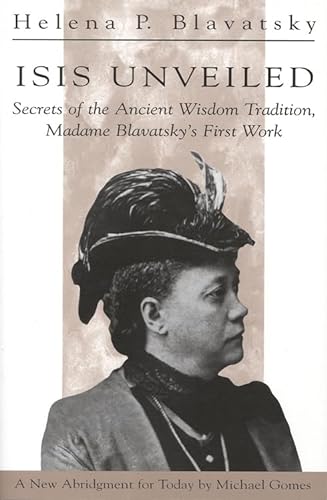
Creating a sensation when it was first published in 1877, the first major work by the young Russian noblewoman who would found the Theosophical Society devoted 1200 pages to the mysteries of ancient and modern science and theology. This new edition abridged by Theosophical scholar Michael Gomes breathes fresh life into this classic of Western esoteric thinking. Stripped of its lengthy quotations from other writers and its repetitious commentary, Isis Unveiled is revealed to be a clear and readable exploration of the universal truths of the Ancient Wisdom Tradition by one of the most remarkable women of modern times.
Die Inhaltsangabe kann sich auf eine andere Ausgabe dieses Titels beziehen.
Über die Autorin bzw. den Autor
Helena Petrovna Blavatsky was born on August 12, 1831, at Dnepropetrovsk (Ekaterinoslav), Ukraine, daughter of Colonel Peter Alexeyevich von Hahn and novelist Helena Andreyevna (née de Fadeyev). In 1849 she married N. V. Blavatsky, and shortly thereafter began more than 20 years of extensive travel, which brought her into contact with mystic traditions the world over. She was the principal founder of the Theosophical Society in New York City in 1875, and devoted her extraordinary literary talents to its humanitarian and educational purposes until her death in London, England, on May 8, 1891. Along with writing her several books, H. P. Blavatsky kept up a voluminous correspondence and also contributed a steady stream of essays and articles to periodicals in English, French, and Russian.
Von der hinteren Coverseite
Isis Unveiled created a sensation when it was first published in 1877. The first major work by the young Russian noblewoman who founded The Theosophical Society, its 1200 pages explored "the mysteries of ancient and modern science and theology". This new abridgment by Theosophical scholar Michael Gomes breathes fresh life into this classic of Western esoteric thinking. With its central themes highlighted and its style modernized for today's readers, Isis Unveiled is revealed as a fascinating exploration of the universal truths of the Ancient Wisdom Tradition by one of the most remarkable women of modern times.
Auszug. © Genehmigter Nachdruck. Alle Rechte vorbehalten.
Isis Unveiled
Secrets of the Ancient Wisdom Tradition, Madame Blavatsky's First Work
By Helena P. BlavatskyTheosophical Publishing House
Copyright © 1972 Theosophical Publishing House
All rights reserved.
ISBN: 978-0-8356-0729-2All rights reserved.
Contents
Publisher's Foreword,
Foreword,
Preface,
Part One: Science,
1. Old Things with New Names,
2. Phenomena and Forces,
3. Theories Respecting Psychic Phenomena,
4. The Ether or "Astral Light",
5. Psychophysical Phenomena,
6. The Elements, Elementals, and Elementaries,
7. Some Mysteries of Nature,
8. Cyclic Phenomena,
9. The Inner and Outer Man,
10. Psychological and Physical Marvels,
11. The "Impassable Chasm",
12. Realities and Illusion,
13. Egyptian Wisdom,
14. India: The Cradle of the Race,
Part Two: Religion,
15. The Church: Where Is It?,
16. Christian Crimes and Heathen Virtues,
17. Divisions among the Early Christians,
18. Oriental Cosmogonies and Bible Records,
19. Mysteries of the Kabbala,
20. Esoteric Doctrines of Buddhism Parodied in Christianity,
21. Early Christian Heresies and Secret Societies,
22. Jesuitry and Masonry,
23. The Vedas and the Bible,
24. The Devil Myth,
25. Comparative Results of Buddhism and Christianity,
26. Conclusions and Illustrations,
CHAPTER 1
Old Things with New Names
There exists somewhere in this wide world an old book—so very old that our modern antiquarians might ponder over its pages an indefinite time and still not quite agree as to the nature of the fabric upon which it is written. It is the only original copy now in existence. The most ancient Hebrew document on occult learning—the Sifra di-Tseniuta [Book of Concealed Mystery]—was compiled from it, and that at a time when the former was already considered in the light of a literary relic. One of its illustrations represents the Divine Essence emanating from ADAM like a luminous arc proceeding to form a circle; and then, having attained the highest point of its circumference, the ineffable Glory bends back again and returns to earth, bringing a higher type of humanity in its vortex. As it approaches nearer and nearer to our planet, the Emanation becomes more and more shadowy, until upon touching the ground it is as black as night.
A conviction, founded upon seventy thousand years of experience, as they allege, has been entertained by Hermetic philosophers of all periods that matter has in time become, through sin, more gross and dense than it was at man's first formation; that, at the beginning, the human body was of a half-ethereal nature; and that, before the fall, mankind communed freely with the now unseen universes. But since that time matter has become the formidable barrier between us and the world of spirits. The oldest esoteric traditions also teach that, before the mystic Adam, many races of human beings lived and died out, each giving place in its turn to another.
As the cycle proceeded, man's eyes were more and more opened, until he came to know "good and evil" as well as the Elohim themselves. Having reached its summit, the cycle began to go downward. When the arc attained a certain point which brought it parallel with the fixed line of our terrestrial plane, the man was furnished by nature with "coats of skin," and the Lord God "clothed them."
This same belief in the preexistence of a far more spiritual race than the one to which we now belong can be traced back to the earliest traditions of nearly every people. In the ancient Quiché manuscript—the Popol Vuh—the first men are mentioned as a race that could reason and speak, whose sight was unlimited, and who knew all things at once. According to Philo Judaeus [De gigantibus 2], the air is filled with an invisible host of spirits, some of whom are free from evil and immortal, and others are pernicious and mortal. "From the sons of EL we are descended, and sons of EL must we become again." And the unequivocal statement of the anonymous Gnostic who wrote the Gospel according to John (1.12) that "as many as received Him," i.e., who followed practically the esoteric doctrine of Jesus, would "become the sons of God" points to the same belief. "Know ye not, ye are gods?" exclaimed the Master. Plato describes admirably in Phaedrus [246C] the state in which man once was and what he will become again, before and after the "loss of his wings," when "he lived among the gods, a god himself in the airy world." From the remotest periods, religious philosophies taught that the whole universe was filled with divine and spiritual beings of diverse races. From one of these evolved, in the course of time, ADAM, the primitive man.
The discoveries of modern science do not disagree with the oldest traditions, which claim an incredible antiquity for our race. Within the last few years geology, which previously had only conceded that man could be traced as far back as the tertiary period, has found unanswerable proofs that human existence antedates the last glaciation of Europe—over 250,000 years! A hard nut, this, for patristic theology to crack, but an accepted fact with the ancient philosophers.
Moreover, fossil implements have been exhumed together with human remains, which show that man hunted in those remote times and knew how to build a fire. But the forward step has not yet been taken in this search for the origin of the race; science comes to a dead stop and waits for future proofs. Neither geologists nor archaeologists are able to construct, from the fragmentary bits hitherto discovered, the perfect skeleton of the triple man—physical, intellectual, and spiritual. Because the fossil implements of man are found to become more rough and uncouth as geology penetrates deeper into the bowels of the earth, it seems a proof to science that the closer we come to the origin of man, the more savage and brutelike he must be. Strange logic! Does the finding of the remains in the cave of Devon prove that there were no contemporary races then who were highly civilized? When the present population of the earth have disappeared, and some archaeologist belonging to the "coming race" of the distant future shall excavate the domestic implements of one of our Indian or Andaman Island tribes, will he be justified in concluding that mankind in the nineteenth century was "just emerging from the Stone Age"?
Whether arrived at by the method of Aristotle, or that of Plato, we need not stop to inquire; but it is a fact that both the inner and outer natures of man are claimed to have been thoroughly understood by the ancient aerologists. Notwithstanding the superficial hypotheses of geologists, we are beginning to have almost daily proofs in corroboration of the assertions of those philosophers.
They divided the interminable periods of human existence on this planet into cycles, during each of which mankind gradually reached the culminating point of highest civilization and gradually relapsed into abject barbarism. To what eminence the race in its progress had several times arrived may be feebly surmised by the wonderful monuments of old, still visible, and the descriptions given by Herodotus of other marvels of which no traces now remain. Even in his day the gigantic structures of many pyramids and world-famous temples were but masses of ruins. Scattered by the unrelenting hand of time, they are described by the Father of History as "these venerable witnesses of the long...
„Über diesen Titel“ kann sich auf eine andere Ausgabe dieses Titels beziehen.
Suchergebnisse für Isis Unveiled: Secrets of the Ancient Wisdom Tradition,...

Beispielbild für diese ISBN
Isis Unveiled: Secrets of the Ancient Wisdom Tradition, Madame Blavatsky's First Work
Anbieter: World of Books (was SecondSale), Montgomery, IL, USA
Verkäuferbewertung 5 von 5 Sternen

Paperback. Zustand: Very Good. Creating a sensation when it was first published in 1877, the first major work by the young Russian noblewoman who would found the Theosophical Society devoted 1200 pages to the mysteries of ancient and modern science and theology. This new edition abridged by Theosophical scholar Michael Gomes breathes fresh life into this classic of Western esoteric thinking. Stripped of its lengthy quotations from other writers and its repetitious commentary, Isis Unveiled is revealed to be a clear and readable exploration of the universal truths of the Ancient Wisdom Tradition by one of the most remarkable women of modern times. Artikel-Nr. 00108378526
Gebraucht kaufen
EUR 6,58
Versand gratis
Versand innerhalb von USA
Versand innerhalb von USA
Anzahl: 3 verfügbar
Beispielbild für diese ISBN
Isis Unveiled: Secrets of the Ancient Wisdom Tradition, Madame Blavatsky's First Work
Anbieter: World of Books (was SecondSale), Montgomery, IL, USA
Verkäuferbewertung 5 von 5 Sternen
Paperback. Zustand: Fair. Creating a sensation when it was first published in 1877, the first major work by the young Russian noblewoman who would found the Theosophical Society devoted 1200 pages to the mysteries of ancient and modern science and theology. This new edition abridged by Theosophical scholar Michael Gomes breathes fresh life into this classic of Western esoteric thinking. Stripped of its lengthy quotations from other writers and its repetitious commentary, Isis Unveiled is revealed to be a clear and readable exploration of the universal truths of the Ancient Wisdom Tradition by one of the most remarkable women of modern times. Artikel-Nr. 00109392920
Gebraucht kaufen
EUR 6,58
Versand gratis
Versand innerhalb von USA
Versand innerhalb von USA
Anzahl: 1 verfügbar
Beispielbild für diese ISBN
Isis Unveiled: Secrets of the Ancient Wisdom Tradition, Madame Blavatsky's First Work
Anbieter: World of Books (was SecondSale), Montgomery, IL, USA
Verkäuferbewertung 5 von 5 Sternen
Paperback. Zustand: Good. Creating a sensation when it was first published in 1877, the first major work by the young Russian noblewoman who would found the Theosophical Society devoted 1200 pages to the mysteries of ancient and modern science and theology. This new edition abridged by Theosophical scholar Michael Gomes breathes fresh life into this classic of Western esoteric thinking. Stripped of its lengthy quotations from other writers and its repetitious commentary, Isis Unveiled is revealed to be a clear and readable exploration of the universal truths of the Ancient Wisdom Tradition by one of the most remarkable women of modern times. Artikel-Nr. 00109990559
Gebraucht kaufen
EUR 6,58
Versand gratis
Versand innerhalb von USA
Versand innerhalb von USA
Anzahl: 1 verfügbar
Beispielbild für diese ISBN
Isis Unveiled: Secrets of the Ancient Wisdom Tradition, Madame Blavatsky's First Work
Anbieter: Books From California, Simi Valley, CA, USA
Verkäuferbewertung 4 von 5 Sternen

Paperback. Zustand: Very Good. Artikel-Nr. mon0004244873
Gebraucht kaufen
EUR 5,24
EUR 4,46 Versand
Versand innerhalb von USA
Versand innerhalb von USA
Anzahl: 1 verfügbar
Beispielbild für diese ISBN
Isis Unveiled : Secrets of the Ancient Wisdom Tradition, Madame Blavatsky's First Work
Verlag:
Theosophical Publishing House, 1997
ISBN 10: 0835607291
ISBN 13: 9780835607292
Gebraucht
Softcover
Anbieter: Better World Books, Mishawaka, IN, USA
Verkäuferbewertung 5 von 5 Sternen
Zustand: Very Good. Pages intact with possible writing/highlighting. Binding strong with minor wear. Dust jackets/supplements may not be included. Stock photo provided. Product includes identifying sticker. Better World Books: Buy Books. Do Good. Artikel-Nr. 4815027-20
Gebraucht kaufen
EUR 10,39
Versand gratis
Versand innerhalb von USA
Versand innerhalb von USA
Anzahl: 1 verfügbar
Beispielbild für diese ISBN
Isis Unveiled: Secret of the Ancient Wisdom Tradition - Madame Blavatsky's First Work
Anbieter: WorldofBooks, Goring-By-Sea, WS, Vereinigtes Königreich
Verkäuferbewertung 5 von 5 Sternen
Paperback. Zustand: Very Good. The book has been read, but is in excellent condition. Pages are intact and not marred by notes or highlighting. The spine remains undamaged. Artikel-Nr. GOR004671622
Gebraucht kaufen
EUR 14,58
EUR 6,62 Versand
Versand von Vereinigtes Königreich nach USA
Versand von Vereinigtes Königreich nach USA
Anzahl: 2 verfügbar
Beispielbild für diese ISBN
Isis Unveiled
Anbieter: PBShop.store UK, Fairford, GLOS, Vereinigtes Königreich
Verkäuferbewertung 5 von 5 Sternen
PAP. Zustand: New. New Book. Delivered from our UK warehouse in 4 to 14 business days. Established seller since 2000. Artikel-Nr. WB-9780835607292
Neu kaufen
EUR 18,28
EUR 5,93 Versand
Versand von Vereinigtes Königreich nach USA
Versand von Vereinigtes Königreich nach USA
Anzahl: 15 verfügbar
Beispielbild für diese ISBN
Isis Unveiled: Secrets of the Ancient Wisdom Tradition, Madame Blavatsky's First Work
Anbieter: Revaluation Books, Exeter, Vereinigtes Königreich
Verkäuferbewertung 5 von 5 Sternen
Paperback. Zustand: Brand New. abridged edition. 274 pages. 9.25x6.25x0.75 inches. In Stock. Artikel-Nr. __0835607291
Neu kaufen
EUR 16,69
EUR 11,82 Versand
Versand von Vereinigtes Königreich nach USA
Versand von Vereinigtes Königreich nach USA
Anzahl: 2 verfügbar
Beispielbild für diese ISBN
Isis Unveiled: Secrets of the Ancient Wisdom Tradition, Madame Blavatsky's First Work
Anbieter: Revaluation Books, Exeter, Vereinigtes Königreich
Verkäuferbewertung 5 von 5 Sternen
Paperback. Zustand: Brand New. abridged edition. 274 pages. 9.25x6.25x0.75 inches. In Stock. Artikel-Nr. xr0835607291
Neu kaufen
EUR 21,38
EUR 11,82 Versand
Versand von Vereinigtes Königreich nach USA
Versand von Vereinigtes Königreich nach USA
Anzahl: 2 verfügbar
Beispielbild für diese ISBN
Isis Unveiled: Secrets of the Ancient Wisdom Tradition, Madame Blavatsky's First Work
Verlag:
Theosophical Publishing House, 1997
ISBN 10: 0835607291
ISBN 13: 9780835607292
Neu
Softcover
Anbieter: Majestic Books, Hounslow, Vereinigtes Königreich
Verkäuferbewertung 4 von 5 Sternen
Zustand: New. Artikel-Nr. 7906127
Neu kaufen
EUR 25,59
EUR 7,68 Versand
Versand von Vereinigtes Königreich nach USA
Versand von Vereinigtes Königreich nach USA
Anzahl: 3 verfügbar