
Verwandte Artikel zu Theological Reflection: Connecting Faith and Life (Catholic...
Theological Reflection: Connecting Faith and Life (Catholic Basics) - Softcover
Buch 6 von 8: Catholic Basics: A Pastoral Ministry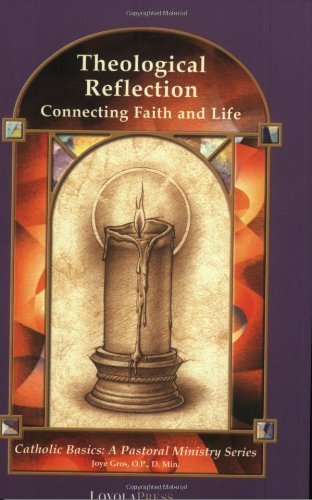
Inhaltsangabe
Many people today are asking the “meaning-making” questions. We want our lives to have meaning. We want to know how our faith informs our work life, how our family life enhances our spirituality, and how we can feel less fragmented and more whole. These are the spiritual questions of life. They are wisdom-seeking invitations stirring within the depths of our souls. These are the hungers that theological reflection can help feed.
This book offers an understanding of theological reflection—a model and a method. It will not only illustrate how readers may use theological reflection in their own spiritual development but will also show how to facilitate the process with others.
—From the introduction
This book offers an understanding of theological reflection—a model and a method. It will not only illustrate how readers may use theological reflection in their own spiritual development but will also show how to facilitate the process with others.
—From the introduction
In Theological Reflection: Connecting Faith and Life, principles of theological reflection are presented to help the believer connect faith teaching and life. Catholic Basics: A Pastoral Ministry Series offers an in-depth yet accessible understanding of the fundamentals of the Catholic faith for adults, both those active in pastoral ministry and those preparing for ministry. The series helps readers explore the Catholic tradition and apply what they have learned to their lives and ministry situations. Includes study questions and suggestions for further reading.
Die Inhaltsangabe kann sich auf eine andere Ausgabe dieses Titels beziehen.
Über die Autorin bzw. den Autor
Joye Gros, OP, holds a Doctor of Ministry degree from St. Mary of the Lake University and a Master's in Religious Education from Seattle University. Her ministerial experience includes elementary education and service as director of religious education, and pastoral associate. Joye has both directed and trained directors and catechists for the Rite of Christian Initiation of Adults. Since 1992, she has served as an educational asssociate for Development in Ministry, Archdiocese of Chicago. She developed training programs for ministers of care, bereavement ministers, and catechists. Joye taught in the Diocese of Joliet Pastoral Leadership Program and facilitated the formation component of the Institute for Spiritual Companionship. She devotes high interest and energy to ministry formation, group facilitation, retreats, and days of reflection. Joye is a Dominican Sister of St. Catharine, Kentucky, and presently serves on her community's governing board.
Von der hinteren Coverseite
Catholic Basics:
A Pastoral Ministry Series
Many people today are asking the “meaning-making” questions. We want our lives to have meaning. We want to know how our faith informs our work life, how our family life enhances our spirituality, and how we can feel less fragmented and more whole. These are the spiritual questions of life. They are wisdom-seeking invitations stirring within the depths of our souls. These are the hungers that theological reflection can help feed.
This book offers an understanding of theological reflection—a model and a method. It will not only illustrate how readers may use theological reflection in their own spiritual development but will also show how to facilitate the process with others.
—From the introduction
A Pastoral Ministry Series
Many people today are asking the “meaning-making” questions. We want our lives to have meaning. We want to know how our faith informs our work life, how our family life enhances our spirituality, and how we can feel less fragmented and more whole. These are the spiritual questions of life. They are wisdom-seeking invitations stirring within the depths of our souls. These are the hungers that theological reflection can help feed.
This book offers an understanding of theological reflection—a model and a method. It will not only illustrate how readers may use theological reflection in their own spiritual development but will also show how to facilitate the process with others.
—From the introduction
Auszug. © Genehmigter Nachdruck. Alle Rechte vorbehalten.
About the Series
Catholic Basics: A Pastoral Ministry Series offers an in-depth yet accessible understanding of the fundamentals of the Catholic faith for adults, both those preparing for lay ministry and those interested in the topics for their own personal growth. The series helps readers explore the Catholic tradition and apply what they have learned to their lives and ministry situations. Each title offers a reliable introduction to a specific topic and provides a foundational understanding of the concepts.
Each book in the series presents a Catholic understanding of its topic as found in Scripture and the teachings of the Church. Each of the authors has paid special attention to the documents of the Second Vatican Council and the Catechism of the Catholic Church, so that further learning can be guided by these core resources.
Chapters conclude with study questions that may be used for small group review or for individual reflection. Additionally, suggestions for further reading offer dependable guides for extra study.
The initiative of the National Conference of Catechetical Leadership led to the development of an earlier version of this series. The indispensable contribution of the series editor, Dr. Thomas Walters, helped ensure that the concepts and ideas presented here are easily accessible to a wide audience.
Certification Standards: National Resources for Church Ministry
Each book in this theology series relates to standards for theological competency identified in the resources listed below. Three national church ministry organizations provide standards for certification programs that serve their respective ministries. The standards were developed in collaboration with the United States Catholic Conference Commission on Certification and Accreditation. The fourth resource is the latest document, developed to identify common goals of the three sets of standards.
Competency Based Certification Standards for Pastoral Ministers, Pastoral Associates and Parish Life Coordinators. Chicago: National Association for Lay Ministry, Inc. (NALM), 1994.
These standards address three roles found in pastoral ministry settings in the United States. They were the earliest to receive approval from the United States Catholic Conference Commission on Certification and Accreditation. Copies are available from the National Association for Lay Ministry, 5420 S. Cornell, Chicago, IL 60615-5604.
National Certification Standards for Professional Parish Directors of Religious Education. Washington, DC: National Conference for Catechetical Leadership, 1998.
NCCL developed standards to foster appropriate initial education and formation, as well as continuing personal and professional development, of those who serve as directors of religious education (DREs). The standards address various areas of knowledge and abilities needed in the personal, theological, and professional aspects of the ministry. Also included is a code of ethics for professional catechetical
leaders. Available from the National Conference of Catechetical Leadership, 3021 Fourth Street NE, Washington, DC 20017-1102.
NFCYM Competency-Based Standards for the Coordinator of Youth Ministry. Washington, DC: National Federation for Catholic Youth Ministry, 1996.
This document lays out the wide range of knowledge and skills that support ministry with young people, as well as the successful leadership and organization of youth ministry wherever it may be situated. The standards are available from the National Federation for Catholic Youth Ministry, 415 Michigan Avenue NE, Suite 40, Washington, DC 20017-1518.
Merkt, Joseph T., ed. Common Formation Goals for Ministry. A joint publication of NALM, NFCYM, and NCCL, 2000.
Rev. Joseph Merkt compared the documentation of standards cited by three national organizations serving pastoral, youth, and catechetical ministries. The resulting statement of common goals identifies common ground for those who prepare persons for ministry, as well as for the many who wear multiple hats. Copies are available from NALM, NCCL, or NFCYM.
Preface
I first recognize my brother, Jeff Gros, FSC, who got me into this project. He recommended me to Tom Walters, the series editor, and thus began this journey of articulating a sacred process. Next I thank Margaret Rose Curry, OP, who tediously and tirelessly edited every comma, phrase, and sentence structure. Jean Bohr, D Min, watched for clarity and content flow, and encouraged me each and every step along the way. Barbara Flynn, Lois McGovern, OP, and Teresa Tuite, OP, began with encouragement and support and didn’t let up until I finished. I have been blessed with cheerleaders, coaches, and confidence builders. Last, but certainly not least, I thank Tom Walters, who provided the framework and direction to keep me on track. This has, indeed, been a blessed journey. May those who read and reflect on this book be graced by the same sacred stirrings that have given birth to this endeavor. We do know the Source of life and creativity. It was a pleasure to partner in the dance of creation.
Introduction
Several years ago friends of mine gave me snorkeling equipment to take on my vacation. I hesitated, as the flippers, hoses, and face masks were cumbersome and awkward to pack. I could not imagine that anything as interesting as snorkeling would require such inconvenience. It seemed a great deal of trouble just to put my face in the water! Wouldn’t plain old goggles do?
Perhaps it was because my friends were so convincing about the fun of snorkeling or, more likely, because I did not know how to say no in the face of their generosity—whatever the reason, I packed the equipment. It sat in the hotel room for several days, however, because I just didn’t want to haul it to the beach each day. I had towels, chairs, incrementally graded sunscreen, books, hats, the ever-present water bottle, and so on.
Then one day there was an offer: A boat would take me offshore to snorkel. I would be given equipment, taught the technique, and taken into deep coastal waters which offered incredible underwater vistas. Well, I thought, if I am going to do this at all, I probably should learn how.
My friend and I climbed aboard a tour boat, and off we went into the wild blue ocean. Fitted with fins and face masks, we learned the basics of breathing in the mask. We were taught how to get in and out of the boat and told what we might see. I adjusted my equipment, descended the ladder, and positioned myself for my first look.
I was startled! I was amazed! I was in awe! It was like looking into a huge tropical fish aquarium. I was caught between wanting to surface to say, “Wow! Look at that!” and wanting to stay transfixed to the technicolor show that was taking place before my very eyes.
Needless to say, the gear got used! I was converted. I was transformed. I was a “preacher” of the “good news” of snorkeling!
Each day we would go to the beach at sunset. I could spend hours just looking at the horizon and marveling at the beauty, its constancy, and its flow. And I never forgot what I learned from snorkeling: No matter how beautiful the surface is—and it is—looking beneath it reveals a whole new world. Its beauty and depth is invisible to the eye unless you take the time, put your face in the water, and take a gander. If you do, you are gifted with incredible sight and insight!
For me, snorkeling has become an image of theological reflection—the attempt to see deeply into life experiences. Theological reflection provides the framework that helps us see the connection between the surface and the depths of life’s meanings. It encourages us to recognize the intimate connection between faith and daily life.
Many people today are asking the...
Catholic Basics: A Pastoral Ministry Series offers an in-depth yet accessible understanding of the fundamentals of the Catholic faith for adults, both those preparing for lay ministry and those interested in the topics for their own personal growth. The series helps readers explore the Catholic tradition and apply what they have learned to their lives and ministry situations. Each title offers a reliable introduction to a specific topic and provides a foundational understanding of the concepts.
Each book in the series presents a Catholic understanding of its topic as found in Scripture and the teachings of the Church. Each of the authors has paid special attention to the documents of the Second Vatican Council and the Catechism of the Catholic Church, so that further learning can be guided by these core resources.
Chapters conclude with study questions that may be used for small group review or for individual reflection. Additionally, suggestions for further reading offer dependable guides for extra study.
The initiative of the National Conference of Catechetical Leadership led to the development of an earlier version of this series. The indispensable contribution of the series editor, Dr. Thomas Walters, helped ensure that the concepts and ideas presented here are easily accessible to a wide audience.
Certification Standards: National Resources for Church Ministry
Each book in this theology series relates to standards for theological competency identified in the resources listed below. Three national church ministry organizations provide standards for certification programs that serve their respective ministries. The standards were developed in collaboration with the United States Catholic Conference Commission on Certification and Accreditation. The fourth resource is the latest document, developed to identify common goals of the three sets of standards.
Competency Based Certification Standards for Pastoral Ministers, Pastoral Associates and Parish Life Coordinators. Chicago: National Association for Lay Ministry, Inc. (NALM), 1994.
These standards address three roles found in pastoral ministry settings in the United States. They were the earliest to receive approval from the United States Catholic Conference Commission on Certification and Accreditation. Copies are available from the National Association for Lay Ministry, 5420 S. Cornell, Chicago, IL 60615-5604.
National Certification Standards for Professional Parish Directors of Religious Education. Washington, DC: National Conference for Catechetical Leadership, 1998.
NCCL developed standards to foster appropriate initial education and formation, as well as continuing personal and professional development, of those who serve as directors of religious education (DREs). The standards address various areas of knowledge and abilities needed in the personal, theological, and professional aspects of the ministry. Also included is a code of ethics for professional catechetical
leaders. Available from the National Conference of Catechetical Leadership, 3021 Fourth Street NE, Washington, DC 20017-1102.
NFCYM Competency-Based Standards for the Coordinator of Youth Ministry. Washington, DC: National Federation for Catholic Youth Ministry, 1996.
This document lays out the wide range of knowledge and skills that support ministry with young people, as well as the successful leadership and organization of youth ministry wherever it may be situated. The standards are available from the National Federation for Catholic Youth Ministry, 415 Michigan Avenue NE, Suite 40, Washington, DC 20017-1518.
Merkt, Joseph T., ed. Common Formation Goals for Ministry. A joint publication of NALM, NFCYM, and NCCL, 2000.
Rev. Joseph Merkt compared the documentation of standards cited by three national organizations serving pastoral, youth, and catechetical ministries. The resulting statement of common goals identifies common ground for those who prepare persons for ministry, as well as for the many who wear multiple hats. Copies are available from NALM, NCCL, or NFCYM.
Preface
I first recognize my brother, Jeff Gros, FSC, who got me into this project. He recommended me to Tom Walters, the series editor, and thus began this journey of articulating a sacred process. Next I thank Margaret Rose Curry, OP, who tediously and tirelessly edited every comma, phrase, and sentence structure. Jean Bohr, D Min, watched for clarity and content flow, and encouraged me each and every step along the way. Barbara Flynn, Lois McGovern, OP, and Teresa Tuite, OP, began with encouragement and support and didn’t let up until I finished. I have been blessed with cheerleaders, coaches, and confidence builders. Last, but certainly not least, I thank Tom Walters, who provided the framework and direction to keep me on track. This has, indeed, been a blessed journey. May those who read and reflect on this book be graced by the same sacred stirrings that have given birth to this endeavor. We do know the Source of life and creativity. It was a pleasure to partner in the dance of creation.
Introduction
Several years ago friends of mine gave me snorkeling equipment to take on my vacation. I hesitated, as the flippers, hoses, and face masks were cumbersome and awkward to pack. I could not imagine that anything as interesting as snorkeling would require such inconvenience. It seemed a great deal of trouble just to put my face in the water! Wouldn’t plain old goggles do?
Perhaps it was because my friends were so convincing about the fun of snorkeling or, more likely, because I did not know how to say no in the face of their generosity—whatever the reason, I packed the equipment. It sat in the hotel room for several days, however, because I just didn’t want to haul it to the beach each day. I had towels, chairs, incrementally graded sunscreen, books, hats, the ever-present water bottle, and so on.
Then one day there was an offer: A boat would take me offshore to snorkel. I would be given equipment, taught the technique, and taken into deep coastal waters which offered incredible underwater vistas. Well, I thought, if I am going to do this at all, I probably should learn how.
My friend and I climbed aboard a tour boat, and off we went into the wild blue ocean. Fitted with fins and face masks, we learned the basics of breathing in the mask. We were taught how to get in and out of the boat and told what we might see. I adjusted my equipment, descended the ladder, and positioned myself for my first look.
I was startled! I was amazed! I was in awe! It was like looking into a huge tropical fish aquarium. I was caught between wanting to surface to say, “Wow! Look at that!” and wanting to stay transfixed to the technicolor show that was taking place before my very eyes.
Needless to say, the gear got used! I was converted. I was transformed. I was a “preacher” of the “good news” of snorkeling!
Each day we would go to the beach at sunset. I could spend hours just looking at the horizon and marveling at the beauty, its constancy, and its flow. And I never forgot what I learned from snorkeling: No matter how beautiful the surface is—and it is—looking beneath it reveals a whole new world. Its beauty and depth is invisible to the eye unless you take the time, put your face in the water, and take a gander. If you do, you are gifted with incredible sight and insight!
For me, snorkeling has become an image of theological reflection—the attempt to see deeply into life experiences. Theological reflection provides the framework that helps us see the connection between the surface and the depths of life’s meanings. It encourages us to recognize the intimate connection between faith and daily life.
Many people today are asking the...
„Über diesen Titel“ kann sich auf eine andere Ausgabe dieses Titels beziehen.
Suchergebnisse für Theological Reflection: Connecting Faith and Life (Catholic...

Beispielbild für diese ISBN
Theological Reflection: Connecting Faith and Life (Catholic Basics: A Pastoral Ministry Series)
Anbieter: World of Books (was SecondSale), Montgomery, IL, USA
Verkäuferbewertung 5 von 5 Sternen

Zustand: Good. Item in good condition. Textbooks may not include supplemental items i.e. CDs, access codes etc. Artikel-Nr. 00100154838
Gebraucht kaufen
EUR 4,31
Versand gratis
Versand innerhalb von USA
Versand innerhalb von USA
Anzahl: 4 verfügbar
Beispielbild für diese ISBN
Theological Reflection: Connecting Faith and Life (Catholic Basics: A Pastoral Ministry Series)
Verlag:
Loyola Press (edition First Edition), 2001
ISBN 10: 0829417249
ISBN 13: 9780829417241
Gebraucht
Paperback
Erstausgabe
Anbieter: BooksRun, Philadelphia, PA, USA
Verkäuferbewertung 5 von 5 Sternen
Paperback. Zustand: Fair. First Edition. The item might be beaten up but readable. May contain markings or highlighting, as well as stains, bent corners, or any other major defect, but the text is not obscured in any way. Artikel-Nr. 0829417249-7-1
Gebraucht kaufen
EUR 4,32
Versand gratis
Versand innerhalb von USA
Versand innerhalb von USA
Anzahl: 1 verfügbar
Beispielbild für diese ISBN
Theological Reflection : Connecting Faith and Life
Anbieter: Better World Books, Mishawaka, IN, USA
Verkäuferbewertung 5 von 5 Sternen
Zustand: Good. 1 Edition. Pages intact with minimal writing/highlighting. The binding may be loose and creased. Dust jackets/supplements are not included. Stock photo provided. Product includes identifying sticker. Better World Books: Buy Books. Do Good. Artikel-Nr. 5306968-6
Gebraucht kaufen
EUR 5,97
Versand gratis
Versand innerhalb von USA
Versand innerhalb von USA
Anzahl: 1 verfügbar
Beispielbild für diese ISBN
Theological Reflection : Connecting Faith and Life
Anbieter: Better World Books, Mishawaka, IN, USA
Verkäuferbewertung 5 von 5 Sternen
Zustand: Very Good. 1 Edition. Pages intact with possible writing/highlighting. Binding strong with minor wear. Dust jackets/supplements may not be included. Stock photo provided. Product includes identifying sticker. Better World Books: Buy Books. Do Good. Artikel-Nr. 9398696-6
Gebraucht kaufen
EUR 5,97
Versand gratis
Versand innerhalb von USA
Versand innerhalb von USA
Anzahl: 1 verfügbar
Beispielbild für diese ISBN
Theological Reflection: Connecting Faith and Life (Catholic Basics: A Pastoral Ministry Series)
Anbieter: Wonder Book, Frederick, MD, USA
Verkäuferbewertung 5 von 5 Sternen
Zustand: Good. Good condition. A copy that has been read but remains intact. May contain markings such as bookplates, stamps, limited notes and highlighting, or a few light stains. Artikel-Nr. T09Q-00121
Gebraucht kaufen
EUR 6,21
Versand gratis
Versand innerhalb von USA
Versand innerhalb von USA
Anzahl: 1 verfügbar
Beispielbild für diese ISBN
Theological Reflection: Connecting Faith and Life (Catholic basics)
Verlag:
Loyola University Press,U.S., United States, Chicago, 2001
ISBN 10: 0829417249
ISBN 13: 9780829417241
Gebraucht
Paperback
Anbieter: WorldofBooks, Goring-By-Sea, WS, Vereinigtes Königreich
Verkäuferbewertung 5 von 5 Sternen
Paperback. Zustand: Very Good. The book has been read, but is in excellent condition. Pages are intact and not marred by notes or highlighting. The spine remains undamaged. Artikel-Nr. GOR002379542
Gebraucht kaufen
EUR 3,27
EUR 6,53 Versand
Versand von Vereinigtes Königreich nach USA
Versand von Vereinigtes Königreich nach USA
Anzahl: 3 verfügbar
Beispielbild für diese ISBN
Theological Reflection: Connecting Faith and Life (Catholic Basics: A Pastoral Ministry Series)
Verlag:
Loyola Press, 2001
ISBN 10: 0829417249
ISBN 13: 9780829417241
Gebraucht
Soft cover
Erstausgabe
Anbieter: Tall Stories BA, Stoneyford, Irland
Verkäuferbewertung 4 von 5 Sternen

Soft cover. Zustand: Very Good. 1st Edition. as new unused. Artikel-Nr. 2000018347
Gebraucht kaufen
EUR 4,80
EUR 12,00 Versand
Versand von Irland nach USA
Versand von Irland nach USA
Anzahl: 2 verfügbar
Beispielbild für diese ISBN
Theological Reflection: Connecting Faith and Life (Catholic Basics)
Verlag:
Loyola University Press,U.S., 2003
ISBN 10: 0829417249
ISBN 13: 9780829417241
Gebraucht
Soft cover
Erstausgabe
Anbieter: Tall Stories BA, Stoneyford, Irland
Verkäuferbewertung 4 von 5 Sternen
Soft cover. Zustand: Very Good. 1st Edition. very minor shelf wear only. Artikel-Nr. 2000024151
Gebraucht kaufen
EUR 4,80
EUR 12,00 Versand
Versand von Irland nach USA
Versand von Irland nach USA
Anzahl: 1 verfügbar
Beispielbild für diese ISBN
Theological Reflection: Connecting Faith and Life (Catholic Basics: A Pastoral Ministry Series)
Anbieter: Anybook.com, Lincoln, Vereinigtes Königreich
Verkäuferbewertung 5 von 5 Sternen
Zustand: Fair. This is an ex-library book and may have the usual library/used-book markings inside.This book has soft covers. In fair condition, suitable as a study copy. Please note the Image in this listing is a stock photo and may not match the covers of the actual item,200grams, ISBN:9780829417241. Artikel-Nr. 9178449
Gebraucht kaufen
EUR 3,20
EUR 15,86 Versand
Versand von Vereinigtes Königreich nach USA
Versand von Vereinigtes Königreich nach USA
Anzahl: 1 verfügbar
Beispielbild für diese ISBN
Theological Reflection: Connecting Faith and Life
Anbieter: Revaluation Books, Exeter, Vereinigtes Königreich
Verkäuferbewertung 5 von 5 Sternen
Paperback. Zustand: Brand New. 80 pages. 8.25x5.50x0.50 inches. In Stock. Artikel-Nr. 0829417249
Neu kaufen
EUR 26,19
EUR 11,66 Versand
Versand von Vereinigtes Königreich nach USA
Versand von Vereinigtes Königreich nach USA
Anzahl: 1 verfügbar