
Verwandte Artikel zu Teaching Peace: Students Exchange Letters with Their...
Inhaltsangabe
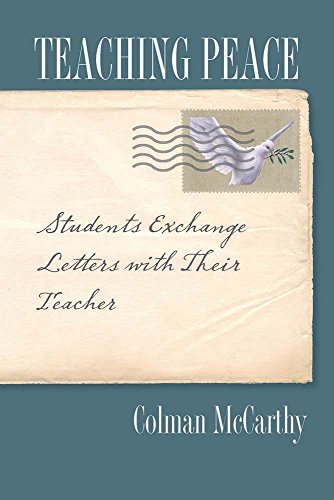
To see if nonviolence could be taught, in 1982 Colman McCarthy became a volunteer teacher at one of the poorest high schools in Washington, DC. In the thirty-two years since then, he has taught peace studies courses for more than ten thousand college and high school students. Large numbers of those students have faithfully kept in touch with McCarthy, often with handwritten letters, and he has answered them with the same seriousness he brought to his columns and books. The exchanges rise to a rare kind of literature that blends personal warmth, intellectual honesty, and shared idealism.
The discussions range from peace and war to a host of other issues of social justice, such as the death penalty, human rights, poverty, the living wage, animal rights, and vegetarianism. The wide-ranging letters suggest how teacher and students co-create a world of more love and less hate.
Die Inhaltsangabe kann sich auf eine andere Ausgabe dieses Titels beziehen.
Über die Autorin bzw. den Autor
Colman McCarthy, a syndicated columnist for the Washington Post for nearly thirty years, is the cofounder and director of The Center for Teaching Peace. He is the author of seven previous books and editor of three. His articles have appeared in The New Yorker, The New York Times, The Nation, The Progressive, The New Republic, The Atlantic, and National Catholic Reporter.
Auszug. © Genehmigter Nachdruck. Alle Rechte vorbehalten.
Teaching Peace
Students Exchange Letters with Their Teacher
By Colman McCarthyVanderbilt University Press
Copyright © 2015 Vanderbilt University Press
All rights reserved.
ISBN: 978-0-8265-2039-5All rights reserved.
Contents
Acknowledgments, ix,
Foreword by Patrick G. Coy, xi,
Preface, xv,
Letters, 1,
Index, 187,
CHAPTER 1
APRIL 10, 1990
Dear Mr. McCarthy,
There are two reasons for this letter. First, I have for some time followed your columns and have developed quite a respect for your abilities as a writer. That respect recently increased considerably when I opened my newest textbook to find a reproduction of your January 2, 1987, column. I read, instantly copied and almost as quickly memorized your list of 10 writing rules, promoted you to "mentor" from "writer-to-admire" and resolved to write you a letter gushing with praise and gratitude. I didn't write it because I soon doubted my ability to do so without violating one of more of the rules, and because there wasn't much to say except to announce myself as an amateur/admirer who aspires in her secret dreams to one day do what you do.
Well, that's one day. Today I am a midshipman at the United States Naval Academy, aspiring to the service of my country, and that, combined with a more recent column, is why I am writing now.
Sir, you have some crazy ideas about women and war. Rule #1: "say what you mean." In your January 14 column you said: "War is a male ritual based on a hyper-masculine ethic that violence is rational. Linda Bray in Panama [the first woman to lead US troops in combat, during the US invasion in 1983] was less a victory for female rights than for male wrongs. She bought into traditional masculinism: fists, guns, armies and killing are sensible solutions to problems."
As far as I can determine, the main thrust of your column is that "war is bad." Sir, I certainly do not disagree. I completely respect your right to be as anti-war and anti-military as you like. However, as a woman in the military, I take great offense at your using the premise that "war is bad" as a launching pad from which to attack Capt. Bray for doing her job. I agree that her role in the conflict—and the fact that she performed her job in a combat capacity—has been overplayed. But I would hardly accuse her of "leading the charge up Mt. Equality." She followed her orders, nothing more.
I cannot speak for Capt. Bray or for all women in the military. I only speak for myself. And you made several assumptions about me that I would like the opportunity to correct. By being in the military wearing a uniform and serving my country, I am not "buying into traditional masculinism," as you put it. I do not believe any more than you that "fists, guns, armies and killing are sensible solutions to problems." And no, I do not believe that Capt. Bray simply accomplishing her given mission provides eternally irrefutable proof that men and women should be side by side in the trenches forevermore. I am, however, unlike you, very much in support of Rep. Pat Schroeder's legislative proposal. Her proposed bill would allow a period of testing for combat roles for women. The issue of women in combat is not going to disappear, and Rep. Schroeder's bill is the first positive step I have seen anyone take toward resolving it.
I don't know the answers. The arguments you and several others have presented against women in combat are valid ones. But the "license to rape" issue that you mention is a problem of war and not a problem of women in war. The solution you offer in your column is the "abolition" of war, and frankly I'm all for that. However, while you columnists and politicians in Washington are working on that one, as a young woman about to become a military officer, I'd like to see more constructive work toward resolving our continuing problems of integration and less pointless prattle about the inequality of the sexes.
There are countless combat roles that women can do as well as men. I can learn to fly an F-14 as effectively as any of my classmates, but at the same time I am under no illusions about my physical limitations in other roles. I appreciate that my male counterpart can run faster and jump higher with a 20-pound pack on his back, and is therefore much better suited to certain combat roles. I am not asking for that kind of "job equality." Like most women in the military I would not want a job that physical limitations would prevent me from doing well. On the contrary, I hope that when the time comes, Congress does not prevent me from doing the job I have been trained to do, as Capt. Bray did in Panama. It cannot longer be a question whether or not women are capable of firing the guns, flying the planes, driving the ships and leading the troops. The question remaining is whether or not America is ready to accept that equality and begin to take advantage of the full resources of military women.
I'm honestly not sure if this country is ready. I am however more than ready to find out, and so is Rep. Pat Schroeder.
Why aren't you?
Sincerely,
Tara Lee
APRIL 15, 1990
Dear Tara,
Half a ton of thanks for your letter, and a full ton for its impassioned language. When I was in college I dreamed, as you do now, of earning a living as a writer. Plenty of room is available for you in this calling, even if you have to call yourself, which is fine because usually no one will or should.
You're right that the "main thrust" of my column was, in your words, "war is bad." If you agree with that, as you say you do, why are you in a school dedicated to war preparation? The Naval Academy has its portion of quality professors, some of whom I came to know when I was invited to speak in writing classes. Many of the students have as high ideals as those in the classes I teach at the University of Maryland and Georgetown Law.
None of that alters what you are being trained to do: kill people and destroy property if the order is given. "Aspiring to the service of my country" is a pseudo-patriotic slogan. When commissioned, you won't be serving your country, you'll be serving those who run the country. A large difference. In The Kingdom of God Is Within You, Leo Tolstoy wrote, "Government is an association of men who do violence to the rest of us." Why serve those men? Government-sanctioned slaughter, otherwise known as war, has caused the deaths of eight million people in this century. Some 40,000 are killed a month in current wars and conflicts. Last December between 1,000 and 4,000 people were killed in the US invasion of Panama. The Pentagon doesn't know or care how many Panamanian civilians were killed, hence the estimates of between 1,000 and 4,000. Instead of a national debate on the morality of sending any US soldier—male or female—to slaughter Panamanians, the triviality of women's role in combat has been the preoccupation.
It's beneath both of us to be sucked into it. What we should be doing, instead, is examining our consciences to be as certain as possible that we are using our time and energy to decrease the violence of war. How is that done? By acting, in our personal and professional lives, on what David Dellinger said on entering prison in 1943 [as a conscientious objector]: "Very few people choose war. They choose selfishness and the result is war. Each of us, individually and nationally, must choose: total love or total war."
We are what we choose.* Perhaps my choices are flawed and someday I will come to my senses and abandon what you call my "crazy ideas."...
„Über diesen Titel“ kann sich auf eine andere Ausgabe dieses Titels beziehen.
Suchergebnisse für Teaching Peace: Students Exchange Letters with Their...

Beispielbild für diese ISBN
Teaching Peace: Students Exchange Letters with Their Teacher
Verlag:
Vanderbilt University Press, 2015
ISBN 10: 0826520391
ISBN 13: 9780826520395
Gebraucht
Paperback
Anbieter: World of Books (was SecondSale), Montgomery, IL, USA
Verkäuferbewertung 5 von 5 Sternen

Paperback. Zustand: Good. To see if nonviolence could be taught, in 1982 Colman McCarthy became a volunteer teacher at one of the poorest high schools in Washington, DC. In the thirty-two years since then, he has taught peace studies courses for more than ten thousand college and high school students. Large numbers of those students have faithfully kept in touch with McCarthy, often with handwritten letters, and he has answered them with the same seriousness he brought to his columns and books. The exchanges rise to a rare kind of literature that blends personal warmth, intellectual honesty, and shared idealism.The discussions range from peace and war to a host of other issues of social justice, such as the death penalty, human rights, poverty, the living wage, animal rights, and vegetarianism. The wide-ranging letters suggest how teacher and students co-create a world of more love and less hate. Artikel-Nr. 00107233174
Gebraucht kaufen
EUR 4,58
Versand gratis
Versand innerhalb von USA
Versand innerhalb von USA
Anzahl: 1 verfügbar
Beispielbild für diese ISBN
Teaching Peace: Students Exchange Letters with Their Teacher
Verlag:
Vanderbilt University Press, 2015
ISBN 10: 0826520391
ISBN 13: 9780826520395
Gebraucht
Paperback
Anbieter: World of Books (was SecondSale), Montgomery, IL, USA
Verkäuferbewertung 5 von 5 Sternen
Paperback. Zustand: Very Good. To see if nonviolence could be taught, in 1982 Colman McCarthy became a volunteer teacher at one of the poorest high schools in Washington, DC. In the thirty-two years since then, he has taught peace studies courses for more than ten thousand college and high school students. Large numbers of those students have faithfully kept in touch with McCarthy, often with handwritten letters, and he has answered them with the same seriousness he brought to his columns and books. The exchanges rise to a rare kind of literature that blends personal warmth, intellectual honesty, and shared idealism.The discussions range from peace and war to a host of other issues of social justice, such as the death penalty, human rights, poverty, the living wage, animal rights, and vegetarianism. The wide-ranging letters suggest how teacher and students co-create a world of more love and less hate. Artikel-Nr. 00108818250
Gebraucht kaufen
EUR 4,58
Versand gratis
Versand innerhalb von USA
Versand innerhalb von USA
Anzahl: 2 verfügbar
Beispielbild für diese ISBN
Teaching Peace: Students Exchange Letters with Their Teacher
Verlag:
Vanderbilt University Press, 2015
ISBN 10: 0826520391
ISBN 13: 9780826520395
Gebraucht
Paperback
Anbieter: ThriftBooks-Atlanta, AUSTELL, GA, USA
Verkäuferbewertung 5 von 5 Sternen
Paperback. Zustand: Very Good. No Jacket. Former library book; May have limited writing in cover pages. Pages are unmarked. ~ ThriftBooks: Read More, Spend Less. Artikel-Nr. G0826520391I4N10
Gebraucht kaufen
EUR 7,84
Versand gratis
Versand innerhalb von USA
Versand innerhalb von USA
Anzahl: 1 verfügbar
Beispielbild für diese ISBN
Teaching Peace
Anbieter: Majestic Books, Hounslow, Vereinigtes Königreich
Verkäuferbewertung 4 von 5 Sternen

Zustand: New. pp. 224. Artikel-Nr. 322552361
Neu kaufen
EUR 86,33
EUR 7,76 Versand
Versand von Vereinigtes Königreich nach USA
Versand von Vereinigtes Königreich nach USA
Anzahl: 1 verfügbar
Foto des Verkäufers
TEACHING PEACE
Verlag:
VANDERBILT UNIV PR, 2026
ISBN 10: 0826520391
ISBN 13: 9780826520395
Neu
Kartoniert / Broschiert
Anbieter: moluna, Greven, Deutschland
Verkäuferbewertung 5 von 5 Sternen
Kartoniert / Broschiert. Zustand: New. Über den AutorColman McCarthy , a syndicated columnist for the Washington Post for nearly thirty years, is the cofounder and director of The Center for Teaching Peace. He is the author of seven previous books and editor of three. Hi. Artikel-Nr. 595083262
Neu kaufen
EUR 51,04
EUR 48,99 Versand
Versand von Deutschland nach USA
Versand von Deutschland nach USA
Anzahl: Mehr als 20 verfügbar
Foto des Verkäufers
Teaching Peace : Students Exchange Letters with Their Teacher
Verlag:
Vanderbilt University Press Mär 2015, 2015
ISBN 10: 0826520391
ISBN 13: 9780826520395
Neu
Taschenbuch
Anbieter: AHA-BUCH GmbH, Einbeck, Deutschland
Verkäuferbewertung 5 von 5 Sternen
Taschenbuch. Zustand: Neu. Neuware - To see if nonviolence could be taught, in 1982 Colman McCarthy became a volunteer teacher at one of the poorest high schools in Washington, DC. In the thirty-two years since then, he has taught peace studies courses for more than ten thousand students. Large numbers of those students have faithfully kept in touch with McCarthy. The exchanges rise to a rare kind of literature that blends personal warmth, intellectual honesty, and shared idealism. Artikel-Nr. 9780826520395
Neu kaufen
EUR 69,93
EUR 35,00 Versand
Versand von Deutschland nach USA
Versand von Deutschland nach USA
Anzahl: 2 verfügbar