
Verwandte Artikel zu Pro-Life, Pro-Choice: Shared Values in the Abortion...
Inhaltsangabe
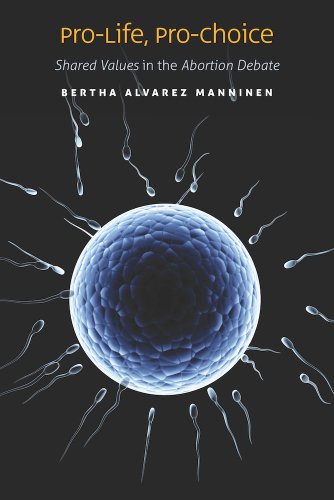
In this provocative and accessible book, the author defends a pro-choice perspective but also takes seriously pro-life concerns about the moral value of the human fetus, questioning whether a fetus is nothing more than "mere tissue." She examines the legal status of the fetus in the recent Personhood Amendments in state legislatures and in Supreme Court decisions and asks whether Roe v. Wade should have focused on the viability of the fetus or on the bodily integrity of the woman.
Manninen approaches the abortion controversy through a variety of perspectives and ethical frameworks. She addresses the social circumstances that influence many women's decision to abort and considers whether we believe that there are good and bad reasons to abort. Manninen also looks at the call for post-abortion fetal grieving rituals for women who desire them and the attempt to make room in the pro-choice position for the views of prospective fathers.
The author spells out how the two sides demonize each other and proposes ways to find degrees of convergence between the seemingly intractable positions.
Die Inhaltsangabe kann sich auf eine andere Ausgabe dieses Titels beziehen.
Über die Autorin bzw. den Autor
Bertha Alvarez Manninen is Associate Professor of Philosophy at Arizona State University.
Auszug. © Genehmigter Nachdruck. Alle Rechte vorbehalten.
Pro-Life, Pro-Choice
Shared Values in the Abortion Debate
By Bertha Alvarez ManninenVanderbilt University Press
Copyright © 2014 Vanderbilt University Press
All rights reserved.
ISBN: 978-0-8265-1991-7All rights reserved.
Contents
Acknowledgments, ix,
Introduction and Background, 1,
1 Why Roe v. Wade's Argument Fails, 11,
2 Responsibility and Other Worries, 46,
3 Of Women and Fetuses: Battling the False Dichotomy, 68,
4 Pro-Choice, Not Pro-Abortion: Rethinking the Pro-Choice Strategy, 89,
5 A Pro-Choice Moral Framework, 104,
6 Respecting Fetal Life and Pregnant Women: Building upon Shared Values, 137,
7 The Forgotten Father: Men and Abortion, 160,
Conclusion, 185,
Notes, 191,
Index, 223,
CHAPTER 1
WHY ROE V. WADE'S ARGUMENT FAILS
Embryos and fetuses are alive and human. This is a biological fact. But biological facts alone do not settle moral issues. The contentious issue is whether embryos and fetuses are human persons—that is, whether fetuses are proper subjects of moral status and moral rights, and, consequently, legal rights. This is not an empirical question: a closer look at fetal biology will not help us to determine whether a fetus is a human person. The question of what constitutes a person is a metaphysical, philosophical, and theological one.
Philosophers, ethicists, theologians, politicians, and everyday men and women all have beliefs concerning what it means to be a person. Leaders of the Catholic Church, for example, believe that all members of the human species, from conception until death, are persons. On the other hand, philosophers Mary Anne Warren, Peter Singer, and Michael Tooley argue that a necessary requisite for personhood is the possession of certain cognitive capacities, such as self-consciousness, reasoning abilities, autonomy (the ability to self-govern and make rational choices), and moral agency (the ability to make morally significant choices). For others, such as philosophers Jeff McMahan and L. W. Sumner, the basic capacity for consciousness is sufficient for some degree of moral status.
PERSONHOOD AMENDMENTS
Despite the lack of consensus, there have been various attempts to codify into law conservative views concerning fetal personhood. In 2011 Mississippi voters rejected, by a narrow margin, a much publicized personhood amendment that would have changed the state's Constitution to grant personhood to fertilized eggs, embryos, and fetuses. On April 13, 2010, Nebraska lawmakers enacted one of the boldest challenges to Roe v. Wade since it was decided in 1973. The law, titled the "Pain-Capable Unborn Child Protection Act" (LB 1103), bans abortion after twenty weeks gestational age on the grounds that after this point in pregnancy a fetus is capable of feeling pain and would, therefore, suffer immensely if aborted. The law includes an exception for the life or health of the pregnant woman, although it does not take mental health into account. It is no coincidence that Nebraska is the home of LeRoy Carhart, who is one of the few physicians in the United States willing to perform late-term abortions. Carhart stepped up his practice after the 2009 murder of George Tiller, who was widely known for his late-term abortion practices.
The Nebraska law directly challenges Roe by enacting a new threshold for when states can prohibit abortion. Under Roe, abortion access cannot be denied by states (though it can be restricted) until the fetus achieves viability at a gestational age of approximately twenty-five weeks. The Nebraska law thus decreases the window for abortion by five weeks.
Supporters of personhood amendments have openly admitted their desire for the proposed policy to be challenged all the way up the judicial ranks to the U.S. Supreme Court in the hopes that the Court will overturn Roe. For example, Robert Muise of the Thomas More Law Center states that personhood amendments establish the "inviolable right of every innocent human being to life," as well as defining "person" as a human being of any age, including "unborn offspring at every state of their biological development, including fertilization." He explains that "the proposal establishes a constitutional principle; it does not enact criminal or civil legislation. And it establishes a constitutional principle that provides a direct challenge to the fundamental holding of Roe v. Wade." In reference to his state's 2011 ballot initiative, Mississippi governor Haley Barbour explained that the ultimate goal of the personhood amendment was not to outlaw abortion in Mississippi but to use the measure as a springboard to the Supreme Court.
The Mississippi and Nebraska efforts are only two in a series of attempts to challenge abortion rights within the last few years; most of these challenges have been in the form of proposed personhood amendments. In the 2008 election year, Colorado and Montana had propositions on their state ballots (Propositions 48 and CI-100, respectively) that, had they passed, would have expanded the legal definition of personhood to encompass newly fertilized eggs. Some residents of Georgia attempted to do the same in 2008, introducing a personhood amendment (HR 536) in the state legislature, but the issue failed to make it onto the Georgia ballot. Two years after the citizens of South Dakota rejected a change to the state Constitution that would have banned all abortions, in 2008 they voted on and rejected a revised version of the ban that would have made exceptions for rape, incest, and maternal health.
In addition to Nebraska, Alabama, California, Colorado, Florida, Michigan, Mississippi, Missouri, Montana, Nevada, and Virginia all attempted to pass personhood amendments in 2010. Although none were successful, more people voted in favor of the amendments than had before. The continual attempts to pass similar laws in previous election years indicate that this issue will likely be repeatedly raised. Indeed, the persistence of supporters of personhood amendments can be seen throughout the four decades since the legalization of abortion. National Right to Life made the first attempt at passing a personhood amendment on the federal level, in 1975. In 1979 the American Life League proposed the Paramount Amendment to Congress, and in 1981, National Right to Life tried once more with the Unity Human Life Amendment. Since 2008, the American Life League has continually attempted to pass a federal personhood amendment.
The foundational assumption that underlies all these amendments is that abortion is legal only because fetuses are not considered persons. Therefore, a federal law that denotes fetuses as persons would render abortion tantamount to murder and subject to criminalization. Let us take a look at whether this conjecture survives scrutiny.
WHERE ROE GOES WRONG
There are three ways we can interpret the right to abortion. First, abortion can be regarded as a mechanism to prevent unwanted parenthood in the social sense—in order to prevent subjection to the obligations and responsibilities that come with rearing a child. Second, abortion can be regarded as a mechanism to prevent parenthood in the genetic sense—in order to prevent the existence of an individual who is one's genetic child. This distinction is important because abdication of social parenthood can be achieved by placing the infant for adoption. For some women, however, the thought of having a child in the world for whom she is not caring is unbearable. Therefore,...
„Über diesen Titel“ kann sich auf eine andere Ausgabe dieses Titels beziehen.
Suchergebnisse für Pro-Life, Pro-Choice: Shared Values in the Abortion...

Beispielbild für diese ISBN
Pro-Life, Pro-Choice : Shared Values in the Abortion Debate
Verlag:
University of Chicago Press, 2026
ISBN 10: 0826519911
ISBN 13: 9780826519917
Gebraucht
Softcover
Anbieter: Better World Books, Mishawaka, IN, USA
Verkäuferbewertung 5 von 5 Sternen

Zustand: Good. Former library copy. Pages intact with minimal writing/highlighting. The binding may be loose and creased. Dust jackets/supplements are not included. Includes library markings. Stock photo provided. Product includes identifying sticker. Better World Books: Buy Books. Do Good. Artikel-Nr. 14463574-6
Gebraucht kaufen
EUR 53,95
Versand gratis
Versand innerhalb von USA
Versand innerhalb von USA
Anzahl: 2 verfügbar
Beispielbild für diese ISBN
Pro-Life, Pro-Choice: Shared Values in the Abortion Debate
Verlag:
Vanderbilt University Press, 2014
ISBN 10: 0826519911
ISBN 13: 9780826519917
Gebraucht
Paperback
Anbieter: World of Books (was SecondSale), Montgomery, IL, USA
Verkäuferbewertung 5 von 5 Sternen
Paperback. Zustand: Very Good. In this provocative and accessible book, the author defends a pro-choice perspective but also takes seriously pro-life concerns about the moral value of the human fetus, questioning whether a fetus is nothing more than ""mere tissue."" She examines the legal status of the fetus in the recent Personhood Amendments in state legislatures and in Supreme Court decisions and asks whether Roe v. Wade should have focused on the viability of the fetus or on the bodily integrity of the woman.Manninen approaches the abortion controversy through a variety of perspectives and ethical frameworks. She addresses the social circumstances that influence many women's decision to abort and considers whether we believe that there are good and bad reasons to abort. Manninen also looks at the call for post-abortion fetal grieving rituals for women who desire them and the attempt to make room in the pro-choice position for the views of prospective fathers.The author spells out how the two sides demonise each other and proposes ways to find degrees of convergence between the seemingly intractable positions. Artikel-Nr. 00106572341
Gebraucht kaufen
EUR 53,99
Versand gratis
Versand innerhalb von USA
Versand innerhalb von USA
Anzahl: 1 verfügbar
Beispielbild für diese ISBN
Pro-Life, Pro-Choice: Shared Values in the Abortion Debate
Anbieter: Ria Christie Collections, Uxbridge, Vereinigtes Königreich
Verkäuferbewertung 5 von 5 Sternen
Zustand: New. In English. Artikel-Nr. ria9780826519917_new
Neu kaufen
EUR 55,95
EUR 11,11 Versand
Versand von Vereinigtes Königreich nach USA
Versand von Vereinigtes Königreich nach USA
Anzahl: Mehr als 20 verfügbar
Foto des Verkäufers
PRO-LIFE PRO-CHOICE
Anbieter: moluna, Greven, Deutschland
Verkäuferbewertung 5 von 5 Sternen
Zustand: New. KlappentextrnrnIn this provocative and accessible book, the author defends a pro-choice perspective but also takes seriously pro-life concerns about the moral value of the human fetus, questioning whether a fetus is nothing more than mere tissu. Artikel-Nr. 595083236
Neu kaufen
EUR 51,55
EUR 48,99 Versand
Versand von Deutschland nach USA
Versand von Deutschland nach USA
Anzahl: Mehr als 20 verfügbar
Foto des Verkäufers
Pro-Life, Pro-Choice : Shared Values in the Abortion Debate
Verlag:
Vanderbilt University Press Sep 2014, 2014
ISBN 10: 0826519911
ISBN 13: 9780826519917
Neu
Taschenbuch
Anbieter: AHA-BUCH GmbH, Einbeck, Deutschland
Verkäuferbewertung 5 von 5 Sternen
Taschenbuch. Zustand: Neu. Neuware - In this provocative and accessible book, the author defends a pro-choice perspective but also takes seriously pro-life concerns about the moral value of the human fetus, questioning whether a fetus is nothing more than 'mere tissue". Manninen approaches the abortion controversy through a variety of perspectives and ethical frameworks. She addresses the social circumstances that influence many women's decision to abort and considers whether we believe that there are good and bad reasons to abort. Artikel-Nr. 9780826519917
Neu kaufen
EUR 70,59
EUR 35,00 Versand
Versand von Deutschland nach USA
Versand von Deutschland nach USA
Anzahl: 2 verfügbar