
Verwandte Artikel zu Right Thoughts at the Last Moment: Buddhism and Deathbed...
Right Thoughts at the Last Moment: Buddhism and Deathbed Practices in Early Medieval Japan (Studies in East Asian Buddhism, Band 26) - Hardcover
Buch 15 von 25: Kuroda Studies in East Asian Buddhism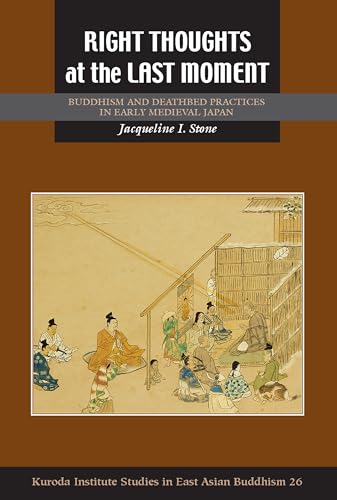
Inhaltsangabe
Buddhists across Asia have often aspired to die with a clear and focused mind, as the historical Buddha himself is said to have done. This book explores how the ideal of dying with right mindfulness was appropriated, disseminated, and transformed in premodern Japan, focusing on the late tenth through early fourteenth centuries. By concentrating one’s thoughts on the Buddha in one’s last moments, it was said even an ignorant and sinful person could escape the cycle of deluded rebirth and achieve birth in a buddha’s pure land, where liberation would be assured. Conversely, the slightest mental distraction at that final juncture could send even a devout practitioner tumbling down into the hells or other miserable rebirth realms. The ideal of mindful death thus generated both hope and anxiety and created a demand for ritual specialists who could act as religious guides at the deathbed. Buddhist death management in Japan has been studied chiefly from the standpoint of funerals and mortuary rites. Right Thoughts at the Last Moment investigates a largely untold side of that story: how early medieval Japanese prepared for death, and how desire for ritual assistance in one’s last hours contributed to Buddhist preeminence in death-related matters. It represents the first book-length study in a Western language to examine how the Buddhist ideal of mindful death was appropriated in a specific historical context.
Practice for one’s last hours occupied the intersections of multiple, often disparate approaches that Buddhism offered for coping with death. Because they crossed sectarian lines and eventually permeated all social levels, deathbed practices afford insights into broader issues in medieval Japanese religion, including intellectual developments, devotional practices, pollution concerns, ritual performance, and divisions of labor among religious professionals. They also allow us to see beyond the categories of “old” versus “new” Buddhism, or establishment Buddhism versus marginal heterodoxies, which have characterized much scholarship to date. Enlivened by cogent examples, this study draws on a wealth of sources including ritual instructions, hagiographies, doctrinal writings, didactic tales, courtier diaries, historical records, letters, and relevant art historical material to explore the interplay of doctrinal ideals and on-the-ground practice.
Die Inhaltsangabe kann sich auf eine andere Ausgabe dieses Titels beziehen.
Über die Autorin bzw. den Autor
Jacqueline I. Stone is professor of religion at Princeton University
„Über diesen Titel“ kann sich auf eine andere Ausgabe dieses Titels beziehen.
Suchergebnisse für Right Thoughts at the Last Moment: Buddhism and Deathbed...

Beispielbild für diese ISBN
Right Thoughts at the Last Moment Buddhism and Deathbed Practices in Early Medieval Japan
Anbieter: Powell's Bookstores Chicago, ABAA, Chicago, IL, USA
Verkäuferbewertung 5 von 5 Sternen

Hardcover. Zustand: Very Good. Minimal shelf wear, clean internals. May have remainder mark. Artikel-Nr. 2046343
Gebraucht kaufen
EUR 16,52
EUR 4,46 Versand
Versand innerhalb von USA
Versand innerhalb von USA
Anzahl: 3 verfügbar
Beispielbild für diese ISBN
Right Thoughts at the Last Moment: Buddhism and Deathbed Practices in Early Medieval Japan
Verlag:
University of Hawai'i Press, 2016
ISBN 10: 0824856430
ISBN 13: 9780824856434
Gebraucht
Hardcover
Anbieter: World of Books (was SecondSale), Montgomery, IL, USA
Verkäuferbewertung 5 von 5 Sternen
Hardback. Zustand: Very Good. Buddhists across Asia have often aspired to die with a clear and focused mind, as the historical Buddha himself is said to have done. This book explores how the ideal of dying with right mindfulness was appropriated, disseminated, and transformed in premodern Japan, focusing on the late tenth to early fourteenth centuries. Artikel-Nr. 00101934217
Gebraucht kaufen
EUR 21,10
Versand gratis
Versand innerhalb von USA
Versand innerhalb von USA
Anzahl: 4 verfügbar
Beispielbild für diese ISBN
Right Thoughts at the Last Moment
Anbieter: PBShop.store UK, Fairford, GLOS, Vereinigtes Königreich
Verkäuferbewertung 5 von 5 Sternen
HRD. Zustand: New. New Book. Shipped from UK. Established seller since 2000. Artikel-Nr. FW-9780824856434
Neu kaufen
EUR 20,16
EUR 8,07 Versand
Versand von Vereinigtes Königreich nach USA
Versand von Vereinigtes Königreich nach USA
Anzahl: 2 verfügbar
Beispielbild für diese ISBN
Right Thoughts at the Last Moment: Buddhism and Deathbed Practices in Early Medieval Japan (Studies in East Asian Buddhism)
Anbieter: Majestic Books, Hounslow, Vereinigtes Königreich
Verkäuferbewertung 4 von 5 Sternen

Zustand: New. pp. 616. Artikel-Nr. 372236791
Neu kaufen
EUR 29,14
EUR 7,76 Versand
Versand von Vereinigtes Königreich nach USA
Versand von Vereinigtes Königreich nach USA
Anzahl: 3 verfügbar
Beispielbild für diese ISBN
Right Thoughts at the Last Moment Buddhism and Deathbed Practices in Early Medieval Japan
Anbieter: Revaluation Books, Exeter, Vereinigtes Königreich
Verkäuferbewertung 5 von 5 Sternen
Hardcover. Zustand: Brand New. 616 pages. 9.50x6.50x1.50 inches. In Stock. Artikel-Nr. __0824856430
Neu kaufen
EUR 25,54
EUR 14,93 Versand
Versand von Vereinigtes Königreich nach USA
Versand von Vereinigtes Königreich nach USA
Anzahl: 2 verfügbar
Beispielbild für diese ISBN
Right Thoughts at the Last Moment: Buddhism and Deathbed Practices in Early Medieval Japan: 26 (Studies in East Asian Buddhism)
Anbieter: Kennys Bookstore, Olney, MD, USA
Verkäuferbewertung 5 von 5 Sternen
Zustand: New. Buddhists across Asia have often aspired to die with a clear and focused mind, as the historical Buddha himself is said to have done. This book explores how the ideal of dying with right mindfulness was appropriated, disseminated, and transformed in premodern Japan, focusing on the late tenth to early fourteenth centuries. Series: Studies in East Asian Buddhism. Num Pages: 792 pages, 11 colour, 1 black & white illustrations. BIC Classification: 1FPJ; HREP; JHBZ. Category: (P) Professional & Vocational. Dimension: 229 x 152. . . 2016. Illustrated. hardcover. . . . . Books ship from the US and Ireland. Artikel-Nr. V9780824856434
Neu kaufen
EUR 33,53
EUR 9,36 Versand
Versand innerhalb von USA
Versand innerhalb von USA
Anzahl: 1 verfügbar
Foto des Verkäufers
Right Thoughts at the Last Moment. Buddhism and Deathbed Practices in Early Medieval Japan.
Verlag:
University of Hawai'i Press., Honolulu., 2016
ISBN 10: 0824856430
ISBN 13: 9780824856434
Gebraucht
Hardcover
Anbieter: Asia Bookroom ANZAAB/ILAB, Canberra, ACT, Australien
Verkäuferbewertung 5 von 5 Sternen
Colour plates, frontispiece illustration, xviii + 597pp, notes, glossary, bibliography, index, 23.5 x 16cm. Head of spine somewhat bumped, otherwise a very good hardback copy in dustjacket. "Buddhists across Asia have often aspired to die with a clear and focused mind, as the historical Buddha himself is said to have done. This book explores how the ideal of dying with right mindfulness was appropriated, disseminated, and transformed in premodern Japan, focusing on the late tenth through early fourteenth centuries. By concentrating one's thoughts on the Buddha in one's last moments, it was said even an ignorant and sinful person could escape the cycle of deluded rebirth and achieve birth in a buddha's pure land, where liberation would be assured. Conversely, the slightest mental distraction at that final juncture could send even a devout practitioner tumbling down into the hells or other miserable rebirth realms. The ideal of mindful death thus generated both hope and anxiety and created a demand for ritual specialists who could act as religious guides at the deathbed. Enlivened by cogent examples, this study draws on a wealth of sources including ritual instructions, hagiographies, doctrinal writings, didactic tales, courtier diaries, historical records, letters, and relevant art historical material to explore the interplay of doctrinal ideals and on-the-ground practice." (Publisher's description). Artikel-Nr. 172517
Gebraucht kaufen
EUR 48,32
EUR 18,94 Versand
Versand von Australien nach USA
Versand von Australien nach USA
Anzahl: 1 verfügbar
Foto des Verkäufers
Right Thoughts at the Last Moment : Buddhism and Deathbed Practices in Early Medieval Japan
Verlag:
University Of Hawaii Press Nov 2016, 2016
ISBN 10: 0824856430
ISBN 13: 9780824856434
Neu
Hardcover
Anbieter: AHA-BUCH GmbH, Einbeck, Deutschland
Verkäuferbewertung 5 von 5 Sternen
Buch. Zustand: Neu. Neuware - Buddhists across Asia have often aspired to die with a clear and focused mind, as the historical Buddha himself is said to have done. This book explores how the ideal of dying with right mindfulness was appropriated, disseminated, and transformed in premodern Japan, focusing on the late tenth through early fourteenth centuries. By concentrating one's thoughts on the Buddha in one's last moments, it was said even an ignorant and sinful person could escape the cycle of deluded rebirth and achieve birth in a buddha's pure land, where liberation would be assured. Conversely, the slightest mental distraction at that final juncture could send even a devout practitioner tumbling down into the hells or other miserable rebirth realms. The ideal of mindful death thus generated both hope and anxiety and created a demand for ritual specialists who could act as religious guides at the deathbed. Buddhist death management in Japan has been studied chiefly from the standpoint of funerals and mortuary rites. Right Thoughts at the Last Moment investigates a largely untold side of that story: how early medieval Japanese prepared for death, and how desire for ritual assistance in one's last hours contributed to Buddhist preeminence in death-related matters. It represents the first book-length study in a Western language to examine how the Buddhist ideal of mindful death was appropriated in a specific historical context.Practice for one's last hours occupied the intersections of multiple, often disparate approaches that Buddhism offered for coping with death. Because they crossed sectarian lines and eventually permeated all social levels, deathbed practices afford insights into broader issues in medieval Japanese religion, including intellectual developments, devotional practices, pollution concerns, ritual performance, and divisions of labor among religious professionals. They also allow us to see beyond the categories of "old" versus "new" Buddhism, or establishment Buddhism versus marginal heterodoxies, which have characterized much scholarship to date. Enlivened by cogent examples, this study draws on a wealth of sources including ritual instructions, hagiographies, doctrinal writings, didactic tales, courtier diaries, historical records, letters, and relevant art historical material to explore the interplay of doctrinal ideals and on-the-ground practice. Artikel-Nr. 9780824856434
Neu kaufen
EUR 35,18
EUR 42,04 Versand
Versand von Deutschland nach USA
Versand von Deutschland nach USA
Anzahl: 1 verfügbar
Foto des Verkäufers
Right Thoughts at the Last Moment | Buddhism and Deathbed Practices in Early Medieval Japan
Anbieter: preigu, Osnabrück, Deutschland
Verkäuferbewertung 5 von 5 Sternen
Buch. Zustand: Neu. Right Thoughts at the Last Moment | Buddhism and Deathbed Practices in Early Medieval Japan | Jacqueline I Stone | Buch | Einband - fest (Hardcover) | Englisch | 2016 | University of Hawaii Press | EAN 9780824856434 | Verantwortliche Person für die EU: Libri GmbH, Europaallee 1, 36244 Bad Hersfeld, gpsr[at]libri[dot]de | Anbieter: preigu. Artikel-Nr. 136860489
Neu kaufen
EUR 27,65
EUR 70,00 Versand
Versand von Deutschland nach USA
Versand von Deutschland nach USA
Anzahl: 1 verfügbar
Foto des Verkäufers
Right Thoughts at the Last Moment
Verlag:
University Of Hawaii Press Nov 2016, 2016
ISBN 10: 0824856430
ISBN 13: 9780824856434
Neu
Hardcover
Anbieter: Books-by-Floh, Paderborn, Deutschland
Verkäuferbewertung 5 von 5 Sternen
Buch. Zustand: Neu. Neuware -Buddhists across Asia have often aspired to die with a clear and focused mind, as the historical Buddha himself is said to have done. This book explores how the ideal of dying with right mindfulness was appropriated, disseminated, and transformed in premodern Japan, focusing on the late tenth through early fourteenth centuries. By concentrating one's thoughts on the Buddha in one's last moments, it was said even an ignorant and sinful person could escape the cycle of deluded rebirth and achieve birth in a buddha's pure land, where liberation would be assured. Conversely, the slightest mental distraction at that final juncture could send even a devout practitioner tumbling down into the hells or other miserable rebirth realms. The ideal of mindful death thus generated both hope and anxiety and created a demand for ritual specialists who could act as religious guides at the deathbed. Buddhist death management in Japan has been studied chiefly from the standpoint of funerals and mortuary rites. Right Thoughts at the Last Moment investigates a largely untold side of that story: how early medieval Japanese prepared for death, and how desire for ritual assistance in one's last hours contributed to Buddhist preeminence in death-related matters. It represents the first book-length study in a Western language to examine how the Buddhist ideal of mindful death was appropriated in a specific historical context.Practice for one's last hours occupied the intersections of multiple, often disparate approaches that Buddhism offered for coping with death. Because they crossed sectarian lines and eventually permeated all social levels, deathbed practices afford insights into broader issues in medieval Japanese religion, including intellectual developments, devotional practices, pollution concerns, ritual performance, and divisions of labor among religious professionals. They also allow us to see beyond the categories of "old" versus "new" Buddhism, or establishment Buddhism versus marginal heterodoxies, which have characterized much scholarship to date. Enlivened by cogent examples, this study draws on a wealth of sources including ritual instructions, hagiographies, doctrinal writings, didactic tales, courtier diaries, historical records, letters, and relevant art historical material to explore the interplay of doctrinal ideals and on-the-ground practice. 624 pp. Englisch. Artikel-Nr. 9780824856434
Neu kaufen
EUR 33,61
EUR 105,00 Versand
Versand von Deutschland nach USA
Versand von Deutschland nach USA
Anzahl: 1 verfügbar