
Verwandte Artikel zu Tea Party Catholic: The Catholic Case for Limited Government...
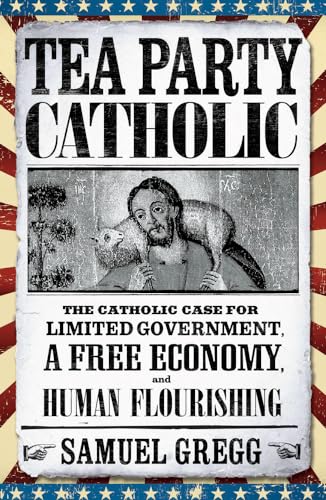
Tea Party Catholic: The Catholic Case for Limited Government, a Free Economy, and Human Flourishing: The Catholic Case for Liberty, Limited Government, a Free Economy, and Human Flourishing - Softcover
Inhaltsangabe
Over the past fifty years, increasing numbers of American Catholics have abandoned the economic positions associated with Franklin Roosevelt’s New Deal and chosen to embrace the principles of economic freedom and limited government: ideals upheld by Ronald Reagan and the Tea Party movement but also deeply rooted in the American Founding. This shift, alongside America’s growing polarization around economic questions, has generated fierce debates among Catholic Americans in recent years. Can a believing Catholic support free markets? Does the Catholic social justice commitment translate directly into big government? Do limited government Catholic Americans have something unique to contribute to the Church’s thinking about the economic challenges confronting all Catholics around the globe?In Tea Party Catholic, Samuel Gregg draws upon Catholic teaching, natural law theory, and the thought of the only Catholic Signer of America’s Declaration of Independence, Charles Carroll of Carrollton—the first “Tea Party Catholic”—to develop a Catholic case for the values and institutions associated with the free economy, limited government, and America’s experiment in ordered liberty. Beginning with the nature of freedom and human flourishing, Gregg underscores the moral and economic benefits of business and markets as well as the welfare state’s problems. Gregg then addresses several related issues that divide Catholics in America. These include the demands of social justice, the role of unions, immigration, poverty, and the relationship between secularism and big government.
Above all, Gregg underlines how economic freedom’s corrosion in America is undermining the United States’ robust commitment to religious liberty—a principle integral not only to the American Founding and the life of Charles Carroll but also the teaching of the Second Vatican Council. As a creative minority, Gregg argues, limited government Catholics can help transform the wider movement to reground the United States upon the best insights of the American Experiment—and thereby save that Experiment itself.
Die Inhaltsangabe kann sich auf eine andere Ausgabe dieses Titels beziehen.
Über die Autorin bzw. den Autor
Samuel Gregg is research director at the Acton Institute. He is the author of many books, including his prize-winning The Commercial Society (2007), The Modern Papacy (2009), and Becoming Europe (2013). He lectures regularly in America and Europe on topics encompassing political economy, Catholicism, and morality and the economy. His writing has appeared in academic journals and magazines including National Review, The American Spectator, Foreign Affairs, and Crisis Magazine, as well as newspapers such as the Wall Street Journal, Investors Business Daily, and the New York Post.
Auszug. © Genehmigter Nachdruck. Alle Rechte vorbehalten.
Tea Party Catholic
The Catholic Case for Limited Government, a Free Economy, and Human Flourishing
By Samuel GreggThe Crossroad Publishing Company
Copyright © 2013 Samuel Gregg
All rights reserved.
ISBN: 978-0-8245-4981-7All rights reserved.
Contents
Foreword,
Introduction,
Chapter 1: Catholic and Free,
Chapter 2: An Economy of Liberty,
Chapter 3: Solidarity, Subsidiarity, and the State,
Chapter 4: The First Freedom,
Chapter 5: But What About ...?,
Chapter 6: A Patriotic Minority,
Acknowledgments,
Notes,
CHAPTER 1
Catholic and Free
We consider the establishment of our nation's independence, the shaping of its liberties and laws as a work of special Providence, its framers "building better than they knew, the Almighty's hand guiding them." And if ever the glorious fabric is subverted or impaired, it will be by men forgetful of the sacrifices of the heroes that reared it, the virtues that cemented it, and the principles on which it rests.
The Catholic bishops of the United States, Third Plenary Council of Baltimore, 1893
On October 15, 1774, the ship Peggy Stewart owned by the Annapolis mercantile company of Dick and Stewart sailed into the harbor of Annapolis in the colony of Maryland, carrying with it a cargo of tea. On arriving, the ship's owner paid the tax then applied by Britain to importations of tea to its American colonies in accordance with the Tea Act of May 1773.
This law was intended to avert bankruptcy of the East India Company which had lobbied the British Parliament to exempt it from the tea import duties which its colonial competitors were required to pay. As if this was not enough, the Company was also granted the privilege of being allowed to ship its tea directly to agents in America instead of placing its tea on open auction in Britain. The Company was thus able to undercut American merchants who were required to purchase tea by the regular process of passing through the higher-taxed British controls.
Leaving aside the inherent injustice of using state power to privilege one commercial enterprise over others, the political point of this exercise was to elicit the American colonists' implicit agreement to the British Parliament's right to tax the American colonies. This at least was how it was understood by those American colonists who were increasingly incensed at what they regarded as a pattern of repression against His Majesty's subjects in British North America.
Opposition to what many Americans viewed as the British government's latest arbitrary act was especially fierce in Maryland. Few were more outspoken in their opposition than one of its leading public figures, Charles Carroll of Carrollton. "It will not do," Carroll insisted, "to export the tea to Europe or the West Indies. Its importation is an offense for which the people will not be so easily satisfied."
Carroll was no man of violence. He was disconcerted by some of the Boston Tea Party's radical undertones and subsequently worried about the potential for anarchy and disorder that is part of any revolution. Such qualms did not, however, prevent Carroll from proposing that the owner of the Peggy Stewart, Anthony Stewart, make amends — and save his own skin — by burning not just the tea but also his ship!
Even some of Carroll's equally angry contemporaries were taken aback by the strength of Carroll's convictions on this matter. They would have been less surprised had they known that after Britain's imposition of the Stamp Act seven years earlier, Carroll had warned his English friends that "The Americans are jealous of their privileges and resolved to maintain them." And as if seeking to provoke his correspondents in the mother country, Carroll added that the Americans "are not yet corrupt enough to undervalue Liberty, they are truly sensible of its blessings, and not only talk of them as they do somewhere else, but really wish their continuance."
A Signer Unlike the Others
Though most often remembered as the last Signer of the Declaration of Independence to depart this world, Charles Carroll was also distinguished by the fact that he was its sole Roman Catholic signatory. But long before most of the other Signers and Founders, Carroll had concluded America should be free. "In time," he said in 1763, "it will and must be independent."
In signing the Declaration, Carroll arguably put more at risk, at least materially, than any other member of the Revolutionary generation. At the time, he was probably the richest man in America. As well as inheriting considerable wealth from his equally-entrepreneurial father, Carroll proved to be an extremely able businessman in his own right, increasing the family fortune several times over. A defeat of the Revolution may well have resulted in the government's confiscation of the fruits of his family's business acumen.
Nevertheless the cause of liberty meant so much to Carroll that he was willing to back what must have seemed to be a forlorn endeavor to many at the time. But Carroll had always embraced the deeper meaning of his family's motto: Ubicumque cum libertate: "Anywhere so long as There Be Freedom." This devotion to freedom — and what he was willing to put at stake — was noticed by many of Carroll's fellow revolutionaries. Speaking of Carroll, the man who would be America's second president, John Adams, remarked: "In the cause of American liberty, his zeal, fortitude and perseverance have been so conspicuous that he is said to be marked out for particular vengeance by the friends of Administration; but he continues to hazard his all, his immense fortune, the largest in America, and his life."
Unlike the other Signers, however, Carroll and his family knew in a particular way what it meant to have one's liberty violated. Until the 1770s, Carroll was formally barred from voting or holding public office in Maryland because of his Catholic faith. Carroll also knew that, unlike the other revolutionary leaders, his Catholicism made him especially suspect to the British government (and more than a few of his fellow revolutionaries). In their minds, Catholicism was still associated with papist disloyalty to a Protestant crown in an overwhelmingly Protestant British Empire.
Another feature distinguishing Carroll from his fellow patriots was his reasons for making his stand for freedom. All of Carroll's biographers affirm that his political and economic thought was influenced by his Catholicism, by what the Catholic Church's greatest minds had said about the nature and limits of government, and by the Church's long history of resisting the incursions of temporal power into its affairs. Carroll was quite aware that the Catholic Church had always insisted that the state had certain legitimate functions. Yet the same Church also maintained — and continues to do so — that there were bounds beyond which governments cannot go.
The limits of state power vis-à-vis the rights of individuals and communities were central to the events leading to and following the American Revolution. The sources to which America's Founders turned in explaining their choice to embark upon a new experiment in ordered liberty were diverse. They ranged from classical figures associated with the Roman Republic, to philosophers such as John Locke who had helped shape England's revolution of 1688. The language and ideas employed by many of these figures when discussing questions of liberty, property, and the nature of government was not, however, completely...
„Über diesen Titel“ kann sich auf eine andere Ausgabe dieses Titels beziehen.
Suchergebnisse für Tea Party Catholic: The Catholic Case for Limited Government...

Beispielbild für diese ISBN
Tea Party Catholic: The Catholic Case for Limited Government, a Free Economy, and Human Flourishing
Verlag:
Crossroad Publishing Co ,U.S., 2013
ISBN 10: 0824549813
ISBN 13: 9780824549817
Gebraucht
Paperback
Anbieter: World of Books (was SecondSale), Montgomery, IL, USA
Verkäuferbewertung 5 von 5 Sternen

Paperback. Zustand: Good. An ever-growing number of practicing Catholics have gravitated to the conservative side of American politics. Adding his voice to the popular chorus of conservative Catholics, Samuel Gregg examines the economic and social positions of the United States and defines where the Catholic Church falls on a host of issues. Artikel-Nr. 00101015293
Gebraucht kaufen
EUR 4,60
Versand gratis
Versand innerhalb von USA
Versand innerhalb von USA
Anzahl: 2 verfügbar
Beispielbild für diese ISBN
Tea Party Catholic: The Catholic Case for Limited Government, a Free Economy, and Human Flourishing
Verlag:
Herder & Herder (edition 9.4.2013), 2013
ISBN 10: 0824549813
ISBN 13: 9780824549817
Gebraucht
Paperback
Anbieter: BooksRun, Philadelphia, PA, USA
Verkäuferbewertung 5 von 5 Sternen
Paperback. Zustand: Very Good. 9.4.2013. It's a well-cared-for item that has seen limited use. The item may show minor signs of wear. All the text is legible, with all pages included. It may have slight markings and/or highlighting. Artikel-Nr. 0824549813-11-1
Gebraucht kaufen
EUR 4,61
Versand gratis
Versand innerhalb von USA
Versand innerhalb von USA
Anzahl: 1 verfügbar
Beispielbild für diese ISBN
Tea Party Catholic: The Catholic Case for Limited Government, a Free Economy, and Human Flourishing
Anbieter: ThriftBooks-Reno, Reno, NV, USA
Verkäuferbewertung 5 von 5 Sternen
Paperback. Zustand: Very Good. No Jacket. May have limited writing in cover pages. Pages are unmarked. ~ ThriftBooks: Read More, Spend Less. Artikel-Nr. G0824549813I4N00
Gebraucht kaufen
EUR 6,07
Versand gratis
Versand innerhalb von USA
Versand innerhalb von USA
Anzahl: 1 verfügbar
Beispielbild für diese ISBN
Tea Party Catholic: The Catholic Case for Limited Government, a Free Economy, and Human Flourishing
Anbieter: ThriftBooks-Dallas, Dallas, TX, USA
Verkäuferbewertung 5 von 5 Sternen
Paperback. Zustand: Very Good. No Jacket. May have limited writing in cover pages. Pages are unmarked. ~ ThriftBooks: Read More, Spend Less. Artikel-Nr. G0824549813I4N00
Gebraucht kaufen
EUR 6,07
Versand gratis
Versand innerhalb von USA
Versand innerhalb von USA
Anzahl: 1 verfügbar
Beispielbild für diese ISBN
Tea Party Catholic: The Catholic Case for Limited Government, a Free Economy, and Human Flourishing
Anbieter: ThriftBooks-Dallas, Dallas, TX, USA
Verkäuferbewertung 5 von 5 Sternen
Paperback. Zustand: Fair. No Jacket. Readable copy. Pages may have considerable notes/highlighting. ~ ThriftBooks: Read More, Spend Less. Artikel-Nr. G0824549813I5N00
Gebraucht kaufen
EUR 6,07
Versand gratis
Versand innerhalb von USA
Versand innerhalb von USA
Anzahl: 1 verfügbar
Beispielbild für diese ISBN
Tea Party Catholic: The Catholic Case for Limited Government, a Free Economy, and Human Flourishing
Anbieter: ThriftBooks-Atlanta, AUSTELL, GA, USA
Verkäuferbewertung 5 von 5 Sternen
Paperback. Zustand: Very Good. No Jacket. May have limited writing in cover pages. Pages are unmarked. ~ ThriftBooks: Read More, Spend Less. Artikel-Nr. G0824549813I4N00
Gebraucht kaufen
EUR 6,07
Versand gratis
Versand innerhalb von USA
Versand innerhalb von USA
Anzahl: 1 verfügbar
Beispielbild für diese ISBN
Tea Party Catholic: The Catholic Case for Limited Government, a Free Economy, and Human Flourishing
Anbieter: ThriftBooks-Dallas, Dallas, TX, USA
Verkäuferbewertung 5 von 5 Sternen
Paperback. Zustand: Good. No Jacket. Pages can have notes/highlighting. Spine may show signs of wear. ~ ThriftBooks: Read More, Spend Less. Artikel-Nr. G0824549813I3N00
Gebraucht kaufen
EUR 6,07
Versand gratis
Versand innerhalb von USA
Versand innerhalb von USA
Anzahl: 1 verfügbar
Beispielbild für diese ISBN
Tea Party Catholic : The Catholic Case for Limited Government, a Free Economy and Human Dignity
Verlag:
Crossroad Publishing Company, The, 2013
ISBN 10: 0824549813
ISBN 13: 9780824549817
Gebraucht
Softcover
Anbieter: Better World Books, Mishawaka, IN, USA
Verkäuferbewertung 5 von 5 Sternen
Zustand: Good. Pages intact with minimal writing/highlighting. The binding may be loose and creased. Dust jackets/supplements are not included. Stock photo provided. Product includes identifying sticker. Better World Books: Buy Books. Do Good. Artikel-Nr. 5843030-6
Gebraucht kaufen
EUR 6,19
Versand gratis
Versand innerhalb von USA
Versand innerhalb von USA
Anzahl: 2 verfügbar
Beispielbild für diese ISBN
Tea Party Catholic: The Catholic Case for Limited Government, a Free Economy, and Human Flourishing
Anbieter: Wonder Book, Frederick, MD, USA
Verkäuferbewertung 5 von 5 Sternen
Zustand: Very Good. Very Good condition. A copy that may have a few cosmetic defects. May also contain light spine creasing or a few markings such as an owner's name, short gifter's inscription or light stamp. Bundled media such as CDs, DVDs, floppy disks or access codes may not be included. Artikel-Nr. Q16O-00515
Gebraucht kaufen
EUR 6,43
Versand gratis
Versand innerhalb von USA
Versand innerhalb von USA
Anzahl: 1 verfügbar
Beispielbild für diese ISBN
Tea Party Catholic: The Catholic Case for Limited Government, a Free Economy, and Human Flourishing
Anbieter: Wonder Book, Frederick, MD, USA
Verkäuferbewertung 5 von 5 Sternen
Zustand: Good. Good condition. A copy that has been read but remains intact. May contain markings such as bookplates, stamps, limited notes and highlighting, or a few light stains. Bundled media such as CDs, DVDs, floppy disks or access codes may not be included. Artikel-Nr. E09K-01260
Gebraucht kaufen
EUR 6,43
Versand gratis
Versand innerhalb von USA
Versand innerhalb von USA
Anzahl: 1 verfügbar